
Before hackers start coding, software developers already have a vision for their product. Prior to the construction of an application, website, information system, or software product, all members of the development team must know what the system should do, who will use it, what its limitations are, and how it will be evaluated as to its success. This is the basis of a Software Requirements Specification (SRS) document, which is organized to describe the expected behavior and capabilities of a software system, its constraints, and its quality requirements. The goal of a well-prepared SRS is to assist the students in understanding the needs of a project, enable the developers to know what they are supposed to develop, enable business analysts to convert business requirements into technical requirements, and enable a project team to develop a common understanding before the project gets into the implementation phase. An SRS is a formal documentation of the requirements, as opposed to a casual conversation or assumption that can be reviewed, discussed, tested, and referred to over the course of the software development life cycle.
A Software Requirements Specification is a document that outlines the requirements of a software system.
What is a Software Requirements Specification?
A Software Requirements Specification is a formal document which specifies what a software system should do and how it should do it. It is typically located between business or user requirements and software design and development. The document is not a guide to the actual programming of the code, it is a guide to what the completed program will accomplish. An SRS for an online learning platform, for instance, could include the ability for registered students to create accounts, enroll in courses, submit assignments, view grades and receive notifications. It can also list other conditions, such as secure authentication, acceptable response time, supported devices, data protection conditions, and availability expectations. While the actual format and content of an SRS may vary from organization to organization and project to project, its ultimate goal is always to establish a solid reference to minimize confusion regarding the software being built.
The Software Requirements Specification document can then be considered as a communication contract between various actors in a software project. Business stakeholders think about the goals of the organization and the needs of the customers, developers think about the implementation details and testers think about conditions that can be tested. If there is no common requirements document, these groups will have conflicting interpretations of the same project. An SRS helps them blend their views together by articulating their requirements in a manner that is clear to the stakeholders and precise enough to be used to lead technical development. This is also helpful when not in its initial stages of development. Developers can take reference from it while making decisions to implement, testers can use it while creating test cases, project managers can use it while monitoring the scope, and stakeholders can refer to it while reviewing whether the delivered product meets the agreed expectations.

Importance of Having a Software Requirements Specification (SRS) Prior to Software Development
When requirements are unclear, they can lead to problems that get worse as the project continues, which is why an SRS is important. However, if developers start implementing a development team without fully comprehending the actual needs of the users, the developers can make assumptions that can get in the way of the stakeholder’s needs. What seems intuitively obvious to one person may have an entirely different meaning to another. For instance, an obligation to “manage an account” does not clarify whether the customer can change a password, update his email address, delete the account, change notification preferences, or do all of these. An SRS helps the team to take a look at these non-specific statements and translate them into specific requirements. Clarification of expectations prior to any significant development work is a good chance for the project team to manage scope creep, minimize misunderstandings, define development activities, and create a common point of reference for subsequent decisions.
Another great advantage of an SRS is its ability to trace it throughout the development process. Requirements can also be linked to design decisions, implementation activities, test cases, and acceptance criteria so that the team can understand the rationale for the presence of a specific feature and its verification. This is especially useful when there are multiple stakeholders for a software project or when the requirements evolve during the development process. If a documented requirement is identified, it can be reviewed to identify any other aspects of the project that may be affected by a proposed change. The SRS can also be used to avoid scope creep; one of the reasons for this is because additional requests can be compared to the original project requirements rather than being added on an informal basis. An SRS should not be static, as that is not the definition of an SRS. Requirements might change as stakeholders gain more understanding of the problem; however, changes should be recognized, discussed, documented, and managed, not introduced without an analysis of the impacts.
Main Components of an SRS Document
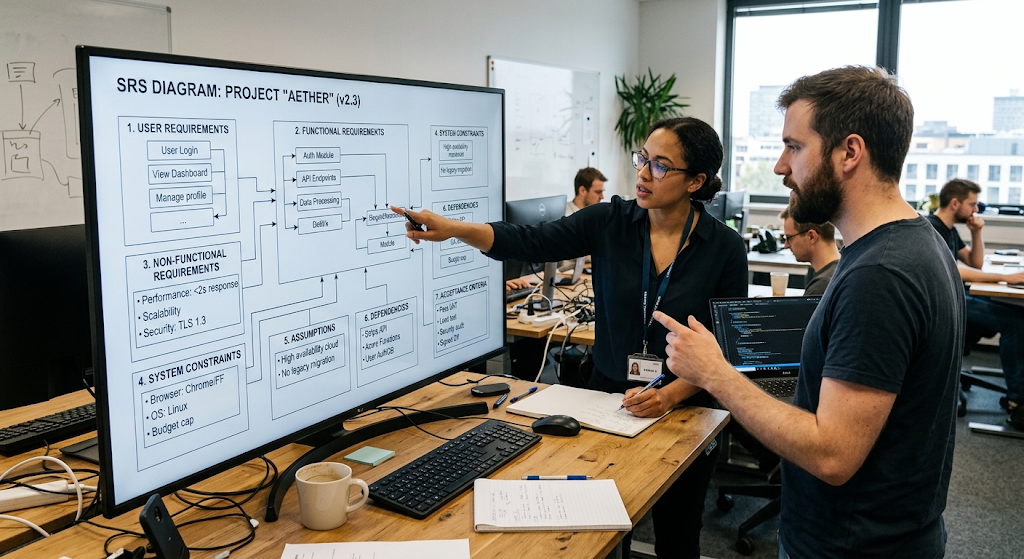
A practical SRS should group requirements into classes that facilitate the understandability and maintainability of the document. While there are other templates available for use, a helpful SRS generally contains an introduction and project scope, user requirements, functional requirements, non-functional requirements, system constraints, assumptions, dependencies, and acceptance criteria. The purpose of each section will be different, but all the sections should be used to describe the expected system as fully as reasonably possible. Important terms, abbreviations, external systems and relevant stakeholders should also be identified where important to understanding the requirements in the document. For larger projects, requirements can be hard to control if they are documented as a list of statements without structure. Headings, consistent terminology, requirement identifiers and logical grouping enable readers to find information without having to read through the entire document to find the answer to each individual question.
Project Scope and Purpose
The scope section sets a clear direction for the software being proposed and provides clarity about the project’s limits. A scope description that explains the problem being solved, the primary users or stakeholders, the significant capabilities of the expected system and significant features that are not part of the project is useful. It is important to define the scope because the software project can easily get bigger when there are more ideas from the stakeholders. For instance, if the hospital appointment system was used, it could be defined in the SRS as a system that allows patients to book appointments, informs them of their upcoming appointments, checks doctors’ availability, and handles the management of patient appointments, but excludes support for medical diagnosis and a replacement for the hospital’s financial accounting system.
Defining scope boundaries assists the developers in understanding what they should be building and assists the stakeholders in understanding that a request to change the current scope should be a new project or additional planning, or a formal change to the requirements.
User Requirements
User Requirements outline the needs of various user groups, typically with a user-oriented view rather than an implementation oriented view. They should explain the tasks users need to accomplish and the outcomes they expect. For example, with an e-commerce system, a customer might want to search for products to find what they are looking for, put items in a shopping cart, place an order, receive an order confirmation, and view past orders. The role of the administrator may include managing products, tracking orders, updating inventory and handling customer accounts.
The requirements should be comprehensible to non-technical stakeholders as they are the needs that are expected to be met by the software. It is helpful to explicitly identify the user types as they can have different expectations, workflows, and permissions. A system that is effective for an administrator may not always be effective for a customer, so this distinction is crucial to make before detailed functional requirements are written, by considering what the customer wants and needs.
Functional Requirements
Functional requirements specify the operations, services, and behaviors that the software will be required to perform. They answer questions like what the system should do if a user does a certain action, what information the system should process, what outputs the system should produce, and what the system should do if it encounters certain conditions. One of the functional requirements for a banking application could be “The system shall enable the customer, who is an authorized customer, to view the current balance of an eligible account.
One could require that a confirmation of transaction be sent out after a successful transfer. Good functional requirements are not ambiguous, for example, “the system should be user-friendly” is replaced by “the system should make it easy for the user to operate it. Unique identifiers, such as FR-001, FR-002 or FR-003, can also be given to each requirement to make it easier to access individual requirements in later stages of the project for developers, testers and project managers.
Benefits of Identifying Clear Functional Requirements
Functional requirements must be testable, consistent and specific. A helpful requirement typically states how the system will behave along with, if applicable, the conditions in which it will behave. For instance, the SRS might say “users should be able to reset passwords easily” while the actual requirement is “the system shall enable a registered user to request a password reset by using the registered user’s email address.
There could then be more information added that explains how the requirement will be verified, when reset links expire and what happens when the email address they submit is not connected to an account. The goal is not to make all sentences needlessly complex, but to eliminate ambiguity of what to expect to happen. The meaning of a requirement should be clear to all developers, and any evidence of the implementation of a feature should be obvious to the testers whether or not it meets the requirement.

Non-Functional Requirements
Non-functional requirements are qualities and operational characteristics to consider when evaluating system performance of its functions. The functional requirements outline what the system should be able to do, whereas non-functional requirements pertain to system properties like performance, security, reliability, usability, scalability, maintainability, compatibility and availability. For instance, a functional requirement may be that a user should be able to search a product catalog, and a non-functional requirement may be that the search results should be returned in a reasonable amount of time under a certain workload.
Likewise, the system needs to be secured to safeguard sensitive data with proper authentication and access control techniques. Non-functional requirements are important because a system might have all the required features and still not live up to the expectations of the stakeholders due to being too slow, too unreliable, too cumbersome or too insecure and too hard to use to the environment required. These requirements are therefore expected to be a critical project requirement and should not be considered as enhancements to be implemented once a project is developed.
Examples of NFRs
Where possible good non-functional requirements should be measurable. A response-time target under specified operating conditions could be included in an SRS, rather than the requirement for an application to be “fast”. The document could state the security needs rather than that it must be “secure,” such as authentication requirements, access-control needs, encryption needs, audit logging, or other security requirements pertinent to the project. A usability requirement could specify supported accessibility considerations, and a reliability requirement could specify an availability goal or recovery expectation. The number of concurrent users or transactions that the system is supposed to support may be specified as a scalability requirement. The non-functional requirements are easier to measure since stakeholders and testers have conditions to which they can test the system against. The metrics will be dependent on the type, purpose, risk and operating environment of the software.
System Constraints
System constraints are limitations imposed on the software and/or rules that influence the implementation options for the software. There may be constraints due to existing technology, organizational policy, legal or regulatory requirements, hardware constraints, budget constraints, compatibility constraints, third party services, or environment in which the system is deployed. Some projects have a specific OS they must run on, a specific DBMS must be used, an existing payment service must be integrated, or they must be able to communicate with an already available authentication system.
There might be a particular version of the mobile application or device capability that needs to be supported as well. It is crucial to document constraints because development decisions are made in relation to the environment of the project, not from the technology alone. If constraints are discovered early, architects and developers can include them in the planning process and avoid finding out late in development that the design does not meet an outside constraint.
Assumptions and Dependencies
Assumptions are a list of conditions assumed by the project team when defining and implementing the system. For instance, an SRS may make the assumption that a user will have an internet connection, or a third party service will still be available, or that an organisation will provide some data in a certain format. Dependencies are external systems, services, components, teams or resources that the software relies on to run properly. These can consist of payment services, cloud services, identity service providers, databases, hardware, external APIs, or organizational systems.
Documenting assumptions and dependencies can help to make the project risks more apparent. A team will be able to identify which requirements or designs might be affected if one of the assumptions later turns out to be wrong. Likewise, when an external dependency changes its API, or becomes unavailable, the team will be able to find out why a certain software function may be affected. This information can be very useful in the planning, testing, deployment, and maintenance phases of a project.
Acceptance Criteria
Acceptance criteria are conditions that must be met so that a requirement or feature is complete and acceptable. They link requirements with verification by mapping out the required outcome in a well-defined context. An online registration feature, for instance, might have acceptance conditions that a user can submit a legitimate registration form, the system refuses to accept registration if the email address is not legitimate, and the user is given a confirmation e-mail if the registration is accepted successfully.
Acceptance criteria should be observable and testable, not a subjective statement. Different people may interpret “excellent” differently as part of a requirement for an interface. When the requirement is based on measurable behavior and/or has a defined set of conditions, the development and testing teams share a common measure for judging if the requirement is met. Therefore, by defining the acceptance criteria in advance, disagreements at the end of development may be lessened because the expected results are known before the feature is developed.
Connection Between Requirements and Testing
An effective SRS should allow for the traceability of a requirement to tests. When a requirement has a unique identifier, the testers can write test cases that will test the requirement. For example, requirement FR-015 may refer to user login, and test cases could validate login with a valid username and password, login with an invalid username and/or password, and fail to log in due to a missing credential, account restriction, and so forth, as they relate to the user login behavior.
Other tests like performance tests, security tests, compatibility tests, reliability tests etc. can be used to test the non-functional requirements. Such a connection between requirements and testing is beneficial since it keeps key requirements from slipping through the cracks. It also assists in project teams determining if a requirement is really testable. If this requirement is not measurable, or can’t be judged objectively, then it may be necessary for the team to rephrase it to show the expected behavior or quality.

Best Practices for Writing an SRS
When creating an SRS, don’t simply capture all the ideas that stakeholders come up with in meetings. Requirements should be in clear and consistent language, avoiding unnecessary ambiguity wherever possible. All the words in the same term should be interpreted in the same way and technical abbreviations should be explained when they might not have been used by all readers. Requirements should also not include multiple unrelated requirements in one requirement statement, as this can make development and testing complicated. The requirements should ideally be separately identifiable and traceable for each of the important requirements. Teams should also try to not describe implementation unnecessarily, when the intent of the requirement is to define the required outcome. For instance, a requirement to notify users is a required behavior, but the use of a specific type of programming framework to implement the notification may be a bad constraint unless it is one of the project constraints.
An effective practice is to examine the SRS with the users and dependents of the SRS. Developers can look at the requirements to see if there are any ambiguities or if they’re hard to implement; testers can look at the requirements to see if they’re hard to verify; business analysts can look at the requirements to see if there are missing business needs; and stakeholders can look over the document to determine if the requirements accurately reflect their expectations. Some other potential errors that should be discovered in reviews include the appearance of contradictory requirements, duplicated statements, missing conditions, unrealistic expectations, and undefined terminology. Requirements should be prioritized where appropriate to ensure the team is aware of which are the critical capabilities and which are the ancillary capabilities. Any change in requirements should be addressed in the SRS by following an agreed change-management process. By considering the document as a living project artifact, and not a document that needs to be written once and forgotten, development work is kept in line with the current expectations.
Common Pitfalls to Steer Clear of in an SRS
A frequent error is having too much ambiguity and leaving key details open to interpretation. These words can help in a casual SRS but may not be enough in formal SRS and should be replaced or backed up by measurable conditions. A second error is a requirement that is confused with an assumption or implementation preference that is not clearly differentiated. A stakeholder may have a desired outcome of a business and a developer may have a desired outcome for the technical solution — this is not the same thing. An SRS can also be too vague if it includes too many irrelevant details which make it hard to locate key requirements. The goal is to give enough information to understand and verify but not to make it an unstructured set of technical notes. Last but not least, if any of the requirements in the SRS are approved and later changed, then there may be a mismatch between what the requirements say and what the project is going to do.
A Handy SRS Structure
A simple structure is often employed for a practical SRS, which makes it easy for various other project stakeholders to go through. The introduction may include scope, purpose, audience and definitions and references. The overall description can provide an explanation of the product context, users, operating environment, assumptions and constraints. Functional requirements, user requirements, non-functional requirements, external interfaces and other behaviors of the system can be described in the requirements section.
Depending on how the organization documents its documentation, acceptance criteria can be linked to the individual needs or be included in a separate section. Information to support, such as Data requirements, Dependencies, Business rules, Traceability information can be added where applicable. The structure will need to be tailored to the size and complexity of the project and should not be mechanically copied from a template. A small sRGB project can have a fairly short SRS, and a large enterprise system can have a much more in-depth SRS and formal requirements management.
Conclusion
A Software Requirements Specification offers a structured structure to grasp the software’s requirements before major software development efforts are undertaken. An SRS provides a shared reference for all stakeholders, business analysts, developers, testers, project managers, and other parties involved. The advantage of its value is that it eliminates ambiguity and sets requirements that can be reviewed, implemented, tested, and traced throughout the software development life cycle.
A good SRS should be clear, but not overly complicated; detailed, but not too cumbersome; and specific enough so that various readers can have the same understanding of what the expected system should be. By carefully analysing and documenting requirements prior to implementation, project teams have a solid foundation for planning development, assessing finished products, managing changes, and producing software that fulfils the needs that it was designed to serve.



I very delighted to find this internet site on bing, just what I was searching for as well saved to fav
I appreciate you sharing this blog post. Thanks Again. Cool.
This was beautiful Admin. Thank you for your reflections.
This is my first time pay a quick visit at here and i am really happy to read everthing at one place
This was beautiful Admin. Thank you for your reflections.