Introduction
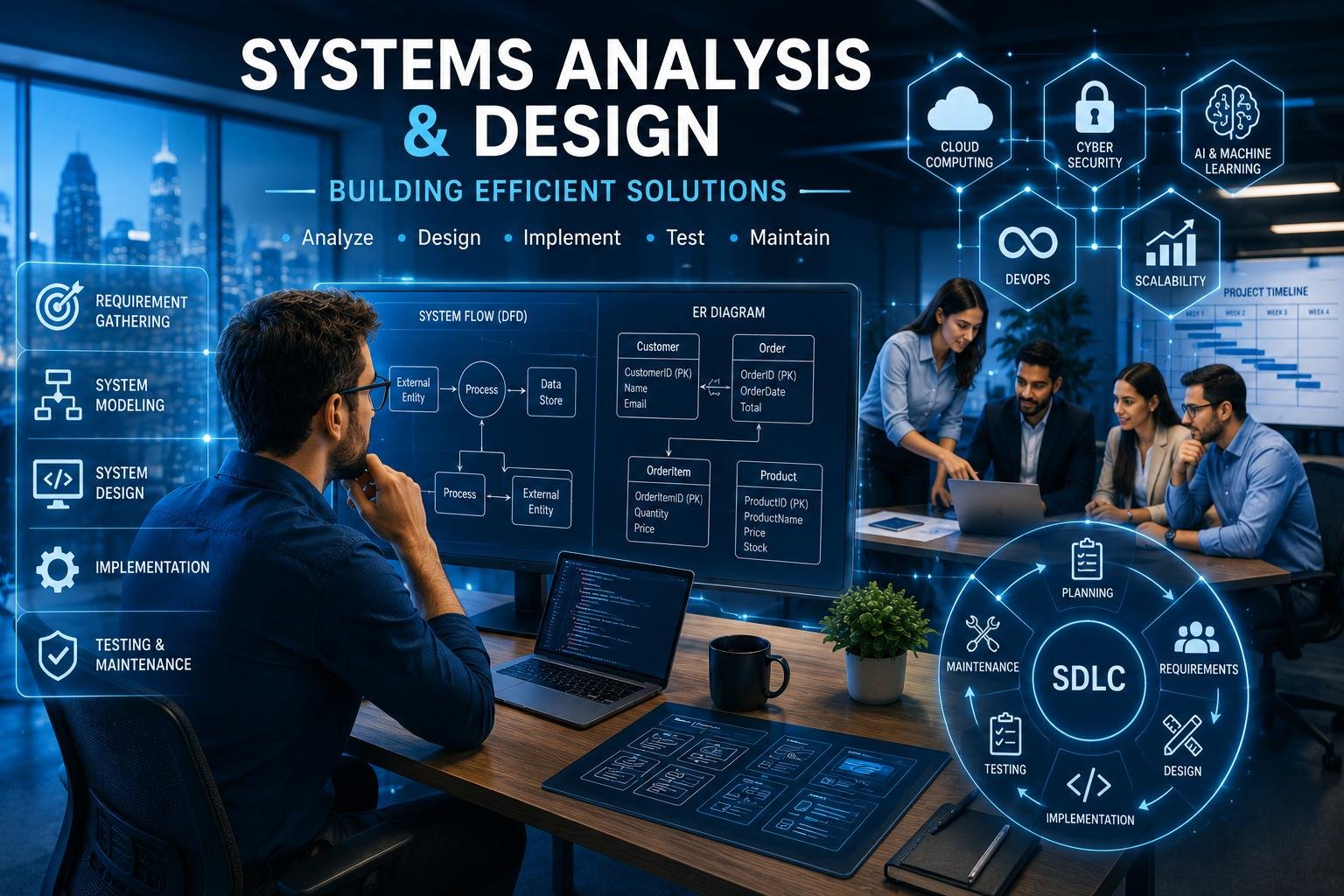
Information systems are essential to the operations and efficiency of modern day organizations in order to manage operations, enhance communication and gain efficiency in the delivery of services. Computer-based systems are used to help organizations to process information quickly and accurately, from hospitals to banks, from schools to online businesses. But it’s not just about coding or installing software to make a successful system. Need careful planning, analysis, design, testing and implementation. It is at this point that the Principles of systems analysis and design comes into play.
Systems analysis and design gives a structure to the way that a business problem is understood and a good technological solution is created. Systems analysis involves defining the problem and determining user requirements and the way a system should operate. Systems design, however, takes those requirements and creates a viable and effective system design.
Without proper systems analysis and design, organizations may suffer project failures, project cost overruns, dissatisfaction with the projects, and poor project performance. By contrast, the systematic development processes increase an organization’s ability to develop reliable, secure and scalable systems.
This article discusses the principles of systems analysis and design, such as collecting requirements, modeling the system, implementing the system, and some good rules of thumb when designing an efficient computing solution.
Understanding the Principles of Systems Analysis and Design
Systems analysis and design is to use present systems, identify issues and put forth better solutions via structured planning and development. We combine business sense with tech know how to see that the systems we develop support what the organization is trying to do.
A system is a group of components that work as a team to achieve a certain goal. For example pay roll systems, e-commerce platforms, banking applications, inventory systems, and hospital management systems.
Systems analysis and in most cases we see two main phases which go by:
- Systems analysis: of present systems, identification of issues, and determination of user requirements.
- Design of Systems: which puts in place the structure, architecture, and specifications of the new system
The aim is to develop systems that do:
- Efficient
- Reliable
- User-friendly
- Secure
- Scalable
- Cost-effective
Importance Systems Analysis and Design
Effective in organization and development is what good systems analysis and design is.
Enhanced Problem Solving
Complex computing issues can be made more approachable when we break them into smaller parts. Analysts are able to identify the root of the issues and to put in much targeted solutions.
Improved User Satisfaction
Involvement of users in the development of systems is a key to their success and improved productivity.
Lower Development Costs.
Careful planning decreases errors, unneeded features, and costly reworks in development.
Improved Efficiency
Well thought out systems do that which is repetitive and also improve workflow.
Improved Security and Dependability
Security issues may be included in the design phase which in turn will reduce vulnerabilities and improve system stability.
Simpler Maintenance
Structured systems go through easier updates, troubleshooting and expansion in the future.
Fundamentals of Systems Analysis and Design
Core principles which inform the development of effective information systems are;
Problem Specification
Each successful system starts with a clear identification of the problem. Analysts must determine:
- What issue exists
- Why it occurs
- Who is affected
- What outcomes are expected
In not properly defining the problem first, development teams may put forth solutions which do not in fact address the issues at hand in the organization.
Human Centered Design
Users are essential to system success. Analysts should include stakeholder input at every step of the development process to ensure the final product meets user expectations.
User-centered systems are typically: In user oriented designs we see that:
- Easier to use
- More efficient
- More widely accepted
Modularity
Large systems must be broken down into smaller manageable units. Each module is dedicated to a specific task but at the same time interacts with other elements.
Benefits of modularity include:
- Easier testing
- Faster maintenance
- Improved scalability
- Better collaboration among developers
Flexibility and Scalability
Organizations are growing and technology is changing very fast. We must design systems to support future growth and change.
For example:
- A small online store may go on to do business in other countries.
- Over time a school database may include.
Scalable solutions which do away with full re designs.
Simplicity
Simple systems do better in terms of ease of understanding, maintenance, and use. As you add more complexity to a system you increase development risk and user confusion.
Accuracy and Performance
Information systems have to present accurate and consistent data. We see in that which they may cause financial loss, operational breakdown, or security issues.
The Systems Development Life Cycle (SDLC)
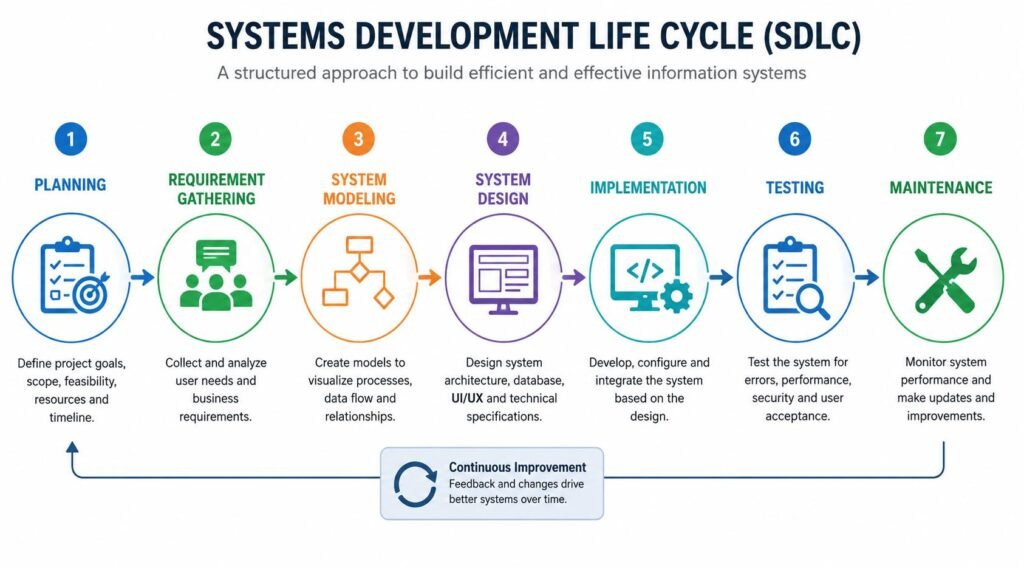
The Systems Development Life Cycle (SDLC) is a structured model which we use for information systems. It also puts forth a step by step approach to project development.
Planning Stage
In the planning phase project goals, scope, resources, timelines, and feasibility are determined.
Feasibility Study
Analysts assess if the project is practical in terms of:
- Technical feasibility
- Economic feasibility
- Operational feasibility
- Legal feasibility
- Schedule feasibility
Project Scope
The scope defines:
- What the system will do
- What features are included
- Project boundaries
Poor project scope definition causes confusion and delay.
Requirement Gathering and Analysis
Requirement collection is at the base of systems analysis. We obtain in this stage in depth information on user needs and business processes.
Types of Requirements
Functional Requirements
These present what the system is to do.
Examples:
- User login
- Payment processing
- Report generation
Non-Functional Requirements
These describe system qualities.
Examples:
- Security
- Performance
- Reliability
- Scalability
Requirement Gathering Techniques
- Interviews: Analysts have conversations with stakeholders to determine system requirements.
- Surveys: Surveys which are used to collect info from large groups.
- Note: Observing how users perform their tasks is to see real workflow.
- Report Analysis: Present reports, manuals, and records also present on the issue.
- Workshop sessions: Group settings which see a lot of interaction between stakeholders.
Importance of Accurate Requirements
Incorrect or incomplete requirements often cause:
- System failures
- Budget overruns
- Delays
- User dissatisfaction
Documentation which is clear does that which developers may put in mind what is expected of them in a project.
System Modeling
System modeling is a visual representation of system processes, structures, and interactions. Models which are visual in nature improve upon complex systems and also better the communication between developers and stakeholders.
Benefits of System Modeling
- Improves understanding
- Detects design problems early
- Enhances communication
- Supports documentation
- Simplifies maintenance
Common Modeling Techniques
1. Data flow models (DFDs).
DFDs display data flow within a system.
Elements include:
- Processes
- Data stores
- External entities
- Data flows
DFDs help in the analysis of system inputs, outputs and processing activities.
2. Entity Relationship Diagrams (ERD’s).
ERDs illustrate relationships between database entities.
For example:
- Students and courses
- Customers and orders
- Employees and departments
ERDs help developers design efficient databases.
3. Flowcharts
Flowcharts present process steps and decisions.
They include:
- Understanding workflows
- Identifying inefficiencies
- Explaining processes to stakeholders
4. Unified Modeling Language (UML)
UML is used in the field of object oriented system design.
Common UML diagrams include:
- Use case diagrams
- Class diagrams
- Sequence diagrams
- Activity diagrams
UML is used by developers to model software architecture and interactions.
System Design
After analysis of the data and modeling we move into the design phase which is that of the system structure.
Types of System Design
Logical Design
Logical design includes:
- Data flow
- Business rules
- Functional processes
It outlines the functions of the system in detail without going into the issues of hardware or software.
Physical Design
Physical design focuses on:
- Hardware
- Databases
- Networks
- Programming languages
- User interfaces
It details the technical operations of the system.
User Interface Design
User interface (UI) is the area at which users interact with the system. Also good interface design increases usability and productivity.
Characteristics of Good UI Design
- Simplicity: Interfaces which should be easy to use.
- Consistency: Buttons, menus, and layout design must be the same across the whole system.
- Feedback: Systems should alert the user to successful actions, errors, or warnings.
- Accessibility: Interfaces for all users.
- Responsiveness: Today’s systems must scale from desktop to tablet to smartphone.
Database Design
Databases hold and present system info. Good database design improves data integrity and system performance.
Important Database Concepts
- Normalization: Normalization decreases data redundancy and improves consistency.
- Primary Keys: Primary keys uniquely identify records.
- Relationships: Relationships connect related data tables efficiently.
- Security Controls
- Access permissions help protect sensitive information.
Substandard database can design results in
- Slow performance
- Data duplication
- Inconsistent records
- Security vulnerabilities
Implementation Strategies
There are a number of different ways in which the implementation can be done, depending on the size of the project, its level of risk and the complexity of the project.
1. Direct Changeover.
The new system is immediately implemented.
Advantages
- Fast implementation
- Lower operating costs
Disadvantages
- High risk if there are problems
2. Parallel Development
At the same time both old and new.
Advantages
- Reduced risk
- Easier verification
Disadvantages
- Higher operational costs
3. Pilot Implementation
We introduce the new system to a small group in the organization, first.
Advantages
- Problems detected early
- Reduced organizational disruption
Disadvantages
- Slower implementation
4. Phased Implementation
The system is being rolled out.
Advantages
- Easier management
- Lower risk
Disadvantages
- Longer transition period
System Testing
Testing to make sure system works well before it’s released.
Types of Testing
- Unit Testing: The individual components are tested separately.
- Integration Testing: A series of components are tested simultaneously.
- System Testing: The entire system is put through as a whole.
- User Acceptance Testing (UAT): The report from the users is that the system meets the business requirement.
- Security Testing: Security hot spots and holes are discovered.
Testing helps prevent:
- Software bugs
- Data errors
- Performance failures
- Security breaches
System Documentation
Documentation contains detailed information about the system operation, development and user’s instructions.
Types of Documentation
Technical Documentation
For developers and IT personnel.
Includes:
- Source code explanations
- Database structures
- Network configurations
- User Documentation
Assist users to learn about system operations.
Includes:
- User manuals
- Tutorials
- Help guides
Maintenance and training are simplified by good documentation.
Maintenance and Support
System development is an ongoing process which does not stop at the stage of implementation. It is necessary to continuously maintain it, to ensure the continued operation of the system and security.
Types of Maintenance
- Corrective Maintenance: System bug fixes and corrections.
- Adaptive Maintenance: Updating of systems to incorporate changes in the environment and technology.
- Perfective Maintenance: Enhance the performance and usability of the system.
- Preventive Maintenance: Finding problems and solving them before they can happen.
System life and performance is improved by routine maintenance.
Systems Analysis and Design Problems
During development of systems we see to put forward that structured approaches break down at times.
Changing Requirements
Requirements of stakeholders may change as development progresses, and so do the schedules and budgets.
Communication Problems
Sometimes, even developers and users fail to share what they actually want in terms of features, which lead to wrong features of the system.
Budget Constraints
Development activities may be limited due to a lack of resources.
Technical Complexity
Large scale systems are a complex integration of technologies.
Resistance to Change
Staff might also be unhappy about the change because of a lack of confidence or because they aren’t being trained enough on the new systems.
That can be minimized with effective communication and project management.
Modern interest in Systems Analysis and Design
Systems are developing with the aid of technology.
Agile Development
Agile methodologies emphasize:
- Iterative development
- Continuous feedback
- Faster delivery
Agile makes it more flexible, cooperative.
Cloud Computing
Cloud-based systems offer:
- Scalability
- Remote access
- Reduced infrastructure costs
Artificial Intelligence (AI)
Automation, decision making and predictive analysis are also AI’s suggestions.
Cybersecurity Integration
Security is not an add-on to the development process; it’s at the heart of it.
DevOps Practices
This collaboration between development and operations teams brings the benefits of a quicker deployment and improved reliability, as seen in DevOps.
Best Practices for Making efficient systems
Best practices are the key to success for organizations.
- Involve Users Early: Requirements are more accurate and user-friendly with continuous participation from stakeholders.
- Maintain Clear Documentation: Documentation facilitates communication and maintenance if it’s well organized.
- Focus on Security: Development security should be a component of all development.
- Conduct Thorough Testing: Comprehensive testing decreases system failures post deployment.
- Plan for Scalability: Systems need to grow and be tech savvy.
- Use Structured Methodologies: Structured Development Life Cycle (SDLC) and Agile Development have been introduced through frameworks.
Conclusion
Principles of systems analysis and design is important in designing a reliable, efficient and scalable information system. Structured methodologies can help organizations resolve complex computing issues without incurring excessive risks, costs, and failures in their development.
These principles of systems analysis and design serve as a basis for comprehending user needs, representing system processes, designing good system architectures, and designing successful systems. Functional activities like requirement gathering, system modeling, testing, documentation and maintenance are crucial to maintaining the value of systems over time.
Today, with the ever-evolving nature of technology, the development and maintenance of systems are transformed by new technologies like Agile development, cloud computing, the integration of artificial intelligence, and cyber security design. The organizations which are capable to make good analysis and design are more capable to enhance the efficiency, support innovation and adapt to the different business demands.
Finally, the construction of successful systems does not just happen. They are the outcome of planning, co-operation, analysis and design processes which are carried out with care to solve complex problems into feasible and effective technological solutions.
Get more well researched information about principles of systems analysis and design here.



The Kitchn is the secret ingredient for home cooks. Our team of expert recipe developers, testers, and editors care deeply about bringing you smart ideas that elevate your cooking experience for reliably delicious food you’ll make again and again.