
Introduction
It is like starting a business without a plan, that is like embarking on a great journey without knowing the destination or how to reach it. Unfortunately, many business entrepreneurs get their business idea excited, but they have not structured their ideas into a strategy that they can use for decision-making and development of their ideas. A business plan is a viable plan that provides a description of a business, the path it will take to reach its objectives and the resources required to make the business a success. Don’t be intimidated by the idea of a business plan, it doesn’t need to be a very long document with a lot of technical detail and cumbersome financial jargon. A modest and targeted business plan can be more valuable since it’s also useful, it’s easy to update, and it’s more easily followed in day to day business. A simple business plan is a perfect tool for an entrepreneur who is planning to start a business or expand an existing one or wants to seek external capital. A business plan clarifies and guides an entrepreneur, eliminates uncertainty and enhances the decision making process. When businesses have a clear plan, it can be easier for them to track their progress, adjust to changes, and focus on long-term goals.
Understand why a Business Plan is Essential
A business plan has a number of important roles to play and is directly linked to the success of a business. It’s no wonder that it’s a helpful tool for entrepreneurs to structure their thoughts and turn them into tangible objectives. It’s not uncommon for many business owners to have great ideas that they have not yet figured out how to implement due to a lack of understanding of their target customers, pricing strategy, operating processes, or revenue expectations. Creating a business plan requires business owners to take a hard look at all aspects of their business before putting in a lot of effort or money. Second, a business plan is typically required by lenders and investors before they invest. This will ensure that they know what the entrepreneur will be doing and will have thought of some risks and opportunities. Third, a business plan serves as a tool for measuring business performance, enabling business owners to compare actual performance and outcomes with those in their plan. This allows for the early detection and adjustments, if needed. Entrepreneurs can develop a useful, practical and easy to use business plan without making it unnecessarily complex if there is an understanding of what is essential to a business plan.
1. Business Objectives, Goals and Vision Statements
The first step to a successful business plan is to have clear goals and objectives. Business aims are the desired outcomes/results that the business wants to attain in a certain amount of time; Business objectives are the measurable actions that need to be taken to achieve the business aims. SMART goals are specific, measurable, achievable, relevant and time-bound. A better objective might be “Through digital marketing and customer retention efforts, boost monthly sales revenue by 20% over the next 12 months, rather than just writing, “increase sales.” When goals are clear, it helps employees, management and stakeholders to know what to do and to focus resources effectively in the business. They also establish accountability as there are targets to measure progress against. Short term goals can be to launch a website, gain a specific number of customers or break even, while long term goals can be to expand to new locations or add a line of products. When entrepreneurs set their goals realistically and measurably, they will be more inclined to remain focused and make decisions in line with their business vision.
2. Clearly Articulating your Business Concept and Value Proposition
A business plan should be able to articulate the business and why customers will opt it over the competition. This section is commonly known as the “business concept” or the “value proposition.” The entrepreneur has to determine what products or services to provide, what problems to solve and what unique advantages do customers get from the offered product or service? Customers do not buy products just for products’ sake, they buy solutions to the challenges they face or problems they have. A bakery can offer convenience and freshness to the busy family, or a technology company can offer efficiency and cost savings to a business. Knowing this value proposition is useful for entrepreneurs to design their product and service accordingly, which is helpful to stand out in the competitive market and meet customers’ needs. The business idea should also contain data regarding the company’s mission, vision and core values that will affect the branding, customers’ relationship and long term strategy. A well-defined value proposition can boost your marketing campaigns and help you attract and engage your target customers.
3. Conducting Market Analysis
Market analysis is one of the most crucial components of a business plan, as even great products could be unsuccessful if there is not enough demand, or fierce competition. Market analysis entails the study of the target market, market trends, customer preferences and the competitive market. To determine the target market for a business, entrepreneurs should first look at the following demographic characteristics: age, income, location, education and purchasing behavior. By understanding customer needs, companies can customize their products and marketing that can help them reach their customers more effectively. Competitors should also be compared and contrasted in market analysis, to determine their strengths and weaknesses, pricing policies, and customer service policies. Companies can learn from the successes and failures of their competitors, instead of seeing them as threats. Consumer preferences and technologies also are constantly changing, which is why industry trends are important as well. By staying updated on market trends, entrepreneurs can capitalize on new opportunities and respond swiftly to market shifts. Extensive research can help to mitigate risks and give confidence that there is a viable market for the proposed enterprise.
4. Identify your Target Market.
Identifying a target market is not just about knowing who may purchase a product or service but also identifying who is most likely to purchase it. It demands that entrepreneurs know their customers’ motive, buying patterns and preferred mode of communication. Focusing on a wide audience can lead to broad marketing messages, which can be ineffective and lead to a lack of success. Having a specific target market will help businesses to use resources more efficiently and create products that solve the problems of their customers. For instance, a company that sells items to university students would probably employ different marketing tactics and pricing than a company that sells items to people working in a corporate environment. Entrepreneurs need to develop customer profiles which tell them what their target customer is like, this should include their lifestyle, their buying habits and the problems they are facing. These profiles help in making decisions about product development, advertising, customer service, and pricing. A business that knows their customer well will be able to develop loyalty and repeat purchasing, a fundamental key for achieving profitability and sustainability in the long term.
5. Financial Planning and Budgeting
Financial planning is frequently said to be the most daunting part of business planning, but it doesn’t have to be too complicated. The object of financial planning is to determine the amount of money required by business and the amount of money that the business can earn. The first step in identifying startup expenses is to determine the costs of equipment, inventory, licenses, marketing and office space. They should also calculate monthly costs for rent, technology, transportation, utilities, salaries and other expenses. Revenue estimates must be realistic, and based on market research and not merely hope. It is very essential to cash flow forecasting as it is, even if the business makes profit, it can still fail if there isn’t enough cash to cover immediate expenses. The basics of your business finances should consist of income and expense estimates, and cash flow projections, for the first year of business operation. Precise financial planning aids in decision-making, boosts investor confidence, and enables businesses to brace for unforeseen challenges.
6. Create and Develop an Effective Marketing Strategy
A business plan should describe how customers will become aware and buy into the company’s products and/or services. Marketing strategies are the methods that are used to attract, convince and retain customers. There are many marketing channels that are available, such as social media, email marketing, search engine optimization, content marketing, paid advertising, and traditional marketing. The marketing strategies that should be used by the entrepreneur should be based on his target population and budget available. For a business that is geared towards young adults, social media can prove to be effective, and for a business-to-business company, professional networking and email outreach can be more effective. Another aspect of marketing that is crucial is pricing strategy, as it can impact customer perception and profitability. Companies need to decide which of the four pricing strategies they will follow: price, quality, convenience and specialization. Marketing is about being consistent in your message and continuously measuring and improving. By periodically assessing the performance of campaigns, businesses can maximize their investments and generate higher returns.
Steps to Developing an Operational Plan
Operational planning describes how the business will run day-to-day to meet the needs of customers through the production of goods and/or services efficiently. Production processes, supply chain management, staffing requirements, technology systems and quality control procedures are covered in this section. Entrepreneurs need to understand what resources are required for a successful business and how they will gain access to them and utilize them. For a retail shop, for instance, it’s vital to have a steady supply of goods, inventory management systems, and staff with customer service training, and for an online business, it’s imperative to have a strong online presence and delivery partnerships. Operational planning also includes the roles and responsibilities to improve accountability and smooth operational workflow. Without the proper framework, businesses can suffer delays, be dissatisfied with their customer service and incur unnecessary costs. Writing procedures and responsibilities beforehand makes for consistency and better productivity. A good business operational plan converts business concepts into repeatable processes that can assist the growth of the business and the satisfaction level of its clients.
Establish the Proper Team and Leadership Structure
Leadership and staffing are integral parts of a business plan as people are an integral part of its success. Having distinct roles and responsibilities is beneficial even to small businesses as it helps minimize confusion and boosts efficiency. It is important for the entrepreneur to gauge what abilities the business needs and whether they have them in-house or should be outsourced. In addition to technical skills and competencies, cultural fit and buy-in should be a key consideration in the hiring process. Leadership structure is also crucial as workers are more productive if they know their reporting lines and how decisions are made. A small business relies on its founder to a large extent in early years, but later on, it is essential to delegate and develop a team for sustainable growth. A business plan should define the roles of financing, marketing, operations and customer service heading into future and what new people are needed for the growth of the business. Effective team work and good leadership is a major component in the long-term stability and growth of businesses.
Assessment, Measurement and Tracking of Progress
Making a business plan is just the starting point, businesses need to track their performance and make certain that they stay on track. KPIs are definite indicators that show that the goals are being met. Financial indicators could be revenue growth, profit margins, cash flow, operating expenses, and more; marketing indicators could be customer acquisition costs, website traffic, conversion rates, and more. Customer metrics like customer satisfaction scores, customer retention, and repeat purchases deliver insightful data on the quality of the service and brand loyalty. Some operational metrics can be production efficiency, delivery time, and inventory turnover. Routine evaluations can help companies realize their strengths and weaknesses, highlight achievements, and inform decision-making regarding strategy changes. It is better for an entrepreneur to make a review of on a monthly and quarterly basis to check the actual results with the planned goals. The business plan is a living document that continuously gets updated in accordance with the business’s development and growth, and is not just a report filed and forgotten.
Business Plans are best kept to the Basics and Flexible.
A lot of business owners don’t write business plans since they think it may be long and complicated. Actually, it is simpler that is more effective, since simple plans are easier to understand, communicate and modify. The information in a practical business plan should be focused on what is relevant to the decisions being made and not be overly detailed. Business Plans should be reviewed and updated regularly in response to changes in the market, customer tastes and business needs. Flexibility is a key characteristic of start-ups since some assumptions when planning has to be realized during the operations. Adaptable, up-to-date goals, budgets, and strategies help businesses stay competitive and agile. A business plan is a guideline, not a formula. Organizations that manage to strike a balance between structure and flexibility will be able to adapt to uncertainties and capitalize on new opportunities better.
Conclusion
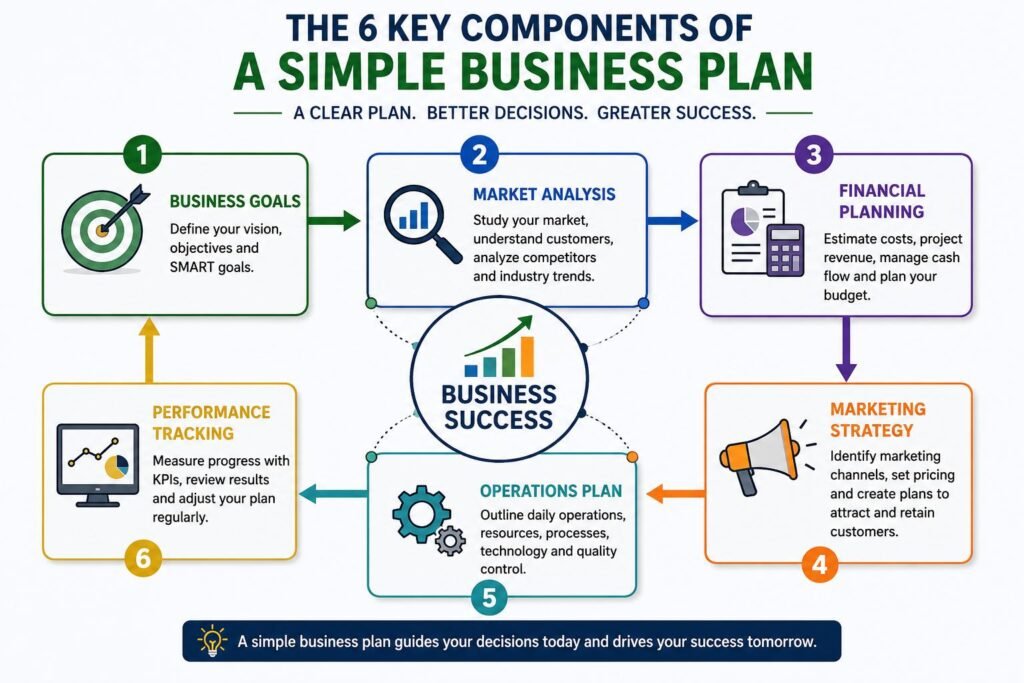
By having a simple business plan that offers direction, clarity and measurable objectives, an entrepreneur has an enhanced probability for success. It assists business owners plan their ideas, grasp their markets, control finances and create methods to lure and keep customers. Business objectives, market analysis, financial planning, marketing plan, operations plan and measuring performance all contribute to the development of a plan for sustainable growth. Importantly, a business plan doesn’t have to be overly complicated. Sometimes, the most useful plans are the ones that are still useful, stay on point, and are flexible enough to change and accommodate the changes. By taking the time to create a well thought out business plan, entrepreneurs put themselves in a better position to obtain funding, rise to the challenges and construct resilient businesses that can succeed in the ever more competitive marketplace.
Get more well researched information about Simple Business Plan here.