Introduction
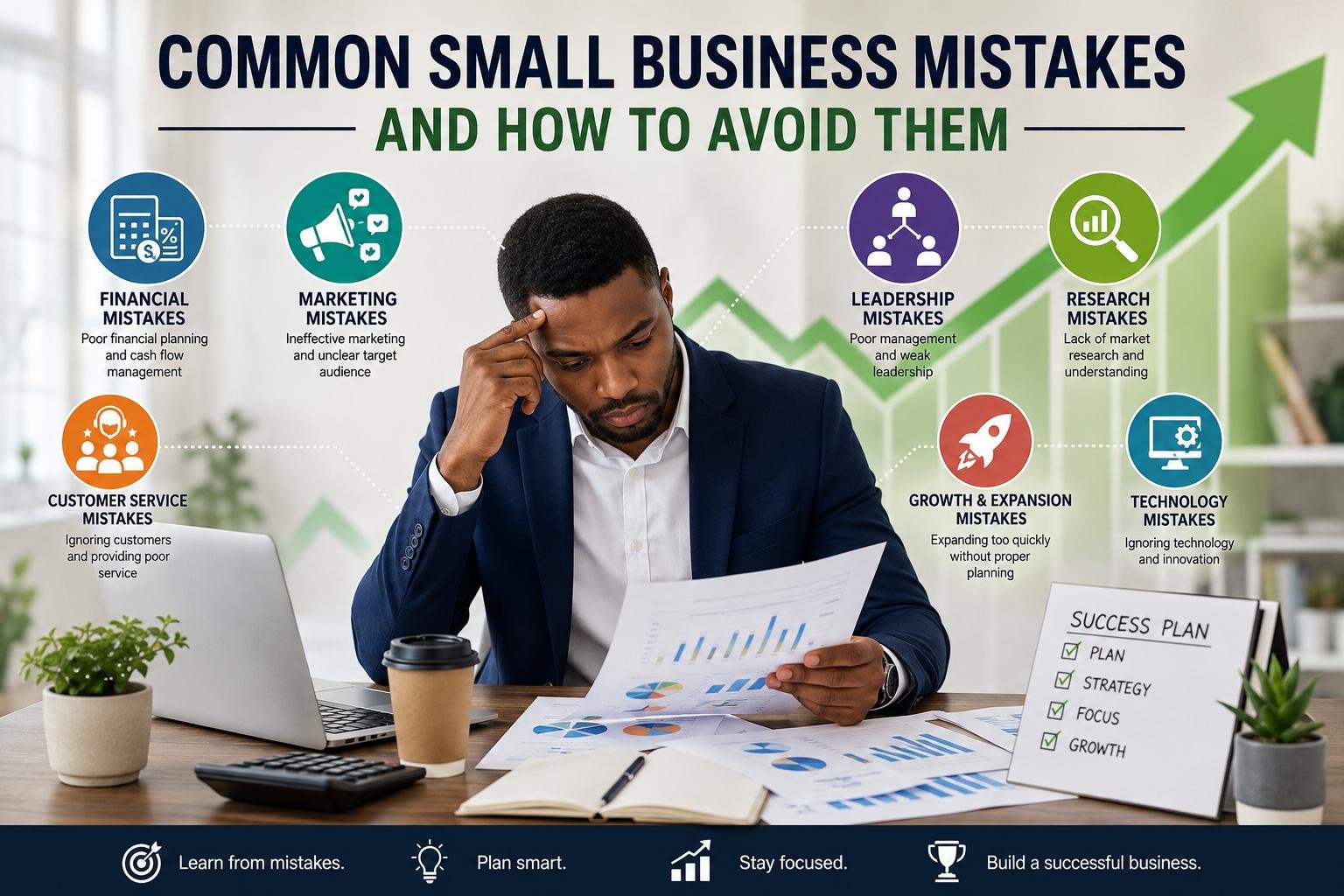
Entrepreneurship can be one of the most fulfilling career paths one can take, starting a small business. Small businesses play a major role in the economy, in jobs and in spurring innovation in communities. But, the majority of businessmen are enthusiastic and determined but many fail to survive after the first couple of years of starting their enterprises. Failure is not always due to a bad business concept or because there was no demand for the product/service. Rather, businesses typically go out of business due to a series of avoidable and unnecessary errors that eventually erode the business, its profitability and customer relationships.
By recognizing these potential challenges, entrepreneurs can avoid these common mistakes and make better-informed decisions to create more sustainable and successful businesses. If business owners are aware of the potential risks, they can develop strategies for reducing the effect of the risks and minimize the risk of their businesses failing in the long run. Learning from the trial and tribulations of others can help entrepreneurs be better prepared to face trials and adjust to market conditions. Small business owners can take proactive steps to mitigate these frequent mistakes and ensure long-term growth and profitability in competitive markets by recognizing them and taking preventive action.
Understanding and Addressing Business Mistakes at an Early Stage
Many entrepreneurs think that errors are part of the learning process and it’s impossible to prevent them. Of course experience is one of the best teachers in business, but, there are some business blunders that can have such devastating implications that it can be impossible to recover. Issues ranging from too much debt, loss of customer confidence, low employee morale, to marketing failures can eat away at a company’s resources and tarnish its reputation. Timely awareness of warning signs gives business owners the opportunity to take corrective action before problems evolve into crises which could jeopardize the continuing operation of a business.
Business owners that are constantly reassessing their business operations will find areas of weakness before the competition or customers. Regular performance reviews, customer feedback, financial audits, and market analysis provide valuable feedback that aids in good decision making. Business owners who are willing to take the time to learn and enhance their operations are more likely to create a business that can adjust to shifting market dynamics and survive the economic climate. Business owners can learn about common pitfalls of entrepreneurship from others and their experiences and avoid making the same pitfalls in their own business.
1. Lack of Financial Planning and Cash Flow Management
Poor financial planning is one of the top causes of the failure of small businesses. Many entrepreneurs begin with a passion and optimism for their business, but aren’t aware of the financial resources needed to sustain their business in the early days. Ongoing expenses like rent, salaries, utilities, inventory, equipment maintenance, taxes and marketing expenses can easily surpass initial projections. Without budgeting in a realistic manner, business owners can find that they are soon in a situation where they need cash but do not have it available to be used in their business operations, and for that reason, it can seriously hinder their growth opportunities.
One of the greatest risks for a profitable business is cash flow issues – it’s one of the reasons why a profitable business can fail. Seasonality in sales, unplanned costs or late payments may cause cash flow stress that is not easy to control. Another common pitfall some business owners fall into is combining their personal and business finances, which can make it difficult to see exactly where the money is going and how profitable their business is. If you don’t have the right financial information, then you’re making decisions on an assumption and not on real data.
If you want to avoid making financial planning errors, you have to be disciplined and careful in your planning. Business owners need to create detailed budgets, have emergency funds on hand, keep an eye on the money flow and ensure that the accounting software they are using is accurate in tracking expenses and income. Consulting with accountants or financial advisors can also be beneficial in terms of tax advice, budgeting, and investing. It helps in having a clear point of view with regards to the finances, and it helps in the financial reporting as well. It helps in making the finances crystal clear and financial reporting easier as well. With financial discipline, entrepreneurs can create stability and minimize the risk of financial emergencies.
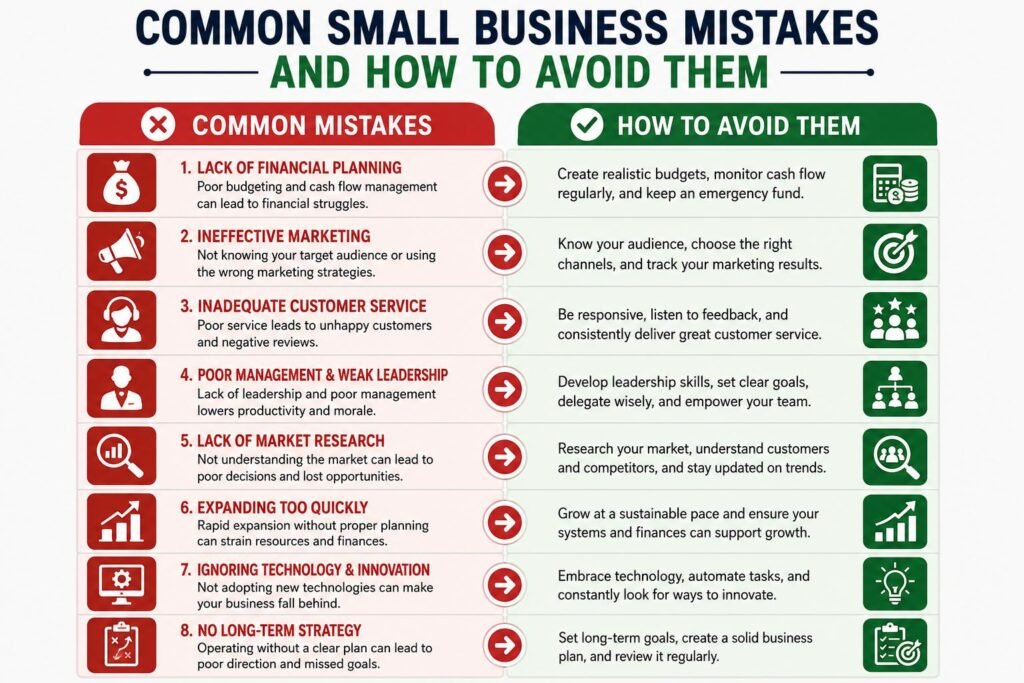
2. Ineffective Marketing Strategies
No matter how good their products and services are, businesses can still fail if their potential customers don’t know they exist. It’s also a misconception that many business owners have that people will want to buy their business because they provide high-quality products. It is not enough to simply offer a quality product, businesses must actively market themselves to customers. One of the most frequent causes of ineffective marketing is when business owners don’t clearly define their target customers or spend time and money on marketing efforts that don’t make an impact. Some companies invest a lot in advertising but fail to track the results, others refuse to do any advertising, to save the cash.
Marketing errors may result in low brand awareness, inadequate customer acquisition and decrease in sales income. If a business uses only one marketing channel then it can become dependent on that channel if it alters its policies or becomes less popular with customers. Moreover, having multiple brands and messaging can also lead to customer confusion and a loss of confidence in the company. In the digital world today, users demand that businesses be accessible online via websites, social media and communications platforms.
With in-depth customer behavior analysis and market research, entrepreneurs can prevent themselves from committing these errors and create robust marketing strategies. Knowing who the target is will enable companies to develop content that is relevant and choose the best advertising methods. By measuring marketing performance with analytics, owners can discover which campaigns work and which fail, which then enables them to remove the ones which don’t. Inconsistent branding can cause uncertainty and confusion among customers when they hear about a product on several platforms and don’t recognize the same brand. When customers hear about a product at several places and don’t recognize the same brand, it can cause uncertainty and confusion. Strategically marketing your business can lead to better growth and customer retention.
3. Inadequate Customer Service
One of the most important factors that affect business reputation and sustainability is customer service. Unfortunately, many business owners put a lot of effort into gaining new customers, but neglect to cater to their existing ones. Inadequate customer service can manifest in delayed response times, unaddressed complaints, unfriendly responses, inconsistent communication, or even not meeting customer expectations. There can be lots of negative comments spread via online reviews and social media that can negatively impact a business brand and turn off prospective customers from attempting to purchase anything.
There are many options for modern consumers, and it’s harder to retain than ever. If they are feeling underappreciated or overlooked, customers are likely to opt for a competitor that offers a better experience. Furthermore, it is much more expensive to acquire new customers than it is to keep current customers. If businesses don’t invest in customer satisfaction, they can be spending a lot of money on marketing and still be losing customers due to bad service.
Businesses need to establish mechanisms that focus on being responsive, empathetic and consistent when it comes to customer service. Investing in communication and conflict resolution training of employees can make a huge difference in customer interactions. Feedback is a great way for businesses to identify areas for improvement and make changes swiftly. Consistent standards of service and measuring service performance ensure consistency everywhere the customer comes in contact with the service. Positive referrals, repeat business and increased brand loyalty are all results that can be gained from businesses that meet or surpass expectations.
4. Poor Management Practices and Weak Leadership
As the direction of a business and its culture is defined by leadership, there is no denying its central role in the process. Without leadership, entrepreneurs can find it challenging to inspire staff, assign tasks and make tough choices. Poor leadership can cause a lot of confusion about objectives, tasks, and expectations, resulting in less productivity and less employee satisfaction. Unsatisfied workers are less likely to be dedicated about the goals of the organization, which could result in greater employee turnover and recruitment expenses.
Another common mistake made by some entrepreneurs is that they attempt to handle all of the business operations on their own. Micromanagement defeats employees’ creativity and robs owners of strategic goals. However, over delegation without accountability can lead to substandard performance and accountability. Trust, accountability and enabling staff to share ideas and solutions are important aspects of effective leadership.
Business owners have the ability to build leadership skills via training, mentorship and ongoing self-improvement. Having clear objectives and objectives conveyed to the employee helps him or her to know his or her job duties. Do regular meetings and evaluations foster accountability and professional growth? By actively listening to employees, acknowledging their accomplishments, and providing support for development, strong teams can be created that can lead to long term business success.
5. Lack of Market Research
Many businessmen do not know what their customers need and that is why they do not make it in business. Going into a market without knowing what their competitors are doing, what consumers are looking for, what they have set their prices at or what the trends are could lead to costly mistakes. New products can be created that customers don’t want, prices can be incorrect or messages in marketing communications cannot hit the mark with the target audience. Information is necessary to make a business decision; if it is not there, then they will make a determination based on what they assume.
Market research offers entrepreneurs important information, helping them to find opportunities and reduce risks. Knowing the demographics of customers, how they spend their money, and their preferred products and services helps companies create products and services that have a better chance of meeting the needs of the market. Research also allows businesses to predict consumer behavior, and act accordingly to new trends. Analyzing competitors can help identify opportunities in the market to help differentiate and innovate.
Entrepreneurs should therefore survey, study industry reports, keep an eye on their competitors, and directly interact with their customers to prevent making such a mistake. Customer behavior and market trends can be gained from digital tools and analytics platforms. Research-based decision-making is better for businesses to compete and adjust to market changes.
6. Expanding Too Quickly
For many, growth is synonymous with success, but rapid growth can be problematic for a small business if it is not well managed. Sometimes, entrepreneurs open new establishments, recruit a lot of staff and launch new products before having solid systems in place. Expansion can lead to greater revenue opportunities but also greater complexity, cost and management demands. Rapid growth can be a challenge for businesses to keep quality and customer satisfaction.
Cash flow and operation can get tight when rapid expansion occurs. When growth outpaces resources, inventory problems, supply chain issues, and manpower problems can occur. In addition, businesses could get distracted from what they do best in order to closely follow opportunities that are not in line with their goals. Sometimes, debts incurred by over-borrowing to support expansion are not sustainable.
Growth should be planned for, with the understanding that entrepreneurs ought to first ensure a stable situation for existing operations, and then look for growth opportunities. As businesses grow and become busier, scalable systems and processes can be put in place to handle their growing needs. Financial estimates and risk analyses are useful tools to know how growth plans can be made feasible. Growth, in general, is better than unsustainable expansion that leads to decreases in quality or financial stability.
7. The Failure to use Technology and Innovation
Technology has revolutionized the way businesses are run, how they communicate with one another and how they provide services to customers. Business owners who remain out of the technological trend are likely to become uncompetitive in today’s digital world. Manual systems can be time-consuming and prone to errors, and legacy systems can hinder productivity and customer satisfaction. Failing to pay attention to online platforms can mean missing out on reaching a wider audience and optimizing your operations.
Innovation is not just about technology, it’s also about modifying products, services and business models to meet evolving customer needs. Without innovation, companies can become irrelevant as rivals come up with improved solutions or new and easy alternatives. They have significantly changing expectations and flexibility and adaptability is key to long-term survival.
Digital tools can be a huge advantage for small businesses, including accounting software, customer relationship management (CRM) systems, inventory management software, and e-commerce platforms. Training ensures that staff members are able to make maximum use of technology and investing in their training is a worthwhile investment. Innovation can help entrepreneurs boost productivity, cut expenses, and deliver better customer experience.
8. Not Implementing a Long-term Strategy.
The lack of long-term planning can be a problem for some entrepreneurs, as they get too caught up in the day to day business. Businesses need to have strategic direction for sustainable growth as well as to manage their immediate tasks. Working without clear objectives can lead to disjointed decision making, and lost opportunity. In the absence of a business plan, businesses can be reactive instead of proactive.
Long-Term Planning is a series of measurable goals that are identified and resources needed to reach the goals. Strategic plans enable businesses to make effective resource allocation and prioritize their activities for growth. They also offer a measuring rod for the owners to assess progress and make changes as needed. Companies that have a vision are easier to get employees excited about and investors or partners to join.
It is important for entrepreneurs to periodically check on the business objectives and update plans to make it fit. When key staff members are part of the strategic conversation, it promotes teamwork and valuable insights. Companies that are short-term and long-term thinkers are more likely to survive uncertainty and take advantage of opportunities if they can.
Conclusion
There are many problems that small businesses have to work their way through, and for many of those issues, it’s not the circumstances, it’s the mistakes made that has caused the challenges. Poor financial planning, ineffective marketing, inadequate customer service, weak leadership, insufficient market research, uncontrolled expansion, resistance to innovation and lack of strategic planning are some of the most common stumbling blocks that entrepreneurs face. These problems can be devastating, but they can be avoided if they are prepared, educated and managed.
Regularly learning and making proactive decisions make a huge difference in the odds of success for entrepreneurs. Long-term growth and resilience are built on robust financial structures, comprehensive customer knowledge, robust leadership development and innovative strategies. While owning a business is always a gamble, this risk can be reduced by entrepreneurs planning their businesses wisely and making well-informed decisions. Small business owners can avoid common pitfalls and take proactive steps to build thriving businesses by learning from their peers’ experiences and applying practical solutions.
Get more well researched information about Common Small Business Mistakes and How to Avoid Them here .