Introduction
One of the key technologies of EVs and HEVs is regenerative braking, which captures some of the energy that’s typically lost during braking. In a normal car, the braking process primarily dissipates the car’s kinetic energy, primarily as heat from friction between the brake pads and discs. Regenerative braking, however, works in the opposite way, where the electric motor turns to a generator when slowing down. The vehicle uses some of that energy to generate electricity and returns it to the battery, where it can be stored.
It’s simple, but the systems that regulate it are sophisticated. When the EV/EHV moves forward, the battery powers the motor, which drives the wheels. As the motor slows down, the wheels may drive the motor as well. The motor then generates electricity and provides resistance that slows the vehicle down. This recuperated energy can be stored in the battery to be utilized at a later time, thereby improving the vehicle’s operating efficiency.
How Regenerative Braking Works
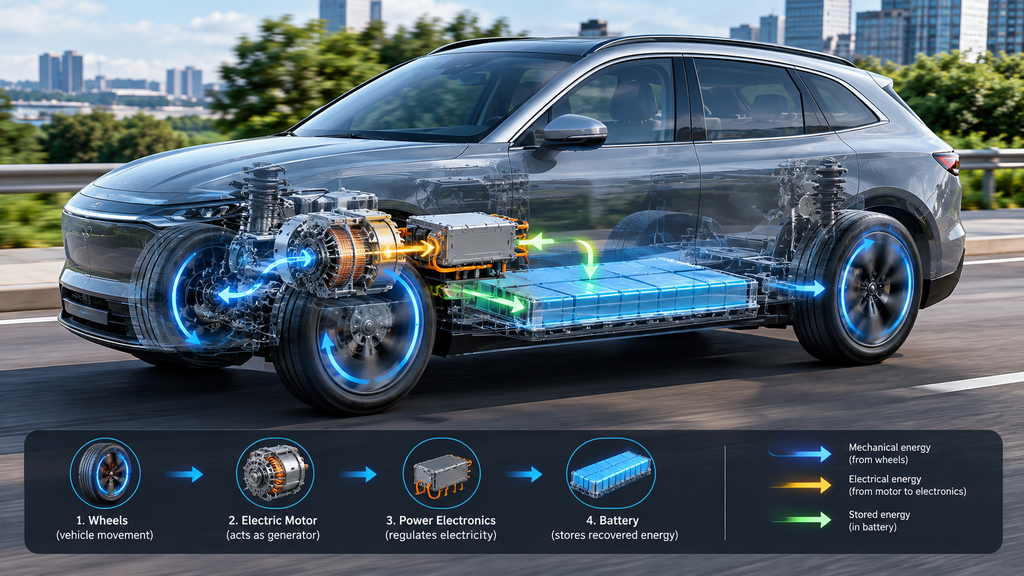
The kinetic energy of the moving vehicle must be converted to another form when its speed is reduced. Usually, traditional braking systems transform this energy into heat. In regenerative braking, the electric motor operates in the opposite direction and works as a generator. The wheels keep the motor spinning, and the motor creates electricity, instead of just using up electricity. Meanwhile, this causes resistance that reduces the vehicle’s speed.
The battery receives the electricity generated by the motor after it goes through the power electronics. These elements regulate the flow of electricity in such a way that it would be appropriate for the battery. The battery-management system also monitors battery temperature, charge, etc. When the battery is able to store more energy, the recovered electricity is stored for use later. But not all of the energy can be recovered, as some is lost due to electrical resistance, drivetrain losses, tire friction, and air drag.
Regenerative Braking vs. Conventional Braking
Regular friction brake systems apply brake pads and discs/drums to slow wheels. When the driver pushes on the brake, friction is produced, and the kinetic energy of the vehicle is turned into heat. The system is very significant as it gives effective stopping power without depending on the battery and the electric motor. The energy lost from a vehicle when it is braking, however, is typically lost and emitted as heat to the environment.
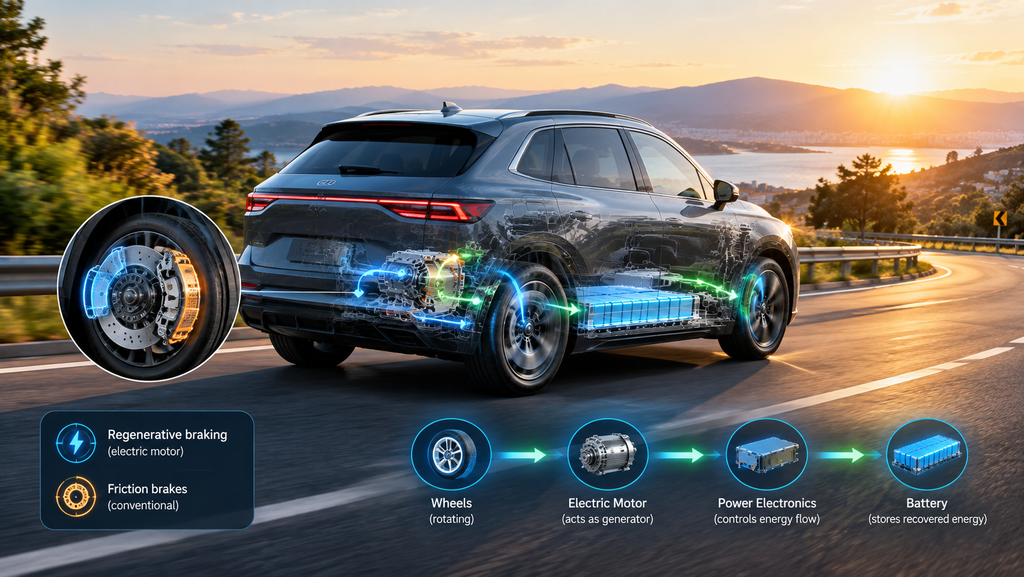
Regenerative braking involves the electric drivetrain being used to provide some braking force and to recover energy. This allows some energy to be used again that would otherwise be lost. It may also help to lessen the effort required by the traditional brakes when driving normally, which can help to lower brake pad wear. But regenerative braking cannot be used in place of friction brakes. Typical modern EVs and hybrid vehicles use both of these for efficient and reliable braking.
How Regenerative Braking Works to Store Energy
The energy from the electric motor is used during braking, and the electrical system controls the energy prior to the battery. The power electronics control the flow of electricity, and the battery-management system determines if the recovered energy can be safely stored in the battery. The electricity is stored in the battery and is available for future driving if suitable conditions apply.
Not all the recovered energy can be stored in the battery. For instance, if the vehicle is already on a high charge or running at an unsuitable temperature, it might decrease the amount of regenerative braking. In such cases, friction brakes might take on more of the braking effort. So, regenerative braking isn’t recovering all of the energy of the moving vehicle, but it can be useful in many driving situations.
Why Regenerative Braking Is Efficient
The primary benefit of regenerative braking is that it enables the use of previously used energy. Energy is transferred into the movement of a vehicle every time it speeds up. As it slows down, some of that energy can be recovered rather than lost as heat. The recovered electricity can then be used in the electric motor, decreasing the need for extra energy from the battery.
The benefit may be particularly apparent in traffic stop-and-start conditions. In city driving, there are lots of opportunities to recover energy because of the frequent acceleration and deceleration. There are fewer opportunities, as a steady speed is maintained in highway driving. Nevertheless, regenerative braking is used in conjunction with other efficiency technologies, such as efficient electric motors, aerodynamics, battery technology, and low rolling resistance.
How It Can Help to Improve Driving Range
Regenerative braking is one way to improve the efficiency of EVs’ battery power. It does not generate new energy or regenerate all of the energy used for acceleration. Rather, it takes up some of the energy which would otherwise be dissipated during deceleration. These small amounts of recovered energy could add up for increased overall efficiency in many braking events and could also help to extend the range of a vehicle on a charge.
Hybrid vehicles can gain from this in addition, as recovered energy can be stored in their batteries and utilized later to help the electric motor. This can help to decrease the workload of the gasoline engine. By doing so, regenerative braking helps meet the requirements of the fuel-saving objectives of hybrid cars and the energy-saving objectives of fully electric cars.
The Sensation of Regenerative Braking
Regenerative braking will be slightly different compared to braking with a traditional gas car. Some EVs will slow down when you take your foot off the accelerator, as the motor starts producing electricity. Other vehicles create a lighter effect and will enable the natural coasting of the vehicle. This action depends on the vehicle architecture, software, and driving mode selected.
A few cars make it possible for the driver to tweak the degree of regenerative braking. A lighter setting will give a more classic feel when you press the accelerator, while a heavier setting will create more deceleration when you let up on the accelerator. In addition, some cars may have the ability to execute the one-pedal driving function, which will slow the vehicle down significantly when the foot is removed from the accelerator in many common driving circumstances. If a driver requires more force for braking, he or she will still use the regular brake pedal.
The Importance of Friction Brakes
Conventional brakes don’t go away because of regenerative braking. Regenerative braking alone is not sufficient in all cases; that’s where friction brakes come in. They play an important role when braking in emergencies and when the battery is unable to accept any more energy. If a vehicle is nearly full, for instance, then it may have less capacity for regenerated electrical power, which will result in a lower level of regenerative braking.
Modern EVs are therefore equipped to control regenerative/friction braking in an electronic manner. It is the amount of braking power that the vehicle requires to come from the electric motor and how much should come from the conventional brakes. The aim is to achieve smooth and predictable braking with the recovery of the greatest useful energy possible without compromising safety.
Impact on Energy Recovery
The amount of energy that can be recovered through regenerative braking depends on several factors. Battery charge level and temperature are critical factors since they influence the amount of electricity the battery can take safely. Other factors such as vehicle speed, road conditions, driving mode, traffic, and braking behavior may also affect the amount of energy recovered. These factors mean that regenerative braking will not have the same effect on every trip.
There are also style factors, such as driving. The more frequent the stopping, the more time for regeneration; the fewer the stopping times, the fewer opportunities for regeneration. Raising the rate of acceleration followed by reducing the rate of deceleration will work better with the system than by accelerating fast and then braking hard. Combined with good driving techniques, then regenerative braking can be the most effective system.
Conclusion
Electric and hybrid vehicles are able to regenerate some of the kinetic energy used in braking back into the system. The electric motor acts as a generator in the deceleration phase, generating some electricity from the vehicle’s movement. It is managed by the car’s electrical systems and stored in the battery to be used when needed. This means that the vehicle can recover some of the energy, rather than dissipating it all as heat through traditional brakes.
The technology can increase energy efficiency, boost driving range, and save on the use of friction brakes in normal driving situations. But regenerative braking can’t capture all of the car’s kinetic energy, and traditional brakes are still required for powerful and dependable braking. Knowing how regeneration works can help drivers learn to handle the different braking characteristics of electric and hybrid cars and maximize the benefits of this technology.