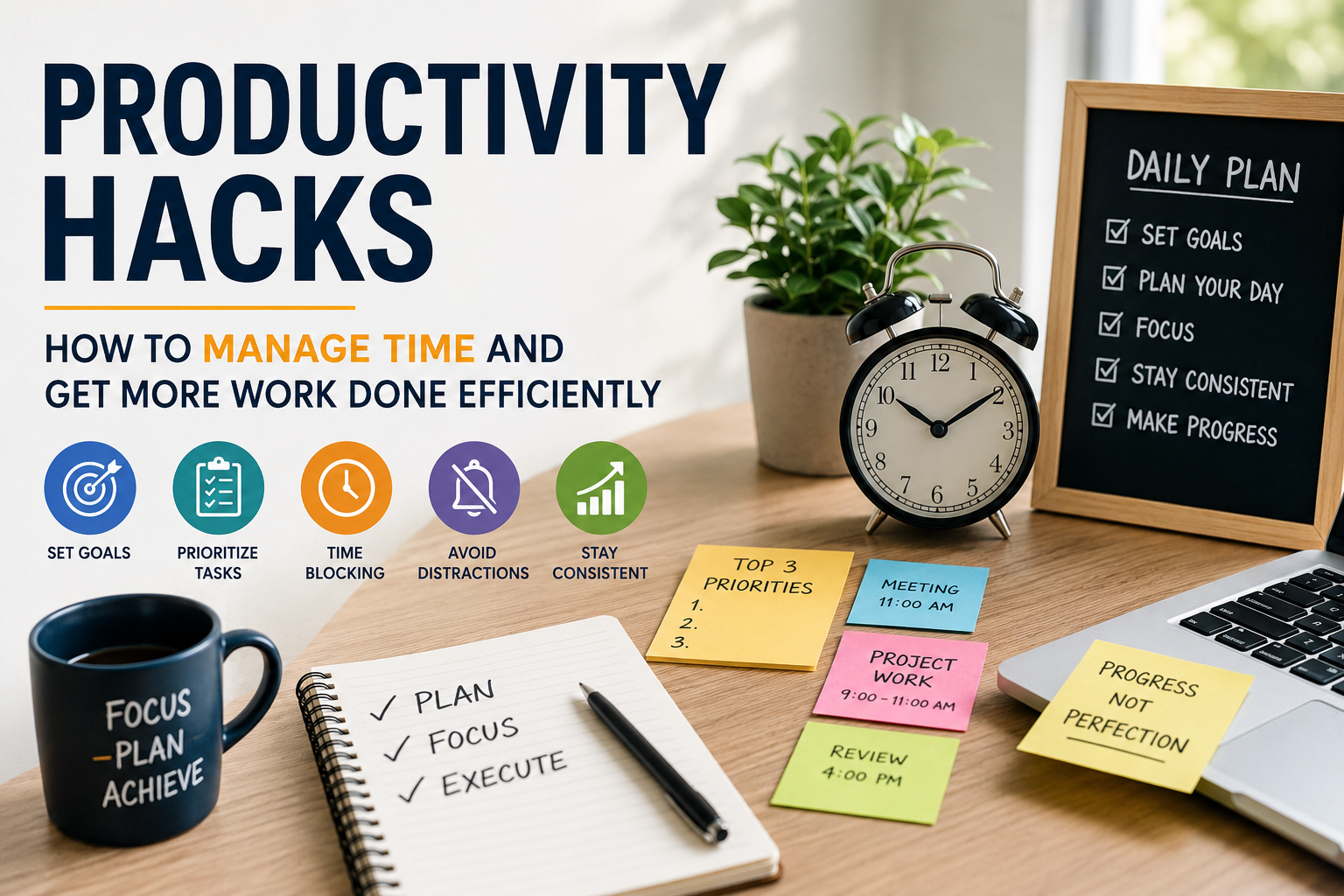
Productivity has become more than a buzzword in the workplace. Time management and the ability to do important tasks effectively and efficiently can make the difference in today’s hectic world between success and failure in life. People who work long hours feel as if they don’t get much done due to a lack of a plan to manage their responsibilities. Fortunately, there is no need to work harder to make productivity improvements. In fact, it is all about smartening up the way you approach the day to ensure that you focus well, expend less effort, and keep your energy levels high. This is where practical productivity techniques become valuable. Instead of supporting people to work longer hours, these productivity hacks help individuals concentrate on the tasks that make the greatest impact.
Whether you are a student, an entrepreneur, a remote worker, a manager, or a busy professional, having the right productivity habits can change the way you do your daily activities. Prioritizing, planning, reducing distractions, and finding a balance between work and life help you get more done without fatigue and burnout.
The Importance of Productivity
Productivity is defined as making something useful out of what one has, such as time, energy, and attention. There is a common mistake that many people make, thinking that being busy equals being productive. However, being busy throughout the day does not necessarily mean making progress towards significant goals.
Effective productivity is being able to do high-value activities that directly impact personal and professional objectives. An increase in productivity can lead to a decrease in stress, better time management, increased self-confidence, and satisfaction with achievements. Working staff also benefit from improved performance, better collaboration, and increased efficiency.
The problem is that there are so many distractions in this modern world, such as notifications on social media, emails, unanticipated interruptions, and the demands of multitasking. This is why establishing reliable systems and habits is important for performing consistently.
Understanding the Foundation of Practical Productivity Hacks
It is essential to grasp the concept of productivity before getting into any strategies, as it is not a matter of finding a magic solution. Rather, it is about incorporating several strategies that have an additive effect in building lasting behaviors. These strategies involve getting the most out of the way an individual spends his or her time and energy, and not working a greater number of hours.
The best productivity systems have common elements of clarity, focus, prioritization, consistency, and balance. With these components in place, people can make good progress without feeling overwhelmed.
The Power of Setting Goals
Define Clear Objectives
The first step to productivity is to know what you want to do. If there are no clear goals, it will be hard to establish priorities or measure progress.
SMART and effective goals should be specific, measurable, achievable, relevant, and time-bound. Rather than having a general objective like “be more productive”, have a specific target like “complete three client proposals by Friday” or “finish the first draft of a report by the end of the day”. Set goals that provide direction and remove uncertainty. They also help break larger projects into simpler tasks.
Divide Up Large Goals into Smaller Ones
Large projects can be daunting because they may seem too difficult. There will be momentum and a reduction in procrastination if you break them into smaller milestones. For instance, a long report might be divided into sections of research, outlining, drafting, editing, and proofreading. When you complete each milestone, you feel good and gain a sense of achievement, which will motivate you to continue. This also allows for better performance monitoring and helps determine if there are any roadblocks that could arise before they become a major problem.
Task Prioritization: Concentrate on What Is Important
Apply the Eisenhower Matrix
The Eisenhower Matrix is one of the most effective methods to boost productivity. This is a system for prioritizing tasks based on their urgency and importance.
There are four types of tasks:
- Important and urgent
- Important but not urgent
- Urgent but not important
- Neither urgent nor important
If tasks are important and urgent, they should be attended to right away. Other activities that are important but not urgent should be scheduled. Tasks that are urgent but less important can often be delegated. Tasks of low importance should be minimized or eliminated. This approach allows individuals to avoid spending too much time on unproductive activities and failing to complete important obligations.
Utilize the 80/20 Principle
According to the Pareto Principle, 80% of the results are generated by 20% of the efforts. When you identify these high-impact activities, you can concentrate on the tasks that give the greatest value. For instance, one salesperson might find that a few clients generate most of the revenue. A business owner may discover that most leads come from a few marketing channels. Focusing resources in these areas can result in huge productivity gains.
Time Blocking: Mastering Your Own Time
What Is Time Blocking?
Time blocking is a method of scheduling designed to allocate specific time periods for specific tasks. Rather than reacting to tasks as they come, individuals plan and assign time for each work activity.
For example:
- 8:00 AM – 9:00 AM: Email management
- 9:00 AM – 11:00 AM: Project work
- 11:00 AM – 12:00 PM: Meetings
- 1:00 PM – 3:00 PM: Creative tasks
- 3:00 PM – 4:00 PM: Administrative duties
This helps minimize decision fatigue and adds structure throughout the day.
The Advantages of Time Blocking
Time blocking is a technique that enhances concentration because it promotes single-tasking. Another benefit is that it provides realistic expectations of what can be achieved in a time period. Many professionals state that their productivity has improved because they spend less time switching between activities and more time focusing on actual tasks.
Avoid Distractions and Ensure Focus
Recognize Common Productivity Killers
Distractions can drastically reduce efficiency. Common examples include:
- Social media notifications
- Frequent email checking
- Unnecessary meetings
- Multitasking
- Workplace interruptions
- Excessive phone usage
Frequent interruptions reduce the ability to focus and may require more time to regain concentration.
Establish a Distraction-Free Environment
Improving productivity can start with optimizing your workspace. When working for extended periods, consider turning off notifications, using website blockers when needed, and signaling availability to family members or colleagues. Keeping your work area neat and tidy can enhance focus. Too much clutter in your workspace can cause mental distractions that lead to decreased efficiency and increased stress.
Practice Deep Work
Deep work refers to a block of time spent on a mentally challenging task in which one is deeply engaged. These sessions are distraction-free and enable individuals to produce better work in a shorter amount of time. Frequent deep work sessions can significantly improve performance, especially in creativity, problem-solving, and critical thinking.
The Importance of Effective Planning
Be Proactive and Start Each Day With a Plan
Starting a day without a clear plan often leads to reactive behavior. Taking a few minutes each morning to prioritize is a good way to gain direction and purpose.
Every daily plan should include:
- Top three priorities
- Scheduled meetings
- Key deadlines
- Time blocks for specific tasks and activities
This simple habit ensures that critical tasks are completed before less important ones take over the day.
Conduct Weekly Reviews
Weekly reviews allow you to reflect on progress, identify areas of difficulty, and re-prioritize. Knowing what has been achieved and what is still pending provides valuable insights for future planning. This helps keep long-term goals on track and prevents minor problems from becoming major obstacles.
Learning to Say No
Overcommitment is a common productivity problem. Taking on too much can spread focus too thin and lead to decreased effectiveness. It is a key productivity skill to know how to say no to requests that are not essential. Saying no does not mean being uncooperative. It is about ensuring that time and energy are properly allocated to existing obligations. Carefully evaluating new opportunities and responsibilities helps people stay on track and avoid unnecessary stress.
Managing Energy, Not Just Time
Know Your Peak Performance Hour
Energy levels are just as important as time management in productivity. Most people have times when they feel most alert, creative, or focused during the day. Recognizing these peak periods allows people to schedule high-energy tasks during these hours, while less demanding activities can be done during low-energy periods.
Take Strategic Breaks
Working for long periods without rest can cause fatigue and reduce mental efficiency. Taking short breaks enhances focus, creativity, and productivity.
Popular approaches include:
- The Pomodoro Technique
- Five-minute movement breaks
- Short walks
- Stretching exercises
- Mindfulness practices
Frequent breaks naturally support productivity throughout the day.
Leveraging Technology Wisely
Whether technology is a positive or negative influence on productivity depends on how it is used.
The following tools can help improve productivity:
- Task management applications
- Calendar scheduling software
- Project management platforms
- Note-taking systems
- Focus and distraction-blocking applications
The goal is not to use every available tool, but to choose a few that simplify workflow and improve organization. It is also important not to get caught up in productivity systems. Tools should facilitate work, not replace work.
Avoiding Burnout While Being Productive
Identify the Warning Signs
Productivity should not come at the cost of well-being. Burnout can occur when a person pushes themselves too hard without adequate rest.
Some warning signs include:
- Chronic fatigue
- Reduced motivation
- Increased irritability
- Difficulty concentrating
- Decreased job satisfaction
Recognizing these symptoms early allows corrective action before productivity is significantly affected.
Establish Healthy Boundaries
It is important to establish boundaries between work and personal time in order to sustain long-term performance. This is especially crucial for remote workers, where work-life separation can be difficult.
Examples of healthy boundaries include:
- Fixed work hours
- Dedicated workspaces
- Regular breaks
- Time away from screens
- Family and personal activities
These practices support sustainable productivity and protect mental and physical health.
Take Time to Rest and Recover
Proper sleep, exercise, nutrition, and relaxation improve cognitive function. Without these, short-term productivity may improve, but long-term performance will decline. High performers understand that recovery is not a luxury but an essential part of sustained success.
Forming Consistent Productivity Habits
Habits, not just motivation, are important for long-term productivity. Consistency is built through strong routines rather than fluctuating motivation.
Some effective productivity habits include:
- Planning the next day before ending work
- Meeting deadlines and important targets on time
- Reviewing goals regularly
- Limiting distractions
- Maintaining organized workspaces
- Tracking progress
Small improvements made consistently result in major improvements over time. It is essential to take things slowly rather than attempting significant changes all at once.
Conclusion
There is no need to work longer hours or all the time to improve productivity. Rather, it is about making conscious decisions on how to allocate time, effort, and attention. Through goal setting, task prioritization, time blocking, distraction control, and energy optimization, people can make more impactful progress while maintaining balance and health.
The best productivity systems are sustainable, flexible, and tailored to individual needs. These strategies, along with proper rest and recovery, enable people to perform at their peak without burnout. Whether applied in the workplace, personal projects, or daily activities, the benefits include greater efficiency, reduced stress, and improved success.