Introduction
Throughout life, there are two phases of dentition development: primary and permanent. Sometimes known as baby or deciduous teeth, primary teeth appear in infancy and early childhood and are slowly replaced as the child grows. A knowledge of the differences of these two dentitions is important in the dental student, dentist, general practitioner or pediatric dentist.
Tooth shape affects the function of eating, talking, appearance, and self-care of the oral cavity. In dentistry, the differential diagnosis, treatment planning, and treatment of a condition depend on various aspects of crown shape, root structure, enamel thickness, pulp size, and eruption pattern. These variations can be vital for the dentists to recognize hence, improve the correct identification of teeth, care for children, and reduce issues during restorative and surgical treatments.
An in-depth look at deciduous teeth can be found in the developmental history and terminology related to primary dentition.
The study is focused on the expression of the differences between the morphological characteristics of the primary tooth with those of the permanent tooth and its importance in clinical practice and oral health management.
Understanding Dentition
What is Primary Dentition?
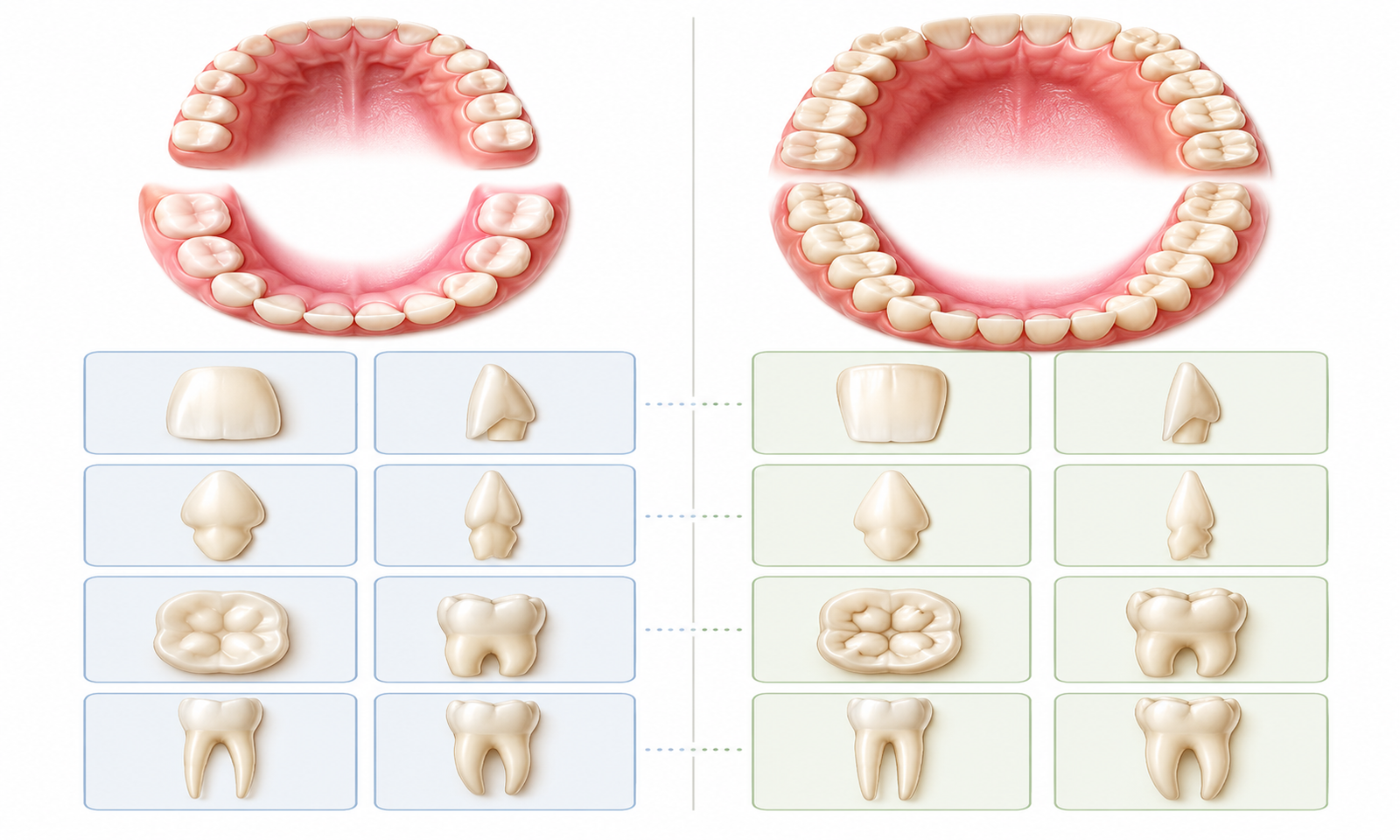
Primary dentition is the first set of teeth that come into the mouth of children. The teeth start to appear at about 6 months of age and appear completely by 2-3 years. There are 20 teeth in a complete primary dentition:
- 8 incisors
- 4 canines
- 8 molars
Primary teeth are very important for:
- Helping to chew food and eat properly.Supporting chewing and feeding.
- Supporting speech development
- Keeping forward space for permanent teeth open.
Helping to make the face and the jaw appear and grow.Helping the face and jaw to look and develop.
Though they are temporary, they have a lot of importance to their oral health development and should be taken care of.
What Is Permanent Dentition?
The permanent dentition begins at about six years of age, and replaces the primary dentition. The permanent dentition with all its teeth is:
- 8 incisors
- 4 canines
- 8 premolars
- 12 molars
Permanent teeth grow so that they can serve a lifelong purpose. They have to endure years of functional stress and are structurally stronger, larger and more durable than primary teeth.
There are significant differences between primary and permanent teeth in terms of their morphology.There are a number of key morphological differences between primary and permanent teeth.
Size Differences
Primary and permanent (adult) teeth can be distinguished by their size.
Primary Teeth
Most primary teeth are:
- LESS in size altogether
- Shorter cervico-incisally
- Narrower mesiodistally
They are smaller in size to fit into smaller mouths of children.
Permanent Teeth
Permanent teeth are:
- Larger and bulkier
- More robust structurally
- Specially designed for stronger bite force
The larger size enables them to better withstand higher occlusal loading during adulthood.
Color Variations
Clinically, colour differences are of importance.
Primary Teeth
The primary teeth emerge at this age:
- Whiter
- More opaque
- Milky in color
This lighter colour is caused by the composition and thickness of enamel. (anatomystudyguide.com)
Permanent Teeth
Permanent teeth are likely to be:
- Slightly yellowish
- Less opaque
- More translucent
The underlying thicker dentin is a source of dark color.The form and outline of the crown.The profile or shape of the crown. The shape of the crown is vastly different in the two sets of teeth. Each of the primary teeth has a distinct crown shape. All primary teeth have unique crown shapes.
Primary crowns usually features:
- Pronounced cervical bulges
- Rounded contours
- Wider crowns than root size
The cervical ridge is particularly pronounced on primary molars which look bulbous.
Functional Importance
These contours:
- Aid in masticating food pieces during chewing
- Protect gingival tissues
- Designed to retain better in developing arches
Permanent Teeth Crown Characteristics
Permanent crowns are:
- Less bulbous
- More angular
- More anatomically defined
Cusps, grooves and ridges are typically more angular and exaggerated.
Differences in Enamel and Dentin
Enamel Thickness
Primary Teeth
Primary teeth possess:
- Thinner enamel
- Less mineralized surfaces
Since the enamel layer is thin, dental caries can rapidly move towards the pulp.
Permanent Teeth
Permanent teeth have:
- Thicker enamel
- Greater mineralization
- Increased wear resistance
This, combined with these features, adds to the durability long term.
Dentin Structure
Primary Dentition
Primary teeth contain:
- Thinner dentin layers
- Larger dentinal tubules
This makes it easier to pick up and faster the attack on the caries process.
Permanent Dentition
Permanent teeth feature:
- Thicker dentin
- More structural strength
- Improved protection for pulp
Pulp Chamber Differences
Primary Teeth
The pulp chambers of primary teeth are:
- Relatively larger
- Towards the outer surface of the toothed object.
- More prominent in the pulp horns
This anatomical structure puts the dentist at greater risk for exposing the pulp when removing the tooth structure during cavity preparation.
Clinical Relevance
Properly there are conservative methods which a dentist should apply in children’s restorative treatment to prevent damaging the pulp.
Permanent Teeth
Permanent teeth have:
- Smaller pulp chambers even in the larger teeth!
- Thicker surrounding dentin
- Minimal risk of accidental exposure
With age, however, the size of the pulp is reduced as a result of secondary dentin deposition.
Root Morphology
Roots of Primary Teeth” is the title for this page of the blog.
The roots of primary teeth tend to be:
- Long and slender
- More flared
- Widely spread in molars
The flaring provides room for development of permanent tooth buds below.
Root Resorption
The permanent teeth erupt and the primary roots are resorbed physiologically and will lead to exfoliation.
Roots of Permanent Teeth
Permanent roots are:
- Stronger and thicker
- Less flared
- Stable for long support, there is no need to worry about this.
Such roots have been modified to withstand the chewing forces of the adults for many years.
Occlusal Anatomy Differences
Cusps and Grooves of Primary Teeth
Primary teeth are normally characterized by:
- Shallower grooves
- Smoother occlusal surfaces
- Less pronounced cusps
This more straightforward structure can minimize the amount of plaque that is retained.
Permanent Teeth Occlusal Features
Permanent teeth show:
- Deeper fissures
- Sharper cusps
- More complex anatomy
This can make chewing less efficient, but can lead to increased risk of pit and fissure caries.
Differences in Tooth Number and Arrangement
Primary Dentition Formula
Primary dentition formula per quadrant is:
- 2 incisors
- 1 canine
- 2 molars
Skips the premolars in primary dentition.
Permanent Dentition Formula
Permanent dentition includes:
- 2 incisors
- 1 canine
- 2 premolars
- 3 molars
Premolars and 3rd molars increase chewing now and occlusal complexity later in development.
Eruption Patterns and Timing
Primary Tooth Eruption
Primary teeth hit the gums between:
- Six months and 3 years old children.
Typical sequence of eruptions is:
- Central incisors
- Lateral incisors
- First molars
- Canines
- Second molars
Permanent Tooth Eruption
The primary teeth come in:
- Usually around the age of 12
- The first permanent molars can be the first permanent teeth to come in.
Clinical Importance
Clinicians can help by:
- Detect developmental abnormalities
- Monitor delayed eruption
- Recognize early signs of orthodontic problems
Discrepancies between primary and permanent teeth can be functional. Primary and permanent teeth may be different with respect to functions. Primary teeth are vital.Primary teeth are important.
Primary teeth play an important role in:
- Early mastication
- Speech development
- Jaw growth guidance
- Space maintenance
The early loss of those first teeth can have these consequences:
- Malocclusion
- Crowding
- Eruption disturbances
Role of Permanent Teeth
Permanent teeth are meant to serve the person throughout life and are capable of offering:
- Efficient mastication
- Stable occlusion
- Long-term aesthetics
- Facial support
Preservation of permanent teeth is a big challenge in dentistry as they need to last a lot longer.
Clinical Relevance in Pediatric Dentistry.
Restorative Treatment Considerations
The morphological differences significantly affect procedures to restore.
In Primary Teeth
Dentists must consider:
- The enamel and dentin are thin.
- Large pulp chambers
- Rapid caries progression
The treatment interventions usually focus on the following:
- Conservative cavity preparation
- Stainless steel crowns
- Providing pulp therapy as needed.
In Permanent Teeth
Restorative practices can include:
- Composite restorations
- Ceramic crowns
- Root canal treatment
- Long-term prosthetic planning
The extent of preparations may be greater when indicated by the anatomy. Certainly in diagnostics and identification a certain degree of importance is placed on them as well.
Identifying Dentition Type
The morphology is used by dental professions to know if the tooth is permanent or primary.
The presence of primary teeth is indicated by the following:-
- Smaller size
- Whiter appearance
- Prominent cervical ridge
- Flared roots
These are signs that may occur in the permanent teeth.
- Larger crowns
- Darker shade
- Sharper anatomy
- Stronger root structure
Identification is critical in:
- Forensic dentistry
- Pediatric assessment
- Orthodontic planning
Orthodontically and space management implications.
Primary teeth hold pivotal areas in which permanent successional teeth can develop. It’s possible for the teeth to be misaligned when pulled too soon.
Consequences of Early Tooth Loss
Possible complications include:
- Mesial drifting
- Crowding
- Midline discrepancies
- Impaction
Space Maintainers
A dentist can use a space maintainer to prevent any loss of integrity of the arch until the permanent teeth come in.
Therefore, the knowledge of tooth morphology and eruption pattern is crucial for preventive orthodontics.
Caries Susceptibility Differences
Infermissing and Caries.
Primary teeth are more susceptible due to:
- Thin enamel
- Large pulp chambers
- Poor oral hygiene in children at a young age
Left untreated, decay can rapidly progress and involve development of permanent teeth.
Permanent Teeth and Caries
Although permanent teeth are essentially tougher, they are still vulnerable because:
- Deep fissures
- Dietary habits
- Poor oral hygiene
Prevention strategies are important at all ages.
Strategies for prevention of oral disease.
How to care for Primary Teeth
Good oral hygiene is:
- Early brushing habits
- Fluoride use
- Reduced sugar intake
- Routine dental visits
It is important for parents to realize that although primary (baby) teeth are temporary, they need professional care.
How to care for permanent teeth.
In long-term oral health maintenance the following are involved:
- Regular cleanings
- Sealants
- Orthodontic evaluation
- Restorative maintenance
Preventative care protects and preserves natural dentition and reduces future problems.
Conclusion
There are significant differences between primary and permanent dentitions with regards to morphology, structure, function and clinical management. A primary tooth is smaller, whiter and weaker in structure; the pulp chambers are extra large, and the enamel is thin. The difference is permanent teeth are more durable, stronger, more complicated structurally, and meant for life.
These differences extend beyond the realm of the simple academic exercise and have important implications in the areas of diagnosis, restorative treatment, orthodontic treatment planning, preventive care, and patient education. Dentists need to be aware of all of these possible variations to ensure safe and effective care for patients of any age.
Pediatric and general dentistry provide the basis on a strong understanding of deciduous teeth and permanent dentition. Understanding the unique features of every dentition will help provide better treatment success, better oral health and better oral development all the way from childhood to adulthood.