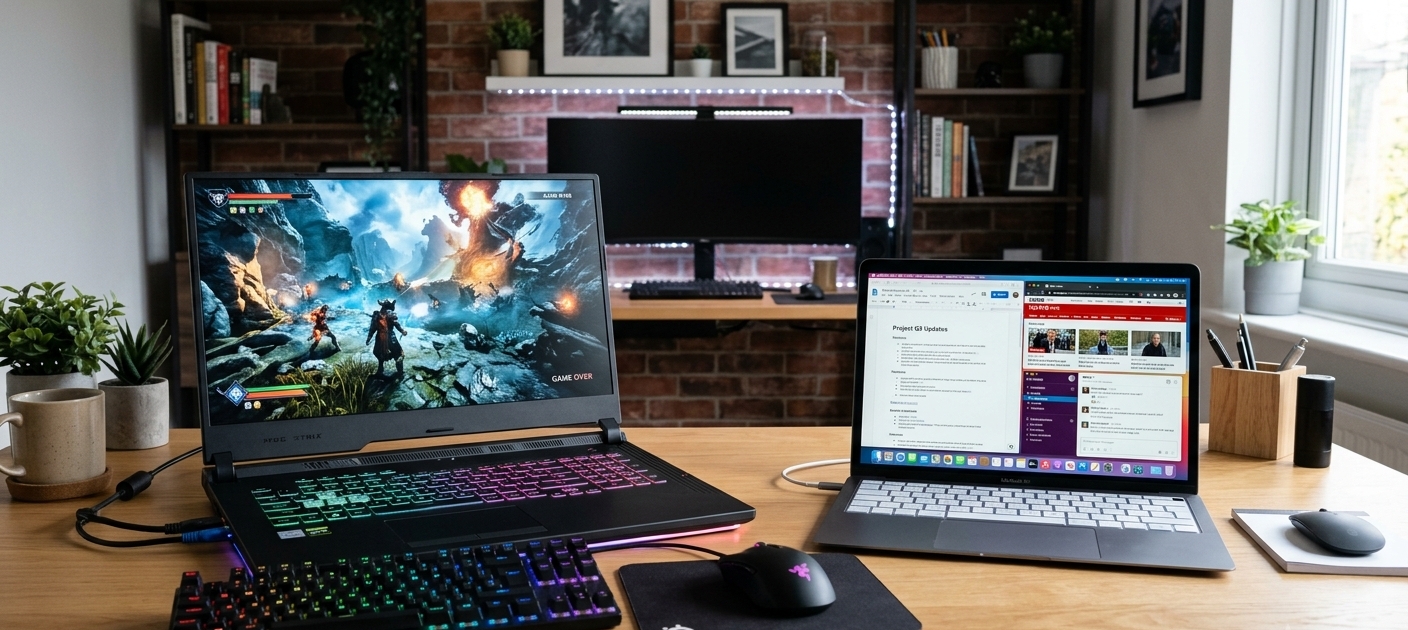
When deciding on what laptop to buy, you’re faced with a choice between a gaming laptop and a productivity laptop, and both may look alike at first glance. Today’s laptops have high-resolution displays, fast storage, and well-designed machines with high-powered processors, and it’s hard to determine which is the best choice for you. A gaming laptop is generally designed to tackle tough applications, including video games, 3D rendering, video modifying, and complex software, while regular laptops are created for schoolwork, work, browsing the web, and communication, among other tasks.
However, the right choice will depend on knowing the difference in performance, portability, battery life, cooling systems, noise level and cost. Gaming specs often lure more buyers due to their perceived greater power, but not all of them are necessarily better for all buyers.
Understanding the Main Difference Between Gaming and Regular Laptops
The primary difference between gaming laptops and standard laptops is that gaming laptops are intended to offer gaming performance. Gaming laptops typically come with powerful CPUs, graphics cards, cooling systems, and high-speed screens, which are designed to handle intensive tasks such as gaming and video editing. This helps them to quickly and efficiently handle large volumes of data and execute applications that demand extensive computational resources. There are also special models made by a number of manufacturers, and anyone wanting to delve into the gaming laptop market will find a variety of gaming laptops suitable for heavy workloads. However, standard laptops are more efficient and convenient. Generally, they employ integrated graphics and less powerful processors since they are used primarily for common tasks like writing documents, attending online classes, managing e-mail correspondence, and streaming videos, as well as running web applications. Don’t confuse, one is not necessarily superior to the other, each type is designed for a specific set of needs.
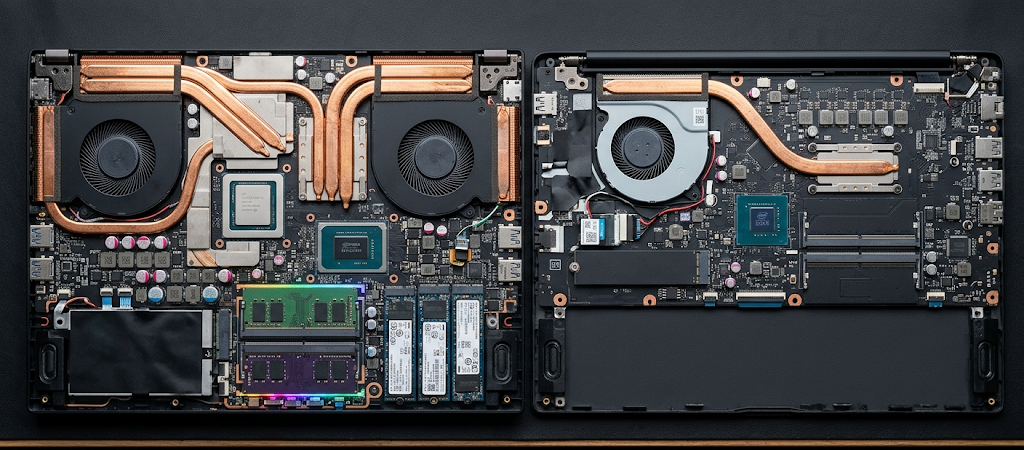
Dedicated graphics processing units (GPUs) are a common feature of gaming laptops and play a crucial role in processing complex graphics. A dedicated GPU comes with its own memory and processing power, enabling it to produce high-quality images, handle modern games efficiently, and boost creative software performance. Standard laptops usually come with built-in graphics that are adequate for everyday tasks but may not perform well with more demanding software like video editing, professional design programs, or video games. This of course is one of the primary reasons why gaming laptops tend to be more expensive and heavier than regular laptops. For users who primarily use their laptop for schoolwork, business-related or research-related tasks, entertainment purposes, and similar use, however, the benefits of paying for a powerful graphics card may not be evident.
Performance: Power vs Everyday Efficiency
Gaming laptops are typically at their best in terms of performance. They are equipped with high-performance CPUs, large amounts of memory, quick solid-state drives, and dedicated graphics cards that enable them to handle complex tasks more quickly. This translates to a better gaming experience for players with smoother gameplay, increased frame rates, and improved graphics. For users, it involves quicker video rendering, better performance in graphic design software, and greater efficiency when handling large files. However, a gaming laptop may offer additional performance if the owners wish to have their machine last for years and years and software becomes more demanding. But there are limitations to maximum performance, such as higher heat output, more power usage and increased size.
Standard Laptops are built to achieve a balance of performance instead of maximum performance. These are typically designed to be efficient and use the minimum amount of equipment needed to do everyday tasks without the additional cost and weight of unnecessary equipment. When it comes to writing assignments, managing documents or simply surfing the web, a student or a professional does not need the same kind of power as if they were gaming or working professionally on documents. Processors have come a long way and many of today’s productivity laptops are still quite fast and features like solid-state storage ensure they’re responsive during use. The benefit of a regular laptop is that it offers sufficient performance for normal work tasks, but concentrates on portability, battery life and convenience.
Weight and Portability: The Heavier the Load, the More Difficult It Is to Carry Power
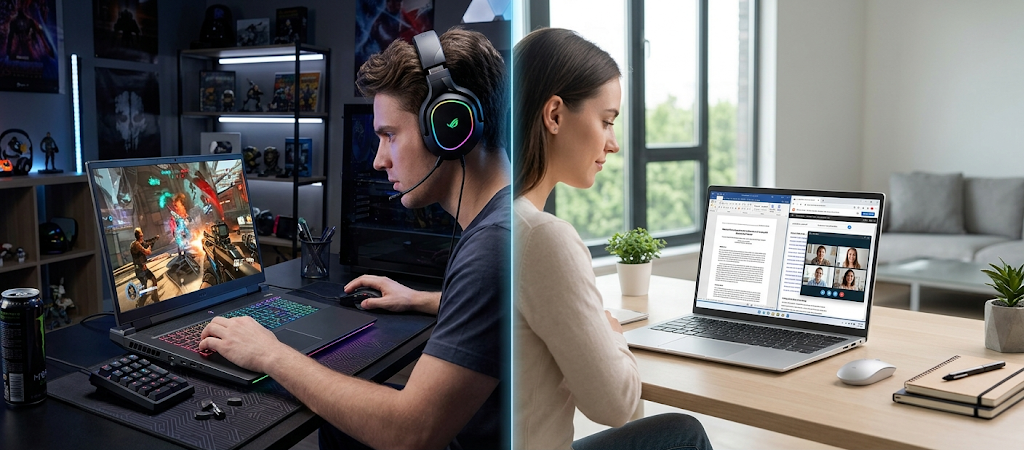
The first noticeable difference between a gaming laptop and a normal laptop is the size and weight of the laptop. Gaming Laptops include bigger components to provide enhanced processors, committed graphics cards, larger cooling devices, and greater batteries. Therefore, they tend to be bulkier and heavier than conventional laptops. This is a good design as the hardware must have adequate space to function properly, but it can become cumbersome for users who frequently move their laptop to school, work, libraries, meetings or travel destinations. This is because a gaming laptop can offer great performance, but isn’t always as easy to take with you to work every day as a lightweight productivity device is.
Laptops are typically built with mobility in mind. Often, manufacturers strive to design a thin and lightweight design that can be easily moved around but can still give the desired performance. Ultrabooks and productivity laptops can easily be packed in backpacks and are better for those who travel often. The lighter design makes them easier to use in a variety of settings from classroom, to coffee shop, to office or home. A standard laptop may be a better choice if you are looking for convenience and portability over the most processing power.

Battery Life: Gaming Power Requires More Energy
Another important difference between gaming laptops and regular laptops is their battery life. More electricity is used by high performance parts, particularly graphics cards and high-performance processors. Many gaming laptops require a charger for optimal performance when used for heavy-duty applications or gaming. While manufacturers are constantly enhancing battery life, gaming laptops typically don’t offer the battery life of lighter productivity models thanks to their high-performance hardware and high-resolution displays. Users who must go to class, meetings or travel for an entire day without having to carry an electric charger with them can be frustrated.
Standard laptops generally come with longer battery life, as they are built with batteries and processors that are more energy-efficient and consume less power. These can be prolonged and can last for hours while watching, typing, video conferencing or streaming content. This helps to make them user-friendly for those who require reliable battery life throughout the day. Battery life can be more important to students and professionals who want flexibility and mobility than additional processing power that they don’t use often.
Cooling Systems and Heat Management
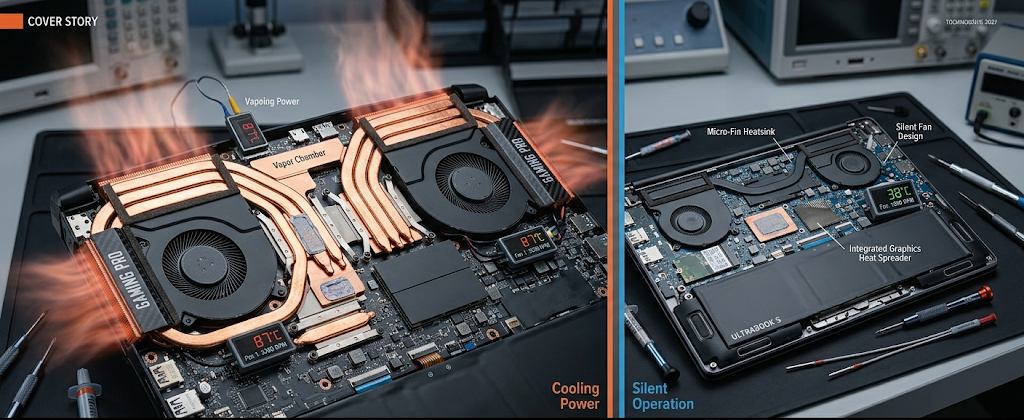
Cooling is of crucial importance in the design of laptops, particularly those equipped with high-performance components. Gaming PCs are hot due to high performance of the graphics cards and processors for extended durations. Manufacturers are putting larger fans, heat pipes, ventilation systems and advanced cooling technologies in place to prevent overheating. Such systems help keep the performance at high levels during heavy workloads, but they also add to the size and weight of gaming laptops. Powerful components would slow down to prevent damage in the event of high temperatures, thus cooling systems are essential for optimal performance.
Typical laptops generate less heat simply because they include components that are less powerful. Their cooling systems can then be reduced in size or quieter, and the manufacturer can thus reduce the thickness of the design. This amount of cooling is typically sufficient for everyday activities. Users who try to use very resource-intensive software for extended periods, however, might experience some restrictions in performance over gaming laptops. The selection of either of the two will depend on the user’s requirement for high performance or a quieter, cooler and more portable machine.
Noise Levels: Powerful Fans vs Quiet Operation
Another factor to consider is noise. Many gaming laptops employ a number of fans that accelerate the speed of those fans when the system is straining. The fans could be noticeable during gaming sessions or other intensive tasks, as they are doing their best to cool down the strong components. This sound is an acceptable noise when performing to maintain performance, but can be distracting in quiet rooms like classrooms, libraries, or meetings. A few gaming laptops have software that lets you tweak fan levels, but when it comes to performance, the fans are likely to be more active.
Standard computers tend to be quieter, since they don’t generate as much heat. There are lots of productivity related gadgets that go with no sound or maybe a little fan noise for regular use. This makes them more appropriate for areas where quiet operation and concentration are paramount. Those who are more into writing, studying, or simply looking at a virtual meeting may favor the more relaxed atmosphere of a standard laptop.
Price Differences: Paying for What You Need
One of the most critical factors to consider is price when deciding on a gaming laptop compared to a standard laptop. Gaming Laptops tend to be more expensive because they have high-end components like graphics cards, advanced cooling systems, high refresh-rate screens, and powerful processors. If users require these features, the additional cost may be worth it as the laptop offers functionality that a standard laptop might not be able to compete with. Power users, such as gamers, designers, engineers, and video editors, may find that a higher-quality computer is worth the investment.
But purchasing a laptop just because it looks more powerful than a PC doesn’t always make the best investment. Some users pay extra for extra functionality that they don’t use much or even ever all while missing out on portability and battery life. For students, office staff and casual users, a good value can be obtained from a regular laptop that offers the same functionality for everyday needs at a lower price. Not always the most expensive laptop is the best, but the one which suits the user’s needs.
Choosing the Right Laptop for Your Needs
Look at the different options to see which laptop suits you best.
It really depends on your needs and usage of the device. If you play a lot of heavy games, make professional videos, use 3D graphics, write complicated programs or have some other special needs that require a powerful computer, you should opt for a gaming laptop. It offers additional power when you need powerful graphics and processing. It can be heavier, louder, and more costly, but if performance is the primary consideration, then these drawbacks might be worth it.
For those whose primary purpose is to use a laptop for school, business use, communication, research, entertainment and daily tasks, a regular laptop computer is likely the better value. It is more portable, has a longer battery life, is quieter in operation, and frequently it’s less expensive. Buyers should not solely rely on breathtaking features, but should take into account their lifestyle and requirements. Having a high-power laptop that you only use a fraction of the time can be less beneficial than a laptop that is comfortable and reliable for everyday use.
Wrap-Up: Selecting the Proper Balance
When it comes to making the choice between a gaming laptop and a standard laptop, it’s important to grasp the compromises made with both. Gaming laptops offer impressive performance, power, and graphics options and can perform many of the same tasks that a standard desktop computer can, but come with some compromises in weight, battery life, noise, and cost. Standard laptops are designed for efficiency, portability and convenience, and are perfect for users who require a laptop for productive work and regular computing.
Buyers should consider carefully what they will be using their laptop for before buying. Gaming hardware may be a worthwhile investment if you are into gaming, creative work or advanced applications are a crucial component of your life. However, if it’s just about studying, working, surfing the web and being productive then a traditional computer might be a better fit at a cheaper cost. Ultimately, the best option is the one that offers the optimal mix of performance, comfort and price for the intended use of the laptop.