Introduction
Pricing is a very large issue for business owners. A product may be outstanding, demand great, and marketing brilliant, still poor pricing will put a dent in profits and slow growth. Many small business owners put all their effort into increasing sales volume which they think will solve all their problems. Also even a small improvement in pricing may greatly increase profit margins without the need for more customers or marketing.
Pricing is also a complex issue which goes beyond just covering costs and adding a markup. We see that customers do not base their choice of products only on figures. Instead they base their decisions on what they perceive as value, which comes from comparisons, emotions, convenience and psychological factors. By studying price psychology businesses are able to set prices which in turn maximize profit but also appeal to the customer.
This article reports on in depth research of which we have presented nine practical pricing strategies that which we have put forward to increase profit margins. We also look at how it is that customers determine value, how companies may go about accurate cost analysis and also what it takes to set prices in a way that doesn’t repel the customer.
Understanding Why Pricing Matters More Than Most Sellers Think
Many business owners think that setting prices low is a sure fire way to get more customers in the door and in turn increase revenue. Although discounts may see an increase in sales in the short term, in the long run constant underpricing is a recipe for trouble. A company which bases its strategy solely on price may very well find itself in a situation of growing expenses, shrinking profit margins, and tight cash flow.
Effective pricing is a balance of what customer’s value and what is sustainable for the business. What we see is that customers will pay more for what they perceive as better quality, convenience, reliability or service. Thus businesses are able to increase profit through selling more but also by price smartly.
Before a seller may use any pricing strategies, first they should know what is the exact delivery cost of all their products and services. Out of which if you do not have proper data you are just guessing at what to price the services out at and that may in turn result in losses.
One of the key steps is in the assessment of true costs. This process consists of identifying direct outgoings such as materials and labor also which is in turn included indirect outgoes like rent, utilities, software subscriptions, packaging, transportation, and admin costs. What many businesses do not do is factor in all the hidden expenses which in turn often report they are making profits while in actual fact their margins are much lower than what is reported.
The Psychology behind Customer Pricing Decisions
Customers do not always make logical purchasing decisions. In fact research in the field of consumer behavior reports that it is the emotions and perceptions which play large roles in purchase choice. We see that a product which is priced at 100 which in actuality is only a one dollar difference.
Consummates also put price forward as a indicator of quality. We see that often when two like products are placed together, many buyers which the more expensive one out to be of better quality. This psychological factor which plays in to why premium brands are able to charge much more than their competitors and still maintain large customer base.
In this we see that which behaviors to price in what way allows companies to improve their bottom line at the same time as they meet customer expectations. The issue is to create a price which tells the value of the product without putting up barriers.

Strategy 1: Pricing based on cost.
What Is Cost-Plus Pricing?
Cost out plus is a very basic and popular pricing method which businesses use. They determine the total cost of the product production and then add a fixed markup percentage for profit.
For instance if we have a product which has a manufacturing cost of 30. This approach is very simple in that it helps cover the base cost of the product as well as produce a profit on each sale.
Cost out plus pricing does very well for manufacturers, wholesalers, and companies which have stable production costs. It brings in a great degree of consistency and simplifies price determination. At the same time which is also true that at times cost plus pricing may leave money on the table as it doesn’t take into account what the customer values or what the competition is doing. Instead of being the sole pricing tool, cost plus should be used as a base for other strategies.
Strategy 2: Price Based Pricing.
Charging Based on Perceived Value
Value based pricing is based on what customers’ perceive the product or service to be worth which may not always reflect the company’s cost structure. We see this approach used by premium brands, consultants, software companies, and service providers.
For instance a graphic designer may put in the same number of hours for which he designed two logos, but one of those may bring in much more value to a large scale client. In such a case by charging based on value as opposed to hour worked the profit may see great increase.
Successful value based pricing is a result of knowing your customer’s needs, issues, and what they are looking to achieve. Which in turn see businesses that clearly put forth the benefits and results often charge more as customers base their decision on the value they receive over the price they pay.
Strategy 3: Pricing for the best seats only.
The Power of Ending Prices with 9
Charm pricing is what we see in 49.99, or $199.99 type of prices. Though this may seem like a basic tactic it still very much works which is because customers pay more attention to the left digit when looking at price tags.
A product that sells for 100 which is not true in many cases. This trend of using that pricing tactic is seen in all types of industries and still very much a used and effective method of influence at the point of purchase.
Charm pricing does very well with consumer and online products. As for luxury brands they tend to stay away from it as round prices play into their image of exclusivity and prestige.
Strategy 4: Pricing bundle of products.
Increasing Average Order Value
Bundle sales are of many products or services put forward as a set which in total costs less than what the items would if sold separately. Also customers see these packages as a better deal and in turn which is good for business that sees up increased average transaction size.
For instance a skincare company may present a set which includes a cleanser, a toner, and a moisturizer. Although the products may be sold separately, the set is put forward to get customers to purchase more items at once.
Bundles do well at increasing average order value, introducing customers to new products, and in moving inventory around. When we structure them right bundle prices may greatly improve profit without having to give large discounts.
Strategy 5: High priced.
Positioning Products as High Value
Premium pricing strategies put prices at a premium to that of competitors in order to project an image of better quality, exclusivity, also prestige. This approach is very much based in branding, customer experience, and product differentiation.
Customers tend to see higher prices as a mark of better performance, durability, or status. Which some companies are able to put forward superior quality and customer service which in turn allows them to maintain high prices and gain dedicated buyer groups.
However also we see that premium pricing requires consistency. If the customer experience doesn’t meet what is expected then buyers may see the higher price as a fair deal which it isn’t and in turn will look for other options.
Strategy 6: Competitive Price Point.
Using Market Prices as a Reference
Competitive pricing is when you set your prices in relation to what the competition is charging. Companies may choose to set their prices equal to, above, or below the market price point based on what they are trying to achieve.
In many industries we see this as a common practice where customers research and compare products between many sellers. Through analysis of what competitors are charging, businesses are able to place themselves in a better strategic position which at the same time does not make them appear out of line or too low in price.
In the case of competitive pricing we see that companies tend to put too great of an emphasis on what the competition is doing which in turn causes them to ignore their own cost structures. For sustainability of profit we see the issue of balance between what the market expects and what is true for the company’s bottom line.
Strategy 7: Penetration Pricing
Gaining Market Share Quickly
Penetration pricing strategy which sets temporary low prices in order to attract customers and take market share. Once we have a base of customers we see us raise prices to sustainable levels.
New companies use this approach to get customers to try out their products and also to spread the word. What we see is that which products which turn out to be what we would term “good value” continue to be bought by the customers even as prices go up.
While we see value in penetration pricing for growth it is best do so with care. Outlasting low prices may reduce profit margins and also set customer expectations which in the long term are hard to change.
Strategy 8: Pricing Dynamics.
Adjusting Prices Based on Demand
Dynamic pricing is a strategy which sees prices changed in relation to market conditions, customer demand, inventory levels, or seasonal trends. Airlines, hotels, ride sharing services, and online retailers are among those which frequently employ this approach.
For instance at holidays we see an increase in demand which in turn allows companies to raise prices. Also during slow times we see the need for promotion and discount to stimulate sales.
Modern technology has made dynamic pricing a possibility for small businesses. When executed well it also helps increase and better manage our income as we see markets change.
Strategy 9: Purchasing Power Adjusted Pricing.
Protecting Margins during Economic Changes
In time inflation rises which in turn increases operating costs of businesses in areas like labor, materials, transportation, utilities, and rent. Also, what we are seeing is that firms that do not pass these costs on to customers are having their profit margins shrink even as they report strong sales.
In terms of inflation adjusted pricing we see to it that we review costs regularly and at times of need we implement reasonable price increases. Also in this process we must be open with customers. When we do make price changes we are to let customers in on the reasons why.
Rather instead of a long wait for large scale changes which may take years many companies see better results from making small gradual adjustments which align with the changing costs.
How to set Prices without Losing Customers
Pricing is a dynamic issue which should not be set in stone. Markets shift, customer tastes change, and operating costs go up and down. What successful companies do is they constantly test and improve their pricing models.
One strategy is A/B testing in that we present customer groups a little different pricing. What we then do is we look at the conversion rates, revenue, and profitability to determine the best price point.
Another strategy is to put out new value instead of cutting prices. Businesses may introduce bonuses, faster delivery, improved support, or more features. This preserves margins while we increase how we present value.
Customer feedback is a great source of insight. We see in surveys, reviews, and sales conversations those customers’ perceptions of price from very high to very low be played out.
Common Price Errors that Cut into Profits
Many companies are aware they are making which they are not aware of. A large issue is that they don’t include what which they think of as hidden costs like packaging, transaction fees, returns, maintenance, and admin expenses. Over time these add up to large sums which in turn greatly reduce what they think are their profits.
Another issue is that of price alone in a constant state of discount we attract the bargain hunter which in turn sees us outdo by a competitor at the drop of a hat. What instead has proven to be more successful is the building of value through quality of product, service, convenience and trust which in the long term proves to be more profitable.
Some companies also do not raise prices out of fear of loss of customers. What we see though is that small increases which are coupled with high value add actually do little to impact customer retention. Also regular reviews are important in making sure prices are in line with what the business is trying to achieve and the economic climate.
Conclusion
Pricing is a field which is as much science as it is art. We see that while accurate cost analysis is the base, customer psychology is very much a factor in what the market will bear. Companies which grasp this balance are the ones which develop pricing strategies that see improved profit without losing customer trust.
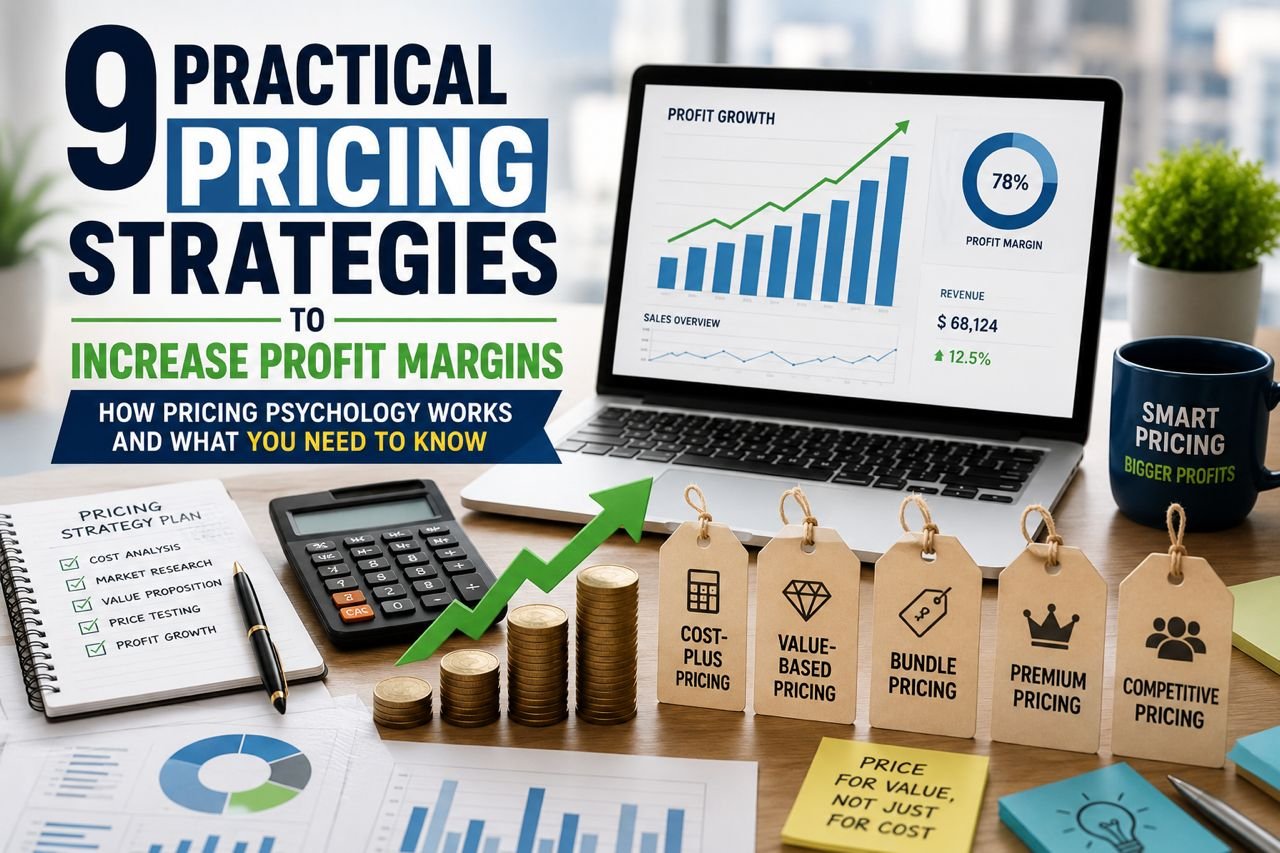
Cost plus pricing structures which cover expenses, value based pricing which captures what the customer perceives, charm pricing which influences purchase decision, and bundle pricing which increases the size of the order. Also we see premium, competitive, penetration, dynamic, and inflation adjusted pricing which each in their own way can improve margins in varying market settings.
The best performing sellers constantly look at their costs, test price assumptions, monitor customer response, and modify strategies as the environment changes. Through the use of sound financial analysis which also takes into account consumer psychology businesses may develop sustainable price structures which in turn support growth, profit, and long term success.
Get more well researched information about Pricing Strategies to Increase Profit Margins here.



certainly like your website but you need to take a look at the spelling on quite a few of your posts Many of them are rife with spelling problems and I find it very troublesome to inform the reality nevertheless I will definitely come back again
Your blog is a constant source of inspiration for me. Your passion for your subject matter is palpable, and it’s clear that you pour your heart and soul into every post. Keep up the incredible work!
Your blog is a treasure trove of knowledge! I’m constantly amazed by the depth of your insights and the clarity of your writing. Keep up the phenomenal work!
I simply could not go away your web site prior to suggesting that I really enjoyed the standard info a person supply on your guests Is going to be back incessantly to investigate crosscheck new posts
Excellent blog here Also your website loads up very fast What web host are you using Can I get your affiliate link to your host I wish my web site loaded up as quickly as yours lol