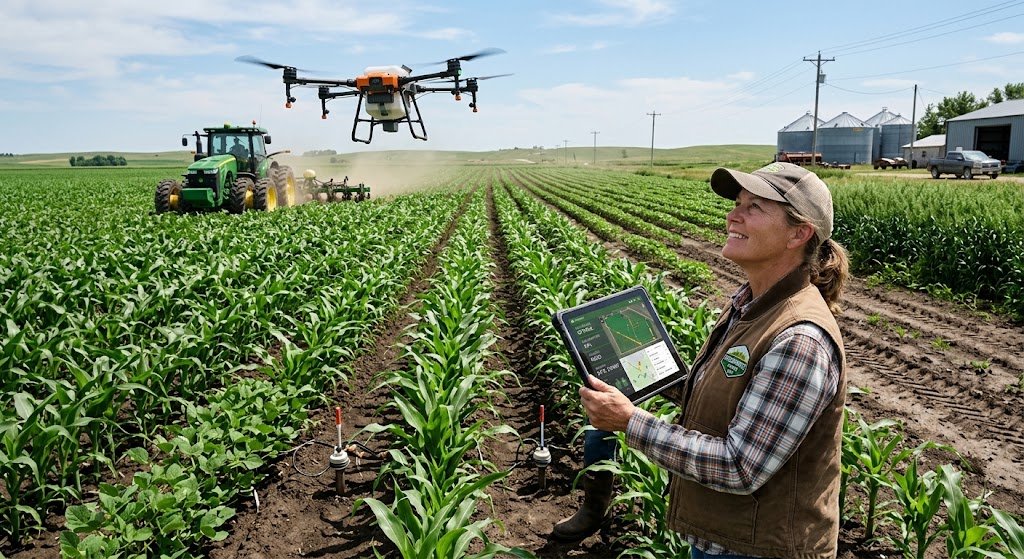
A farmer does not need another dashboard unless it helps answer a useful question: which plants need attention, when to irrigate, how much crop to expect, or which animals require inspection. Machine learning can support these decisions by finding patterns in images, sensor measurements, and production records.
The practical applications of machine learning in farming range from weed recognition and crop forecasting to livestock monitoring and harvest planning. Their maturity varies, however. Some are available within commercial workflows, while others remain research tools or require substantial customization. The right starting point is a specific decision the farm can improve, supported by evidence from relevant operating conditions.
Crop Protection: Recognizing Problems and Directing Attention
Machine learning is a branch of artificial intelligence in which models learn relationships from examples. Computer vision applies image analysis to tasks such as locating weeds or classifying visible symptoms. Neither process removes the need to check whether a result makes agronomic sense.
1. Detecting Weeds for Targeted Control
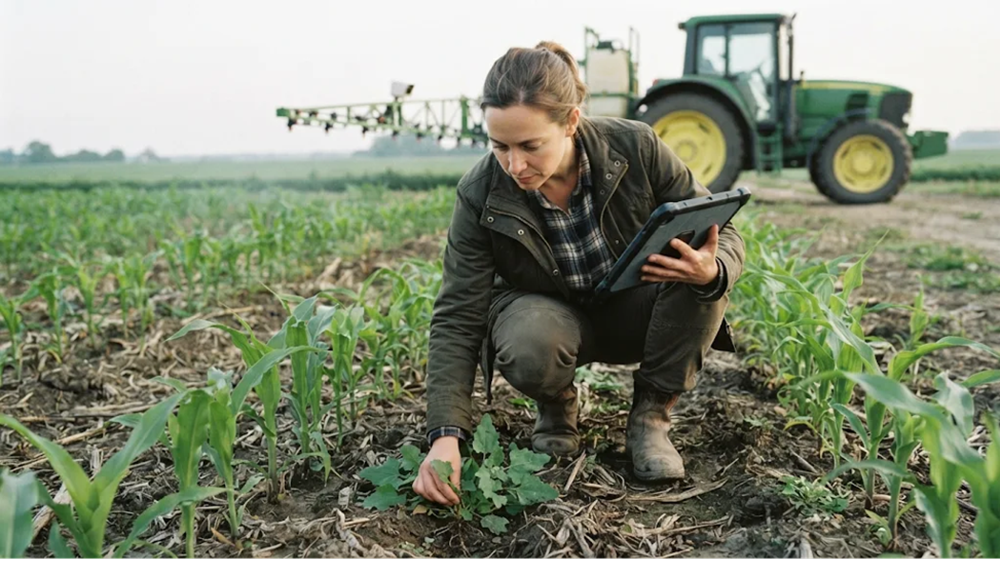
Image-based models can distinguish supported weeds from crops and background material. When connected to suitable application equipment, their output can guide spot spraying or mechanical weeding rather than treating every location identically.
The practical decision is where to apply control. Relevant inputs may include close-range camera images or aerial imagery collected at sufficient detail for the target weeds.
Evaluate the complete workflow: identification, location, treatment execution, and follow-up. Correctly recognizing a weed in a photograph does not establish that a moving sprayer will treat it effectively. Ask how the system performs with small weeds, overlapping leaves, and the crop stage involved.
Potential input savings also depend on weed distribution. Do not assume that a high detection score translates into a fixed percentage reduction in herbicide expenditure across every field.
2. Screening Crops for Disease Symptoms
Machine learning can classify images or spectral measurements associated with healthy plants and supported diseases. This can help prioritize scouting and organize observations from larger areas.
A practical workflow uses the output as a screening result: identify a suspect plant or patch, inspect it, and confirm the problem before selecting treatment. A phone-based leaf classifier and a drone-based canopy assessment solve different observation problems and should not be evaluated as equivalent tools.
Performance depends on representative training examples. Natural field backgrounds, multiple overlapping leaves, changing light, and unfamiliar symptoms make the task more difficult than classifying clean reference photographs.
Request a list of supported crop-disease combinations and a procedure for uncertain results. Do not interpret every “unhealthy” classification as proof of a particular pathogen.
3. Identifying Insect Pests in Monitoring Images
Models can analyze camera images of insects, including those captured on monitoring traps, to support identification and counting. This can help staff review pest activity and decide where further inspection is needed.
The decision is not automatically whether to spray. Counts need interpretation alongside pest identity, crop stage, local guidance, and field observations. A trap image describes the monitored sample, not necessarily the entire field population.
Visually similar target and non-target insects can cause classification errors. Some pests are also difficult to observe directly because they occupy leaf undersides or cause damage during life stages not adequately represented by the monitoring method.
Before adopting a system, compare its identifications and counts with competent manual checks. Pay particular attention to whether beneficial insects are being confused with pests.
Water and Soil Management: Supporting Input Decisions
Monitoring becomes useful when measurements inform an action the farm can execute. Machine learning can help estimate conditions and recognize relationships, but it cannot compensate for unrepresentative samples or unreliable sensors.
4. Improving Irrigation Scheduling
Models can combine soil moisture readings, weather information, crop characteristics, and historical observations to estimate water requirements or support irrigation schedules. This differs from a simple timer, which follows a preset program without learning relationships from data.
A sensible use is to compare model-supported recommendations with the farm’s existing scheduling method, retaining checks on field conditions and system capacity.
Data quality remains central. A damaged sensor or poorly represented soil zone can lead to an inappropriate recommendation. Confirm how missing readings, communications failures, and unusual weather are handled before connecting recommendations to automated control.
Measure both water application and crop performance. Reduced irrigation is not a success if it creates an unacceptable production loss, and lower water use does not automatically create an equal financial saving.
5. Mapping Soil Properties to Guide Nutrient Management
Machine learning can estimate supported soil properties by learning relationships between reference soil tests and other information, including spectral measurements. Researchers have applied these methods to soil organic carbon, organic matter, and nutrient-related assessments.
The practical output can be a map that helps organize sampling or inform nutrient-management planning. The model is estimating properties from learned relationships; it is not replacing physical measurements with certainty.
Reference samples are essential for training and validation. Ask which properties were measured directly, which were predicted, and whether performance was checked in soils comparable to those on the farm.
Do not jump directly from a predicted nutrient map to a fertilizer prescription. Application decisions also require agronomic interpretation, crop requirements, and equipment capable of delivering the intended treatment.
Crop Planning: Estimating What Will Be Ready and When
Forecasting applications help businesses prepare for an uncertain season. Their value lies in supporting realistic plans, not in presenting one model output as a guaranteed outcome.
6. Forecasting Crop Yield
Yield models can combine weather, soil, management history, and crop observations to estimate production. Image-based approaches may also count visible fruit or estimate biomass for a supported crop and sensing arrangement.
These estimates can inform storage planning, transport, staffing, and conversations with buyers. They do not themselves increase biological yield.
Ask whether the forecast applies to a region, an entire farm, a field, or a smaller area. A model validated at one scale should not automatically be treated as reliable at another.
Compare forecast errors with the farm’s current method and track how estimates change as the season progresses. Look for validation on separate seasons and locations rather than relying only on performance within the original development dataset.
7. Assessing Crop Development and Harvest Readiness
Machine learning can classify supported growth stages and fruit maturity characteristics. Research applications include categorizing coffee fruit maturity and predicting rice development stages using environmental and crop records.
For a grower, the relevant question may be which blocks deserve a harvest inspection or where labor should be scheduled next. The output should fit the commodity’s actual maturity criteria.
Visible fruit color alone may not capture every quality requirement. Request an explanation of what the system measures and compare its output with the accepted harvest assessment for that crop.
Treat harvest readiness and total yield as separate decisions. A block can contain substantial production without being ready for collection. Neither an image classifier nor a forecast proves that an automated harvester can pick the crop successfully.
Livestock Management: Focusing Care on Individual Animals
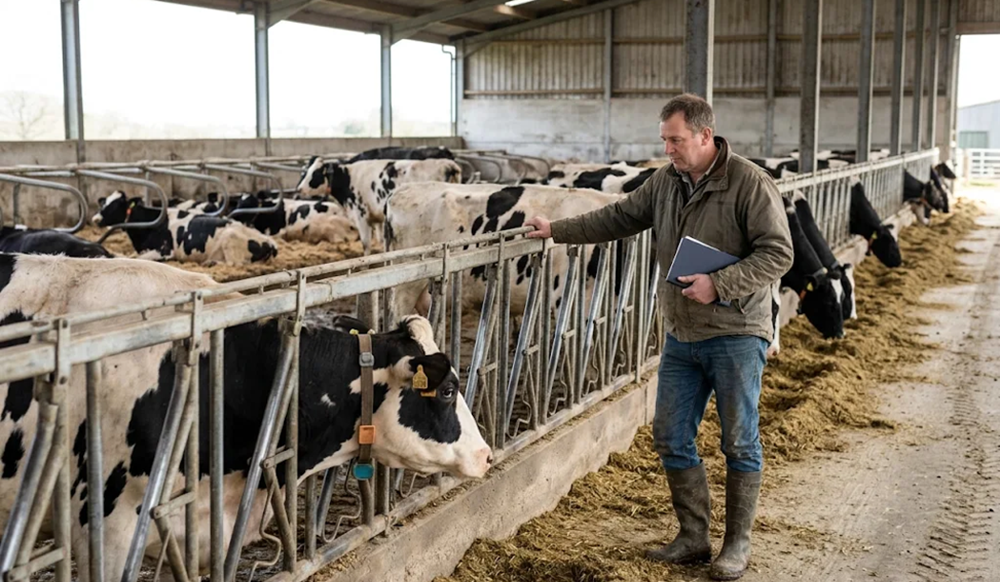
Livestock applications use a different evidence base from crop imagery. Movement, behavior, and production records can support useful alerts, provided staff understand what each alert represents.
8. Monitoring Animal Behavior and Welfare
Machine learning has been used to classify cattle behaviors such as grazing, walking, resting, and rumination from wearable sensor data. Camera-based methods have also been investigated for tracking animal movement and activities.
The practical purpose is to identify observations that deserve attention or document behavior more consistently. An activity change may prompt inspection, but it does not establish a veterinary diagnosis.
Evaluate missed events as well as unnecessary alerts. A system that produces frequent unhelpful warnings can consume staff time, while a quiet system may still be overlooking important changes.
Test performance with the animals, housing, and management routines involved. Keep a clear process for equipment checks and professional assessment where welfare or health concerns arise.
9. Predicting Livestock Production and Growth
Machine-learning applications also include predicting livestock production outcomes from relevant animal, feeding, environmental, and historical data. Reviewed research includes cattle weight estimation and the prediction of rumen fermentation parameters.
The business use is planning: understanding expected output, reviewing feeding strategies, or identifying animals that need closer assessment. These models address production questions rather than simply recognizing behavior.
Check what the prediction actually represents and whether it supports the intended decision. An estimate of body weight is not a complete feeding recommendation, and a research model for one production system should not be assumed suitable for another.
Compare estimates with reliable measurements. Where a proposed action changes feed costs or expected output, evaluate those consequences separately rather than treating better prediction as an automatic profit gain.
Post-Harvest Management: Checking Product Quality
The role of machine learning continues after the crop leaves the field. Image and spectral analysis can support consistent screening of defined product characteristics.
10. Classifying Crop Quality and Detecting Supported Defects
Models can analyze images or spectral measurements to classify grain quality, identify damaged kernels, or detect selected foreign material. Research applications include wheat grading, maize kernel inspection, and identifying foreign matter in cotton.
This can support sorting, inspection priorities, and documentation. However, each system has a defined scope: a model trained to identify visible kernel damage is not automatically capable of detecting every contaminant or establishing complete food safety.
Specify the commodity, characteristic, and acceptance standard before testing. Include borderline examples and representative variation rather than only obvious defects.
Measure both incorrect rejection of acceptable products and incorrect acceptance of defective products. The useful comparison is with the existing inspection workflow, including throughput, labor, product losses, maintenance, and verification requirements.
How to Choose a Practical Starting Point
These ten applications are opportunities to evaluate, not a shopping list. Commercial availability, local support, and integration differ by crop, enterprise, and region. A narrowly defined tool that solves a recurring problem may be more valuable than a broad platform with unclear responsibilities.
Begin with one decision where the farm has both a measurable need and the capacity to act. Then request a representative pilot covering the following:
| Evaluation area | Question to resolve |
| Relevant evidence | Has the system been tested on comparable crops, animals, and conditions? |
| Input quality | Can the farm provide the required images, sensors, or records reliably? |
| Operational fit | Who reviews the result, and what action can follow? |
| Error handling | What happens when the model is uncertain or incorrect? |
| Financial value | Do measured benefits exceed all additional workflow costs? |
| Data control | Can records be exported, and are access and reuse terms clear? |
Record the chain from observation to action and outcome. If a recommendation changes nothing, do not count it as a realized benefit. If it requires extra field checks or corrective work, include those costs.
The governing principle is validation. Model scores matter, but the purchase decision should rest on reliable field performance and a defensible business result.
Turn One Useful Application Into a Repeatable Workflow
Machine learning is most useful in farming when it helps people recognize a defined problem, estimate a relevant outcome, or make a better-supported decision. Its role is not to replace every observation or automate every responsibility.
Select one application, define success against current practice, and request a documented assessment under representative conditions. Expand only after the complete workflow proves useful, affordable, and dependable enough for the decisions it will support.