Introduction
The high-level programming languages (such as Python, Java, JavaScript, and C++) are the languages used by most of the software developed today, in which the instructions are written in words and structures that are more easily understood by a human being. However, computers do not directly understand these languages. The lowest level processors use machine code, which consists of a sequence of ones and zeros in the form of instructions. There is a strong, but little understood programming language between human-readable programming languages and machine code that is called assembly language. Programming in assembly language is closer to the hardware, and will give programmers a more direct control over the processor, but they will still be able to program using commands that can be read by a human. It is important to look at assembly language as a link between thoughts in software and the actual operations performed by the computer’s processor.
Assembly language has been a significant part of the evolution of computer programming and still affects the use of computers today. While most applications are developed in high level languages, the use of assembly can be beneficial where memory usage and direct control of hardware are critical, or performance is paramount. Knowledge of assembly is used in operating system components, embedded devices, firmware, cyber security research, and reverse engineering. While it is not considered a “modern” language, assembly language is still a specialised tool for the developer to understand how computers execute instructions.
What Is Assembly Language and How Does It Work?
Assembly language is a low-level programming language that can be used to directly communicate with a computer’s central processing unit (CPU). Unlike high level languages that are based on abstract concepts like objects, functions and classes, assembly language relies on instructions that are close to the operations a processor can perform. These instructions typically are represented by short words referred to as mnemonics that are representative of a specific machine operation. For instance, the programmer of an assembly language program could have a line that reads “add these two numbers” while the corresponding machine language instruction is ADD.
To learn more about what assembly language is and its relationship with machine-level instructions, it is important to understand how assembly provides a readable connection between programmers and computer hardware.
To run assembly language programs on a computer, assembly language itself must be translated into machine instructions. This is a process that is handled by a program known as an assembler. The assembler converts the “assembly” code into CPU understandable binary code. There are many different processor architectures and each processor architecture has its own assembly language, since the internal design of the processors are different, as are the instructions they support. This means that programs compiled for one processor type may not run on another processor type without modifications.
It is one of the most similar languages to hardware, because its relationship with assembly language is similar to that of assembly language and hardware. Assembly language developers can precisely access memory locations, processor registers and individual instructions. In many cases, this type of control is not necessary during normal software development, but is critical when developing a system where every performance and efficiency increment, or decrease, counts.
High-level Code, Assembly, and Machine Code are interconnected
A good way of understanding the role of assembly language is to contrast the representation of the same trivial operation at various levels of programming.
Let us take a simple instruction such as adding two numbers and putting the sum in a register.
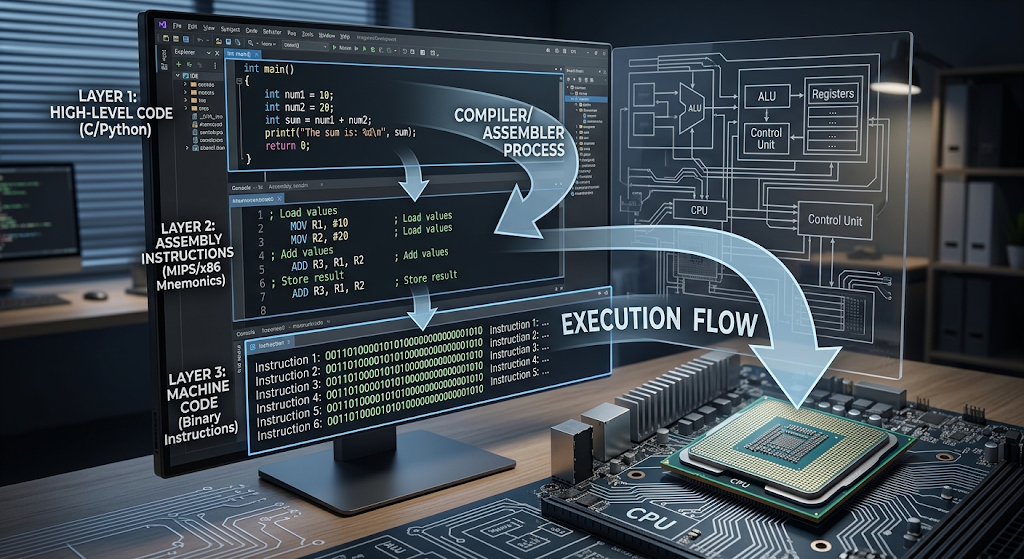
High-Level Programming Example (C Language)
int result;
result = number1 + number2;
This instruction looks easy to understand for humans in a high level language like C. The programmer need not know where values are stored in the CPU, memory location or which instructions are needed to be executed by the CPU. These details are automatically taken care of by the compiler.
Assembly Language Example
MOV AX, number1
ADD AX, number2
MOV result, AX
There is a lot more detail in the assembly version about what the processor is doing. MOV instruction moves data into a CPU register, ADD instruction adds the numbers together. The order of operation and the processor registers are directly programmed by the programmer.
Machine Code Example
10111000 00000001
00000101 00000010
Machine code is the lowest level of instructions that the processor can understand, interpret and execute. This format is very efficient for processing by computer, but is very hard to read and maintain by humans. The reason for the existence of assembly language is that it offers a more understandable representation of machine instructions, without sacrificing the control of hardware.
The significance of assembly in computer systems is highlighted in this comparison. High-level languages focus on programmer productivity, and machine code focuses on efficient execution by hardware. Moderation between these two worlds is realized with assembly language: the programmer writes programs near the processor itself, but without the need to write long sequences of binary numbers.
The Role of Assemblers and Understanding Them
The assembler is a special program that translates programs written in assembly language into machine language. The assembler is needed to translate the assembly language into a language that the processor can understand. The assembler takes each instruction from an assembly program, determines the corresponding machine instruction, and produces an object file with the machine language.An assembler program is given to it as a programmer wrote the program in the assembly language, and it produces an object file that contains the machine language for each instruction given in the assembly program.
There are some key things assembled do when translating. They translate symbolic names to actual memory addresses, translate mnemonic to processor instructions and verify the correctness of the assembly language. For more advanced assemblers, there are also more features like macros, which enable the programmer to write sets of instructions that can be reused and make more complex programming easier.
The instruction sets of the different families are not exactly the same, so different families need different assemblers. An ARM-based smartphone processor’s assembly language, for instance, is not the same as that of an Intel x86 based desktop processor. The ability to understand the assembler and the processor architecture is therefore very important for those who develop at this level.
What Are Mnemonics in Assembly Language?
Mnemonics are short words that are easy for humans to read and represent a machine instruction in assembly language. Because binary instructions are hard to understand, meaningful names are used instead that describe the operations being performed by the processor: these names are called mnemonics. Examples of moves are: MOV – moves data, ADD – add, SUB – subtract, JMP – jump to another code section, CMP – compare.
Using mnemonics greatly simplifies the process of programming in assembly language as opposed to writing raw machine code. Programmers can use meaningful commands, which can be interpreted as defined actions, rather than having to recall long binary strings. The assembly, however, will need a thorough knowledge of the processor, because the programmer needs to directly control the registers, memory addresses, and the flow of the instructions.
Mnemonics also give a strong insight into the relationship between assembly code and the behavior of the hardware. Typically, every instruction represents a single operation carried out by the CPU. It makes programming at a very low level advantageous and useful for those programs where speed and efficiency are of paramount importance, where this direct relationship is present.
Why Assembly Language Is Still Used Despite Modern Programming Languages
Despite the advent of modern programming languages, there are certain areas where assembly language hasn’t been phased out, as it enables direct interaction with the hardware and ensures maximum efficiency for certain systems. Low level programming concepts are used in many technologies used on a day-to-day basis. The assembly is still used in all kinds of devices, such as in the manufacturing of smartphones, medical equipment, automotive systems and industrial machines to develop reliable and optimized technology.
One big reason why assembly still exists is that it’s useful for optimizing performance. In certain cases, software has to execute very fast or use up very little memory, in which case assembly can be utilized to boost the performance and minimize memory consumption. For instance, assembly code that performs optimizations to increase processor performance may be included in parts of a video processing system, encryption system and even in portions of an operating system.
Another benefit of assembly is knowledge of computer architecture. Learning assembly allows programmers to gain insight in the inner workings of software. Low-level programming gives developers an understanding of concepts like memory management, processor instructions, and limitations of hardware. This will help them to write efficient programs even if they are using high level languages.
Writing Assembly Language for Embedded Systems
One of the most significant remaining uses of assembly language today is in embedded systems. Small computers embedded in smart appliances, vehicles, industrial equipment, medical instruments, and electronic controllers. Embedded systems typically don’t have as much memory, processing or energy as a desktop computer. By allowing developers to build highly optimized software with efficient use of resources, Assembly offers a way to create efficient programs.
For instance, a microcontroller in a washing machine or automotive control system might have to process sensor data in a timely fashion and consume minimal power. With assembly programming, the developer can obtain accurate timing and efficient communication with the hardware. If reliability is important, then it can be very beneficial to control exactly how instructions are executed.
Many embedded developers use a mixture of languages like C and Assembly, using the assembly for parts of the program where maximum performance or direct access to the hardware features is required and the majority of the program in a high-level language. The combination gives efficiency in development as well as low level control.

Reverse Engineering and Understanding Assembly Language Codes
As another example, when reverse engineering, the knowledge of the assembly is still very useful. When malware researchers, software developers and security researchers study compiled programs they are interested in understanding how they function. When software is compiled into machine instructions, these instructions are also converted back into assembly language for analyzing the software behavior.
Reverse Engineering is used for discovering security vulnerabilities, analysis of suspicious software, identification of lost source code and enhancement of software protection. Debugging and analysis tools may present programs in assembly language since it is a very useful way of providing information on how the processor runs the program.
When the malware is investigated, the cybersecurity professionals employ assembly knowledge. The knowledge of assembling instructions can help researchers and create ways to protect computer systems from suspicious activities. If you don’t know any low-level programming, many advanced security investigations would be a lot harder.
Assembly Language in Operating Systems and Hardware Development
It is historically significant in the development of operating systems because the operating systems must have direct access to the computer hardware. Low-level programming is frequently necessary during computer boot-up, for controlling processor operations, and for interacting with hardware devices.
Most modern operating systems that are primarily developed in C or C++ also have some amount of assembly code in them. These sections are generally used for specific tasks that are not easily accomplished with high level languages. Examples are processor-specific instructions, system boot-up, and controlling features of hardware.
In processor testing and in firmware development, hardware manufacturers also utilize assembly. It is important for engineers for new chips and electronic devices to know how instructions can be associated with hardware components. A knowledge of assembly is essential in the design, testing and optimization of these systems.
Advantages and Limitations of Assembly Language
There are several benefits of using assembly language: It is fast, efficient, and it can control the hardware directly. As the instructions used to assemble the program are similar to the instructions that can be executed by the processor, assembly programs can be very optimized. The developers have complete control over memory management, execution time and processor behavior.
But assembly has many drawbacks. It is more difficult to learn and maintain compared with high-level languages. The programs are not as portable between different systems as are assembly programs, since they must be written to a particular processor architecture. Often code written for one CPU type will need significant modifications to execute on another platform.
These problems have made most modern software projects use high-level languages and depend on compiler programs to produce efficient machine code. It is generally used in special cases where the benefits of assembly are greater than its complexity.
Why Low-Level Programming Skills Remain Valuable
Programming languages such as assembly are not likely to go away, as computers will require instructions on the hardware level forever. As technology progresses, new processors, embedded devices, and special computing systems will be emerging that will need experts to grasp the relationship between software and hardware.
Low-level programming skills are growing in importance due to the advancements of robotics, Artificial Intelligence Devices, Internet of Things (IoT) products and autonomous machines. Engineers designing these systems frequently require tight performance, power and hardware communication control.
Today, fewer programmers write a full application in assembly, but programming ability in assembly is still useful in comprehending the basics of computer science. Teaches that computers process information and gives understanding of the relationship between software instructions and physical hardware.
Conclusion
One of the closest methods for humans to communicate with a computer processor is in assembly language. While most modern software is written in higher level languages, assembly remains relevant in specific areas such as efficiency, performance and control of the hardware. The idea behind Assembly is that it allows us to understand the ideas of high-level programming in a way that is closer to how the computer works.
Even today, assembly language is a useful language that can be used in embedded systems, operating systems, cyber security, and reverse engineering applications. It might not be the first language that comes to mind for most software projects, but that is not to say that it has fallen out of favour. Knowing the Assembly language allows the developer to value the technology of modern computing in their development process and to prepare them to create faster, more efficient, and more reliable systems.