Introduction
Today’s computing systems are required to handle vast amounts of data, conduct highly complex calculations and host services for millions of users. Many computing applications, such as weather prediction, scientific research, artificial intelligence, on-line banking, etc., benefit from greater processing power than can be afforded by any single processor. To satisfy these demands, various computing methods are adopted in which work loads are distributed across several processing units, typically referred to as ‘multi-computing’.To address these demands, various computing methods are adopted, in which workloads are distributed across several processing units, commonly known as ‘multi-computing’.
Parallel computing is important and so is distributed computing. While both try to increase processing efficiency by assigning multiple resources to similar tasks, they vary in the architectures, communication techniques they use, the way resources are managed, and how they deal with scalability. These differences are important to consider when choosing the technology for your workloads, infrastructure budgets and optimizing application performance. Both are essential aspects of contemporary computing architectures and they are often used side by side in enterprise applications, research facilities and cloud platforms.
What is Parallel Computing
Parallel computing is a method of computing in which a large problem is broken up into smaller parts which are processed concurrently. One processor is replaced by multiple processors or processor cores, each processing independent or partially independent operations. These units operate concurrently, and the output of each unit is added to the others to create the overall output. A multicore desktop computer, graphics processing unit (GPU), powerful workstation or a cluster of multiple computers can be used for parallel computing.
It is used mainly to help decrease execution time, boost computational throughput, and make tasks difficult to perform manageable. But parallel computing is not effective for all problems and it depends on the extent to which a problem can be partitioned, the amount of communication between tasks, and the level of efficiency with which the software is written to make use of multiple processing units.
How Parallel Computing Works
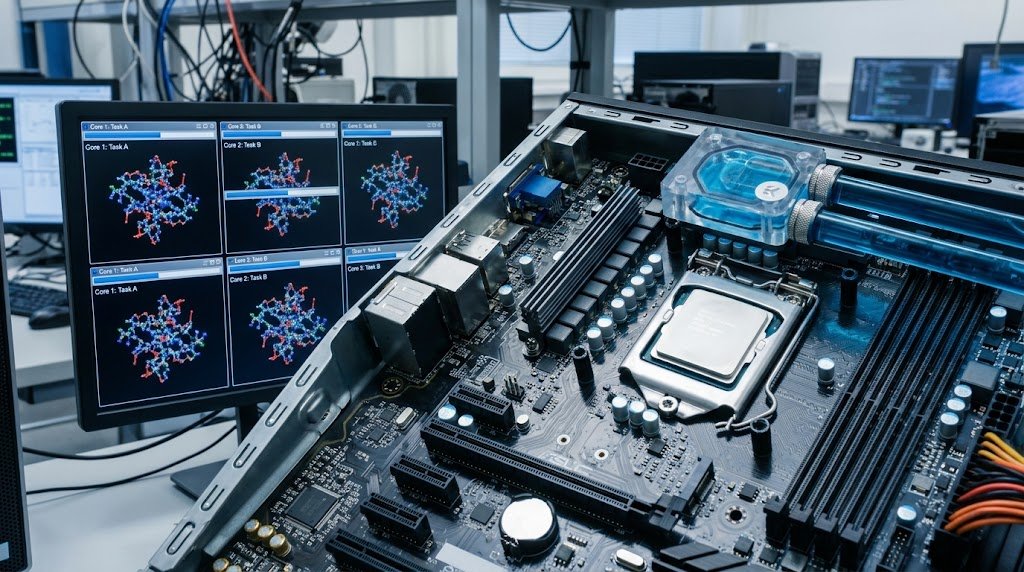
The first step in parallel computing is to find a problem that can be decomposed into subproblems. The developers then write the pieces to various processing units and have them run calculations at the same time. For instance, if you have a large set of photos, a program that processes a lot of photos may break the set down into a number of sets and assign an image processor to each set. Once the various processing units have completed their respective tasks, the program is able to merge the output of the processing units together or record them all in a common output.
Some tasks can be done independently, some others have to wait for the intermediate results of other tasks that are close by or previous operations. Execution, dependency and synchronization of the processing units must therefore be coordinated in the system and be controlled as needed. The dependent operation must wait for the information needed from the previous operation to be available. Because if the processor is overloaded, the entire computation may be delayed even though the others complete their work early, it is important to have good load balancing and task division.
Types of Parallel Computing
There are a number of approaches to parallel computing, including task parallelism and data parallelism. Task parallelism is the partitioning of tasks into multiple processors so that multiple tasks can occur concurrently. For instance, if the operations can safely operate independently from one another, then they can be performed as separate tasks in an application that processes incoming data, validates records, and generates reports. Data parallelism performs the same function on different data sets in parallel. A graphics processor can carry out the same mathematical operations on many pixels or data elements at once, for example.
Another method of classification of parallel computing is the memory architecture. Shared memory systems provide access to a shared memory space for processing units, whereas distributed memory systems provide each processing unit with its own memory, and use communication to pass information between the processing units. Hybrid approaches are a mixture of models. The best design depends on the size of the workload, the hardware available, dependencies on data, and the program development tools available to the computing environment.
What is Distributed Computing
Distributed computing refers to an approach that uses multiple computers operating independently, but communicating and cooperating to perform tasks or provide services. Each computer, or node as they are known, comes with a processor, memory, operating system, and possibly storage. A distributed system is a system that does not rely on only one machine, but rather divides responsibilities across many nodes, with each node carrying out its part and passing information to other nodes via network links and communication protocols.
The nodes can be in the same building, across data centers, or in different regions in the cloud. Many services that we use every day benefit from distributed computing, such as online shopping services, large databases, cloud storage, content delivery systems, and enterprise applications. The key benefits are that it can scale machines to add more machines, it can distribute workloads over the available machines, and it can design systems that will continue to serve important functions in the event of machine failure.
How Distributed Computing Works
The basic needs of a distributed computing system are the ability to partition work, allocate tasks to nodes, transfer information between component systems, and integrate and/or share results. The coordinator could plan tasks and keep track of progress, depending on its design, or nodes could coordinate through decentralized means. If a user asks for data from an online service, for instance, the request can be received by one server, another service can get the customer data, and the database node can provide the data records needed. The components communicate by exchanging network messages, application programming interfaces or other protocols.
They can be running concurrently, but the delays in the network, unavailable nodes, and inconsistencies in the information can make it difficult to coordinate. Failure detection, operation retry, data consistency and the prevention of duplicate processing where appropriate, are therefore essential for any distributed systems. Their performance will depend on the quality of the network, where the data is stored, how efficient the communication is and what happens if there is a failure and the software is not robust enough.

Common Types of Distributed Systems
There are several ways to implement distributed computing: according to the way the responsibility is distributed and the means by which computers communicate. A client-server architecture is one where client devices are used to access services that are provided by servers which deliver data or execute operations. A cluster of more than one computer that is loosely coupled to provide processing power or services; typically these computers are managed or scheduled in a centralized way. Cloud computing delivers computing services through a network, where organizations can lease virtual machines, storage, databases and more based on their current requirements.
Peer-to-peer systems allocate tasks to peer nodes that are not completely centralized. Data is distributed or partitioned across multiple machines in distributed databases, and data-processing tasks are broken up between worker nodes in large-scale data-processing platforms. There are various complexities and trade-offs of these designs in terms of performance, availability, control and complexity. Another system can integrate multiple models, e.g. a cloud app connecting to client-server architecture, then a distributed database storage and then multiple processing nodes for some very big data sets.
Differences between Parallel and Distributed Computing
Parallel computing and distributed computing have the same objective – use more than one computing resource more effectively – but they refer to different aspects of systems design. The key to parallel computing is to do several things at once, the key to distributed computing is to cooperate in the independent networked computers. A parallel program can be executed on a single multicore machine while a distributed application can store information on several computers, respond to requests or finish a common task. The distinction is not absolute, since a distributed system might be able to do parallel computations across the nodes, and a parallel application might be executed in a distributed-memory cluster. So, they are not mutually exclusive terms. To understand the major design goal, memory model, communication needs and failure types, is more helpful than to make a classification based on one. Below is a comparison of the major differences that developers and IT professionals must take into account when planning computing infrastructure.
| Comparison Factor | Parallel Computing | Distributed Computing |
| Primary objective | Perform several components of a calculation at once | Manage single computers independently and share among each other to work together and to deliver services. |
| Typical architecture | A multicore CPU, GPU, multiprocessor system, or computing cluster can be used. | A network of computers, clusters, cloud services or distributed services. |
| Memory | May be able to use shared memory, distributed memory, or both | In most cases, every node will have its own local memory. |
| Communication | Provided that synchronization or message passing is not required. | Network messages, remote calls, distributed communication protocols |
| Main performance concern | Processor utilization, synchronization and task dependencies | Network latency, data movement, coordination and node availability |
| Scalability | Often limited by hardware resources and communication overhead, depending on architecture | Can add nodes to expand with coordination and infrastructure constraints |
| Fault tolerance | May be interrupted by a processor or machine failure (depends on the system) | Can be configured to failover if single nodes fail |
| Typical applications | Numerical calculations, image processing, simulations and matrix operations. | Cloud services, distributed databases, large-scale data processing and web applications. |
Architecture and Processing Units
One of the principal differences between the two is that the computing resources in the latter are organized differently. The most common form of parallel computing involves multiple cores or processing units within a single computer, where they are able to access local hardware resources and have the possibility of sharing a memory space. A multicore processor can run multiple processes at once, a GPU can run a lot of similar processes on a multitude of data elements. Distributed computing, on the other hand, manages individual machines that are linked via a network.
Each node is able to work independently and bring its own processing power, memory and storage. Distributed computing doesn’t always imply that each task is executed by a different computer, nor is parallel computing limited to a single physical computer. For example, a high performance computing cluster is a collection of networked computers each running parallel workloads on a node. The crucial difference is between one that focuses on concurrent execution, and one that focuses on cooperation between independent machines, or both.
Memory Management and Data Access
The architecture of memory affects the ability of the processing units to communicate with each other. A shared-memory parallel system is a parallel system where multiple threads share the same memory space, which means they can access and modify the same data without having to send messages over the network. This can make certain aspects of programming more straightforward, however developers have to be careful to avoid conflicts when multiple threads attempt to alter the exact same info. In a distributed-memory system, each node has its own memory and data that another node requires must be sent via communication methods.
The separation can enable the large capacity of the whole memory, but the movement of information adds complexity and delay. Distributed applications also have to determine where data should be stored, how to update copies, and how to resolve conflicting updates. Both approaches require efficient memory and data management, since an excessive degree of data movement, data synchronization, or memory contention can negate much of the performance benefit of multiple processing units.
Shared Memory vs. Distributed Memory
Shared-Memory Architecture
In the shared memory architecture, several processors (or processor cores) have access to the same memory space. Other threads can access the updated information after the one thread updates a shared data structure, according to the synchronization and memory-consistency rules of the system. This is convenient when multiple operations are working with the same data or information is shared to and from multiple operations on a regular basis. In the case of a scientific application executing on a multi-core workstation, the application may split the calculation into multiple threads and each thread may read the data required from the memory of the system running the application.
Shared memory can simplify data sharing as threads don’t require explicit network messages to access shared variables. But shared-memory systems have their problems like memory contention, synchronization overhead, and race condition. The more threads that attempt to use the same resources, the less the performance is enhanced. Developers are thus required to carefully coordinate access to the data and implement the necessary synchronization to ensure that data is correct without needless slowdowns in the execution.
Distributed-Memory Architecture
Distributed memory architecture provides each processor with its own memory that can typically not be accessed directly by other processors as local memory. If the information is required at another node, the system needs to move the information from one node to the other via a network or communication system. This type of design is widely used in computing clusters, the cloud and massive scientific applications, as it makes it easy to add more machines and memory to a system. A climate simulation might split up a large geographical model across several computers, for instance, storing and computing the climate conditions, for a given region, on each computer.
When neighbouring regions affect each other, the computers share their boundary information. Distributed memory is used to support workloads that place a greater burden on a single computer, but developers should consider data partitioning, data synchronization and communication delays. Distributed applications are efficient and don’t make unnecessary transfers of information, bringing the right calculations to the information they need.
Hybrid Memory Architecture
There are lots of modern high performance computing systems which are a hybrid of shared memory and distributed memory systems. Each computer has several CPU cores or GPU processing units which operate on a local memory. Network communication enables the cooperation of network nodes to solve larger problems across computers. This combination gives it flexibility: it is shared memory for communication within the machine and distributed memory for increasing the amount of computing power across machines. A scientific simulation may employ multiple threads on each server to perform different parts of a model and communication via message passing between servers to pass information to and from each other.
They can process large amounts of calculations, but the programs used to make up such systems can be harder to develop and optimize, since there is parallelism to be controlled on more than one level. The number of threads per node, memory requirement, network performance and frequency of communication are important factors in designing a successful hybrid implementation. It is evident from hybrid architectures that parallel and distributed computing are not two distinct modes of computing but rather complementary.
Communication Overhead and Resource Management
Communication overhead: time and resources needed for information exchange, task coordination and processing unit synchronization. Overheading can occur in parallel computing when threads stall waiting for each other, when threads become waiting for shared memory, when threads wait to synchronize repeatedly for further computations. Network latency, data transfer times, message processing and coordination between services on different machines may all be considered communication overhead in distributed computing. These costs are especially relevant in the case of small jobs and frequent communication.
For instance, if the tiny calculation is to be performed on a distant computer, it might take longer than if the computer were local, because there is extra time required for sending the task to the distant computer and receiving the result back from the distant computer. So, to manage the resources effectively, it is important for the developer to find the right balance between the number of operations assigned to each processor and the cost of coordination. For larger independent tasks, less frequent communication sometimes can be used to effectively process the tasks, however when the tasks must always depend on one another, the communication should not be the primary performance limiting factor and careful planning is necessary.
Load Balancing
Distributing work to ensure that computing resources are utilised efficiently and not overloaded on some processors while others are idle is called load balancing. In parallel computing, the problem space can be partitioned into equal partitions or work can be dynamically allocated to processors as they become available. But, when data sizes are the same, this does not necessarily imply the same workloads since some records or calculations could demand more resources than others. However, when the requests are not equally distributed or a node has higher capacity, then the problem is similar to the one faced by distributed systems.
If a cloud application receives a lot of requests, it can route these requests to multiple servers to lower the load and quicker response times. While good load balancing can improve throughput and mitigate delays, it is important to consider the location of data, the capacity of the nodes, the dependency of tasks, and the cost of moving work between resources. Load balancing can diminish the benefits of parallel and distributed computing, especially if the cost of the slowest operation dictates the end time of the whole operation.
Synchronization and Coordination
Synchronization prevents concurrent operations from interfering with each other in an incorrect way, or from running before the information they need is ready. Synchronization mechanisms in shared memory parallel programs include locks, barriers, and atomic operations.Shared memory parallel programs use synchronization mechanisms like locks, barriers and atomic operations to avoid conflicting updates and coordinate threads. The mechanisms should be carefully used since if locked to much then other processors will not be able to work independently. Distributed computing demands synchronization between machines, and due to the delays on the network it is hard to define when an operation has finished on another node.
Dependencies and consistency can be achieved through the use of acknowledgements, distributed locking, message queues, or coordination services within systems. For instance, an on-line ordering system needs to coordinate stock updates and payment processing to prevent additional orders of the same item from being placed. Synchronization is necessary for correctness, but can introduce latency and complexity. A developer should therefore determine what is needed in terms of dependency, try to avoid conflicts when using a shared state, and select coordination mechanisms that are suitable in terms of reliability and performance for the application.
Security, Privacy, and Trust
Scalability
Scalability is a characteristic of a system that can process more work the more resources it has. The use of more processor cores, other processors, or more powerful processors can help to boost the performance of parallel computing. Adding more processing units, however, may not be beneficial because of the number of cores, bandwidth of memory, or other dependencies between the programs. Distributed computing can scale up by having more computers, storage nodes or service instances. This is especially useful for applications which have to manage larger datasets or increased numbers of users.
However, improvements in performance are not necessarily proportional when adding machines. Growth can be limited by network congestion, duplication of work, database bottlenecks and coordination costs. Only a system that is designed in such a way that when more resources are added to it, it can provide useful work without significantly increasing overhead. In determining real performance, organizations should test actual performance under expected workloads, not doubling the number of processors or servers and expect twice the performance.
Fault Tolerance and Reliability
Fault tolerance – how well a system can continue to function or recover from failure. A single-machine parallel application will be interrupted by a failure of one of the critical processors, memories, or operating systems. Depending on the application, the failure of individual threads might be tolerated. Distributed systems can provide better opportunities for fault tolerance, as workloads and services can be replicated at multiple nodes. If a server is unavailable, another server can take over servicing requests, depending on the appropriate level of redundancy and recovery in the system.
Distributed databases can also have copies of critical data stored to mitigate risk of data loss. But distributing an application doesn’t mean that it will be reliable. Multiple components can be impacted by replication errors, network partitions, software bugs and inconsistent updates. In order to ensure reliable distributed systems, health monitoring, failure detection, backup, recovery procedures and well-designed consistency rules are important. Not all fault tolerance is intuitive, it needs to be designed and tested.
Consistency and Availability
A major problem with distributed applications is maintaining consistency of information on several computers. If a database has multiple copies of a record on multiple nodes, an update to one node can take some time to propagate across the network to other nodes. Users might end up with an older value in the system for a while or until the update has been confirmed. Using strong consistency can make application behavior easier to use, but may need more coordination and longer response times. To enhance availability and performance, other systems permit temporary differences between replicas, where synchronization occurs later to resolve the differences.
The most suitable option is chosen based on the implications of wrong or delayed information. A social media platform can have an acceptable lag time between the time that content is published and when everyone sees it, whereas a financial transaction system can’t allow for inconsistent account balances. Consistency is a key architectural issue in a distributed system, as well as in parallel systems, where consistency of shared state must be managed, but distributed systems must also address communication failures and coordination between independent machines.
Performance Considerations
The number of processors/computers is not the only thing that affects performance. The execution time, throughput, latency, use of resources and time for exchanging information are important measurements. Execution time is defined as the duration of a task, and throughput is defined as the amount of work that a system performs in a given period of time. Latency is the time delay a person operation or request encounters. Use of parallel computing may be able to drastically shorten execution times when calculations can be broken down into distinct parts, where sequential operations might constrain overall reduction.
Distributed computing can provide additional processing power and support a large number of users, but communication overhead and coordination can impact the time that it takes for a response. Developers should create a baseline to determine the baseline before making an architecture change, test realistic workloads, and determine which is the actual bottleneck. Adding processors may be of little benefit if a program is waiting for storage for most of the time. Likewise, if all the tasks are dependent on one overloaded database, then distributed nodes may not be of any assistance.
Speedup and Efficiency
The ratio of the speedup of a task when performed by multiple processing units to when it is performed by a single processing unit. The observed speedup is 4 in the given case, assuming the same measurement conditions, because the task takes 100s on one processor and 25s on four processors. Parallel efficiency is a ratio of the actual speedup to the number of processing units. In this case, efficiency in the single-processor case would be 100 percent, assuming that the single-processor results can be compared directly with the four-processor results, and that overhead is ignored. Although a lot of effort has been put into implementing optimal efficiency in real applications, it is not always possible to achieve a perfect efficiency as some operations must still be performed sequentially, and communication and synchronisation take up time.
Network latency, task scheduling, and node performance variations are among the other problems that distributed systems must deal with. The architecture and the workload are thus two factors that determine the speedup. The developers should consider if the time saved is worth the extra infrastructure, energy, development, and operations complexity.
Choosing Appropriate Benchmarks
Benchmarking is helpful in deciding if the parallel or distributed design will enhance performance. A good guide is the amount of work the app will generate when deployed in production, and include realistic data size, user activity, communication patterns, etc. To measure several things, including completion time, CPU/memory usage, network traffic, error rates, and performance under increasing workload, developers should choose several factors. If only a subset of the data is tested and issues arise with limited memory or network traffic, they could go undetected.
Likewise, average response time can miss out on occasional delays which could have a substantial impact on user experience. The results are to be obtained under repeatable conditions and comparisons should take into account hardware differences and configuration changes. Following optimization, the same tests should be repeated to assure that the result benefits and check for unexpected side effects. Benchmarking serves as proof for the making of architectural decisions, for example, when an organization will not need a more complex infrastructure than is required.
Real World Applications and Use Cases

- Scientific Simulations and Research
Many scientific problems involve huge numbers of mathematical operations and parallel computing is often used in scientific research to solve such problems. Calculations can be broken up in many different ways, such as weather forecasting, climate modeling, fluid dynamics, astronomy, and molecular research. A model of the weather is, for instance, based on the atmosphere being divided into a three dimensional grid and the changes in temperature, pressure, humidity and wind estimated over various areas. The grid can be calculated by multiple processors at the same time, and neighboring processors can communicate with each other.
A large research project can also split the simulation into a cluster of computers, running parallel processing on each computer and communicating between computers. This enables researchers to simulate larger systems or conduct more detailed simulations than a standard desktop would be able to provide. The effectiveness of the design is dependent on the mathematical model, the frequency of the communication between regions, available memory and the efficiency of the algorithms. Some simulations don’t scale the same way, and researchers need to weigh the accuracy, speed and resource usage of their simulations.
- Cloud Computing Platforms
Cloud computing platforms are distributed infrastructure that offers scalable computing, storage, networking and application services. A cloud application is not necessarily deployed on a single virtual machine, container or managed service. If the demand grows, an instance can be added or additional resources assigned to keep response times acceptable. There are also cloud environments, in which applications run on multicore virtual machines, GPUs or clusters, which can be used for parallel computing.
For instance, a company that studies millions of customers can break the data into partitions and work across several worker nodes. Each worker independently does calculations on the values it stores and the system aggregates the results. While cloud platforms allow resources to be provisioned on-demand, the deployment of resources in the cloud still involves data transfer costs, scheduling workloads, security, and service availability. Cloud computing is thus not an independent method of replacing parallel computing, but a setting in which parallel and distributed techniques can be used in parallel.
- Large-Scale Databases and Big Data
In large-scale databases, information is typically stored and processed on many machines. When data volumes grow or requests increase, a database could store its data across nodes, store multiple copies for availability, or spread requests across multiple processing resources. In many systems, partitioning is referred to as sharding, which means that data is distributed across various nodes to be handled by them separately. Replication produces extra copies that may be used for recovery or, as per the design, distribute read requests. Parallel execution can also be used to boost the performance of a database by dividing up the work of a query into chunks that can be executed in parallel. For example, a data analytics platform can read multiple partitions concurrently and merge their results to provide a report. But there are some compromises with distributed databases between consistency, transaction coordination, network latency and complexity. The developers have to choose the right partitioning and replication design for the query patterns and the required reliability. Distributed storage and parallel processing can offer a boost in capacity and higher analysis speeds for applications dealing with huge amounts of information.
AI applications are trained using parallel and distributed computing, analyze data, and provide predictions. GPUs are particularly well suited for parallel processes, like multiplying matrices, that is often needed in deep learning. GPUs perform multiple calculations at once, which helps to speed up the training and inference process compared to doing the same calculations sequentially on hardware that is less well suited. In some cases, the model and/or dataset are so large that they cannot fit into a single accelerator or machine, so distributed computing can enable training to be coordinated across multiple GPUs or servers. Systems can partition the data over workers, partition a model across devices, or use a mix of both. Communication requirements arise from distributed training as workers might need to share gradients, parameters or intermediate results. Coordination of workers can take away some of the advantage of increasing the number of hardware elements deployed. To ensure a successful deployment of AI infrastructure, it is essential to match model, dataset, communication and available accelerators to the workload.
- Enterprise Applications
Enterprise applications include customer relationship management, inventory management, accounting, human resources, logistics, reporting, and other functions that are used by businesses. Distributed computing can be helpful if these applications need to be available to staff at several offices, be available for online transactions, or integrate multiple business services. An enterprise system could have a user-authentication service, an order-processing service, and a database service. These components exchange information through a network and sometimes can be expanded individually based on the need.
Within a service, parallel computing can enhance performance particularly when handling large data sets or when they make independent calculations. For instance, in a reporting service, they could process some subsets of transactions at the same time and still generate a single report. Security, authentication, access control, monitoring, backups and impact of service failures will also need to be taken into account by enterprises. A good architecture is able to achieve the right mix between speed and scalability, reliability, maintainability and the “working cost” of the system.
How to Integrate Distributed Computing and Parallel Computing.
The power of parallel and distributed computing is frequently realized in the combined systems. A distributed system can split a large workload into several computer systems, and parallel processing can break down the workload into several smaller jobs that can be processed concurrently on the same computer. It is typical in high performance computing clusters, cloud-based analytics, big data AI training centers, and scientific research systems. Suppose the research team is looking at satellite images of multiple areas. The application might split a set of images into several servers and perform parallel processing of each image using the CPU cores or GPUs within each server.
After processing, the system may be able to gather the results and give an overall analysis. This design enables the load to take advantage of the ability of multiple machines and the parallel execution speed of the local machines. At both levels, however, the developers will need to coordinate the distribution of tasks, the use of memory, the transfer of network data, and the management of errors. A hybrid system should thus be considered if it offers an appreciable benefit compared to simpler designs, due to its extra capacity.
Selecting the Appropriate Computing Aapproach
The decision between parallel and distributed computing starts with the understanding of the problem, its performance needs and the available resources. A single machine with a large number of CPU cores or GPUs may be a good choice for parallel computing when the problem involves computationally intensive tasks that can be broken down into parallel tasks, and the data is not too large to fit in the memory of a single machine. It can deliver significant performance benefits without the overhead of network communication or operation of multiple machines. Distributed computing also is more suitable for certain applications that need to be capable of storing very large amounts of data, service users at numerous sites, scale beyond that of a single computer, and service even if one or more nodes fail. For the problems that involve significant amounts of data and calculations, both methods are needed as one fails to be sufficient. Developers should consider partitioning the workload, frequency of communication between components, what to do if a component fails, and the level of infrastructure that the organization can sustain.
Organizations should also take software compatibility, team experience, budget, security, and long-term maintenance into consideration before making a final decision. Having concurrent code can create complex concurrency bugs, and distributed applications can be tricky to manage, because network failures are a possibility, partial failures are a possibility, data consistency can be an issue, and they can be deployed across multiple machines. One moderately sized server might be the perfect solution for a small business application running moderate traffic.For moderate traffic in a small business application, a distributed architecture may not be necessary and may be unnecessarily complicated. On the other hand, an international online service with many requests may require distributed infrastructure to provide the necessary capacity and availability. The decision should be based on performance, not which is more advanced, and should be based on performance testing to begin with. Teams should start with the most basic architecture that meets the team’s needs, test its shortcomings, and add in parallel and distributed methods when there is evidence that with this additional complexity, the team’s requirements will be met.
Conclusion
Parallel computing and distributed computing are important techniques for addressing the processing and scalability requirements of today’s software systems. Parallel computing is that which involves running many operations in parallel, usually on several CPU cores, processors or GPUs, to get the results of complex calculations faster. Distributed computing is the coordination of independent computers, in order to enable programs to increase their processing power, share storage, and offer services across multiple nodes. The biggest differences lie in their architecture, memory management, communication, scalability and fail handling patterns, but often these patterns intersect in real systems.
Data processing, especially scientific calculations, image processing, numerical analysis and others, which are useful in concurrent executions, are of great value to parallel computing. Distributed computing is particularly beneficial for cloud services, big data centers, enterprise applications and systems that demand extra capacity on machines. One method is not necessarily better than the other. The selection depends on the work load, data requirements, performance goals, budget, and reliability requirements. When these factors and a real-life system’s performance can be understood and measured, students, developers, and IT professionals can create efficient, scalable, and dependable computing systems.