
Introduction
To build a successful business, more than just making sales and covering bills is required. The bottom line is that those in the business world, particularly entrepreneurs and managers, require a clear financial map to be able to determine the direction of the business, the amount of money that the business will generate, how much money it will need to spend, and how the business will react if it doesn’t meet the expectations. This forward-looking view is achieved by the 12-month financial plan which integrates revenue projections, operating costs, profit goals, cash flow forecasts, investments and contingency planning. Whilst a monthly budget might be mostly about restricting current spending, an annual budget will link spending throughout the year and allow management to appreciate how their choices today can have an impact on their performance, liquidity and growth down the road.
An effective annual financial plan is more than a set of financial projections. It is a planning instrument that helps to convert business goals into tangible financial goals and actions. The plan should be in line with the company’s anticipated sales, personnel needs, marketing programs, operating expenses, capital expenditures, financial needs, taxes, and risks. It should also be flexible enough to suit the ever changing market conditions. The world of business is characterized by sudden changes in customer demand, supplier prices, interest rates, competition, exchange rates and the overall state of the economy. While not a silver bullet to eliminate uncertainty, a 12-month plan provides management a systematic means to look ahead and expect uncertainty, track results and make necessary adjustments early rather than late before financial issues becomes serious.
What is a 12-month Financial Plan?
A 12-month financial plan is a comprehensive financial forecast of a business’ activity and financial status in the next 12 months. Typically contains anticipated revenue, operating expenses, payroll, taxes, financing expenses, capital investments, cash inflows and outflows, anticipated profits and financial reserves. A plan can be drawn up on a calendar year or a plan can be drawn up for any 12 month period that has been rolled forward and fits the planning cycle of the organization. It is intended to offer management with a realistic view of what the business may face in terms of finances, and measurable to measure against actual performance. The plan can be used to help business owners make financial decisions, rather than by the month, but instead, by how each decision helps them meet their annual goals.
A good financial plan should also tie in financial data to operational priorities. For instance, a new company that is about to launch in a market might require extra working capital, staff, equipment, technology, or advertising prior to the revenue coming in. These costs could seem high when considering the immediate month’s budget, but a yearly look could reveal that the investment is helping the organization to maintain a longer-term growth strategy. Likewise, a company doing well in one quarter may be tempted to ramp up their spending, but a 12-month projection could show that they have a big equipment order, debt repayments, or seasonal downturn in sales to consider in the near future, and they wouldn’t want to do that. The annual plan then helps to make decisions that take the full financial picture into account instead of just looking at financials on a monthly basis.
Step 1: Establish Clear Business Goals.
The first task in creating a 12-month financial plan is to determine the goals the business hopes to accomplish with the plan. Numbers don’t really have any meaning unless they’re included in a financial plan that starts with some strategic context. Management needs to decide what it is that it wants the organization to achieve for the year. Goals could be a 10% revenue growth, a better gross margin, or a new market, a product launch, a growing customer base, debt reduction, employing more people, expanding a location, a new piece of equipment, or a larger cash reserve. Such goals need to be measurable and specific enough to turn into economic needs and also assess at the end of every single quarter.
When objectives have been set, the management should be able to estimate the cost of each objective and the money return that should be obtained from it. For example, going into a new market can involve extra marketing, transportation, staff training, inventory, technology and professional services. These costs should be planned for in the finances, rather than as an additional cost to the budget further down the year. While the anticipated additional revenue should also be estimated conservatively, it should not be assumed that every investment will yield a return immediately. Linking strategic goals to financial needs will make the annual plan a viable map of action and not a spreadsheet that stands apart from day-to-day business decisions.
Step 2: Make a Realistic Sales Forecast.
One of the most critical items in a 12-month financial forecast is sales forecasting, since anticipated sales have an impact on virtually every other financial decision. No business can make a “reasonable” determination about how much money it can spend, how many employees it needs to add, how much inventory it needs to purchase, or how much profit it can make, without first making an estimate of the amount of sales it expects to make. The forecast should be informed by historical sales data (where available), customer demand, current contracts, pricing changes, sales pipelines, seasonal trends, as well as the market and capacity to meet the company’s products/services. It is important for entrepreneurs to not present a forecast that is too positive just because the sales are up when it becomes a good-looking financial plan.
A good way is to break down the annual sales forecast into estimates for each month or quarter and to be aware of the assumptions used to arrive at each estimate. For instance, if you’re a retailer your sales may be higher during specific holidays, or if you’re a professional services firm, the time when corporate clients are more likely to renew contracts. For a new venture that may not have much historical information, it can utilize market research, customer surveys, information about its competition, pending sales activities, and conservative assumptions to help formulate its forecast. It can also create various scenarios, including a base case, an optimistic case and a downside case. The benefit of scenario forecasting is that it provides management with some idea of what the business may do if sales are less than or more than they hoped for; and how the business will respond accordingly.
Step 3: Carefully Plan Operating Expenses
Once the amount of money that the business will bring in is predicted, the next step is to find out and estimate all the operating costs that will be needed to keep the business going. Such costs can be salaries and wages, rent, utilities, insurance, marketing, transportation, software subscription, professional fees, office supplies, maintenance, telecommunications, inventory costs and other recurring costs. The budget should be considered by its intended purpose and when it is likely to occur, and not be based on the previous year’s numbers plus an arbitrary percentage. While it’s beneficial to have historical spending, prices, staffing, supplier agreements, business activities, and operational requirements can vary greatly from year to year.
When planning expenses, it is important to identify fixed, variable and semi-variable expenses. Fixed expenses usually do not vary significantly over a range of sales or production volume and variable expenses vary in direct proportion to sales or production volume. Semi-variable costs have fixed + variable costs. Knowing these can aid management to make an estimate of how the costs might react to various revenue scenarios. It also helps to know about the costs which can be cut if sales are not as expected. The same cost assumption should not be applied to all months, but instead the management should take into account the seasonality, planned investments, salary changes, contract renewals, inflation, changes in suppliers’ costs, etc., that have an influence on the spending throughout the year.
Step 4: Establish a Realistic Profit Target.
Growth alone is not a financial goal that should be the only goal of an annual plan. If the expenses of a business increase at a faster rate than the revenue, then the business has the potential to make a lot of money without being able to make a lot of profit. Therefore, management must have clear profit goals that are determined by the business model, market conditions, growth goals and financial needs of the company. The plan can have a gross profit target, operating profit target, net profit target or profit margin target. Once these targets are established, management can work out how much it can spend and if the investments they are considering are sustainable or not. It also helps to give a standard for measuring performance during the year and not just when the financial year has ended and it has been realized that the sales growth has not yielded sufficient profits.
Specific assumptions should be used to back up profit targets. Management should try to estimate the expected revenues and costs to achieve a desired net profit margin if the firm wishes to attain it. This exercise can be a clue as to whether the target is possible and attainable or not. For instance, where expected revenue is not enough to cover up the planned operating expenses and generate the expected profit, management will have to adjust the products’ prices, boost sales volume, cut down on unnecessary expenses, negotiate better terms with suppliers, or rethink some investments. Profit planning thus breaks down an overarching target like “make more money” into specific financial needs that managers are able to track and manage.
Step 5: Use a Cash-Flow Forecast to help you prepare
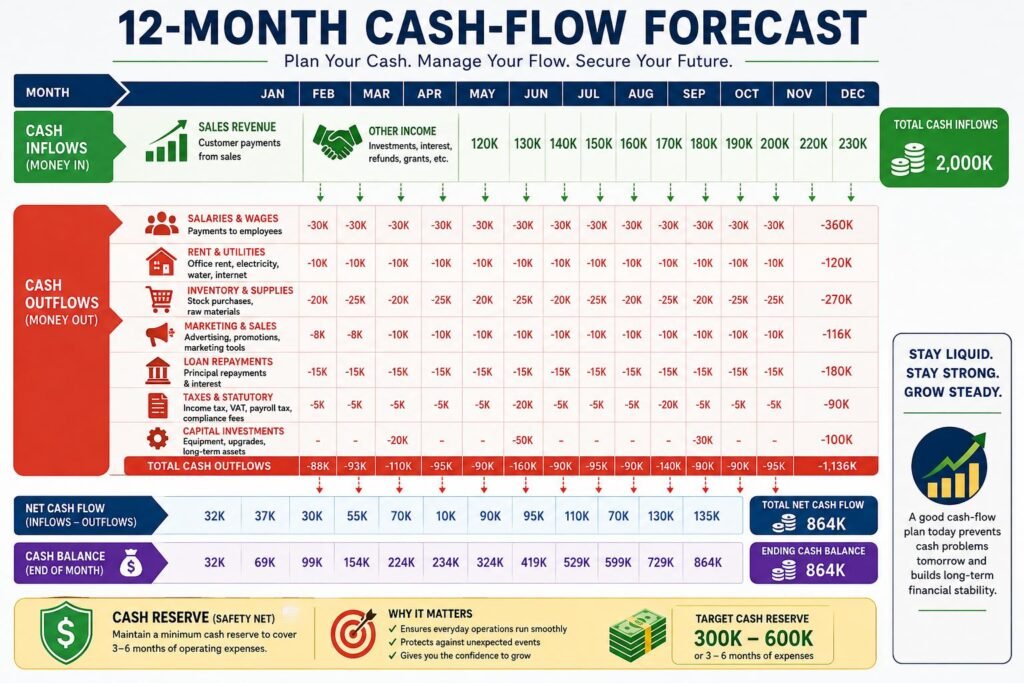
Profit and cash are not equal and cash-flow forecasting is an important component of the 12-month financial plan. The accounting profit may be positive while cash short, due to customers’ late payment of bills, absorption of cash in inventory, cash requirements for loan repayments, or large cash expenditures prior to customers’ receipt of cash. The cash-flow forecast should, therefore, include a prediction of when cash will be flowing into, and out of the business. These are customer receipts and payments to suppliers, wages, taxes, loan repayments, rent, capital expenditure, insurance payments and other important cash flow items. Reviewing the timing of cashflow will enable management to see when the business may be profitable, but difficult to keep going due to a lack of liquidity.
The cash-flow forecast should be revised from time-to-time as actual data becomes available. The impact on future cash balances should be acknowledged if customers start to begin paying slower than expected, and not continued to assume that as they did in the original plan. Likewise, when sales are higher than anticipated, it’s important to ask the question: is it really money that can be spent or is it money that’s required to fill inventory, taxes, debt, expansion, or other future needs? Good cash forecast allows the business to keep adequate cash flow, prevent needless borrowing of money in an emergency, and decide when to invest, employ, pay off debts and create cash reserves.
Step 6: Capital Expenditure and Long-Term Investments
Doing some planning for the next year must not just be limited to the normal running costs of the business. Companies frequently have a need to acquire assets that are used for multiple years, such as equipment, vehicles, technology, property enhancements, machinery, software systems or others. These capital expenditures should be distinguished from other normal operating expenses and may involve substantial cash investments which could impact the depreciation, financing needs and future operating capacity. The management should first think about capital investments, identify their acquisition and implementation cost, estimate when they will be paid for and consider how they will affect business performance.
Prior to making a significant investment, management should evaluate if the investment is in line with the company’s goals and if the business has the cash to cover the investment. While a new machine may improve production capacity, it might not be the right time for its purchase, resulting in a cash-flow challenge. Likewise, expensive technology can make things more efficient, but the value added to the investment should be in accordance with the expected benefits. The initial cost, maintenance expenses, useful life, financing options, potential savings, additional income and risk should therefore be taken into account when making capital planning choices. Capital expenditures are separated from routine operating expenditures so management can see the true financial impact of long-term investments, and can avoid putting money at risk for routine operations.
Step 7: Set up your Contingency Fund.
No financial plan will be complete without taking into account that everything may not occur as forecasted on an annual basis. Financial or operating results, supply chain, manpower, technology, customer demand or financing costs can be adversely impacted by unforeseen events. A contingency fund is a reserve of money that can be used to meet unforeseen emergencies without requiring immediate and costly loans or other financing for the business. It will depend on the type of business, risk profile, size and cash-flow of the business etc. Firms that have steady income will be in different situations than those in the line of work that have all the time variations or economic impact.
Contingency planning can’t be just about saving the money. The management should determine what the risks are and what action would be taken if they were to actually materialize, if they are going to have the greatest financial impact. For instance, if sales drop off sharply, the company might put off non-essential capital spending, cut back on discretionary marketing spending, renegotiate with suppliers, or temporarily not hire. If the major customer payment is overdue, management could have to speed up the collection or have to take out short-term financing. The financial plan, as it is written, will minimize hasty decisions in case of a crisis. The contingency fund and response strategy work together to provide greater financial resiliency.
Step 8: Break down the Annual Plan into Quarterly Milestones
While this is 12-month planning it is important that management do not wait 12 months to see if the plan is working. The year is marked out in 4 quarterly checkpoints and can be reviewed in accordance with the actual outcomes versus the forecasts. The revenue, expense, cash-flow and profit and loss goals of each quarter should support the annual goals. The Quarterly Milestones assist the annual plan to be manageable by breaking it down into shorter timeframes which managers can monitor and influence. They also allow it to be easier to catch any issues early on, before they turn into a massive shortfall at the end of the year.
Quarterly reviews should include an analysis of financial results, as well as the assumptions used in the financial results. The management should compare the actual revenue with the forecast revenue, actual expenses with budgeted expenses, actual cash balances with the projected balances and actual profit margins with the targets. Any significant differences should be explored and not just recorded. When sales are lower than expected, the management needs to know if the issue is a temporary one, seasonal, market, pricing, or weak sales activity. When costs are exceeding budgets, the business needs to find out if the increase is due to growth, inflation, inefficiency, unforeseen events or poor cost control. This analysis transforms the financial plan into a living management tool, instead of a static document.
Step 9: Use Variance Analysis to improve the Plan
Variance analysis should be used in each quarterly review as it will give insight of the difference between business plan and actual performance. A favorable variance can mean more revenue than anticipated or a lower expense, or price, than expected whereas an unfavorable variance can mean lower revenue or higher expenses, or price, than expected. The label is not sufficient, however. Management should be able to explore the root cause, implications and potential consequences of each key variation. For instance, if an expense is out of budget because the company has made a wise investment, it is probably not a problem that needs to be addressed, whereas if the expense is due to waste or poor purchasing controls, then it is likely that it will need attention.
Results of variance analysis should be used as input to future predictions. If a business has been over decades continuously pricing its shipping costs too low, then the future budgets should take that into consideration as well. If a company’s sales forecasts are consistently too high, the management should recalibrate the forecast and set expectations accordingly. Similarly, if marketing efforts which yield strong returns occur consistently, then the company may choose to invest more in these activities. This process leads to a continual loop of how performance affects how future planning is done. The financial plan is based on actual operations, not assumptions which don’t change with time, so the business can make better resource allocation decisions and forecasts over time.
Step 10: Review you Debt, Taxes and Financing Requirements
Payments should be factored in to the annual financial plan from the outset not when they are due as tax and debt obligations. If a business has loans, they should include the following in their cash-flow projections: Principal repayments, interest expenses, refinancing dates and financing commitments. Also, management needs to consider if the intended growth plan will need extra financing. If additional borrowing might be needed, the company should consider the extent of financing that it can support and the impact on its cash flow and profitability if it borrows more. This helps to limit the amount of financial debt taken without comprehending how it will affect the overall financial plan.
Tax considerations should also be taken into account as tax payments may result in significant cash-flow needs. The business should make an estimate of the tax liabilities that will apply in accordance with the rules and be based on the performance of the business and the timing of the payment. Depending on the nature of the business and jurisdiction, the obligations may include income taxes, payroll taxes, sales or consumption taxes, statutory payments and others. Completing the financial plan with qualified accounting or tax professionals can help ensure that the requirements you consider are implemented appropriately. The plan includes taxes and debt obligations, giving a more accurate picture of how much money will be available for operations and investments and for growth.
Step 11: Review and Track important Financial Metrics.
A 12-month financial plan is much more effective if management is able to select a limited number of key performance indicators to track during the year. Revenue growth, gross profit margin, net profit margin, operating expenses as a percentage of revenue, accounts receivable days, inventory turnover, cash balance, operating cash flow, customer acquisition cost, return on investment are just some of these indicators. Indicators will vary by enterprise, but should give management data to determine if it is on track to achieve its financial goals. There is a risk of too much complexity if too many metrics are tracked as this can distract from really relevant measures that contribute to key business decisions.
Financial indicators should not just be checked when there is a problem, but periodically as well. If profits are shrinking, for instance, it could be a sign that sales are not outpacing expenses or supplier expenses. An increase in receivable days could be an indicator that customers are paying slower and may cause cash-flow problems in the future. If a company is growing while its revenue is robust, but its cash balances are shrinking, it could be that the growth is using up working capital that the company may not have anticipated. Managers can use this monitoring of these relationships to detect issues that may be developing before they get to a serious level. Key performance indicators are therefore a link between the detailed financial plan and the action that needs to be taken in practice.
Common Mistakes to Avoid When Building a 12-Month Financial Plan
The most frequent error is to have over-optimistic sales projections. Business owners always want the business to expand but forecasts that are largely optimistic can lead to unrealistic plans for spending and false expectations of profits. A huge error is underestimating costs, for instance, failing to account for inflation, salary growth, maintenance, taxes, professional fees, technology costs, and any other operational needs that may arise. Profit is often the primary interest of the businesses, whereas they do not pay much attention to cash flow. The errors can give a company a good-looking balance sheet that cannot support its daily requirements. A robust annual plan should thus be based on realistic assumptions, specify the rationale for the above assumptions in important areas, and allow for flexibility of assumptions to account for uncertainty.
The other error made is to use the annual plan as a document that is made once and put to one side. Business needs and priorities shift, costs shift, customer attitudes shift, markets shift throughout the year. When management won’t make the necessary changes to the plan when big changes occur, the financial roadmap can go down the tubes in no time. The answer isn’t to continually shift targets when results aren’t meeting expectations, but to differentiate between accountability and new forecasts. Original targets need to be kept in sight to assess performance and forecasts can be adjusted if they can be substantiated with new information. This ensures the business is disciplined and not caught in some assumptions that are no longer true.
A Simple 12-month Financial Planning Framework
An annual financial plan can be broken down into multiple, related sections. First part should include a statement of business goals along with the measurable financial goals. The second one should contain sales forecasts for the month, based on realistic assumptions and, when possible, on different scenarios. The third should include detailed operating expense estimates with a breakdown of the fixed and variable expenses. The fourth one should set gross profit and net profit objectives. Monthly cash-flow forecast should be included in the fifth, with expected cash-flow in and out. The 6th one should outline any planned investments in capital items and major expenditure. The 7th – set up contingency reserves and risk responses. Last but not least, the plan should have dates for each quarter for review, and key performance indicators that will be tracked throughout the year by management.
This is a good tool for progressing from strategy to money. For instance, if the business goal is to boost overall yearly income, the sales forecast ought to depict exactly how this increase will take place. The need for additional resources to support the growth should be included in the expense plan and the financial worthiness of the growth should be determined by the profit target. The cash-flow forecast should help to show if there will be a liquidity issue or not when the business expands. In the contingency plan, you should discuss what your management will do if sales don’t meet your expectations. The financial plan is one single roadmap and not a set of unrelated financial schedules by linking each section.
Conclusion
A 12-month financial plan is one that enables entrepreneurs and managers to analyze a plan not just on a month-by-month basis, but also for the entire year. Realistic sales forecasting, in-depth expense planning, profit targets, cash-flow forecasting, capital investment planning, contingency reserves and quarterly performance evaluations enable businesses to match their financial resources with their financial goals. The biggest advantage of this method is not just to know how much money they are striving to make or spend in the business. It is the ability to appreciate how the various financial decisions will influence each other, and how they can offer chances or issues before they become significant in terms of stability of the business.
For long-term financial stability, one needs to plan things and make adjustments from time to time. The annual plan should give guidance and not be so prescriptive as to be unable to adapt to changing circumstances. Management should evaluate the actual results against the original objectives, and determine where significant differences are, and update the forecasts as needed, maintain sufficient cash reserves, and make sure spending continues to help the organization reach its most important objectives. These practices are integrated into the business management process and the 12-month financial plan becomes more than a budgeting activity. It can be a strategic financial plan that allows businesses to manage costs, maintain liquidity, chart a sustainable growth path, plan for uncertainty and make smarter business decisions all year long.
Get more well researched information about 12-month financial plan here.