Since an ‘open’
offers infinite resistance, there would be no current in that part of the
circuit where it occurs. In a parallel circuit, an open can occur in the main
line or any of the parallel branch.
offers infinite resistance, there would be no current in that part of the
circuit where it occurs. In a parallel circuit, an open can occur in the main
line or any of the parallel branch.
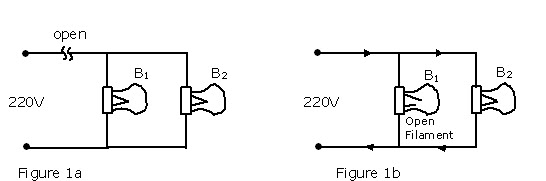
In figure 1a,
an open occurs at the main line. This prevents the flow of current to all the
branches. Hence, neither of the two bulbs will glow. However, the full voltage
applied (i.e. 200V in this case) is available across the open.
an open occurs at the main line. This prevents the flow of current to all the
branches. Hence, neither of the two bulbs will glow. However, the full voltage
applied (i.e. 200V in this case) is available across the open.
In figure 1b,
the open occurs in branch circuit of B1. Since there is no current
in the branch, B1 will not glow. The open at B1 produces
an infinite resistance which makes nearly all the current to flow through B2.
However, as the other bulb remains connected across the voltage supply, it
would keep operating normally.
the open occurs in branch circuit of B1. Since there is no current
in the branch, B1 will not glow. The open at B1 produces
an infinite resistance which makes nearly all the current to flow through B2.
However, as the other bulb remains connected across the voltage supply, it
would keep operating normally.
It may be
noted that if a voltmeter is connected across the open bulb, it will read full
supply voltage of 220V.
noted that if a voltmeter is connected across the open bulb, it will read full
supply voltage of 220V.