Introduction
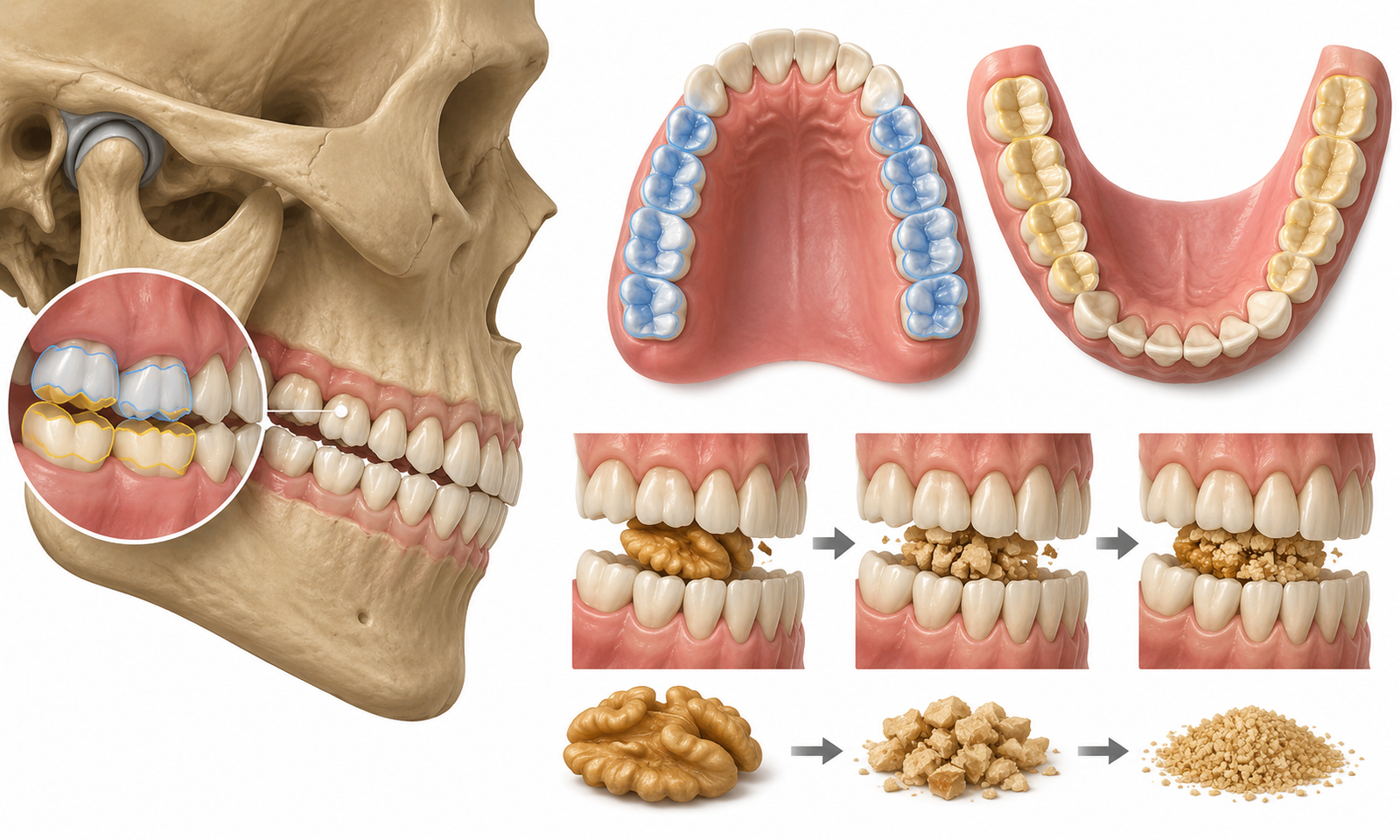
Optimal mastication is an essential condition for good digestion and oral hygiene. Food breakdown into smaller bite-sized particles is key to the ability of teeth to function as well, and this relies on the design and condition of the occluding surfaces of teeth. Such surfaces are not level or random—they are highly evolved, biomechanical structures, specifically designed during the course of evolution to perform mechanical supervision of food items with accuracy.
The anatomy of the occluding surfaces of the teeth plays a key part in dentistry for proper diagnosis and treatment of occlusal disorders, designing restoration and providing long-term harmony of the dentition. They show complex surfaces, the cusps and ridges, the grooves and fossae, which are important for the effective chewing and balancing of the pressure.
The use of friction in tooth contact.
Occluding tooth surfaces are the contact points of posterior teeth (useful ones are the second/third molars and the premolars) that come into contact during mastication. These surfaces terminate on them in a co-ordinated manner referred to as occlusion, which keeps chewing forces distributed across the surfaces and food being broken down efficiently.
Occlusion in dental sciences is a well-studied topic in Occlusion, the study of the contact of the upper and lower teeth during functional and parafunctional movements.
- The bodies of these surfaces are very specialized:
- Cusps are main grinding- and penetrating structures.
- The ridges are used to direct food as it is chewed.
- Grooves allow for food to pass by and do not allow too much pressure to build up.
All these functioning structures are contributing to balance and efficiency of the masticatory system.
Cusps: Primary Functional Units of Mastication
The pointy, raised, parts of teeth that are generally only seen on the large back molars and premolars are known as cusps. They are the most significant elements for occlusion surfaces.
The Cusps also serve other functions.
Cusps are used for various purposes in mastication:
- Food penetration; sharp cusp tips are used to penetrate feed particles.
- Crushing and shearing food against the opposing teeth in the cuspal inclines, gives rise to grinding efficiency.
- Force Distribution: Cusps facilitate the transmission of occlusal forces along the long axis of the teeth and minimise the trauma to supporting structures.
Based on their function, cusps are divided into two classes: functional (which are supporting) and non-functional (guiding) cusps. Primary contact while chewing is given by functional cusps, whereas non-functional cusps guide jaw movement.
Chewing becomes inefficient if cusps become worn away from attrition (wear) or erosion (dental decay). This can cause strain in the temporomandibular joints and force unequal stresses on the teeth.
Ridges: Guiding Structures of Occlusion
A linear elevation in the surface of a tooth(teeth) that helps to guide food and maintain structural integrity during mastication.
Types of Ridges
- Marginal ridges: sit at the side of occlusal surfaces at the mesial and distal edges.
- Square ridges: Run along the middle point of the cusp tips.
- Transverse ridges: Two triangular ridges merge to form a transverse ridge.
The ridges perform a number of functions.Ridges have functional significance.
Ridges contribute to:
- redirecting food towards the occlusal grooves to facilitate efficient grinding of food.
- Stabilizing cusps on occlusion.
- Structural Integrity during masticatory stress.
In the absence of ridges, food can be locked into non-optimal ways which can lead to less effective mastication and food stagnation, which increases the risk of dental caries.
Grooves and Fossae: Areas to Support Functional Movement
A groove is a depression or channel between cusps and ridges, and a fossa is a wider concave space between cusps and ridges.
Role of Grooves
Grooves are escape points for food when chewing. They enable cusps to move without interference and minimize stress concentrations at cusp surfaces.
Role of Fossae
During these events, food is temporarily stored in fossae, where crushing movements carried out by opposing cusps will occur. They play a significant role in the molars, where they are most important for the efficiency of grinding.
Grooves and fossae combine to insure that food particles move smoothly and under control thus providing greater masticatory efficiency.
Structures\Basic Mastication Interactions
The occluding surface works not atomistically. Rather, the system of cusps, ridges, grooves and fossae are synchronized.
During chewing:
- Cusp tips penetrate the food, first.
- It is then pushed by ridges to fossae.
- In crushing food is crushed by the opposing cusps.
- Grooves provide lateral avenues for the passage of the softened food particles.
This collaborative system enables mastication to be both effective and damaging in minimal fashion to the teeth and alveolar bone.
This system is only stable as long as it is aligned, called Occlusion which maintains balance between the opposing arches while functioning.
Significance of Occluding Surfaces in Dentistry
Maintaining the integrity of occluding surfaces is one of the key objectives of restorative and preventive dentistry. If the cusps, ridges and grooves are altered, this will result in a loss of occlusal harmony which might cause functional issues.
Common Causes of Occlusal Surface Damage
- Dental caries
- Attrition from bruxism
- The erosion caused by eating acid foods.
- Fractures from trauma
- Improper restorative procedures
Clinical Consequences of Damage
If there is an interruption in the occlusion, patients could have any of the following symptoms:
- Reduced chewing efficiency
- Jaw muscle fatigue
- Temporomandibular joint discomfort
- Tooth sensitivity
- Higher chances of more dentist wear.
Role in Restorative and Prosthetic Dentistry
A precise reproduction of the occluding surfaces is very important in Restorative Dentistry. The cusp-fossa relationships that occur in natural teeth need to be reproduced at the time of the dental restoration to restore function.
Key Principles in Restoration Design
- Restoring the proper cusp height and inclination
- Keeping intact the natural grooves used to escape food
- Proper alignment of opposing teeth points making contact with each other.
- Ensuring the proper occlusion to avoid overloading specific areas of the teeth;
The other prosthodonic procedures are also highly dependent on the accuracy of the occlusion. If they are not designed correctly, they can cause discomfort and cause damage to the structures over time due to unequal forces on the bite.
Helps maintain good oral health.
Chewing is not only efficient but the well structured occluding surfaces are also good for oral health. These allow food to not get stuck around the teeth, minimize the amount of plaque and encourage self-cleaning of the mouth.
Well-formed occlusal anatomy equally reduces the risk of periodontal stress by evenly dispersing forces throughout the supporting bone structures.
In prevention, protecting natural anatomy of the occlusion is regarded as a protective factor to alleviate the occurrence of multiple oral diseases.
Significance of occlusal harmony in clinical setting.
Occlusal harmony describes how evenly all the surfaces of teeth function on each opposing side during the functional movements of chewing, swallowing and speaking.
If there is imbalance, even the slightest irregularity may result in:
- Bite imbalance
- Tooth mobility
- Muscle pain
- The headaches that are coming from occlusal strain.
The dentist will closely examine occlusion when making a diagnosis to see when a restoration will not obstruct any natural movement of the jaws.
Occlusal Analysis and Dental Technology
The occlusion norms and relationships are analyzed and reproduced with high precision using digital scanning, CAD/CAM systems and occlusal mapping tools in modern dentistry.
With these technologies, the clinicians can:
- Visualise 3D cusp-fossa relationships.
- Prepare more accurate designs for restoration.
- Recognize and identify occlusal interferences early in treatment.
- Improve long-term success of prosthetic work
This has led to patient outcomes that have greatly benefited in restorative and prosthetic procedures.
Conclusion
The occluding surfaces of teeth are complex anatomical structures which are crucial for an effective chewing process. The cusps, ridges, grooves and fossae coordinate to ensure breakdown of food and balance in the dental arch.
Dentists and other professionals involved in the care of people need to understand the anatomy of the occluding tooth surfaces in order to affect the diagnosis, treatment planning, and success of the restorative treatment. These structures can be preserved and/or accurately restored to provide not only chewing efficiency, but long term functional stability and oral health.
His work highlights the perfect dynamic between opposing surfaces, a balance between form and function that the human dentition has evolved and preserved, which is what dentistry today works toward through the use of preventive strategies and hightech restorative methods.