Introduction
The oral cavity is an extremely integrated functional system of teeth, bones, muscles and ligaments that is necessary for good nutrition through chewing, speaking and swallowing. The operation of this system is dependent on the action of the mandible, the action of the lower and upper teeth. These are dynamic, and continuously change when function, and are essential to maintain healthy occlusion.
The correct interpretation of the movements of the mandible is thus extremely important for not only clinicians, students of dentistry, and researchers, but even slight deviations of the movements of the mandible can impact on occlusal disharmony or temporomandibular joint (TMJ) dysfunction. This article discusses the various transfers of mandible’s movements: protrusive, retrusive, as well as lateral movements and how they influence the occlusal contact pattern, which in turn affects oral health.
Structure and mechanism of the movement of the lower jaw.
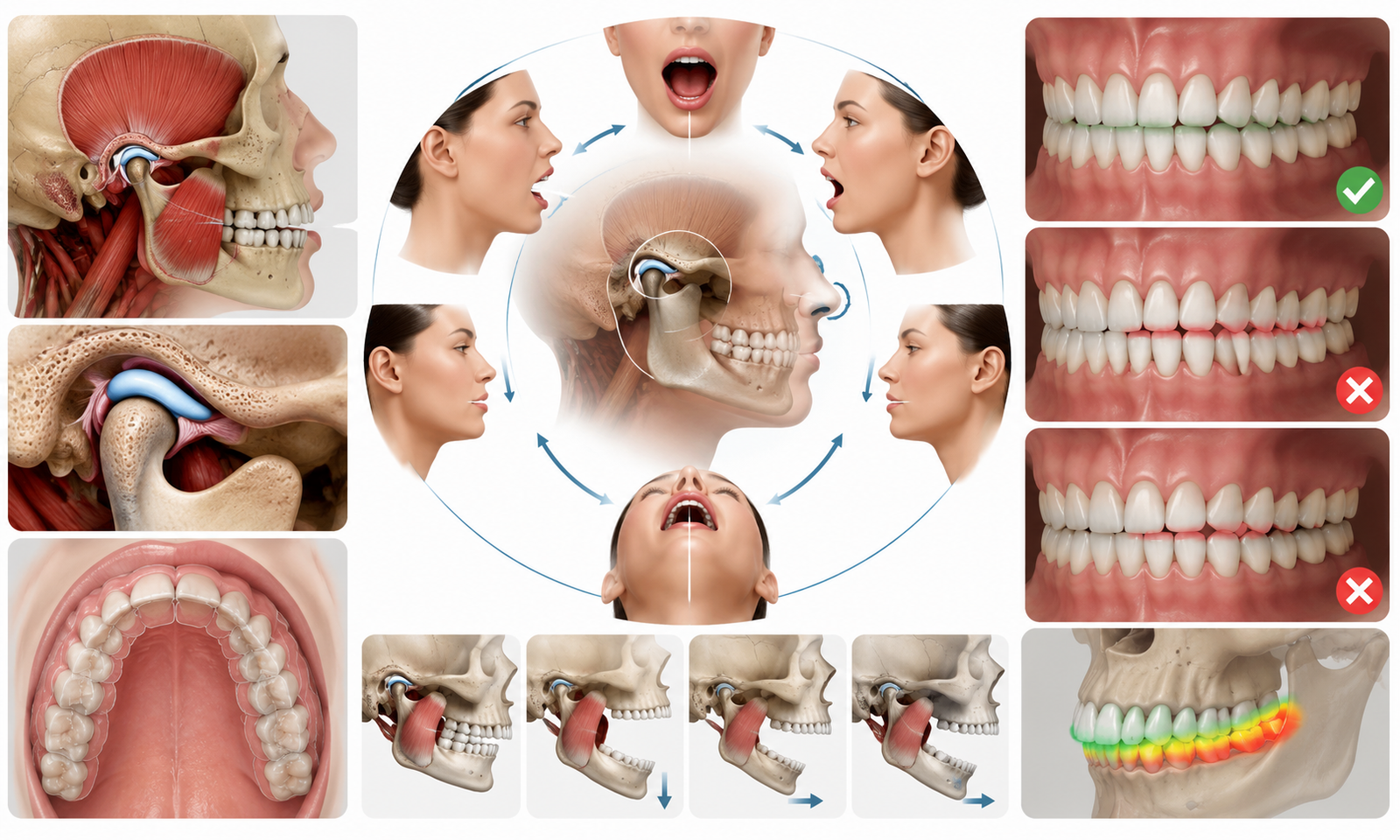
The mandible functions as a pivot signal by the TMJ, which is coupled by bilateral “hinge and glide” motion. The interconnected joints are capable of rotation and translation thus giving the mandibular movements a unique complexity to all other skeletal joints in the body.
These are the key anatomical features of the body involved:
- Temporomandibular joint (TMJ): Allows hinged movement and allows for sliding movement.
- Masseter, temporalis and pterygoid muscles: Action to elevate, depress, protrude and move laterally.
- Cartilage: Cushions stress and allow motion in a joint to be smooth.
- Guide and limit movement patterns during function (occlusal surfaces of teeth):
These are all integrated and contribute to the highly predictable and reproducible mandibular movement which in turn allows for stable occlusion.
Understanding Mandibular Movements
Three major functional movements of the mandible can be identified, namely protrusive, retrusive and lateral. Both have different functions in occlusion and functional balance.
Protrusive Movement
The mandible moves forward past centric occlusion which is known as protrusion. In this motion, the condyle moves forwards over the eminence.
In ideal occlusion:
- Students will use the movement of the teeth to guide (anterior guidance)
- Posterior teeth disclude (separate) to prevent interference
Whether there are posterior contacts in protrusion can be identified as the protrusive interference. These can lead to abnormal wear or muscle strain.
Retrusive Movement
Retrusion is movement of the mandible backwards toward the terminal hinge position. Lastly restricted by the ligaments of the TMJ and posterior tooth contact.
Clinically, retrusive movements are important because:
- They are able to assist in the recognition of discrepancies in centric relation
- They will show up with insufficient contacts in the back teeth
- They help with the diagnosis of occlusal instability.
Lateral Excursions
Lateral movement is the movement of the mandible to the right or left side. This movement involves:
- The side which the mandible moves towards (the working side).
- The rear of the device (as opposed to the working side)
Lateral excursive movements which involve:
- When tooth disclusion is a posterior tooth, the canine is discluded.
- Group function is when more than one tooth carries the load of chewing.
- The desired contacts are the side interferences (e.g. two teeth next to each other in one jaw that meet each other perfectly) which can destroy the occlusion and need to be balanced.
It is important to recognise these trends and avoid uneven force distribution.
Biomechanics of occlusion and jaw movement
Occlusion is not just a static relationship of the teeth, it is a dynamic relationship changing because of the continuous movements of the mandible. The chewing, speaking and swallowing involves coordinated movement patterns for every functional activity.
At mastication, the mandible moves in an elliptical/teardrop motion:
- Opening phase (depression)
- Closing phase (elevation)
This is the period of time when food items are chewing (also known as the occlusal contact phase).
Each component of this cycle can fail if the cycle is not followed:
- Uneven tooth wear
- Muscle fatigue
- Joint overload
Occlusal contact patterns.
The path of mandibular movement has a direct influence on occlusal contact patterns. Even slight irregularities in movement can change the way teeth are in occlusion when they are in function.
Protrusive Contacts and Anterior Guidance
However, in a healthy system anterior teeth will dominate in incisal movement to allow posterior teeth to exit. This prevents:
- Excessive posterior wear
- Left, right, and up or down.
- Muscle overactivity
However, if anterior guidance is poor there may be interference from posterior teeth causing occlusal trauma.
Retrusive Contacts and Centric Stability
The most stable jaw position—centering, also characterized by retrusive movement. A mandible exhibiting premature posterior contacts may have another direction of motion when retruded, either forward or sideways, depending on the relationship with the teeth. This adaptive motion can at some time result in:
Malocclusion
TMJ strain
Asymmetric muscle activity
Lateral excursions and load distribution.
With lateral movement, the forces are spread evenly, with proper occlusion. In dogs a lateral stress is taken by one tooth (canine), which is a very strong tooth, to reserve the remainder of the teeth (posterior). For multi-tooth operation, each tooth carries a load.
Not so, balancing side interferences are complicated owing to the fact that they:
- Don’t place too many contact points, but make them non-functional.Make nonworkable contact points.
- Increase joint stress
- Participate in parafunctional habits such as bruxism
Assessment of Mandibular Movements
The knowledge of the ability of the TMJ to move is important in clinical dentistry, especially in planning for restorative, prosthodontic and orthodontic treatment. The main advantage of functional assessment is to prevent the creation of interferences that impede natural jaw movement.
Diagnostic Evaluation
Mandibular motion is assessed by:
- A hypothesis regarding the movement pattern is developed through visual observation.
- Exterior of amalgam with holes for positioning on the articulator.
- Occlusal paper analysis
- Digital jaw tracking systems
These tools can be used to discover:
- Interferences in motion
- Asymmetrical movement patterns
- TMJ dysfunction indicators
Restorative Dentistry Applications
Clinicians must make sure that when designing crowns, bridges or dentures the following applies:
- Proper anterior guidance
- Balanced occlusal contacts
- Smooth lateral excursions
If not properly designed, poor restorations may compromise mandibular motion and result in future problems or discomfort.
Orthodontic Considerations
In addition, functional movement needs to be taken into consideration with orthodontics. When teeth grow inwards misalignment of them may prevent mandibular motion resulting in:
- Limited forward motion / lateral motion
- Compensatory jaw shifts
- Muscle imbalance
Relationship between the mandibular motion and temporomandibular dysfunction
The movement patterns of the mandible are frequently found to be out of normal range in people with temporomandibular dysfunction (TMD). In some cases, occlusion does not match functional motion, and results in an overloading of the TMJ and surrounding muscles.
Common contributors include:
- Interferences on the occlusal surfaces during excursions:
- Loss of vertical dimension
- Malaligned anterior guidance
- Parafunctional habits like clenching and/or grinding one’s teeth are not beneficial.
Symptoms may include:
- Pain or stiffness to the jaw(s)
- Sometimes clicking/popping noise is heard.
- Headaches
- Restricted movement of joints.
Much can be done to prevent chronic dysfunction if abnormal movement patterns are identified early.
Functional Assessment in Modern Dental Practice
Most of the current work in dentistry brings a significant amount of stress on functional occlusion rather than static alignment to the fore. Nowadays, digital tools are able to provide real-time tracking of the mandibular motion, offering a more accurate assessment of it, compared to traditional methods.
Key advancements include:
- Jaws for the Deaf: 3D jaw tracking systems
- Digital articulators
- Occlusal force mapping technology | Oral Health Australia
These devices aid the clinician in simulating functional movements and adjusting the treatment plan to achieve better outcomes in the long-term.
Concept of Anatomy and Functional Dynamics
Comprehensive knowledge of occlusion involves incorporation of dynamic motion patterns with anatomic structures. Occlusion is not defined by teeth – it is defined by the movement of the mandible.
Key principles include:
- When using a 2-point alignment, use a 3-point alignment first, as movement dictates contact, not just static alignment.
- Smooth and interference-free motion is necessary for TMJ health.
- Maintaining function of muscles brings the occlusion into balance.
- There are many tiny occlusal changes that can make a huge difference to the pathways of the motion.
This holistic strategy ensures efficient function and extended oral stability.
Conclusion
Mandibular movement is essential to oral function and stability. These movements include protrusive, retrusive and lateral movements which work together to influence the way teeth interact with one another for all of the normal activities in a person’s life. Understanding these dynamics helps the clinician to avoid occlusal interference, to properly design the restoration and to minimise the risk of temporomandibular dysfunction.
Combining anatomical and functional assessment may enable dental professionals to break away from occlusion-centric thinking and adopt a more kinematic perspective of the oral cavity. Through this, patients’ oral function is ultimately strengthened for healthy, stable, and comfortable living.