Introduction
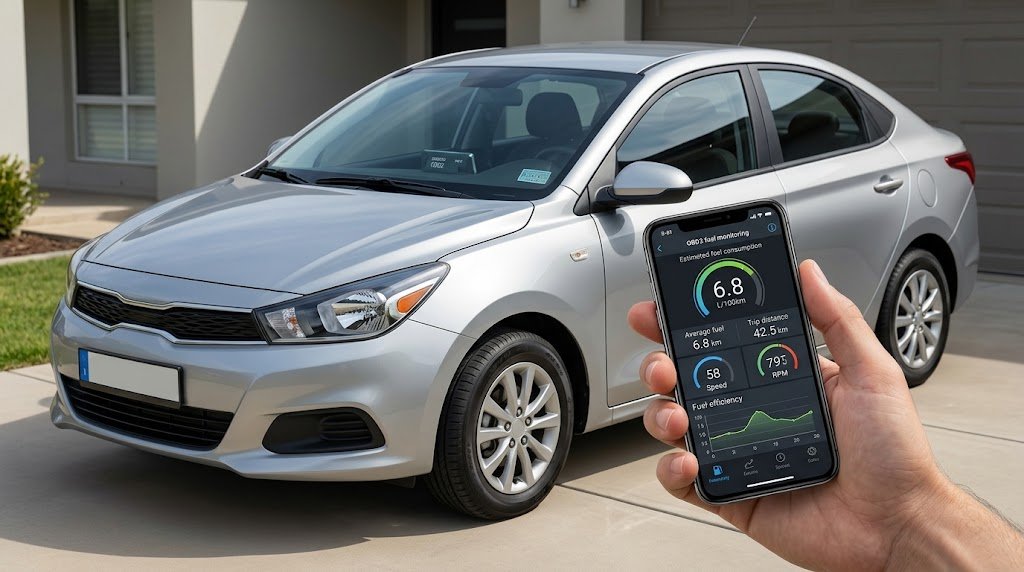
OBD2 fuel monitoring can help drivers understand how their vehicles use fuel and identify factors that may affect fuel efficiency. There are many factors other than vehicle type that can impact fuel efficiency. A car’s fuel consumption can be affected by a variety of factors, such as acceleration, engine speed, traffic conditions, tire pressure, load, air conditioning, and engine condition. Modern vehicles also store much data via electronic control modules and sensors. Some of this information is available to the driver with the aid of an OBD2 scanner app via a suitably compatible OBD2 adapter.
An OBD2 scanner app doesn’t have the ability to reduce fuel consumption in an engine. What it brings is the monitoring and understanding of vehicle data. Fuel-consumption estimates, engine speed, vehicle speed, sensor readings, diagnostic trouble codes, and more information can be displayed to the driver, depending on the vehicle and application. This information can be reviewed over a series of trips to let drivers know if they are making poor driving decisions and if their vehicle is performing differently than usual, which might indicate the need for additional tuning or repair.
OBD2 Apps for Monitoring Fuel Consumption
How OBD2 apps provide information about fuel will vary from car to car, OBD2 adapter to OBD2 adapter, and application to application. Some apps calculate fuel usage based on data provided by the car’s computer; others use driver-provided data (fuel bought, miles driven, etc.) and vehicle data. Fuel economy estimates, average fuel economy, trip distance, and other metrics are revealed based on the application.
These numbers are not to be taken as exact laboratory readings. Applications can calculate fuel consumption in various ways, and different vehicles provide different information via their diagnostics. There is still value in the data if it is monitored regularly, though. Crossing multiple trips or fuel periods may show patterns in fuel economy that would not be seen from a single fuel reading.
What Information Can an OBD2 App Provide
Fuel-Use and Trip Information
Certain OBD2 solutions can show the approximate fuel usage for a trip. This enables drivers to see the difference in fuel consumption when accelerating, cruising, idling, and during stop-and-go driving. Drivers don’t just find out how much fuel they have used after filling the tank; they can also learn more about what happens on an individual trip, within the tank.
Trip records may be more useful if they are obtained over time. A driver can compare fuel economy when driving in the city versus highway driving, or short trips versus long trips. This can help identify if the low fuel consumption is generally due to driving conditions or if fuel consumption looks unusually high on a variety of trips.
Engine Performance Data
An OBD2 app can also give information about the operation of the engine. Various data such as engine RPM, vehicle speed, coolant temperature, throttle position, airflow-related readings, and other sensor data may be available, depending on the vehicle. Combined, these values can provide drivers with an understanding of the engine’s response to various driving conditions.
Fuel economy may also fluctuate for reasons that can be helpful to have engine performance information. For instance, once a warning light has displayed and the consumption suddenly drops, diagnostic trouble codes could give a first indication that a system is in need of investigation. A diagnostic code does not always help determine the exact component which has failed, however, and more testing might be required.
Impact of Driving on Fuel Efficiency
Acceleration and Engine RPM
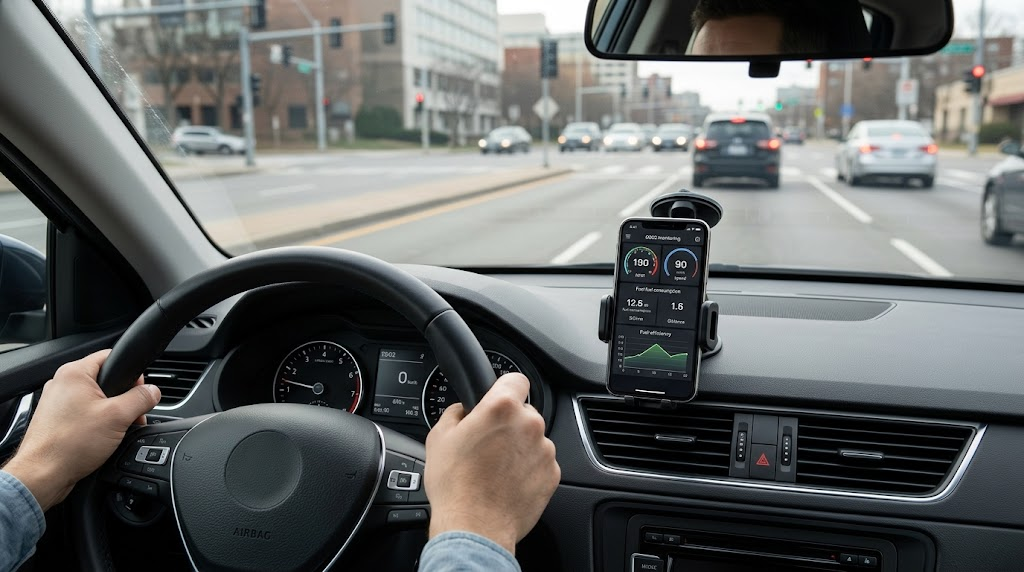
Fuel consumption is directly related to driving behavior. During hard acceleration, the engine has to generate more power, potentially leading to higher fuel consumption. Excessive idling is another factor that can impact fuel efficiency, depending on the vehicle and road conditions, if the engine remains idle for an unnecessarily long period of time.
With an OBD2 app, it’s a lot easier to see these changes as drivers can compare their engine RPM, vehicle speed, and estimated fuel consumption. This can help to promote a more gradual increase in speed and a steady driving rhythm. However, instead of making all the assumptions, drivers can benefit from their own driving experience and learn how their driving practices affect their vehicle.
Excessive Idling and Stop-and-Go Traffic
A car’s engine can still run while the car sits idle. This can result in unnecessary fuel consumption, especially if idling times are prolonged or if they are frequent. A few OBD2 apps will be able to show the RPM of the engine and the estimated fuel consumption, which will help the driver know what is happening during the time that the car is running without any movement.
Another obstacle to fuel efficiency may be traffic. Increasing the number of times someone accelerates, brakes, and starts moving as they drive can lead to higher consumption than if they drive at consistent speeds. Although drivers may not always have the luxury of not driving in congested conditions, the trip information can indicate the impact of congestion on fuel economy. This information can help foster good habits like planning shorter trips when they can be made and refraining from unnecessary idling.
OBD2 Data for High Fuel Consumption
Rapid fuel consumption sometimes means that the vehicle has undergone some changes. An OBD2 application can read the diagnostic trouble codes and show the information about the sensors available to the driver, providing them with useful information when investigating the issue. Poor fuel economy combined with an engine warning light, rough running, or other noticeable change can be used as a starting point for further inspection based on diagnostic data.
But don’t rely on an OBD2 code to tell you what part is broken. A code usually signifies what conditions or system have been detected, but does not always give a full diagnosis. Sometimes symptoms can be related to issues with sensors, wiring, air intake, fuel delivery, emissions systems, or other components. Therefore, professional diagnosis might be required prior to repairs.
How to Track Fuel Consumption Over Time
The best way to do this is to track fuel economy regularly—even if no warning signs seem to be there. The drivers can log fuel purchases, mileage, trip distances, and fuel-consumption estimates from the app. This data can be used to compare fuel consumed in multiple refueling cycles to gain a better understanding of fuel consumption patterns.
The circumstances of each journey should also be noted. Fuel economy can vary due to heavy traffic, tire pressure, load, weather conditions, the use of air conditioning, and driving style. Considering these factors makes the data understandable. If one of the poor results is due to challenging driving conditions, don’t worry. But if the results are poor on all similar trips, you should investigate further.
Selecting an OBD2 App for Fuel Monitoring
Some OBD2 applications offer more fuel-monitoring capabilities than others. Fuel-efficiency drivers should seek an app which can record trips, calculate fuel economy, provide live data, diagnostic trouble codes, and historical data. A clear dashboard is helpful, too, as the information from the various sensors can be complicated and hard to understand if it is just dumped on the screen.
Before using an app or adapter, think about how it will fit in with the other applications. Various vehicles provide various diagnostic parameters, and some applications need a certain data set to be able to calculate vehicle fuel consumption. The level of communication with the vehicle may also be influenced by the quality of the OBD2 adapter. It’s important to verify compatibility if you’re particular with the specific vehicle in question to reduce disappointment and guarantee that the app supplies the information that the driver is in search of.
Restrictions With OBD2 Fuel Monitoring
There are some limitations to fuel monitoring using OBD2. The estimates for fuel consumption are dependent on the vehicle, application, adapter, and data provided by the car. Consumption can also vary greatly depending on the environmental conditions and driving behavior. Therefore, the number that an app shows should just be used to track the trend and not be seen as a true number.
Using an OBD2 app is in no way a substitute for maintenance or professional diagnosis. Some mechanical issues may not set a trouble code, and some may need more in-depth testing or inspection. Problems with tires, brakes, wheel alignment, mechanical problems, or any of the systems could require more attention than an OBD2 connection can provide.
Does an OBD2 Scanner App Make a Difference in Fuel Economy?
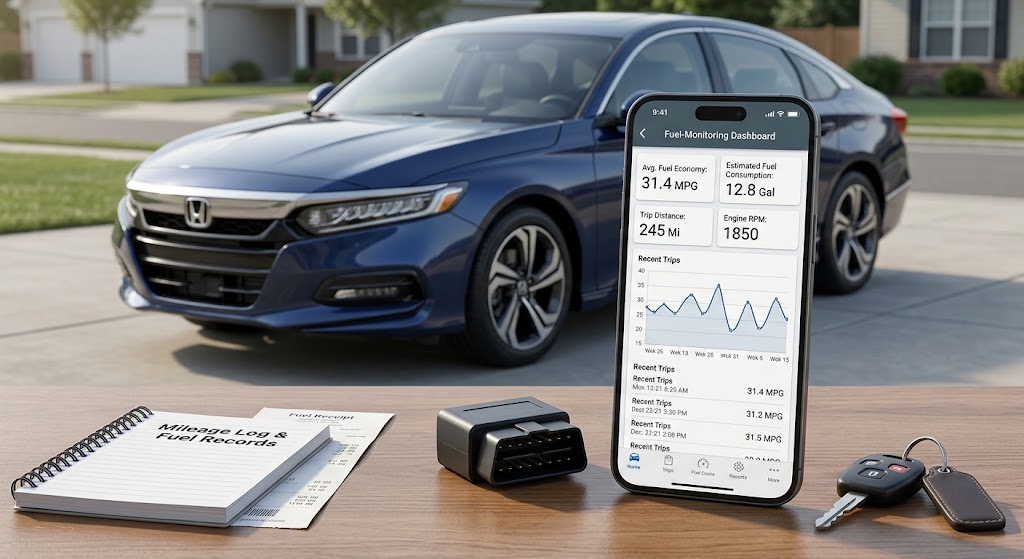
Using an OBD2 scanner app can indirectly enhance the fuel efficiency of the driver. It cannot alter the engine or fuel economy without being combined with other technologies. Rather, it provides drivers with data that can alert them to potentially poor driving habits and shifts in how the vehicle is driven. For instance, a hard acceleration might lead to significantly more fuel usage, or multiple short trips may lead to lower fuel efficiency.
The same information can also aid the driver in keeping track of any vehicle issues. If fuel usage increases and remains high when driving under the same conditions, OBD2 information can be helpful in further investigation. This information, if taken in conjunction with good maintenance practices and safe driving practices, can turn fuel monitoring into a more usable and quantifiable process.
Conclusion
An OBD2 scanner app can help you to understand how your vehicle uses fuel and what factors can affect it. The driver can view the estimated fuel economy, trip data, engine data, sensor data, and diagnostic trouble codes depending on the model and use. These features can be helpful in relating driving operations to fuel use and provide some data when fuel use is not as predicted.
Here lies the difference: OBD2 data is a tool for monitoring rather than a magic bullet for improved fuel economy. Record performance for several trips, compare performance of similar runs, keep the vehicle in good condition, and investigate any unusual changes if they continue. In this capacity, an OBD2 app can enable drivers to gain insight into their vehicle and make appropriate adjustments that can help to quantify the amount of unnecessary fuel usage.