Introduction
Buyers and sellers engage in transactions and this affects the market and, subsequently, the price of goods. There are many examples of transactions including the purchase of food, transport and housing and so on. Demand, supply and price are key economic principles which relate to buyer and seller behavior. Demand reflects the desire and ability of consumers to buy goods and services and is affected by price. Likewise, supply refers to the desire and ability of producers to supply goods and services. Price then acts as the link between demand and supply. Studying Demand and Supply in economics therefore allows us to analyze why items can become highly priced when there is a shortage of them, why prices can fall when there is an abundance of goods and how companies can adapt to evolving buyer requirements. Demand and supply principles thus underpin a market economy as they largely dictate the pricing of, as well as the supply of, goods and services.
The Law of Demand
The law of demand demonstrates all else being equal, how consumer demand typically falls as the price of an item rises. Generally, consumer demand will tend to rise as the price of an item falls. People have a defined level of income which must be allocated across expenditure. Thus, for example, where rice prices rise substantially, some people may cut back on buying rice and opt for lower cost goods such as beans, garri or other basic foodstuffs. Alternatively, where rice prices decline, people may begin to purchase more. This highlights the significance of price in shaping consumer behavior. As a result, the demand curve will typically slope downwards from left to right.
Factors Affecting Demand
Whilst price is a significant determinant of demand, a range of further variables can impact on buyer behavior. Firstly, income levels play a defining role in shaping consumer demand as higher income levels can enable people to afford more and lower income levels may result in people restricting expenditure. Moreover, people’s likes and dislikes can also affect demand, as evolving trends, lifestyles, health concerns and other considerations can cause demand for, and/or dampen demand for, certain goods. Associated item prices can further affect demand. For example, should the price of beef rise, some consumers may opt for chicken as an alternative. People can also be affected by their expectations regarding future prices. Should individuals expect prices to rise, they may even boost current buying in anticipation. Ultimately, population growth, seasonality and marketing can all contribute to affecting demand by altering the number of potential buyers and buyer preferences.
Demand Schedules and Curves
Demand schedules and curves are analytical tools which economists use to show how consumers’ demand is affected by price. A demand schedule is essentially a list detailing the volume of an item that is likely to be purchased at different prices, during a defined timeframe. People may for instance buy five bags of rice at a price of ₦80,000 per bag but only wish to buy three bags when the price of rice increases to ₦100,000. Price is shown on the vertical axis and quantity demanded on the horizontal axis of a demand curve. Again, this curve will typically slope downwards to emphasize the negative correlation between price and demand. Just as with demand, supply can both shift and move along a curve. Price alterations will result in a movement along a demand curve. Alterations to income, preferences, population and other non-price variables will however see a demand curve shift.
The Law of Supply
Similar to demand, the law of supply reveals how, all else being equal, the volume of an item that is supplied is often positively affected by its price. Greater prices can often lead to greater company profits and thereby stimulate firms to boost supply. Conversely, as prices fall, companies may choose to lower supply as production can become less enticing and/or lucrative. For instance, given that the potential income from growing tomatoes may increase, farmers may wish to grow more tomatoes where tomato prices are high in order to cover extra costs incurred in, for example, labour, seeds, fertilizer and transport. Nonetheless, should tomato prices slump, some farmers may curtail tomato production and diversify into other crops. Hence, the supply curve generally slopes upwards from left to right and effectively demonstrates how companies adapt to shifting market prices.
Factors Affecting Supply
Numerous elements can affect the extent to which companies are willing and able to supply. Production expenditure is especially influential as a firm’s profitability is often impacted by costs incurred in obtaining resources, employing staff and accessing electricity together with those associated with transport and equipment. Companies may scale back supply and/or raise prices where these production costs rise. Technology can also affect supply as enhanced machines and production techniques can improve efficiency and allow firms to boost supply, at lower costs. Government policy can similarly affect business supply. For example, where the government offers subsidies for farming resources, farmers may seek to expand food supply. Finally, the number of suppliers within a market is relevant as typically the greater this figure, the greater will be overall supply. Weather, natural disasters, resource availability and expectations about future pricing can also affect supply.

Supply Schedules and Curves
A supply schedule is essentially a list which sets out the volumes of an item that companies are prepared to supply at differing prices, again for a specific timeframe. For instance, holding all other factors constant, a bakery may be prepared to supply 180 loaves of bread per day where the selling price is ₦700 per loaf compared to just 100 loaves where the price is ₦500. Price is once again illustrated on the vertical axis and quantity supplied on the horizontal axis of a supply curve. The upward slope of a supply curve emphasizes the positive link between price and supply. As with demand, supply can both shift and move along a supply curve. Price variations will result in a movement along an existing supply curve. Alterations to production expenditure, technology, taxation and/or the number of suppliers will however cause a supply curve to shift.
Market Equilibrium – Using Demand and Supply to Determine Price
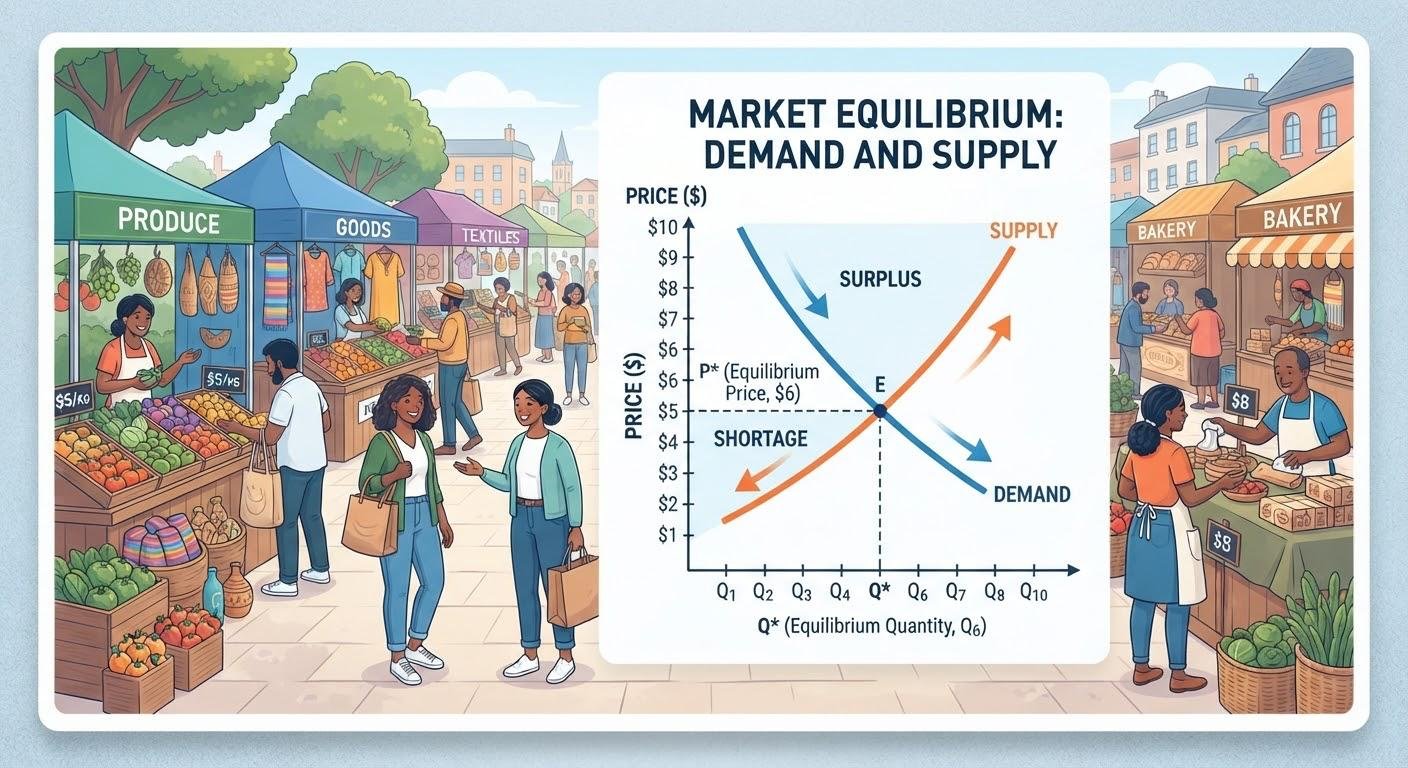
Market equilibrium is established where the volume of an item demanded by consumers is equivalent to the volume supplied by producers, at a given price. This price is termed the equilibrium price and the relevant volume of supply and demand is known as the equilibrium quantity. Consequently, at this stage, there is usually no urgent requirement for market price to alter as the number of people wishing to buy an item is in line with the number of people seeking to supply it. Should market price exceed the equilibrium price, supply will frequently surpass demand, creating a market surplus. Companies may then lower their pricing in an effort to attract more buyers. By contrast, should market price fall below the equilibrium price, demand is likely to exceed supply and this can place upward pressure on market price. Demand and supply therefore work together to shape the price at which goods and services are sold in a competitive market.
Price Elasticity of Demand and Supply
Price elasticity identifies the extent to which demand and/or supply will change in response to a price variation. Price elasticity of demand quantifies how responsive consumer demand is to price and price elasticity of supply demonstrates how easily supply can be modified in response to changes in price. Demand is deemed to be elastic if relatively large variations in demand occur as a result of relatively minor price fluctuations. Usually, goods which have numerous substitutes or which are not essential will exhibit this characteristic. Consumers for instance may readily switch between soft drink brands where one brand’s price rises. Nevertheless, demand for essential medicines is often relatively inelastic as people may still endeavor to obtain such products despite price increases. Supply can also be elastic or inelastic and this is contingent upon, amongst other things, a firm’s production capabilities, resource availability and the time-frame within which a company can react to market change.
Real Life Applications of Demand, Supply and Price
Demand and supply theory is evident within many real-life markets including food, transport and housing. Food supply can be impacted by adverse environmental factors such as drought, flooding and pests which can all affect the availability of key foodstuffs, such as tomatoes, onions and rice. Provided that consumer demand for such goods is robust, a lack of supply can in turn drive up pricing. Within the transport industry, companies may experience heightened production costs due to increased fuel prices and so may increase ticket charges to sustain profitability. Again, higher transport prices can prompt some people to avoid superfluous travel and/or to seek alternative transport. Likewise, within the housing industry, where a city’s population expands and housing supply fails to keep pace with this, rental prices may climb. Improved availability of building resources, technology and land can then enhance housing supply and alleviate rental price pressures in due course.
The Impact of Market Forces on Price
Within a market economy, market price is continually shaped by market forces relating to both demand and supply. Typically, where demand grows but supply is static, market price will rise as more people seek to obtain goods. For instance, greater demand for generators may cause companies to raise their prices for these, particularly where stocks are constrained, in response to inconsistent electricity supplies. By contrast, where demand wanes and supply remains steady, companies may lower prices in an effort to entice a reduced number of prospective buyers. Alterations to supply can also affect market price. Enhanced production technology and/or favorable harvests can for example increase supply and thus, where demand is unaffected, typically depress market price. Reduced supply will tend to have the reverse effect. Where both demand and supply evolve, the net impact on market price will depend on the magnitude and nature (i.e. whether they are increasing or decreasing) of these changes. Clearly then, a multitude of factors can impact on market outcomes.
The Significance of Demand and Supply
Knowledge of demand and supply is valuable for businesses, consumers and governments. Businesses utilize demand data to inform decisions on which goods to produce, how much stock to hold and what prices to set. Farmers may for instance boost crop production where strong demand exists for particular crops. Retailers can also modify their stock holdings in line with consumer demand. Meanwhile, consumers stand to gain by comprehending demand and supply as they can then more effectively decide how to spend their money, evaluate options and predict how market developments might affect their finances. Governments also leverage demand and supply knowledge when devising strategy in areas including food, housing, transport, taxation and core services. Although actual markets can also be influenced by elements such as competition, government involvement, market power and unforeseen occurrences, demand and supply are key in analyzing how market price and supply are determined.
Conclusion
Demand, supply and price are key concepts which facilitate analysis of buyer and seller behavior. The law of demand highlights that, generally speaking, consumer demand will rise as price falls and the law of supply indicates that typically, as price increases so will the volume of goods that companies are keen to supply. Demand and supply schedules alongside market curves and price elasticity are all effective ways of analyzing demand and supply and ascertaining how individuals and organizations react to economic development. Market equilibrium effectively integrates demand and supply to establish the price at which supply and demand will balance. These principles are pertinent to numerous aspects of everyday life including food, transport, housing and household goods. Thus, a good comprehension of demand and supply enables individuals to understand the rationale for market price variations, supply and demand shortfalls and surpluses together with supply evolution. Such knowledge therefore establishes a solid basis for appreciating how a market economy functions.
Get more well researched information about Demand, Supply, and Price here.


