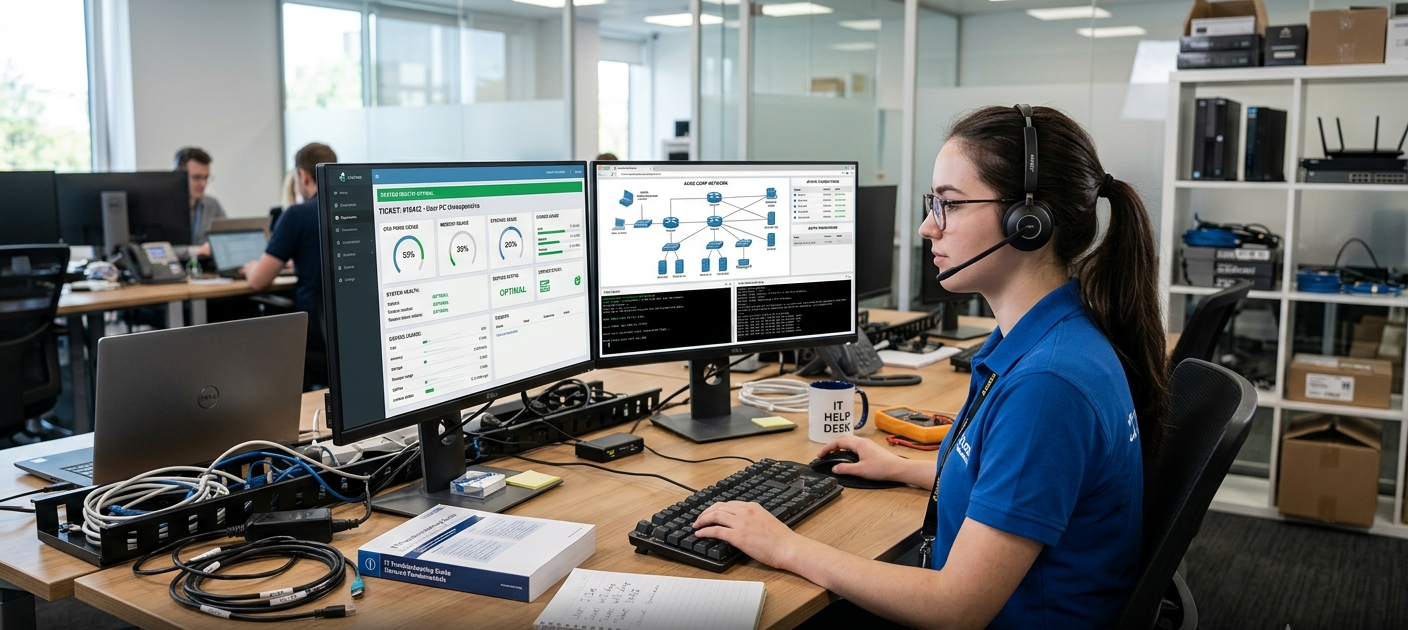
The IT industry can be daunting as there are numerous specialties, such as artificial intelligence, data analysis, networking, software development, cloud computing, and cyber security. A lot of students think that they would need superior programming skills or years of experience in the field before they can find a first job in the IT industry. One of the more practical entry points into the technology sector is, however, provided by IT support and help desk positions, which enable everyone from novices to hone important technical skills while simultaneously getting valuable hands-on experience in the workplace. IT support professionals assist users resolving technology-related issues, maintain computer systems, troubleshoot hardware and software problems and ensure that the organization functions efficiently. These duties lay a solid groundwork that can translate into higher-level IT jobs.
This is a career in IT support that’s valuable because of its blending of technical knowledge and communication skills. Support professionals deal directly with users, and encounter a diverse range of issues daily, in contrast to certain technology positions where the workload primarily involves a narrowly defined set of tasks. A novice in the field of IT support can discover the way businesses utilize technology, what a network is, and the way operating systems function, as well as how to use security in actual environments. This exposure will allow the new professionals to learn about various domains of IT and also help them decide on which specialization they wish to pursue in future. No matter if a student chooses to become a network administrator or a cybersecurity specialist, cloud engineer, or a systems administrator, IT support equips them with the experience necessary to move forward in their career.
The role of an IT Support and Help Desk Professional
The IT support staff must maintain the systems in good working condition and help users deal with issues, if they arise. They might spend their day installing software, setting up computers, handling user accounts, fixing internet connectivity problems, fixing printer issues, removing malware and defending against it, configuring devices, and explaining technical solutions to employees. While they may seem like simple tasks, they are vital to the functioning of businesses and rely on technology. An organization that has technical issues that need to be addressed can have low productivity, security issues, and financial loss.
When a user has a problem with their technology, the help desk tech is likely to be the first person they will talk to. This implies that they need to be able to comprehend problems rapidly, ask the right questions and identify possible causes and solutions. The difference between a successful IT support and other IT professionals is that they don’t just fix a problem; they also document their solution, communicate effectively, and do everything they can to not have the same problem occur again. IT support professionals possess a blend of technical expertise and problem-solving capabilities, which makes them valuable assets in any organization.

The great thing about starting with IT support is that many of the entry level roles require no years of experience. Employers are more likely to see a candidate as inquisitive, eager to learn, technically knowledgeable and a good communicator. These qualities can be cultivated by a beginner by undertaking self-study, practice projects, and online learning and certifications or through volunteer work. While some technology careers mandate many years of academic programs, IT-Support provides an opportunity for an individual to develop a career by working in the real world.
IT support is also a realistic way to get a job in higher tech careers. People who used to answer support tickets, fix computers, and help users and then went into specialized jobs were many successful IT professionals. As a support technician, one learns about networks, security, servers, applications and company technology environments. This experience is a stepping stone to future growth, as future employment opportunities in IT may involve real-life scenarios where IT is part of the job.
Building the Skills to Tackle Common Issues
Troubleshooting is one of the most essential skills for anyone that wants to get into IT Support. Troubleshooting is the process of applying a logical approach to find the cause of a problem and decide on the best solution. Rather than trial and error or equipment replacement, IT personnel use systematic approaches to troubleshoot issues. One of the most typical methods used to troubleshoot a problem is to determine the problem, collect data, brainstorm potential solutions, experiment with solutions, implement a solution, and record findings.
Problems with troubleshooting should be practiced on a regular basis as technical confidence comes from practice. They are able to set up virtual machines to create practice environments, fix typical computer issues, install home networks and try out various types of software tools. If a person has more and more problems solved, then he/she will be better at recognizing patterns and quickly finding solutions. There are many IT specialties in which troubleshooting skills are applicable, as technology users routinely face unexpected problems.
Developing an understanding for hardware and software
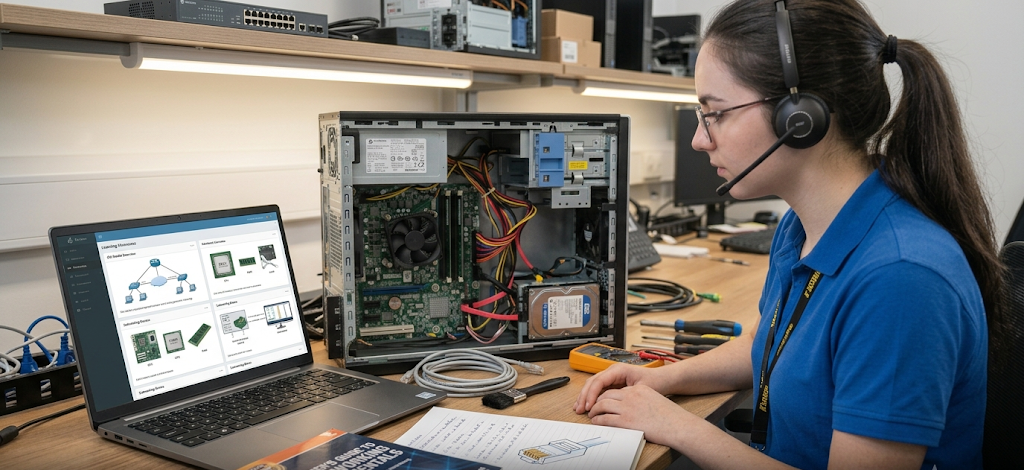
It’s important for a strong IT support professional to have a basic knowledge of computer hardware and software components. Knowledge of hardware refers to understanding processors, memory, storage devices, motherboards, power supplies, peripherals and common hardware failures. Computer software knowledge is the understanding of operating systems, applications, drivers, security software, and troubleshooting utilities. With these basics, support technicians can effectively diagnose issues and offer the right solutions.
The beginning student should be taught the interdependence of computer components and the interdependence of problems in one component on other component(s). Slow computer performance can be caused by running out of memory space, storage issues, malware, unnecessary background applications or outdated drivers. To grasp these relationships enables IT professionals to avoid speculations and apply evidence-based troubleshooting techniques. This is practical knowledge that is essential for any individual that wants to make it in any entry level IT job.

Operating Systems and Technical Foundations
Learning Windows, Linux, and Other Operating Systems
One of the most important skills for IT support personnel is knowledge of operating systems, as the majority of technical issues will involve operating systems. New users should feel at ease using common OS platforms (Windows, Linux, macOS). The importance of Windows is particularly great, as a large proportion of businesses use Microsoft based environments for their employees’ computers, applications and tools to manage them.
Knowing how to open programs is not the only thing involved in learning an operating system. IT support technicians need to know how users manage their accounts, how to configure systems, how to handle files, permissions, updates, security, command-line tools and troubleshooting utilities. For instance, the tools a Windows support technician might use to troubleshoot problems include Task Manager, Event Viewer, Device Manager and command-line commands. Knowledge in Linux is also important as many servers and technical systems are dependent upon Linux based environments.
Understanding Networking Basics
Another critical component of the foundations to build upon for success in IT support roles is networking knowledge. Newcomers do not need to be a network expert right away, but they should grasp the fundamentals of the network, like IP addresses, routers, switches, Wi-Fi networks, DNS, DHCP, and internet connectivity. Various help desk issues are related to network problems, so it is important for technicians to understand how devices communicate in order to resolve network issues better.
A novice should work on creating small networks and mastering the relationship between devices. They should learn about the distinction between local networks and the internet, be familiar with troubleshooting commands and how to deal with common connectivity issues. Knowing about networking also opens up doors for further career development, as numerous higher-level IT professions, such as cybersecurity and cloud computing, depend upon networking fundamentals.
Earning Foundational IT Certifications
Getting Ready For CompTIA A+
Certifications can be useful for the novice to show they know what they’re doing and make their first IT job more attainable. CompTIA A+ is a widely-used and popular entry-level certification that focuses on hardware, operating systems, networking, security basics, troubleshooting and technical support skills. The certification is geared toward those starting their careers in the IT field, and offers a systematic approach to acquiring the basic technical skills that are typically required of entry-level technicians.
Getting ready for CompTIA A+ gives the newbies self-confidence as they come across numerous technologies while taking up the course. Certification is not a substitute for hands-on experience, but it can certainly complement a resume and demonstrate to an employer that a candidate has invested time in furthering his or her technical skills. The combination of a certification study program and practical application provide a more solid base for entering the IT industry.
An understanding of ITIL and Service Management
For IT support technicians, another valuable certification subject is ITIL that is centered on IT service management. ITIL provides skills for professionals to help organizations deliver, manage and improve technology services. User experience, procedures, issue prioritization and service quality are a part of IT support, not just technical troubleshooting.
Knowing the concepts of ITIL will enable novices to align IT support with everything else and understand that computer repair is not the only thing that comes into the picture. It’s also about delivering dependable service that supports organisations to accomplish their objectives. The ideas of incident management, problem management, change management and service improvement are good as they illustrate the way a professional IT department works.
Developing Customer Service Skills for IT Support
Many novices only think about technical skills and neglect to consider client service skills. But one of the most essential skills that IT support professionals must have is communication since they deal with people who typically may not know the technology.
When helping users, a technician needs to have a clear explanation of solutions, patience, listening skills, and not use technical jargon.
Skills for Professional Support
Customer service skills can be learned by practicing the explanation of technical solutions, which is beneficial for the beginners. They should learn to ask clear questions, to summarise the problem correctly and to give step-by-step instructions. These skills can be developed through volunteer work, internships, school technology support and personal projects without entering the workplace.
IT support professionals are the tech department in an organization. Their interactions affect the overall impression of the whole IT team. If beginners have strong communication skills in addition to technical skills, they will be more competitive and prepared for the workplace.
How to get your first IT support job quickly?
Many people make the mistake of thinking that they must have a job before they can get experience. But there are numerous ways to gain some real-world experience before getting hired.
Building a home laboratory, making repairs on personal items, assisting friends and family with computer issues, involvement in online communities, and documenting projects that are completed can show job opportunities valuable skills.
Submitting applications for Entry Level Opportunities
If you are looking for your first IT job, it is best to target roles like help desk technician, IT support specialist, desktop support technician, technical support representative, and junior systems assistant.
These positions allow the opportunity to learn while gaining experience with experienced professionals.
Using IT Support as a Stepping Stone to Other IT Careers

It’s not for everyone to become a professional IT support! Rather, it may be a means to a higher education in the IT world. Once they have had experience, they can select areas that are in line with their interests and strengths.
A person with interest in security can obtain employment in cybersecurity, and an individual with a passion for infrastructure can enter into networking or systems administration.
Continuing education and career growth
The IT industry is constantly evolving, and it is important for successful IT professionals to keep learning throughout their careers. Once they have gained experience in support, they can pursue further certifications, specialization training and professional projects.
Depending on their career goals, they can acquire knowledge about cloud platforms, cybersecurity tools, automation, programming, or database management.
Conclusion
One of the easiest ways to enter the technology industry is as an IT support or help desk worker. They provide an avenue for the beginning learner to acquire troubleshooting skills, knowledge of operating systems, networking skills, and communication skills, and provide a realistic work experience. Students have the opportunity to develop confidence and gain jobs in the technology field by obtaining pertinent certifications in addition to hands-on experience, including CompTIA A+ and ITIL.
Once you’ve secured a position at the Help Desk, the road doesn’t stop there. Rather, support experience will provide exposure to more advanced positions in IT and specialization in topics that align with individual interests. If you are a beginner looking to transition your career into the technology field, IT support is not only a career; it is a stepping-stone to a successful career path in Information Technology.



I help career changers entering IT support find practical tools to speed up their learning. Your directory would be a useful addition to the resource list I share with people studying for CompTIA A+.