Introduction
Accounting internal controls are the policies, procedures, checks and practices that are implemented by a business to safeguard its resources, provide reliable financial information, reduce errors and fraud and ensure financial activities are carried out within the rules. While the term internal control typically refers to the accounting department, it can impact nearly any facet of the organization, from the purchasing, payroll, sales, inventory, banking, financial reporting, and more. A business owner and/or manager can feel more confident about the correct authorization, recording, review and support of transactions with a well-designed control system. For startups and small businesses, which may not have a big finance department or an accounting department, it is vital to understand the principles of internal control in accounting.
The consequences of financial mistakes can go beyond figures in an accounting system, therefore, internal controls are especially important. The wrong payment, wrong inventory, duplicate invoice, payroll mistake, or fraudulent transaction can impact profitability, and diminish management’s decision-making process. If there are no controls in place, staff might have too much access to the company’s material or money systems, transactions could be recorded without sufficient documentation, and mistakes can go undetected for a long time. Good internal controls are in place to provide accountability, making clear who is responsible and what are the processes for authorization, documentation, reconciliation, review and monitoring. They do not ensure that all problems will be avoided, however they substantially lower the chances and the level of monetary mistakes, misuse of resources and intentional misconduct.
What is Internal Controls in Accounting?
An accounting internal control may be described as the systems and procedures that a company has put in place to ensure that the company’s financial objectives are met in a reasonable way. These controls can be preventative, detective or corrective. Preventive controls are intended to prevent a problem from happening like obtaining management approval before making a large payment. A detective control is one that is used to detect issues or discrepancies after they happen, for example, verifying a bank statement with the accounting records to find unexplained discrepancies. Corrective controls respond to weaknesses identified and fix errors, recover losses or change procedures to help reduce the chances of similar errors occurring again. These methods collectively constitute a strategy to ensure a business has financial control and to facilitate effective business operations.
Internal controls may be manual, automated or a mixture of both. An example of a manual control would be a manager having to review and sign an expense authorization form, whereas an automated control would be accounting software that would not allow an employee to approve their purchase request. A control environment that is most effective typically will contain a mixture of technology and human judgment, as automated tools can help maintain consistency and speed; however, there still will be a need for people to investigate unusual transactions and respond to situations in which technology is not always so well-informed. Importantly, the internal controls should be designed based on the size, structure, risk and activities of the business. While a small company may not be as complex as a multinational corporation, it does require proper protection of its money, records, inventory, information and other valuable assets.
Purposes of Internal Controls in Accounting
A primary purpose of internal control is to help protect the assets of the business. Assets refer to cash, bank balances, inventory, equipment, property, financial instruments and valuable information. Assets may be stolen or misused, assets may be involved in unauthorized transactions, bad record keeping, or operational errors can result in the loss of assets. If, for instance, a business permits one employee to accept payments from customers, to enter the amounts into its own books and records, to make deposits and to ensure that the bank account is balanced, it may be challenging to discover any irregularities. Where feasible, the separation of these responsibilities will give one another an extra protection. Other physical controls, access controls, authorization controls, inventory controls, and periodic reconciling can also minimize the possibility of the misappropriation or improper accounting of valuable resources.
Another crucial goal is to provide accurate and reliable financial reporting. Accounting information is used by the business owners, managers, investors, lenders, regulators, and other stakeholders to gain insight into the financial condition and performance of an organization. Financial statements could give a false picture of the business if transactions are omitted, have been duplicated, misclassified, or entered in the wrong accounting period. Internal controls that minimize these risks include the need for supporting documentation, authorizations, reconciling, review, and proper accounting procedures. For example, monthly bank statement reconciliation can help to detect any missed transactions or incorrect payments entered. Likewise, auditing A/R can be beneficial in uncovering overdue payments and any unusual activity on customer accounts prior to any bigger problems.
Internal controls further help the organization adhere to laws and regulations, accounting procedures, contracts, and internal company policies. Compliance is required in different legal and regulatory environments, otherwise businesses may face financial penalties, damage to reputation, legal issues, and restrictions of operations. Some of the areas where controls can be used to ensure that employees are performing approved procedures include payments, access to data, financial reporting, purchasing, taxation and payroll. Compliance controls are not just documents that are seldom read by employees. They need to be embedded in daily practice and the right action become part of the normal business process. Having knowledge of both the requirements and the reasons for these makes it easier to maintain compliance and management can be able to uncover potential weaknesses before they become big issues.
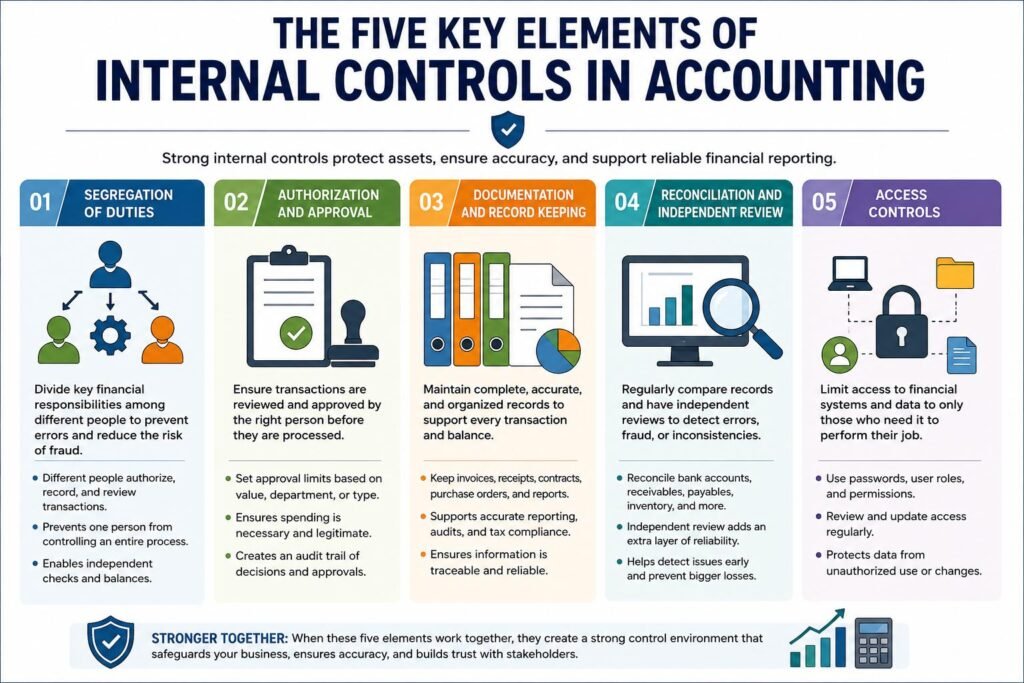
The Five Elements of Internal Controls
1. Segregation of Duties
Prevention of undue concentration of responsibility is one of the most important principles of internal control, because segregation of duties does this. Preferably, various workers need to be involved in authorizing transactions, making the records, maintaining custody of the assets and checking the records. For instance, the person responsible for preparing a payment to a supplier may not be the same person who approves the payment and is responsible for making bank payments reconciliation. By splitting these roles it is possible to provide for independent review points and to make deliberate manipulation less easy. Small businesses may not be able to completely separate, but the owner can put in measures to compensate, such as reviewing their bank statements personally, watching the unusual ones, or requiring approval for larger purchases.
2. Authorization and Approval
Authorization controls prevent unauthorized transactions from taking place by ensuring that transactions are authorized prior to them being processed. Approval limits can be set at the business level using the transaction value, the department or the type of the transaction. For instance, department managers may give permission for routine purchases and capital expenditures may need approval from senior management. The authorization process minimizes the risk of unauthorized expenditure and helps to define the decision-making position. They also document a trail where a transaction was reviewed prior to committing company resources. This, however, is not a hassle-free but not really effective authorization, though. Important transactions should be subject to suitable checks and the level of approval should be tailored to the risk and business requirements of the business to avoid slowing down standard business activity.
3. Documentation and Record keeping
Good documentation will show evidence of financial transactions and that they have been processed in line with company procedure. Other documents like invoices, receipts, purchase orders, contracts, payroll, payment confirmations, bank statements, and other supporting documents can be useful to accounting teams to reconcile transactions and account balances on financial statements. Record keeping also helps to facilitate audits, tax preparation, management reviews, and financial analysis. Documentation should be full, accurate, easy to access and stored as per applicable requirements and company policy. With digital accounting systems, this can be made easier to do by attaching supporting documents to transactions, and keeping electronic records. If the documentation is incomplete or there are inconsistencies, it is much more difficult to establish whether a transaction was valid, properly valued, properly authorized and properly recorded in the proper accounting period.
4. Plan for Reconciliation and Independent Review
Reconciliation is the process of comparing records to look for and investigate any differences. While bank reconciliation is perhaps the most common reconciliation, businesses can also reconcile accounts receivable, accounts payable, inventory records, payroll information, cash collections and other financial data. Independent review provides an extra level by involving a third party who was not involved in the preparation of a transaction or report to review it for any unusual items, errors or inconsistencies. These controls are especially beneficial as even good employees can make errors. If the problem is discovered earlier than it becomes serious, then regular review is helpful for management to uncover them before they build up. Reconciliations should be done at regular intervals depending on the risk and number of transactions, for high-risk activities or high volumes, more frequent reconciliations are desirable.
5. Access Controls
Access controls limit access to financial systems, company bank accounts, accounting records, databases and other sensitive resources. Access to employees should be limited to the level of access necessary to carry out their responsibilities. For instance, an employee who is entering suppliers’ bills of entry might not require authorization to create new bank beneficiary accounts and to release payments. Effective access controls may involve different user accounts, password encryption, two factor authentication, access permissions by roles, access approvals and regular audits of access. Access should also be removed or changed in a timely fashion when an employee leaves the organization or changes roles. With the growing reliance on cloud accounting solutions and digital payment methods, access management has become a crucial financial management aspect, not just an IT issue.
Types of Internal Controls
Internal controls are generally categorized as preventive, detective and corrective controls based on the time they are used and their purpose. Preventive controls try to prevent errors and/or unauthorized actions from occurring. These may involve approvals, password, segregation of duties, spending limits, etc., and automated validation rules. Detective controls are used to uncover issues once they have arisen, such as bank reconciliations, inventory counts, financial reviews, exception reports and internal audits. Corrective Controls are implemented when a weakness or problem has been identified. These can be correcting an accounting entry, getting back an amount that was paid but shouldn’t have been, making changes to employee permissions, making improvements to documentation, or redesigning an ineffective procedure. A strong internal control environment typically incorporates the three categories of internal control since not all risks can be prevented.
Technology has also revolutionized how businesses have been implementing internal controls. Accounting software can automate the approval workflow, limit user access, identify any odd transactions, keep auditing logs, and even avoid certain data entry errors! Automated controls can be especially beneficial in businesses where there are numerous transactions in a day as it offers consistency without having to keep manual check on each of the routine activities. However, no automation can take the place of supervision. Bad configurations, insufficient access, faulty data or improper overrides can pose additional risks. Regular checks of automated controls should therefore be conducted to ensure the controls are performing as intended, preferably by management periodically. Businesses should also make sure that their employees know what to do when systems flag exceptions instead of taking them for granted as being an automated process error.
Examples of Internal Control
Examples of internal controls in practice are in the accounts payable process. Assume a company has an invoice from a supplier. The controls may be as simple as having to match the invoice with an approved purchase order and receipt of goods or services. One employee could then input the invoice into the accounting system, and an authorized manager could provide approval and payment for the invoice. The payment may be processed by an individual or a workflow in the system and then the bank activity is reconciling with the accounting records. This way, there are several points in the process at which errors and suspicious activity can be identified. It also helps to prevent paying fake invoices, paying the same invoice twice, and having goods purchased without permission and paying for goods that were never received.
Payroll is an example of a process that is useful. Payroll controls may consist of limiting access to employee data, controlling for new hires and payroll adjustments, auditing timesheets, splitting payroll data preparation from payroll checks approval, and reconciling payroll reports with general ledger. These controls are vital since payroll is typically among the significant on-going costs that a company incurs. Poor payroll controls can cause problems with salaries, unauthorized bonuses, paying to former workers, duplicate employees or fraudulent updates to bank information. Checking the employee master file and payroll reports periodically can provide some assistance in detecting unusual changes. With the use of preventive controls and the independent review and reconciliation of employee-related accounting records, companies can safeguard their accounting records and their financial resources.
Role of Internal Controls in Managing a Small Business’s Finances.
While some small businesses may think they don’t need to have internal controls because they don’t have a large finance department, this can actually put them in a vulnerable situation. Within a small company, the staff may have to have multiple financial obligations since they are not able to split work. This makes it imperative that the owner is able to monitor and that there are compensating controls in place. The business owner might look at bank statements monthly, authorize large payments, audit expense reports, and audit the books on a regular basis and compare them with paper receipts. These actions need not be carried out by a large internal audit department. They just establish the independent supervision which will make the financial activity more transparent. Good controls can also be introduced early in small businesses so that they can get into the habit of them, which will make it easier to expand their finances as the business expands.
When well structured, internal controls can serve to enhance operational efficiency. Some controls are perceived as cumbersome and hindering procedures that slow employees down, but proper controls can help eliminate confusion and redundant work. Clear approvals eliminates confusion about who can approve a purchase, standard documentation facilitates transactions and eliminates the need for any unnecessary communication and automated workflows can direct transactions to the proper person. Controls provide information to managers to help them identify weaknesses in business processes. An unclear ownership of approvals could often be the problem rather than employees, since invoices may not be getting paid when they are due. Therefore, enhancing the control environment has a potential for financial protection and operational benefits.
How to Create Effective Internal Controls
The first step in financial risk and business impact analysis is to define financial and operational risks that may impede the success of businesses in achieving their goals. Management may ask questions about assets of highest value, financial exposure for transactions, most common areas of error, access to sensitive systems, and potentially areas of activity that may be susceptible to fraud or unauthorized use. With an understanding of the risks, the business can then create controls to mitigate the highest risks. Procedures for controls should be commensurate to the risk too much control could be more expensive without offering any real benefit. The aim is not to slow down the entire transaction process by asking for multiple approvals, but to put in place sensible checks and balances for transactions that may result in larger losses if the transaction has an error, is fraudulent, or is misused.
Once controls are in place, management should clearly define responsibilities and offer training to employees for management. Staff members should be aware not only of the procedure that they are expected to perform, but also of the rationale behind the procedure. Documented policies can set limits on purchases, approvals, documentation standards, access, reconciliation and reporting. Managers should then be aware if the policies are being adhered to. It’s not that much of a safeguard if a control is only documented but seldom followed. Regular reviews can be used to identify if controls are still suitable given the business’ change. New employees, new software, more locations, more transactions, acquisitions and regulation changes can all discover new risks that necessitate changes to the control environment.
Common Weaknesses in Internal Controls (CWIC)
Many people have a tendency to have one employee responsible for too many aspects of a financial transaction. This can be due to shortage of staff, convenience, or lack of knowledge of the hazards. Another vulnerability is granting access to the system that is too great, especially for employees who have had their access rights to the system remain after they have moved on to a new position. It can also be challenging for businesses to keep up with documentation and reconciliation, as well as use informal approvals and fail to monitor. Another possible risk is management override, when the top-level employees override the procedures. Occasionally there may be exceptions in extraordinary situations, but continued overrides can have a negative effect on the entire control system. Put significant exceptions in writing, look into any unusual behavior, and consider if there is any regular override that means something is not working in the current processes or if it’s being intentionally slowed.
It’s also possible for controls to become ineffective if they aren’t updated in response to the changing nature of the business. What was successful for a small company of five employees might not be effective with a large company of fifty employees. Also, manually approving transactions can become inefficient with a significant surge in transactions. New technologies can bring new opportunities for automation but can also pose cyber security and access risks. This is why internal controls should be viewed as a management process and not a project. Regular risk assessments, management reviews, internal (where applicable) and employee feedback can result in businesses being aware of any weaknesses and able to make improvements. The continuous evaluation will ensure that the control environment is relevant to the organization’s present operations and risk profile.
Internal Controls and Sustainable Business Growth
Internal control is important for sustainable business growth because management can grow their businesses without the loss of financial visibility and accountability. Informal processes grow increasingly difficult as revenue, number of employees, customers, suppliers and transactions grow. A reliable control system that is put in place early can be used to develop repeatable systems to aid growth and mitigate unnecessary financial risks. Record keeping enables management to determine the profitability, cash flow, liabilities and operating performance of the business, which enables the leaders to make sound decisions on hiring, expanding, investing, pricing, and allocation of resources. Controls thus are not just about fraud; they are about establishing the certainty of financial information and the certainty of processes of growing organizations.
The confidence of the stakeholders can also be boosted due to a strong control environment. Financial information is more likely to be trusted by investors and lenders if there is an appropriate authorization, documentation, reconciliation and review process applied to transactions. Employees have clear roles as they know what they are expected and who has authority to take decisions. When financial processes are reliable; payments, invoices and contracts are accurate, and records are accurate, it can be an indirect benefit to customers and suppliers. As time goes on, these benefits can help to build better governance, better decision making, better resource management, and increased organizational resilience. It’s important to consider internal controls as an investment in the long-term health of the business, and not as an administrative burden.
Conclusion
Internal controls in accounting are vital systems that can be used to safeguard assets, identify and avert errors, deter fraud, ensure accurate financial reporting, or help a business meet its required obligations. They are effective based on the principles of practical implementation like segregation of duties, authorization, documentation, reconciliation, independent review, access control, continuous monitoring. Preventive, detective and corrective controls can be integrated to tackle risks across their financial processes. Technology can automate many control activities but there are some control activities that must be done by management and employees, such as the proper configuration, monitoring, and reviewing of systems.
The best internal control system an organization can have is the one that is commensurate with the size, activities, risks and growth goals of the organization. Small businesses don’t have to replicate large companies’ sophisticated control mechanisms but should have sensible safeguards of cash, payments, payroll, inventory, accounting records and financial systems. As your business expands, so do its controls. Businesses can build a more secure environment for sustainable growth, operational discipline, and protection of valuable resources while making internal control a habit of financial management to ensure the reliability of accounting information.
Get more well researched information about Internal Controls in Accounting here.