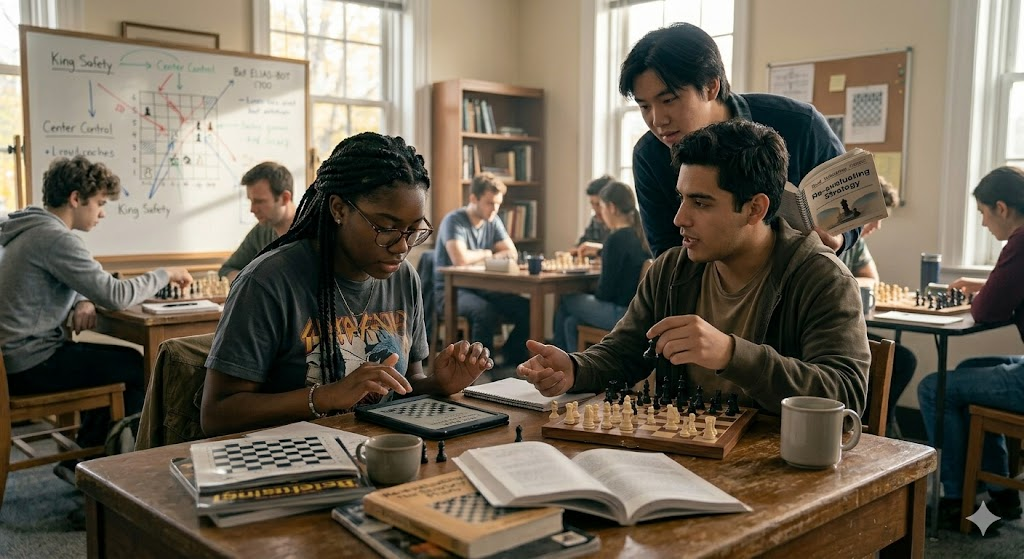
My chess club friend Tariq has this thing he says whenever someone complains about being stuck at a rating: “You are not stuck. You just keep making the same mistake and hoping for a different result.” Annoying thing to hear. Also, in my case, completely accurate. I had been hovering around 1230 for the better part of a year and a half. Same openings, same middlegame drift, same endgame panic. I decided to try something different, specifically ninety days of daily practice against a proper chess bot instead of grinding rated games against random online opponents. I kept rough notes. What follows is what actually happened, including the parts that did not go the way I expected.
Fair warning: this is not a success story with a clean arc. It is messier than that. But I think the mess is actually the useful part.
Days 1 to 12: More Frustrating Than Expected
The first stretch was rough, and not in the productive way. I had assumed that switching from human opponents to bots would feel easier; less pressure, more controlled. In some ways it was. But I kept running into a specific problem: I could not figure out what to actually work on. I would sit down to practice, open the platform, stare at the list of available bots, and then just pick one randomly and start playing. Which is almost the same as what I was doing before, just against a different kind of opponent.
The games themselves were fine but I was not learning much. I would win some, lose some, and at the end of a session have only the vaguest sense of what went right or wrong. Around day ten I almost quit the whole experiment because I was not seeing any obvious benefit. I am glad I did not, but I also think there was a real problem in those early days that had nothing to do with the bots: I had no structure to the practice at all.
The Shift: Deciding What I Was Actually Practicing
Around day thirteen I did something that sounds obvious in retrospect. I wrote down, before each session, one specific thing I wanted to work on. Not “get better at chess.” Something concrete: today I am practicing not moving the same piece twice in the opening. Today I am practicing keeping my king safe before starting an attack. Today I am practicing calculating one move deeper than feels comfortable before committing.
That change made an immediate difference. Suddenly every game had a purpose beyond winning or losing. If I blundered but kept my king safe the whole game, that was still a partial success. If I won but moved the same knight three times in the first eight moves out of habit, that was worth noting even though I won. The bots became a training tool rather than just an opponent, because I was finally treating practice like practice instead of like a casual game.
I cannot overstate how much this mattered. The bot was the same. I was the same player. The only change was intentionality, and it produced a different quality of attention that made each session genuinely useful.
What Happened to My Opening Play
Before this experiment, my approach to openings was embarrassing in its inconsistency. I played the Italian Game as White when I remembered it, drifted into random London System moves when I forgot, and occasionally opened with the King’s Gambit when I wanted to feel exciting and then immediately regretted it. As Black I was even worse; basically just responding to whatever White played and hoping for the best.
During the experiment I committed to one opening as White and one as Black and played them in every single bot game for the entire ninety days. No exceptions. When things went wrong, I tried to figure out why instead of switching to something else. It was uncomfortable at first; there were stretches where I kept reaching the same bad positions and losing the same way. But gradually, something changed. The positions started feeling less like foreign territory and more like home.
By week six, I was not thinking about my opening moves at all. They just happened. My attention shifted immediately to the middlegame, which meant I had more mental energy available at the point where games are actually decided. That cognitive shift alone was worth the entire experiment, honestly. I had been burning thinking time on moves I should have automated years ago.
The Middlegame Problem I Did Not Know I Had
Here is something that took me until roughly day forty to figure out. In most of my games, I was playing the first reasonable move I saw rather than looking for the best one. Not because I was lazy, but because I had developed a habit of thinking: “this move looks okay, let me play it and see what happens.” That works up to a point and then completely stops working as opponents get stronger.
What the bots revealed, through sheer repetition, was that “okay” moves were consistently leaving me slightly worse off; not by much each time but in an accumulating way. By move twenty I would be defending. By move twenty-five I would be losing. And I would have made no single terrible move; just twenty-five okay ones. The bots do not let you off the hook for that the way weaker human opponents sometimes do.
Fixing it meant slowing down. Actively asking myself, before each move, whether I had considered alternatives. It is uncomfortable to sit with a position for two extra minutes when you think you already know what to do. It is also, apparently, necessary.
“Twenty-five okay moves in a row is a loss waiting to happen. The bots taught me that before any coach or book ever did.”
An Unexpected Benefit: Endgames Stopped Terrifying Me
I have always had a complicated relationship with endgames. By which I mean: I avoided them whenever possible and felt a low-grade panic whenever I could not. Playing full games against chess bots for ninety days meant reaching a lot of endgames whether I wanted to or not. The bots did not agree to keep the position complicated for my comfort.
The first few endgames I reached were as bad as I feared. I had a winning position in what should have been a straightforward king and pawn ending and somehow managed to draw it because I did not activate my king early enough. I lost a rook endgame where I was up a pawn. I messed up a queen ending twice in the same week in almost the same way. Each of those failures was instructive in a way that no textbook example had ever been, because they were my failures in positions I had actually played to, not abstract examples from someone else’s game.
By month two something had quietly shifted. I stopped dreading the endgame and started recognizing patterns I had seen before. Not because I had studied; I had barely cracked an endgame book. Just because I had been in enough of them to start developing feelings. That feel is not complete; I still make endgame errors. But it is real, and it came from nowhere except repetition.
The Days When It Felt Pointless
I want to be honest about this because most improvement writeups leave it out: there were stretches during those ninety days where I felt like nothing was working. Around day fifty I hit a bad patch where I lost eleven games in a row against bots I had been beating comfortably. My notation from that week is full of frustrated margin notes. “Same mistake again.” “What is wrong with me?” “Maybe I am just bad at this.”
I kept going mostly out of stubbornness. I had told people I was doing this experiment and quitting felt worse than continuing to struggle. But I also think those rough patches were when the most learning was happening, even if it did not feel that way. The mistakes I kept making during that stretch were the deep ones; the habitual errors that required a lot of exposure before they started to shift. They were not going to fix themselves in a week.
Where Things Stood at Day 90
My rating in human games had gone up 210 points by the end. More than I expected, honestly. But the number is almost beside the point because the experience of playing chess felt fundamentally different in a way the number does not capture.
Positions that used to feel chaotic felt manageable. I had real plans instead of reactive moves. My opening phase was almost automatic, freeing up attention for when it actually mattered. Endgames were no longer something I tried to avoid; they were just part of the game. And the anxiety that used to accompany hard positions had mostly been replaced by something more like curiosity. Not always. Not in every game. But often enough that it changed how chess felt to play.
Tariq, my chess club friend, noticed before I said anything. He asked what I had changed. When I told him it was mostly just ninety days of deliberate bot practice, he looked skeptical in the way that people do when the answer to a problem turns out to be less complicated than they expected.
If you are stuck and you have been stuck for a while, try being honest about whether your practice is actually practice or just playing. There is a difference, and it matters enormously. A good bot gives you the perfect environment to figure that out: patient, available, honest in the way that only something that does not care about your feelings can be. That honesty is worth more than it sounds.