
Introduction
The idea of owning a small business is an exciting one that can change your ideas into a viable business. But success isn’t often a fluke. Most entrepreneurs who spend time planning, researching and preparing are far more likely to create businesses that are long-term, thriving enterprises. No matter if you’re starting a retail outlet, an online enterprise, a consulting practice or a home-based business, a step-by-step approach can enable you to sidestep expensive pitfalls, and make decisions from the start.
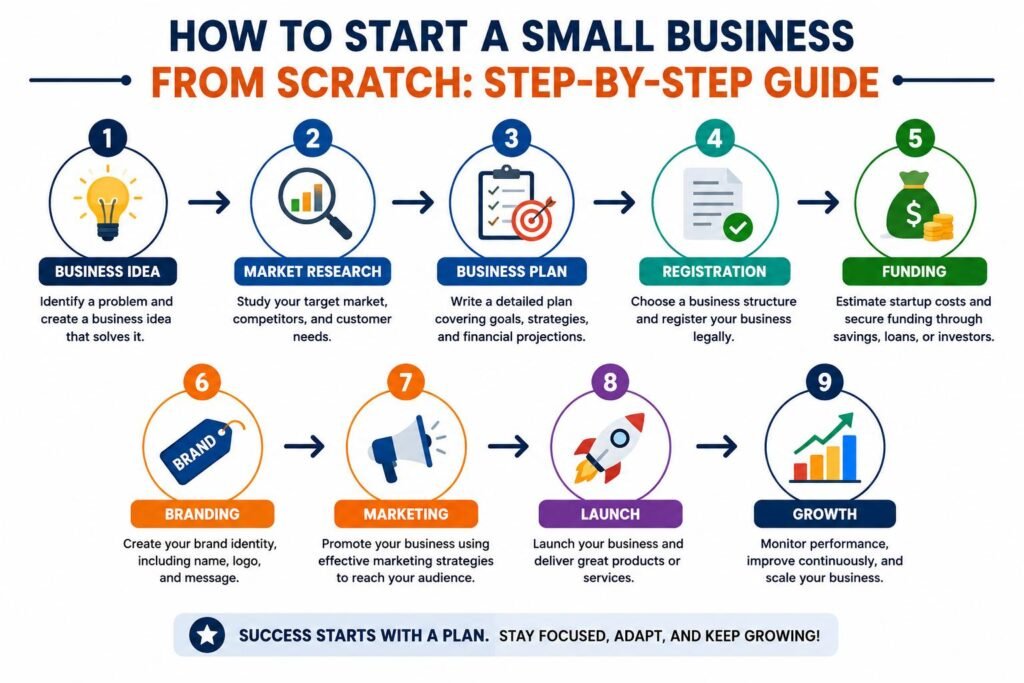
Creating a business from the ground-up is a lot more than just having a really good idea. You need to know your target customers, confirm the market demand, prepare a realistic financial plan, legalize your business, get adequate funding and prepare a strategy to attract and retain customers. These initial steps are crucial for any new business and if not carried out properly, can create unnecessary delays that could otherwise be avoided by planning effectively. It offers a detailed structure that breaks the process down into manageable steps, making it easy for beginner entrepreneurs to take a step-by-step approach from an idea to launch and paving the way for long-term growth.
Produce an idea for a Business that Addresses an Authentic Problem.
All great businesses start with a great idea and the best ideas always address a problem. While considering which kind of business to undertake, consider the problems that individuals frequently encounter and how your business will be able to solve these issues. Consider your own abilities, career history, activities, and interests, since companies that grow out of their knowledge base can be simpler to manage and grow over time. Think beyond using excitement in the market, think about industries that are steadily growing. Passion is one thing that can drive you, but if they are willing to pay for the value you add, then it will be profitable. Being able to speak to potential customers, be involved in industry discussions and observe other companies in action can help you narrow your idea down to a viable and profitable business opportunity that can actually be sold in the market place.
1. Do in-depth Market Research.
Market research enables business people to see if their business idea is feasible before putting a lot of time and money into it. This process includes defining your audience, analyzing your competitors, understanding the industry and determining the customer demand. Don’t assume anything, but rather collect data by conducting surveys, interviews, online forums, customer reviews and industry reports from the public. Find out what customers enjoy about current businesses, what their competitors have done wrong or what they have done right that the customers wish to improve. Knowing the prices that customers expect, the way they shop, and the preferred methods of communication can also enable you to start out with a better position. By doing detailed market research, entrepreneurs can minimize the guesswork involved in their decision making since they make important decisions based on facts and not assumptions. This can help them create products, marketing campaigns, and customer experiences that actually meet market needs.
If you are interested in becoming a business owner, learning about successful business principles and conducting extensive market research can help you make informed decisions prior to starting your business.
2. Prepare a Detailed Business Plan.
Your business plan is the map to your company’s development and growth. It defines your goals, your target audience, how you’re going to operate, the costs of your initial business and the projected income. Even if you don’t expect to go out and raise money right away, a written business plan will require you to critically assess your assumptions and think about all parts of the business. Provide a section on your mission statement, products or services, customer analysis, competitive advantages, marketing strategy, operational workflow, staffing needs, pricing models, financial projections and some growth goals. Businesses evolve and change, so review and update your plan regularly. The business plan is also a helpful tool for making business decisions and will help build credibility with banks, investors and business partners who will want to see that your business has been well-prepared and financially sound.
3. Clearly Communicate Your Unique Selling Point (USP).
Your value proposition is what makes your business different from the other one. It should make it very clear what the benefits are to the customers, what you are solving and what makes your products different. Don’t use generic terms like “excellent customer service” as that is something that many businesses will say. Rather, pinpoint measurable or meaningful distinctions like quicker delivery, customizations, niche knowledge, outstanding product quality, competitive prices, or unique capabilities. A good value proposition helps to drive branding, advertising, customer communication and product development; and provides consistency in the marketing message. People are more likely to recall companies that communicate clear information about what they want to offer, rather than just products and services.
4. Selecting the Right Business Structure is Crucial.
The legal structure chosen will have implications for taxation, liability and ownership responsibilities as well as future growth opportunities. These include sole proprietorship, partnerships, limited liability companies and corporations. Sole proprietorships are usually inexpensive and simple to setup, and offer minimal protection for personal assets. Partnerships are formed when two or more people agree to share responsibility and profits and make an agreement about management and financial responsibilities. Popular among small business owners are the limited liability companies, which offer a mix of flexibility and personal liability protection. Corporations provide other avenues to obtain capital, but typically have more complex legal and administrative requirements. Consider seeking legal or financial advice before selecting the structure to make sure that the structure meets your business needs, projected income, tax liability and future expansion plans.
5. Ensure that your Business is Registered and Meets Legal Obligations.
Running a business legally means abiding by the local, regional and national laws. Register your business name, secure the proper licenses and permits, get the required tax identification numbers if needed, and make sure your business is adhering to employment, health, safety and industry regulations. The failure to fulfill these legal obligations may lead to penalties, fines, and/or business interruption. Also, if your business is based on an innovative invention or product, or a distinctive brand, you may want to consider intellectual property protection, such as trademarks, copyrights or patents. Having a business bank account and keeping its finances well-organized right from the start also makes accounting for the business, tax reporting and financial management easier. When you set up legal and financial structures early, it will minimize administrative problems as your business expands.
6. Discuss the Estimated Start-up Costs and Consider Financing Options.
Financial resources are a need for every business, even with relatively low start-up costs. Develop a comprehensive budget for equipment, stock, marketing, technology, licenses, insurance, office space, salaries and reserves. It is important to know what your financial needs are to see if you need to use money from a private savings source or you’ll need to take out a loan. Often, entrepreneurs use several of these types of financing, such as personal investment, family money, business loans, grants, crowd funding campaigns and private investors. Consider the terms of repayment as well as ownership issues and long-term financial viability for each funding option before committing. If your business is still in the infancy stage, it’s important to stick by with realistic financial projections and cash flow in order to keep your business stable.
7. Create an Emergency Financial Reserve (EFC)
Almost all new companies will encounter unforeseen costs. Without proper reserves, equipment maintenance, unpaid bills or orders, supply chain disruptions, or seasonality can easily lead to cash flow problems. It’s wise to build up an emergency fund before starting operations, as this gives you flexibility when times are hard, and will remove the need to take out high interest loans. With financial discipline in the beginning, the entrepreneurs may face any circumstances at ease without jeopardizing the basic operations and the quality of their service to the customer.
8. Develop Your Brand Identity
When your business has a strong brand it tells your customers that they can identify, remember, and trust in your brand. Your business brand is more than just a logo; it is your business name, message, customer experience, visual identity, tone of communication, and reputation. Establish your brand persona and be consistent in your website, social media, packaging, advertising and customer interaction. Professionalism, reliability, and authenticity are key attributes that customers look for in businesses. Branding is a strategy that requires investment of thought and time and pays off in establishing credibility and building a memorable brand in the minds of customers that can help build long-term loyalty. This uniformity of customers’ experience at all points of contact enhances customers’ sense of recognition and makes your business distinguishable among other businesses in your industry.
9. Create an effective marketing strategy
If you start a business without marketing, it’s like opening a store without letting people know that it’s there. The marketing plan should target the places where your target audience spends time, and which methods would be the best way to reach target customers. SEO, content marketing, email marketing, social media marketing, online advertising and local business directories are all digital marketing avenues that small businesses can use to gain visibility for a low-cost. Also depending on your industry, offline marketing tactics such as networking events, community collaborations, referrals, direct mail, and local sponsorships can be important. Instead of trying all of the marketing strategies at once, choose a few and stick to those ones that are most similar to your audience and have a consistent measurement system. With ongoing evaluation you can fine-tune performance, while maximizing your marketing dollars.
10. Plan operations prior to launch
Efficient systems are essential behind the scenes to make successful business launches a reality. Set up clear processes for inventory, customer, payments, order fulfillment, supplier, scheduling, accounting and communication. Having quality software to support the bookkeeping, customer relationship, project management and inventory systems can have a significant impact on efficiency and minimize administrative mistakes. Thorough training of employees, documentation of normal operations and contingency planning also help to ensure smooth day-to-day operations. A business that cares more about organization than it cares for its customers when it’s starting up may find that it has fewer disruptions and can focus on meeting customer needs and increasing profits rather than needlessly dealing with preventable internal issues.
11. Start Your Business with Strategy.
Opening up should be considered as a planned event and not just a single day. Use social media and email communications, partnerships, local community connections, and promotions to create awareness prior to your official launch. Give customers incentives to first sign up, such as paying less for joining or getting a discount on the next purchase if they do. Pay special attention to the feedback from the customers in the first few weeks as this often indicates areas of need for improvement. Handle customer issues quickly and adaptively make changes to products/services, pricing or processes based on real world experiences. While a successful launch is a momentum starter, the long-term success comes from a consistent delivery of value and a willingness to meet customers’ needs over time.
Some of the Most Common Mistakes Novice Entrepreneur Makes.
Many companies fail because owners make mistakes that they can have avoided instead of facing circumstances that they can’t. A common mistake is starting a product or service without proving customer demand, meaning that the product/service is not actually wanted by the customer. Others underestimate the costs of starting up a business, which results in cash flow problems in the early stages which may not be able to produce profit. Businesses often fail to expand because they lack good record-keeping, don’t have a good marketing plan, don’t have a consistent approach to customer service, offer unrealistic prices or try to please all customers. Other entrepreneurs fail to follow the market trend, and forget to apply customer inputs even when it is needed. Identifying these issues early will enable business owners to make proactive changes that will enhance their long-term sustainability rather than having to take remedial action once significant problems arise.
Planning is a Critical Part of Achieving Long-term Success.
A business that is sustainable doesn’t just happen, it takes continual planning after it is launched. Set short- and long-term objectives, regularly check on the financial results, keep track of industry trends and consistently assess customer satisfaction. Continuously educate yourself through seminars, journals, meeting successful business owners, and seeking mentors as needed. Establish processes that support your business and that don’t rely solely on your day-to-day involvement. As the company grows, invest wisely in technology, employee training, product enhancements and marketing efforts to support the growth. Successful entrepreneurs know that planning is not a one-time thing done before opening the business, but rather it is a continuing activity.
Conclusion
There is a lot of work that goes into starting a small business from scratch, and some planning and thinking is necessary, but it can be a very gratifying and rewarding venture to follow to both a business and personal level. By taking the time to choose a suitable business idea, undertake detailed market research, develop clear business plans, adhere to legal obligations, raise suitable finance and create effective marketing plans, entrepreneurs build better bases for sustainable success. Each journey of business comes with its own set of challenges, but by making sure you don’t fall into common traps, and are flexible along the way, you will have a much better chance that your business will grow in the long run. With these simple steps and constant adaptation to customer preferences and market trends, aspiring entrepreneurs can successfully convert their ideas into successful enterprises that will provide value to customers for years to come.
Get more well researched information about How to Start a Small Business from Scratch here.