Introduction
The journey of starting and operating a small business is an exciting one, and it is associated with a lot of responsibilities and challenges. While many business ideas are good and the motivation to start is powerful, the problem is that many of them encounter difficulties because of preventable errors. Businesses may have a great idea and have a lot of drive to start, but they fail due to avoidable pitfalls, not lack of potential. Often business owners are so busy designing products or services that they forget to develop the systems, planning and strategies that ensure that their business is viable and competitive in the market. Business owners need to be proactive, rather than reactive, as markets change, so do customer expectations and so does technology. By identifying these issues early on, entrepreneurs can create a more resilient base and enhance their sustainability in the long run. Business managers can make sound decisions, reduce needless risks and plan to ensure steady growth if they understand these challenges. “Learning from others” is often less costly than making expensive mistakes and prevention is one of the savviest business moves to be made.
Understanding the challenges encountered by entrepreneurs and putting in place effective solutions to address these challenges before they negatively impact business performance is one of the best ways to prepare for business success. There are many things that can go wrong and can be foreseen, such as weak financial management, poor management planning, poor marketing, inconsistent customer service, and market changes that are not embraced. Luckily, each of these problems can be resolved with careful planning, ongoing education and good business sense. The key to successful entrepreneurs’ thinking is to see trouble as an opportunity to enhance systems, improve decision-making and make their enterprise more resilient. Recognizing these pitfalls early and taking preventive action can mean the difference between a successful business and the closure of many small businesses that suffer setbacks and don’t survive the first few years.
Reason why Small Businesses Make Costly Mistakes
As a business owner, you need to juggle many aspects of your business at the same time, such as operations, marketing, finance, staffing, customer relations, compliance and planning. Many business people begin businesses because they’re knowledgeable or have a passion for a certain industry, but they need a different type of expertise to be a business manager. New owners often don’t appreciate the ins and outs of managing cash flow, forecasting demand, creating effective processes or reacting to market shifts. With less resource, it is likely that entrepreneurs end up doing everything on their own which may cause fatigue, impatience, and neglect of details. Business owners often get caught up in day-to-day business activities and forget to look into the future or plan strategically for their growth. Knowing what went wrong can help entrepreneurs learn good practice, get guidance when needed, and put in place management systems to minimize the chances of similar mistakes from occurring again.
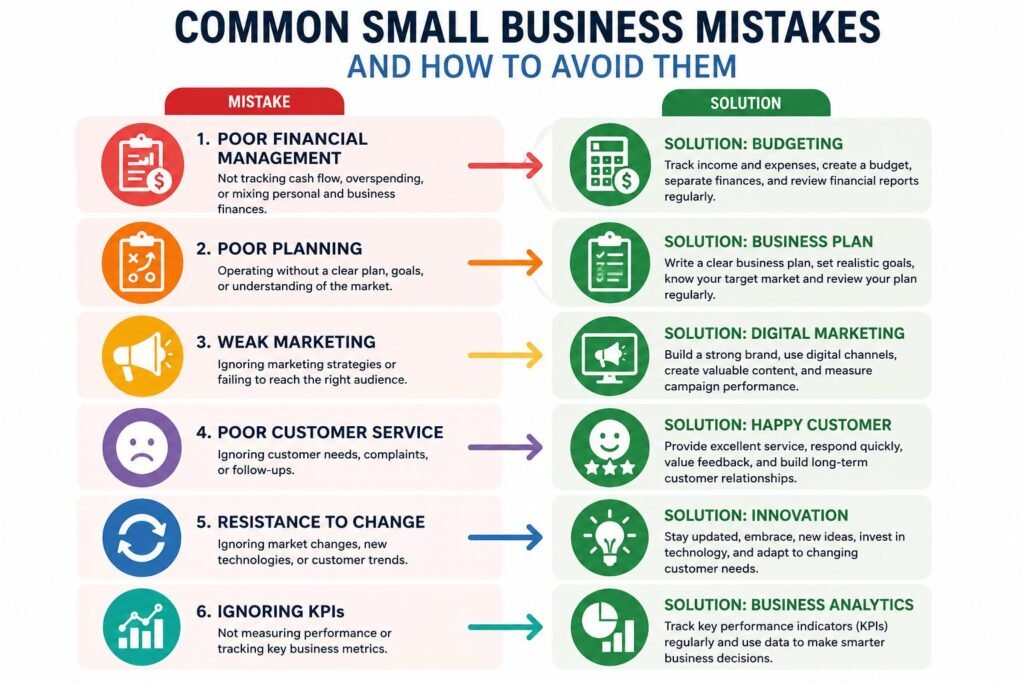
1. Poor Financial Management
Worst mismanagement is still one of the biggest problems that cause a small business to fail or falter. Many business owners are more concerned about sales and sales volume and neglect to think about expenses, profitability, taxes, and cash flow. Businesses can seem profitable with increasing sales, but if they are not managed well, it can lead to decreasing profits. Examples of common financial errors include commingling personal and business finances, not keeping good records, pricing products and services too low, not following budgets, and spending more than the revenue when it is plentiful. Businesses can run into financial difficulties if they do not keep enough cash reserve if they encounter unexpected expenses, seasonal variation and if the customers are unable to pay bills on time. Lacking accurate financial reporting will result in poor performance assessment and make it difficult to make appropriate investment choices, thus creating potential for expensive blunders.
The following are some of the ways to prevent you from making financial management mistakes.
The first step in good financial management starts with being able to keep good books and read financial statements on a regular basis. Business owners should account for business and personal funds separately, make realistic budgets, keep track of their cash flow weekly and regularly review their financial projections. Accounting software makes bookkeeping easier and offers insightful data to help monitor a business’ performance. It’s also important for entrepreneurs to create funds that address unforeseen expenses and not use too much debt. Tax planning, pricing and profitability analysis can benefit from talking to accountants or financial advisors. Financial decisions are based on accurate information, rather than speculation, which leads to greater stability and businesses, can be more reactive in bad economic times.
2. The failure to plan businesses
Numerous young business owners start their ventures with energy and do not have a well-thought-out business plan. Flexibility is essential but not having a clear path to follow can lead to decisions that can be disjointed and wasted resources. A business plan gives direction by explaining a business’s target markets, competitive advantage, business strategies, marketing objectives, financial forecasts, and business growth. If they don’t have this plan, business owners could pursue something that might not be the right direction for the business or spend time on activities that won’t pay off monetarily. Also, financial support is more difficult to obtain if the business isn’t planned, as lenders and investors are looking for proof that the business owner is knowledgeable about his or her market and has a realistic growth plan. Unless there are tangible objectives to measure, it’s difficult for businesses without them to determine how they’re doing and what needs improvement.
How to Create an Effective Business Plan
Business planning should be considered as a continuous document and not just a product for investors. All entrepreneurs need to set up short and long-term goals, determine their key performance metrics, identify their target customer base, and research competitors, and create realistic financial projections. Regular review and update of the plan enables businesses to be able to meet the market demands effectively and drive the strategic direction. Also, having contingency plans in place for various risks like economic downturns, supply chain changes, and customer preferences can add to the business’s resilience. Having a clear plan allows for more efficient use of resources and can help to inform decision-makers more confidently before, during, and after various phases of business development.
3. Ineffective Marketing Strategies
Enterprise growth will not happen unless potential customers are aware of excellent products and services. Many small businesses devote very little time and budget to marketing and don’t know their target audiences, and they may use inconsistent marketing. Others try to sell to everyone rather than the customer base most likely to buy their product and/or services. Weak branding, infrequent social media posts, low online visibility, out-of-date websites, and disjointed messaging impacts marketing effectiveness. Another mistake that some businesses make is not measuring the results of the campaigns, which makes it difficult to know what marketing campaign yields the greatest return on investment. With the growing digitalization of consumer behavior, any business that doesn’t make the most of modern marketing methods risk losing visibility to other businesses.
Create an effective marketing strategy.
To be successful in marketing, one must have an understanding of the needs, preferences and purchasing behaviors of customers. Owners need to identify their target customer, ensure that their branding remains consistent on every platform that they communicate on, tweak their websites for search engine optimization, develop useful material and be active on social media and email marketing to connect with their audience. Continuous improvement is possible through measurement of website traffic, conversions, cost of customers, and the performance of the campaigns. In order to avoid overspending on the market and consequently on all platforms, entrepreneurs should concentrate on marketing avenues that are most popular amongst their target customers. Regular messaging and meaningful content help foster trust and create ongoing customer connections.
4. Inadequate Customer Service
Customer service is a vital aspect of a business’s image, customer retention, and sustainability. A huge portion of the small business’s energy is invested in acquiring new customers and very little is directed to the customer experience after the sale. When communication is inadequate, when something takes longer, when a customer’s complaint is not addressed, when the service quality is inconsistent across different areas and when things are not followed up, it can hamper customer loyalty. Customers who aren’t satisfied are often perceived to be “gloating” when they discuss their bad experiences with friends, family, or online, and bad customer service is getting more and more expensive in this social world! Companies that do not focus on the satisfaction of their customers are faced with a decrease in repeat purchases, in referrals and in competitive positioning, even if they have a good product.
Improving Customer Service
The service level must be exceptional and systems need to be put in place to ensure this is achieved at all times. Staffs should be trained in the ability to communicate, solve problems and solve conflict situations, and give them latitude to handle typical customer complaints effectively. Companies should proactively seek out customer insights by asking them for their opinion in surveys, reviews and face-to-face communication to look for areas to improve. The quickness of response to questions or complaints is a reflection of professionalism and trust of the customer. Personalized service, communication transparency and the recognition of customer loyalty ensures repeat customer and leads to positive recommendations for sustainable growth.
5. Inability to Adjust to Change
Markets change continuously as a result of technological advances, shifting consumer tastes, economic conditions and competition. Firms that cling to the old ways tend to become obsolete as other, more flexible, firms get market share. Some business owners are stuck with obsolete technologies, do not pay attention to digital transformation, or simply don’t want to adapt their pricing, products or services even when there are evident changes in customer demand. Some get carried away with strategies that have worked in the past but don’t realize the market has shifted. If the company fails to innovate over time, they will become less competitive, and will have fewer growth opportunities, especially in industries with fast-moving technology.
Staying Adaptable
The first step towards adaptability is to constantly learn and keep track of the industry changes. It is important for entrepreneurs to continually research their competitors, understand what their customers are doing, invest in employee training and development and consider new technologies that will help them operate more efficiently or better serve their customers. Businesses can innovate and keep their competitive edge while preserving their strengths by testing new products, growing their service offerings and introducing new digital tools. It was important that any change is seen as an opportunity, not a threat, as this will help foster innovation and business resilience over the long-term.
6. Ignoring Employee Development
Staffs are directly involved in productivity, satisfaction and innovation. But, due to time or budget constraints, many small businesses neglect training and professional development. Employees can become ineffective, unengaged, and/or job-hopping without the right support. High employee turnover leads to higher recruitment expenses, loss of productivity, loss of organizational knowledge, etc. Organizations that do not foster healthy company cultures may have poor employee morale, lack of teamwork, and let down customers.
Investing in People
Employee training, recognizing employee excellence, open communication and professional development should be a priority for entrepreneurs. Frequent feedback, skill training and supportive management boost employee engagement and the overall business performance. Employee engagement is a key factor in providing excellent customer service, creating new ideas and being a positive contributor to organizational success.
7. Neglecting Risk Management
Many business owners tend to look for growth opportunities and neglect to consider any risks. Business operations can be affected by various unexpected events, including cyber-attacks, legal issues, equipment failure, supplier disruptions, and a downturn in the economy. If you don’t have a contingency plan in place, your business could take a long time to bounce back if faced with an unexpected problem. Risk management is not just about removing uncertainty, it’s about planning for uncertainty that may impact the continuity of your business.
Creating a Risk Management Strategy
Every business owner needs to identify their operation, financial, technological and legal risks and have a practical response plan. Organizational resilience is enhanced by having the right insurance, safeguarding valuable customer information, diversifying suppliers, backing up digital information, and setting up emergency protocols. Businesses can always keep up with the changing landscape by carrying out regular risk assessments.
8. Avoiding the Measurement of Business Performance
When evaluating the success of their business, many entrepreneurs go by intuition and not numbers. There are no correct measures of the performance indicators unless monitored. Customer retention, profit margins, marketing effectiveness, inventory turnover, and employee productivity are all important metrics that give valuable insights that inform decision making. Failure to heed these signals can lead to delayed action on issues and allow them to become more difficult to remedy in the long term.
Efficiently Leveraging Business Metrics
The goals and objectives should be translated into key performance indicators (KPIs) by the entrepreneurs and monitored regularly. Financial reporting, customer satisfaction scores, web analytics, employee performance metrics, and operational efficiency metrics are used to identify trends to follow up on. Data-driven decisions enhance resource allocation, fortify accountability, and drive sustainable business growth.
Creating a Successful Business (for the long haul)
It is rare to avoid all the mistakes in order to have a long-term business success. It is, however, based on early detection of difficulties, learning from experience and continuous improvement. The successful entrepreneur is always curious, takes feedback, is open to innovation and sets up systems to minimize risks. They know that being good at financial management, planning, marketing, service and flexibility are important factors that contribute to business growth. Sustainable Business is about establishing solid relationships with customers, employees, suppliers and communities, and continually learning and improving. Each challenge becomes an opportunity to improve the way things are done and to further develop competitive strengths when faced with it properly and with determination.
Conclusion
All small businesses have challenges, but some of the worst problems can be avoided if you plan well and manage it properly. Some of the most typical business owner pitfalls include poor financial management, weak planning, ineffective marketing, inadequate customer service, resistance to change, neglecting employees, failing to understand risks and failing to measure performance. Thankfully, there are solutions to each of these challenges that can make a business more resilient and successful in the long-term. By embracing continuous learning, data-driven decisions, customer satisfaction, and strategic planning, entrepreneurs position themselves for better odds of navigating through uncertainty and capitalizing on future opportunities. Rather than being afraid of making some mistakes, business owners
should embrace them as learning and growing opportunities that spurs them to be innovative, to have better leadership, and to make better business decisions. Each of these are challenges that can be avoided by addressing them early to create organizations that stay competitive, profitable, and ready to sustain for the long-term.
Get more well researched information about Common Small Business Mistakes here.