Introduction
Without a business plan, starting a business is like taking a trip without a map. Passion, creativity and determination are keys to being an entrepreneur, but not necessarily for a business to be successful over the long-term. All businesses, from a small business in town to a large company, start with an organized business plan that details what they see as their vision, method and way to making money.
There are several reasons for having a business plan. Helps entrepreneurs structure their thoughts, understand opportunities and risks, provide financial estimates and express their vision to investors, lenders and other business partners. More importantly, it becomes a practical guide to inform about the business growth and evolution for making decisions. When there is no business plan, entrepreneurs tend to have unclear goals, inefficient business practices and marketing strategies, and weak financial practices.
Among the most important things in developing a good business plan is to understand what makes a good business plan. All the sections are informative and illustrate the feasibility of the business and a plan for future operations.
This booklet outlines each of the key elements of a business plan, includes some helpful writing tips and suggests strategies that can help you develop a business plan that will attract investors and become a successful tool for sustainable business growth.
Every Entrepreneur Needs a Business Plan.
A business plan is NOT just a document written for banks and/or investors. It’s a planning tool that enables a business owner to convey thoughts and make sound plans on how to accomplish their objectives. When business goals, working procedures, financial expectations and business opportunities are clearly documented, entrepreneurs have a better grasp of how each of their businesses fits into the whole.
There are also other benefits to writing a business plan, such as the fact that it serves as a way to thoroughly research before investing time and money. Often the research findings provide valuable knowledge on customer demand, competition, pricing and industry trends that may not be apparent. This means that many of the problems that could occur are spotted in time to be resolved and prevented from being expensive errors. An effectively drafted business plan can also facilitate communication between co-founders, workers, lenders and investors, as everyone knows the direction the business is going and what the priorities are. Instead of guesses, entrepreneurs can make decisions based on established goals and measurable objectives, thus making it more likely for them to be successful in the long-term.
Knowing the Purpose of a Business Plan and How to Write a Business Plan
But, before writing any part of the business plan, the entrepreneur needs to have a clear idea of the purpose of the business plan. There is a variety of motives for the same document to be used by different audiences. Investors are looking for proof of a good return on the investment. Banks are concerned with the financial stability and the ability of the borrower to repay the loan. Operational strategies and potential for the long-term are considered by business partners and the business plan is used by the entrepreneur for day-to-day decision making and for tracking progress.
The key to a well-prepared business plan is finding the right balance between the various needs, with a mixture of strategic and realistic financial information. It is a show of not only the entrepreneur’s aspirations but how these will be achieved. This vision and practicality builds stakeholder confidence and is a great management tool that will continue to serve the business well after it’s up and running.
Having a Good first Impression is Essential
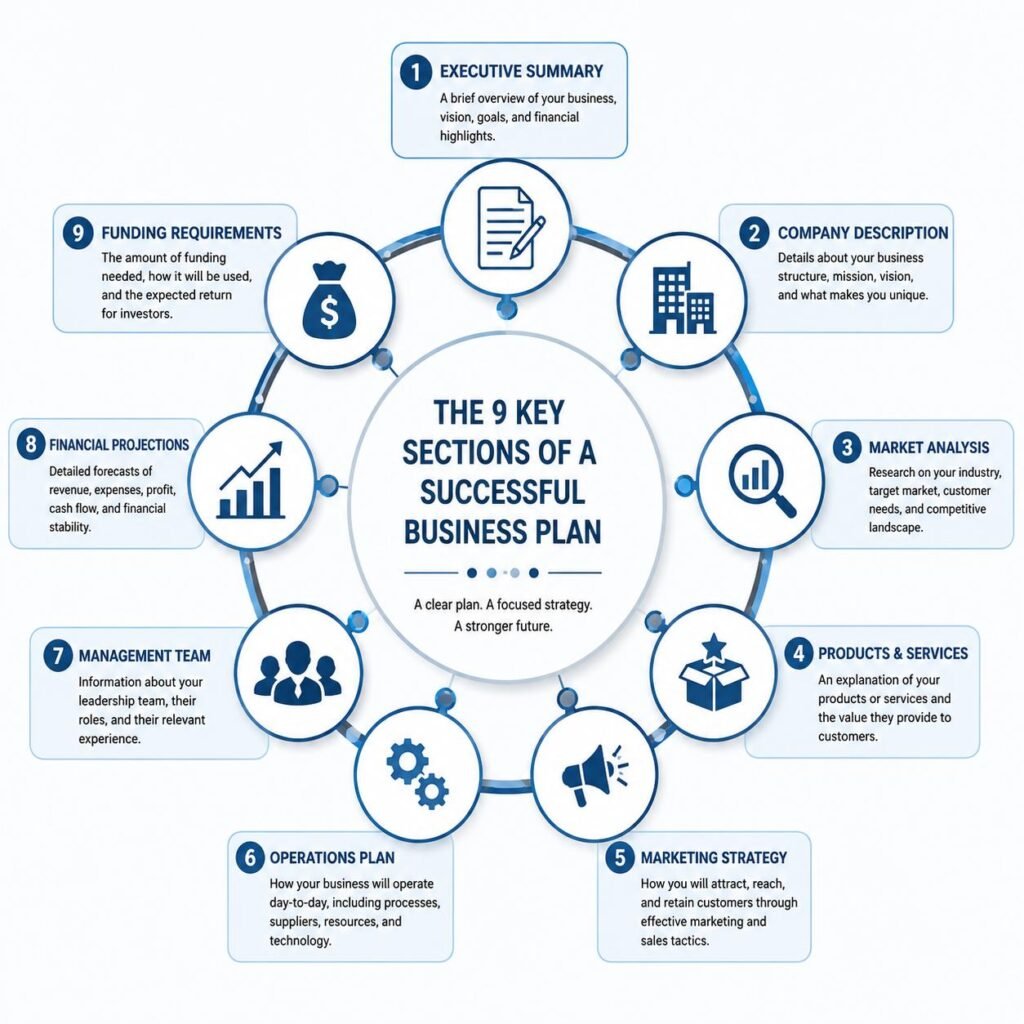
The executive summary is generally regarded as the most significant part of the business plan, as it makes the reader’s initial impression of the business plan. It is often found at the start of the document, but is typically added at the end once the rest of the document has been written. This technique can be used by entrepreneurs to make sure they’ve covered all the important points of the business without missing anything.
A good executive summary provides a short overview of the business, explains what you’re selling, describes your target market, summarizes your competitive advantages, outlines your financial expectations and summarizes the amount of investment you need if you are seeking it. The aim is to give readers a sufficient amount of information to get them to want to read the whole plan. Often investors base their decision to look at an entire proposal on the executive summary only. For this reason, it should be short, convincing, professionally presented and backed by sensible business objectives and not overstated claims which will be retracted later in the document.
Understand your Company
The company description provides the information about the company to the readers, so that they can understand what the company does, why it was set up and what sets it apart from other companies. This section provides identity to the company and makes them understand what is the mission, vision, and long-term goals of the company. Business owners need to communicate the legal form of the company (sole proprietorship, partnership, Limited Liability Company or corporation) because it can impact who owns the company, how it is taxed and its legal obligations.
In addition to the basic organizational information, the company description should give customers understanding of the problem that the company is solving and the value of the business’s products and/or services. When interviewing entrepreneurs, what you want to see is them discuss what their business does, what it does that they’re better than everyone else at, and why their business succeeds in the market. A good company description is a statement of confidence, shows that the writer is confident without being too sales and sets the tone for credibility before readers are introduced to more substantive portions of the business plan.
Learn about everything in the Market and who your Customers Are
A comprehensive market analysis is one of the best signs of a good business plan. Investors will look for an indication that the entrepreneur knows both the customer and the competition before investing financial means. Business decisions are not based on assumptions but on market analysis.
The first thing a comprehensive market analysis should do is to look at the overall industry, along with trends, growth expectations, regulations, technology and the potential risks. Next, it is important for the entrepreneur to identify the target market by describing the customer demographics, purchasing behavior, preferences, customer location, and needs they are not satisfied with. By grasping these aspects, businesses can create products and marketing strategies that meet the expectations of their customers.
Another aspect of market research is competitive analysis. It is important for entrepreneurs to understand the key players, their pros and cons, understand the pricing models, review the reviews of the customers and look for differentiations. Effective business plans don’t just say that there is a competition, they describe how the business will be better – either because it offers a better product, has better customer service, provides new technology, unique brand name or more efficient operations.
How to Promote your Value Proposition in Terms of your Products and Services
In this section, you’ll get details about the products or services that the company will be providing. Entrepreneurs need to make it very clear to customers what they are buying, how these goods or services satisfy customers’ needs, and how they offer more value than the customer could get elsewhere. It’s important to keep the focus on the benefits to the customer and real-life application, rather than on technical descriptions.
Innovative products should be introduced and intellectual property rights, patent and trademark information, research activities or future product development plans should be explained as applicable. For service-oriented businesses, they should explain how the services will be provided, the cost, the quality of the service, assurance and the customer service. If applicable, review the concept of a product life cycle, supplier relationships, manufacturing needs or inventory management. A comprehensive products and services section reveals that the entrepreneur has thought through every detail of providing value to customers, and ensuring that quality is maintained.
How to Reach the Right Customers via Marketing and Sales Strategy
Without customers knowing about their existence, no great product could be a success. This is why marketing and sales tactics are considered as vital parts of a successful business plan. When determining marketing activities, entrepreneurs need to describe the ways they will attract, convert and retain customers with realistic and measurable marketing activities.
Some of the key elements of a successful marketing campaign are branding, digital marketing, search engine optimization, content marketing, social media marketing, e-mail marketing, advertising campaigns, partnerships, networking events, and public relations campaigns. It is crucial for entrepreneurs to make sure that they are using all the marketing channels they have chosen because customers will buy from them, not just because they like it. The sales strategy is intended to include pricing models, how customers are acquired, sales funnels, sales distribution channels and customer relationship management. As in the other sections, this section’s credibility is enhanced by a clear understanding of customer acquisition costs, conversion rates and customer lifetime value, and the reassurance that the revenue growth is underpinned by realistic planning and not wishful thinking.
Operational Plan: Handling day-to-day business tasks
“Operational plan” is the plan that describes how the business will be managed on a day to day basis after it has opened for business. Marketing helps sell products and/or services, Operations helps to ensure the product and/or services are delivered efficiently and consistently. This section should depict the locations of business, facilities, equipment, technology systems, supply chains, inventory management, production processes, quality control processes and customer service processes.
It is also important that the entrepreneurs outline the staffing needs, roles of employees, the recruitment process, training and development, and workflows. Where important external suppliers or service providers are involved, their involvement needs to be identified and contingency plans made to ensure the services are available. When investors see plans that recognize challenges and provide for practical solutions, they will see thoughtfulness in planning, and that is a good thing. The efficient operations directly impact customer satisfaction, profitability, and sustainability of the business.
The Structure of the Organization and its Management Team
Entrepreneurs are as much as invested as are the business ideas. In the management section, important individuals involved in the team should be introduced and their qualities, experience, leadership and industry knowledge should be emphasized. If the business is just being run by one business owner, the entrepreneur should articulate the business’s future plans for staffing and outline the skills that will be required to grow the business.
Reporting lines and responsibilities can be illustrated using an organizational chart. Business owners should also consider consulting with advisory boards, mentors, and/or strategic partners that offer operational, marketing, financial, and/or technical expertise. Having established that they have access to expert guidance gives investors more confidence that the business will be a good success, as good companies are built by good leaders.
A Report that Shows the Viability of a Business
Financial projections are the conversion of business ideas into measurable expectations. This is a crucial part of the analysis as it gives the investor or lender an idea of whether the business will be able to sustain profits and be able to control their expenses. When creating a business plan, entrepreneurs must make detailed revenue projections, expense estimates, profit and loss statements, cash flow projections, balance sheets and break-even analyses for a minimum of three to five years, if feasible.
Financial estimates must always be backed up by market research, pricing strategies, estimates of customer acquisition and operating costs. Forecasts that are too optimistic, with no supporting evidence, can harm a forecast’s credibility, but forecasts that are realistic, with reasonable assumptions, can help gain stakeholder confidence. It’s also important for entrepreneurs to pinpoint significant financial risks and demonstrate how they plan to deal with unforeseen events like slower sales, higher operating expenses or a downturn in the economy. Open financial planning is a sign of a responsible approach to management, builds trust with potential investors.
Identifying Funding Needs and Investment Approach
However, if it is necessary to seek funding from outside, entrepreneurs should be very clear on the amount of funds needed, the purpose of the funding and what they can give in return to investors or lenders. Opportunist business plans spread out the money to allocate for certain categories like equipment, inventory, marketing, staffing, technology, working capital, and facility improvements, etc., instead of asking for a ton of cash without reason.
Where loans are being repaid or equity capital is being invested, the entrepreneur should also negotiate terms for repayment of loans and/or expected return of the equity capital. Realistic timelines, financial milestones and measurable performance targets can help investors better appreciate how their investment is helping the business grow. Giving your investors a clear overview of your financial requirements will help convey your professionalism and help minimize uncertainty when negotiating funding.
Using these tips, you can craft a business plan that will appeal to investors for your business.
Creating a business plan that investors will be attracted to is more than the typical business plan. The document should be a business opportunity that presents evidence and realistic assumptions and it should be professionally presented. The entrepreneur should keep his writing clear and avoid using unnecessary jargon and should be able to back up any claims with research or financial data. There should be consistency throughout the document, as otherwise it will have a reduced credibility and doubt.
Another key aspect of successful business plans is that they are not just a description of a product, but a consideration of the needs of the customer. Investors would like to see proof that the market is there and that the entrepreneur knows how to satisfy the market in a profitable way. Use charts, graphs, financial tables and timelines to create a more readable and understandable documents. Lastly, it is crucial for entrepreneurs to thoroughly read through the document to make sure all grammatical, spelling, and formatting issues are removed that might negatively impact the professional image during an investor review.
The following are examples of common business plan mistakes:
Some of the most common pitfalls that many entrepreneurs make are unnecessary and make their business plans weaker than they could be. Unrealistic financial predictions, making claims for quick growth without evidence. Unsupported assumptions are obvious to investors and can cause them to turn down what could be a good deal if they are not realistic in their expectations. One common pitfall is failing to conduct adequate market research to determine whether customers have a need for the product, what other products they are interested in, and how much they are willing to pay for them.
There are also business plans that tend to pay too much attention to features of the product, but not on customer benefits, marketing, or operations planning. Others make their presentations unnecessarily long, adding irrelevant information to the content rather than offering concise and meaningful analysis. Inconsistencies regarding organization, formatting, grammar, and data can diminish credibility, as can outdated data. Business plans should be updated regularly to adapt to changes in the market as the document may not capture the current opportunities and challenges in the market
Using Your Business Plan as a Growth Roadmap
Business plans should not be filed after financing is secured, they should be a management tool. Businesses are growing, markets are changing, customers’ needs and wants are shifting, new products are coming to market, and the economy is changing. Business plans should be reviewed and updated regularly, and business performance should be compared to business goals, in order to ensure that they are relevant.
By having regular updates, business owners can monitor the financial performance, make improvements to their marketing strategies, optimize their operations, discover new prospects and mitigate risks before they escalate into significant issues. Organizations that implement their plans for business decision-making more regularly tend to more easily adjust to an ever-changing environment with their goals and measurements. This process of planning is a continuous one and this business plan is valuable, not just for startup but it is a guide for sustainable long term growth and becomes a leadership tool.
Conclusion
A well-crafted business plan is one of the best tools any businessman can make. In addition to investment or financing, it offers strategic guidance, better decision making, better operational planning and measurable targets for future success. Each part of the business plan, from the executive summary and market analysis to financial projections and operational planning is crucial in illustrating the potential of the business and assisting entrepreneurs in preparing for potential challenges.
While creating a business plan takes lots of research, analysis and thought, the benefits are long-lasting and go beyond the start-up. When entrepreneurs invest the time to develop business plans that are clear, realistic, and well-organized, they ensure they will be more confident, better connected with investors, and have the resources needed to sustain their business. With a business plan that is evolving with the business, entrepreneurs can make well-informed decisions, adjust to the changes in the business market and create businesses that can be successful in the long run.
Get more well researched information about Business Plan Writing Made Simple here.