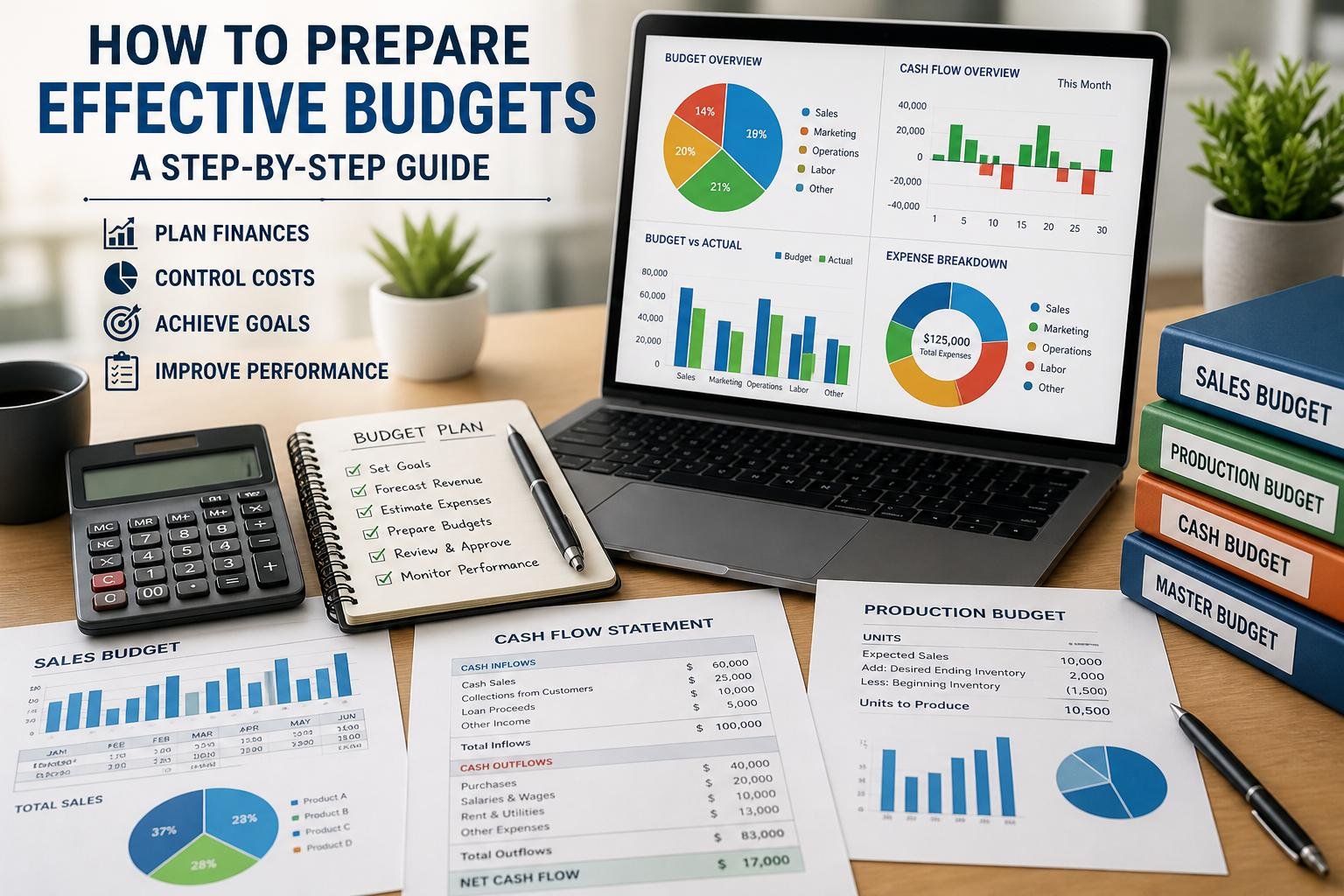
Introduction
Every business regardless of its size does in fact depend on good financial planning for stability and growth. In the area of financial management we see that budgeting is a very powerful tool. A budget serves as a financial guide that helps companies to allocate resources, watch expenses, and achieve goals efficiently. Also out there are businesses which do not have a proper budget which in turn may have issues with over spending, poor cash flow and also poor decision making, this is where how to prepare effective budgets comes in.
In the practice of budgeting we estimate future income and outgoings for a given time frame. This in turn allows managers to plan out operations, to coordinate activities, and to appraise performance. Businesses put in place whatever type of budget is best for their stage of operation which may include cash budgets, sales budgets, production budgets, and master budgets. While each budget may have a separate function they all play a role in running the business more efficiently and in a controlled financial environment.
Budgeting’s role in financial planning is very great as it allows companies to prepare for the unknown, to increase profits, and to maintain financial stability. Also budgeting improves communication between departments which in turn gets all units to work towards the same goals.
This article is a detailed guide that walks you through the process of putting together solid budgets. We look at what different types of budgets there are, walk you through the budgeting process, also we discuss issues which organizations may come across, and also we present how budgeting play a role in the success of an organization.
Understanding Budgeting
A budget is a financial plan which puts forth what we expect in terms of income and outgoings over a future period. Knowing how to Prepare effective budgets gives direction on how to spend and also helps organizations control financial activities. While we think of budgeting mainly for business purposes in fact governments, nonprofit organizations, and individuals also use budgets to manage resources well.
Budgeting is a process of predicting future actions and taking organizational plans and turning them into measurable financial goals. Managers use budgets to see what the money is for, how it should be spent, and to make sure that operations are profitable.
Objectives of Budgeting
The primary objectives of budgeting include:
- Planning future activities
- Coordinating organizational operations
- Controlling expenditures
- Allocating resources efficiently
- Measuring performance
- Supporting decision-making
- Enhancing accountability
Budgets we prepare for certain time frames which may be monthly, quarterly or annually. Once approved serve as a base use to compare actual performance.
Importance of Budgeting in Financial Planning
Budgeting is a key element in financial planning as it enables companies to put in place what is needed for the future and at the same time reduce risk. Also effective budgeting which is done well sees resources used in the best way and thus organizational goals are achieved more efficiently.
1. Improves financial control
Budgets which are tools for managers to track income and outgo which in turn reduces the issue of unnecessary spend. By which we mean through the process of comparing what we have actually achieved against what was budgeted for we identify variances early and thus are able to correct them promptly.
2. Supports Decision Making
Budgeting presents to managers the info they need to make operational and strategic decisions. We see that decisions related to expansion, investment, staffing, and pricing go more easily with accurate budget data.
3. Enhances Resource Allocation
Organizations work with small resource pools. In terms of budgeting we put those resources to best use in the areas which will benefit most, in that way we see improved efficiency and productivity.
4. Promotes Goal Attainment
Budgets serve to put large scale goals into quantifiable financial terms. Within the organization, from departments’ heads out to the rank and file, all focus is on these goals to enhance total company results.
5. Improves Cash Flow
Cash flow issues can interrupt operations at the same time a business is profitable. Budgeting allows companies to see coming shortfalls and plan for them.
6. Improves Performance Evaluation
Managers may contrast what is actually performing against what was budgeted for as a way to determine if things are going as planned.
7. Prepares for the Unpredictable
Economic shifts, inflation, and market fluctuations impact businesses greatly. Budgeting in turn helps companies prepare for the unexpected by creating financial flexibility.
Types of Budgets
Organizations create separate budgets for different areas of operation. We see large scale budgets for sales, production, cash flow, and master budgets.
1. Sales Budget
A sales budget is a forecast of what products and services a company will put out for sale and the revenue which is to be generated from them over a given period.
Purpose of a Sales Budget
The sales budget is a base which we start from when we put together other budgets which in turn support operational plans. It helps businesses:
- Forecast revenue
- Plan production levels
- Estimate marketing needs
- Allocate sales resources
- Set performance targets
Steps in Preparing a Sales Budget
- Review past sales data: Historical sales data which in turn identifies patterns, trends, and seasonal variations.
- Research Market Trends: Businesses have to take into account customer want, competition, economic climate, and industry trends.
- Project Sales Volume: Managers predict the number of units to be sold.
- Set the price at which to sell: The price per unit is what we have put out as an estimate.
- Compute Total Sales Revenue: Sales revenue is determined by the product of expected units and selling price.
Example of a Sales Budget
A company will put out 5,000 units of Product A at a price of 15 each. We expect 45,000 from Product B. Total project sales revenue will be $145,000.
2. Production Budget
A production budget determines what number of units must be produced to fulfill sales demand and to also maintain desired inventory levels.
Importance of a Production Budget
The production budget helps organizations:
- Avoid overproduction
- Prevent inventory shortages
- Plan labor and materials
- Improve operational efficiency
Formula for Production Budget
Units to Produce = Expected Sales + Desired Ending Inventory – Beginning Inventory.
Steps in Preparing a Production Budget
- Calculate Expected Sales: Sales data from the sales budget is used.
- Determine Inventory Needs: Businesses set the desired ending inventory level.
- Determine Opening Inventory: The opening inventory balance is determined.
- Determine Production Needs: Production needs are determined through application of the formula.
Example of a Production Budget
Suppose that we project sales of 10,000 units, we desire to end with an inventory of 2,000 units, and we begin with 1,500 units in inventory. The company would determine production requirements as follows:.
10,000 which is added to 2,000 and then reduced by 1,500 equal 10,500 units.
This company is to produce 10,500 units which will cover demand and stock.
3. Cash Budget
A cash flow budget reports on cash in and out during a given period. It is a tool which helps companies to maintain sufficient cash balances for operating purposes.
Importance of a Cash Budget
The cash budget helps businesses:
- Prevent cash shortages
- Plan borrowing needs
- Manage payments effectively
- Maintain liquidity
- Improve financial stability
Components of a Cash Budget
1. Cash Incomes
These include:
- Cash sales
- Collections from customers
- Loan proceeds
- Investment income
2. Cash Transactions.
These include:
- Salaries and wages
- Rent and utilities
- Purchases of inventory
- Loan repayments
- Operating expenses
3. Net Cash Flow
Net cash flow is determined by the difference between cash receipts and cash payments.
4. Closing Cash Balance
The final balance reports if the organization has enough cash.
Steps in Preparing a Cash Budget
Step 1: Determine Opening Cash Balance.
At the start of the period notes.
Step 2: Project Cash Inflows.
Estimate all expected cash receipts.
Step 3: Projections of Cash Outflows.
Calculate all expected payments and expenses.
Step 4: Determine Net Cash Position.
Subtract total outflows from total inflows.
Step 5: Identify Financial Requirements.
If at the prospect of a cash shortage, organizations may arrange for loans or cut expenses.
Example of a Cash Budget
At the start of the month a business has 40,000 in cash in the month. Thus total available cash is 38,000 the business will end the month with a cash balance of $17,000.
4. Master Budget
A master budget is a consolidation of all individual budgets.
Components of a Master Budget
The master budget also includes:
- Sales budget
- Production budget
- Cash budget
- Direct materials budget
- Labor budget
- Overhead budget
- Budgeted income statement
- Budgeted balance sheet
Benefits of a Master Budget
- Improves coordination
- Provides an overall financial picture
- Supports strategic planning
- Enhances organizational control
Step-by-Step Guide to Preparing Effective Budgets
Knowing how to prepare effective budgets requires care in the planning stage, accurate forecast, and input from all departments.
Step 1: Set organizational goals.
Budget preparation to put in place should start with the organization’s goals. We may see these goals to be in sales increase, cost reduction, expansion of operations, or improved profitability.
As soon as the objectives are set out clearly budgets become more focused and realistic.
Step 2: Collect Relevant Financial Data.
Organizations put together data which includes:
- Past sales reports
- Expense records
- Cash flow statements
- Production data
- Market research
Precise data improves budget forecasts.
Step 3: Prognosis Revenue.
Revenue planning is a key element in the budgeting process. Companies determine what they will bring in based on market conditions, customer demand, and past trends.
Revenue forecasts need to be realistic to avoid poor planning.
Step 4: Determine Expenses.
Firms should determine which expenses are fixed and which are variable.
Fixed Expenses
These are the same at any production level.
Examples include:
- Rent
- Salaries
- Insurance
Variable Expenses
These change according to activity levels.
Examples include:
- Raw materials
- Utilities
- Commissions
Accurate expense estimation helps prevent overspending.
Step 5: Prepare departmental budgets.
Each division is to present its own budget in relation to our goals.
Departments may include:
- Sales
- Production
- Marketing
- Human resources
- Administration
In the aggregate departmental budgets form the master budget.
Step 6: Align budgets across departments.
Coordination is what sees to it that all departmental budgets are in alignment with organizational goals.
For example:
- The production budget is to support the sales budget.
- The purchase budget should fulfill production requirements.
Poor organization causes operational inefficiencies.
Step 7: Review and Revise the Budget.
Management should go over the put forth budget which includes out of line assumptions and inconsistencies.
Adjustments may be necessary to: Adjusting may be required to:
- Reduce unnecessary expenses
- Improve cash flow
- Align budgets with strategic goals
Step 8: Get Management OK.
Once reviewed the budget should be approved by senior management.
Approval ensures accountability and organizational commitment.
Step 9: Propose the Budget Plan.
Once approved departments begin to run within budget guidelines.
Managers must present budget expectations in a clear manner.
Step 10: Watch and Report Performance.
Budgets are continuous. Also it is up to organizations to compare actual results with what was budgeted for.

Variance Analysis
Variance analysis reports on what is the difference between actual and budgeted performance.
- Favorable Variance: Occurs when actual performance exceeds expectations.
- Unfavorable Variance: When performance does not meet expectations.
Managers perform variance analysis for corrective actions.
Challenges in Budget Preparation
Despite that, budgeting puts forth many issues.
- Improper Forecasting: Uncertainty in economic terms may impact revenue and expense forecasts.
- Lack of Communication: Departments may not communicate well during budget preparation.
- Time consuming Process: Preparation of in depth budgets is a very time and effort intensive process.
- Resistance from Staff: Some workers may oppose budget controls which they see as too restrictive.
- Transforming Business Landscape: Unforeseen issues like inflation, technology changes, or market disruptions which in turn affect budgets.
Tips for Preparing Effective Budgets
Organizations can improve upon their budgeting results by knowing how to prepare effective budgets by using best practices.
- Use practical assumptions: Budgets should be realistic and attainable which in turn will set proper expectations.
- Include Employees: Employee participation improves commitment and accuracy.
- Review your budgets regularly: Regular review of performance is what allows organizations to adapt to change.
- Use Financial Software which does Budgeting: Technology increases accuracy, efficiency, and data analysis
- Watch Performance Constantly: Frequent monitoring helps identify problems early.
- Stay Flexible: Budgets should be flexible to change.
The Budget’s Role in Organizational Control
Budgeting is a key element of organizational control which sets forth financial standards and performance expectations and knowing how to prepare effective budgets is important in every organization
- Financial Discipline: Budgets reduce waste and promote responsible use of resources.
- Accountability: Managers will be responsible for meeting budget targets.
- Performance Measurement: Organizations may look at the performance of their budget versus what they planned.
- Strategic Alignment: Budgeting is a tool which sets departmental activities in alignment with organizational goals.
- Risk Management: Budgets also put in place measures for when the unexpected happens.
Budgeting Techniques Used by Organizations
Organizations apply various budgeting methods based on their operational requirements.
Incremental Budgeting
This year we see slight changes to last year’s budgets.
Advantages
- Simple to prepare
- Saves time
Disadvantages
- May encourage inefficiency
Zero-Based Budgeting
At the start of each budgeting cycle all expenses will be.
Advantages
- Eliminates unnecessary spending
- Improves efficiency
Disadvantages
- Time-consuming
Flexible Budgeting
Budgets fluctuate as per the level of activity.
Advantages
- Adapts to operational changes
- Improves accuracy
Disadvantages
- More complex to prepare
Conclusion
Budgeting is a key component of financial planning and organizational control. Understanding how to prepare effective budgets enables companies to predict income, control spending, put resources in which they should be for best performance, and track results also. In preparation of budgets which include sales budgets, production budgets, cash budgets, and master budgets, companies see improved coordination as well as attainment of strategic goals.
Understanding how to prepare effective budgets includes setting goals, gathering financial info, forecasting revenues, estimating expenses, coordinating departmental activities, and regular performance monitoring. While budgeting may bring in problems like that of inaccurate forecast and changing business conditions, organizations may overcome these also via proper planning, employee involvement, and continuous review.
Most in that we put that budgeting in financial plan’s core is that it puts structure to decision making, improves financial stability, and supports long term success. Which we see that companies that develop and maintain good budgeting systems are better able to manage risk, adapt to change, and achieve sustainable growth.
Get more well researched information on How to Prepare Effective Budgets here.


