Introduction
The path to dental competence is organized and evolving: the cognitive knowledge and psychomotor processes must be continuously improved. Theoretical information is not enough for working in dentistry, a professional field that necessitates the ability to make accurate judgments, combine spatial understanding, and demonstrate precise hand skills to provide safe and effective patient care. The sequence gets referred to as ‘the learning curve’ in dentistry and refers to a gradual sequence of skills acquired from simulated skills in a preclinical environment to more complex real world clinical skills. The stages in this adventure are successive; this reflects not only the need for technical knowledge but also the confidence, adaptability and professionalism to be acquired by the learner. Since dental education is in constant change, deliberate practice with reflective learning and competency based assessment which will make all the graduates ready for meeting the demands of modern clinical practice are given priority.
Preclinical Training Foundation in Dentistry
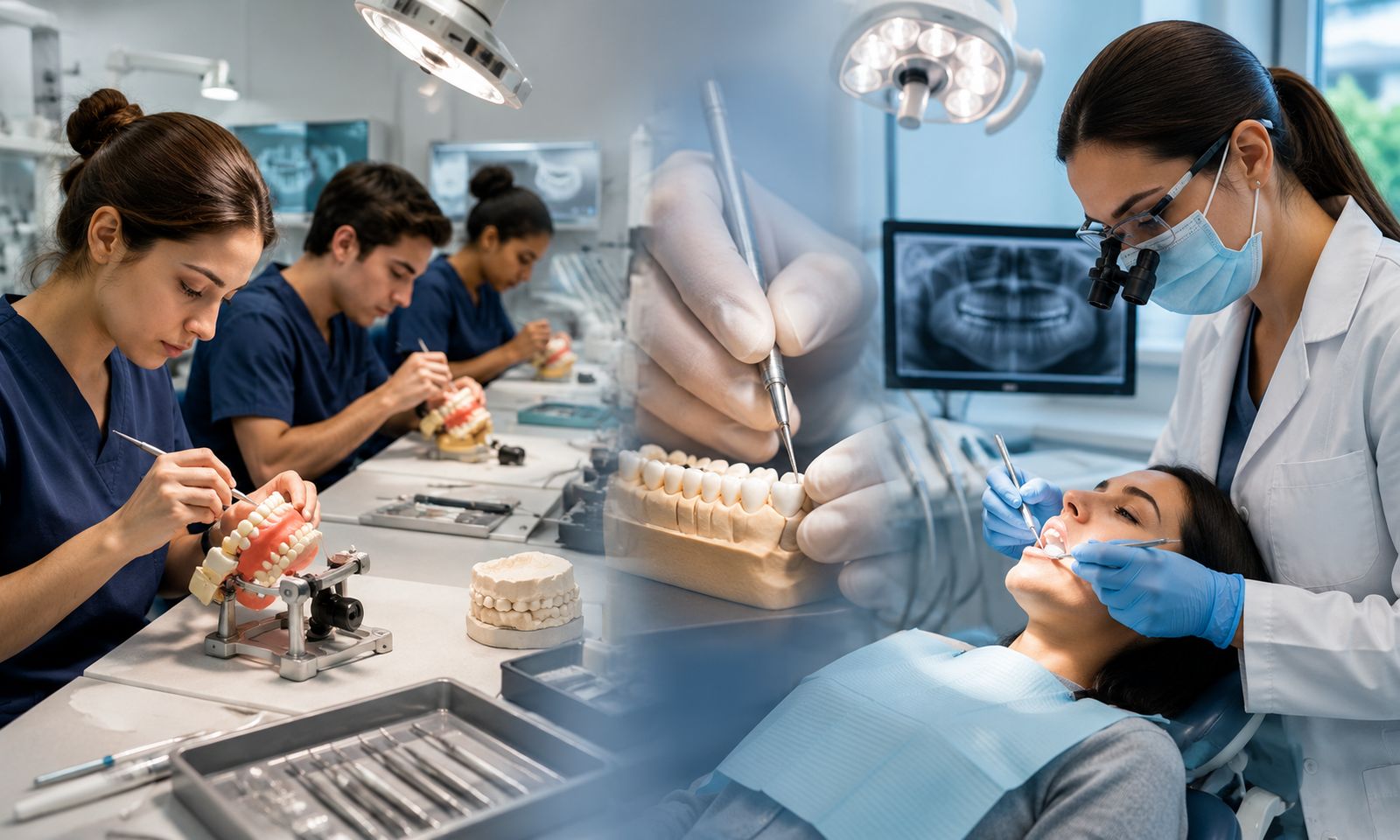
The fundamental aspects of tooth morphology, instruments, and procedure development are included in the preclinical stages of dental skill acquisition. The students are next taken to the laboratory setting with set-up conditions that mimic actual clinical settings, but without the stressors of real patients. This stage is crucial as it gives the student the opportunity to make mistakes, improve techniques, support muscle memory and is conducted in a controlled environment. Repetition, accuracy, and studying biomechanics of dental career-related processes like cavity preparation, waxing and restorative modelling are emphasized. In this first level, students also start to understand the significance of ergonomics, instrument handling, and visual-spatial coordination which are essential for success in clinical skills.
An essential element in this early learning is an awareness of ‘structured learning pathways’ that move the student through levels of increasingly demanding tasks. This has reinforced the need to maintain discipline and consistency as students are required to practice procedures over and over again, until they can repeat them quickly and with accuracy. In the end the preclinical foundation becomes the starting point for all of their future competency in the clinical arena, making it possible to prepare them to care for patients.
Simulation Lab and Skill Refinement.
The simulation laboratory this represents is a key link between theoretical training and clinical experience. At such sites, dental students interact with sophisticated manikins, typodont models and digital simulation systems that simulate patient pathology and conditions. This stage is especially significant in creating a continuity of skill development in Dentistry because during this stage the students will be able to realise the transition between individual technical tasks and more and more comprehensive clinical situations. The simulation labs are built to simulate real-life conditions and constraints like limited visibility, interaction with soft tissue and time management, thus making procedures more realistic. Students are encouraged to engage in repeated exercises while being supervised and providing themselves with feedback to correct errors and fine-tune techniques.
The advantage of simulation based learning is that it helps to increase learners’ confidence while it reduces risks. Students are able to try multiple methods for cavity preparation, crowned placement or for scaling without damaging patients. This will improve hand-eye co-ordination, touch and feel and decision making over time. Secondly, simulation training also teaches students to reflect on themselves by comparing their performance with the desired output and finding ways to improve. Such a reflection process is crucial for the sustainability of skills, enabling the learners’ adaptability to the cultural and technological evolution of the dental field, both in terms of its methodology and operative knowledge.
Clinical Practice Transitioning to Preclinical.
One of the biggest milestones from simulation-based training to real patient care is the first occasion you find yourself in the chair with a patient.The first time you sit in the chair with a patient is one of the biggest steps from using simulation-based training to real patient care. The aim of this phase is to entrust students with the challenges of human variability, which either constitute no two patients with the same characteristics from the anatomical and physiological point of view, or may. The clinical setting imposes demands on adaptability, communication and an awareness of the environment that is higher than in the controlled laboratory. Students need to be able to practically combine their technical skills, patient management, ethics and decision making. This step up from the preclinical stage is frequently difficult, can push the learner to his or her limits and demands precision and professionalism.
In this phase, supervision becomes a critical component for the safety of patients, and will be essential for the student’s growth. Clinicians who have greater experience have insight into how well the technical execution has been and patient participation, treatment planning and efficient procedures. This mentorship allows students to experience the transition from theory to practice gradually and finally become independent while having a good support system. The students start to comprehend the complexity of treatment, risk assessment and care plan for long-term care of the patient, as they encounter different clinical scenarios. This hands-on learning component is a crucial part in taking technical proficiency and making it into clinical skills.
Individual Hand Skills and Repeatable Accuracy
Hand skills are the foundation of a dental practice and must be fostered over time with intent and effort. The key qualities required to distinguish competent practitioners from novices are precision, control and consistency. These skills develop through repeated training in instrument handling and fine motor coordination and spatial judgment. They need to learn to work in restricted oral space, preserve their vision and accuracy while working in it, which requires physical skill and concentration. Such activities include cavity preparation, scaling and contouring for restorations, and as skills develop, added complexity.
Equally significant is the development of procedural rhythm, ease and efficiency of the performance of the clinical tasks without unnecessary hesitation and error. This part of learning the skills goes hand in hand with confidence – the more experience students gain and the more constructive input and feedback they receive, the more confidence they build. Through repetition, a clinician will be able to focus more on creating problem-solving strategies and incorporating patient factors, as basic movements become more automated. In conclusion, hand skills form a core part of dental skills and can play a significant role in clinical efficiency, accuracy of the clinical treatment and patient comfort.
Attention to Detail and Accuracy in Clinical Situations.
The attention to detail is another virtue of successful dental practitioners: even the least of inaccuracies may greatly affect treatment outcomes. Requires a combination of observational training, analytical thinking and careful practice. Students learn to identify subtle changes in tooth morphology, tissue response, and occlusal relationships, which all impact the clinical decision. Throughout dental education, precision in measurements, selection of materials and correct procedure is stressed, which makes it a habit to be more accurate from the beginning of treatment.
Technical skills are not the only ones needed for clinical accuracy, but rather cognitive processing and situational awareness. The dentistry professional’s responsibility is to constantly measure and re-measure results of the treatment, modifying certain techniques as circumstances dictate to ensure optimum patient results. This has to involve a rational approach to documentation, diagnosis and procedural plan. Therefore, students practice and develop the ability to anticipate potential complications and preventive strategies to further ensure the reliability of treatment as students progress. This attention to detail contributes to the overall care and health of patients, the effectiveness of treatment, and a positive mouth and long-term health prognosis—the essential cornerstone of clinical dentistry.
Professional Development and Continuous Learning
Dentistry is ever-changing and new materials, devices and treatment approaches are constantly appearing. Therefore, lifelong learning is a must to keep clinical skills current and to gain knowledge about best practice. It is imperative that dental professionals commit to lifelong learning by attending workshops, seminars, clinical courses and professional literature. This dedication to continuous learning will make the practitioner adaptable and prepared to incorporate new developments into his/her clinical practice.
Reflective practice is an essential strategy for learners to be able to do continuous learning, by helping a clinician to look at a patient’s performance and see how they can learn more and improve. Insights from these previous cases and outcomes can be used to tweak procedures and improve problem solving abilities. Further, the fostering of peer-to-peer interaction and memberships in professional groupings also helps with knowledge exchange and development of skills. It is not only about getting better at your job, continuous learning is also about professionally developing, learning about ethics and confidence in your clinical work, all of which are important for long-term success in dentistry.
Conclusion
From the preclinical learning to clinical mastery is a process of evolving miracle and continuous development and is an evaluative process in dentistry. Throughout this voyage there are different degrees of contributions from each step that aid in the development of a qualified dentist ranging from the laboratory sessions onwards to sophisticated care by the dentist to the patient. The students are taught how to react quickly and precisely through simulation, clinical practice and constant practice in order to be ready for the modern requirements of dental practice. Additionally, continuous learning guarantees that these skills stay applicable in a continually changing industry. In the end, the learning of any technical skills in dentistry is never really complete, as it is a continuous process of refinement, reflection and learning throughout a clinician’s career.