Introduction
Businesses and in time see a flow of financial information. What we see is that sales go up and down, expenses vary, the market changes and cash flow goes in and out at different times. To make good decisions we see that accountants, financial analysts, and economists use tools which in turn help them to see through these trends and to predict what is to come. Of the methods used for this time series analysis is a very effective one.
Time series analysis which is the statistical analysis of data collected over time. It enables companies to see patterns, trends, cycles, and seasonal variations in financial data thus improving forecast of future performance. We see this used in which companies put out estimates of future revenue, manage their inventory, predict cash flow, analyze economic conditions, and in the preparation of budgets.
In the fields of accountancy and economics which are very much into the future oriented decisions, forecasting is of great importance. Companies must determine if demand is going to rise, if costs may go up, or if profits are to fall. Time series analysis which is a systematic method turns past data into useful forecasts.
Understanding Time Series Analysis
Time series analysis is the study of data points recorded in time order. This data may be collected daily, monthly, quarterly, or annually based on the analysis’ purpose.
Examples of time series data include:
- Monthly sales revenue
- Annual profit figures
- Daily stock prices
- Quarterly GDP growth
- Monthly inflation rates
- Weekly cash flow reports
- Yearly production costs
Unlike what is done in typical statistical analysis which does not take into account the time element, time series analysis looks at how data plays out over time. The aim is to identify patterns which in turn will predict future values.
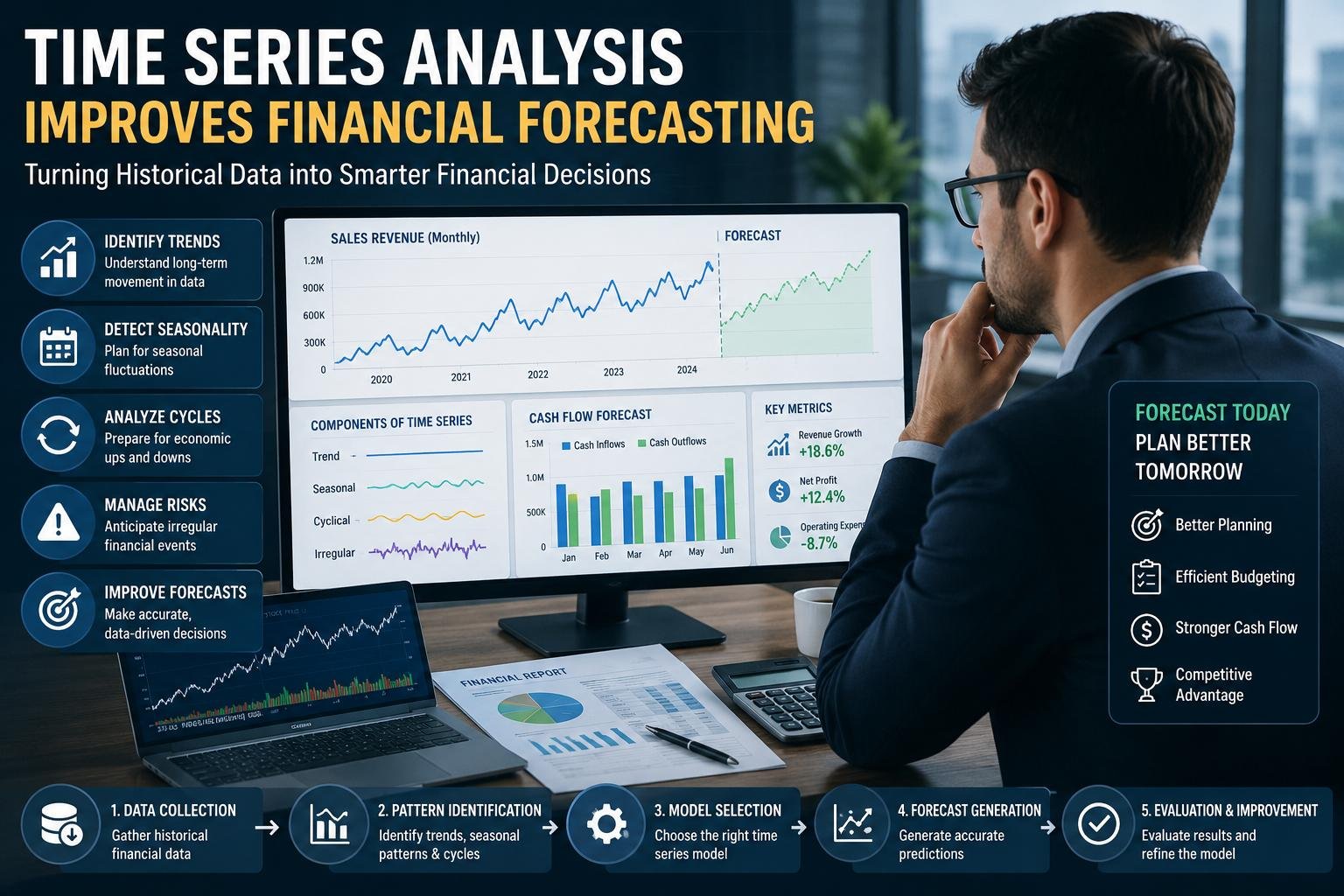
Components of Time Series Analysis
Financial and in economic reports we see many different elements. What these elements are tells businesses how to better interpret past trends.
Trend Component
A trend is what we see in data which plays out over a long period of time. It may present growth which continues over time, decline which is consistent over that period, or stability.
For example:
- A company’s steady increase in revenue over five years.
- Inflation rising gradually over decades
- Technology firms experiencing long-term growth
Trends present to companies the big picture of financial performance.
Seasonal Component
Season in which we see changes within a year are regular. Also these fluctuations are very much so to weather, holidays, and consumer behavior.
Examples include:
- During peak holiday seasons sales increased.
- Higher electricity consumption during summer
- Increased tourism during holiday seasons
Businesses do seasonal analysis for staff and inventory.
Cyclical Component
Economic booms and busts which we see over long term are what I am referring to.
For example:
- Reduced consumer spending during recessions
- Increased investment during economic booms
Cyclical study is a key element in economics and macroeconomic forecast.
Irregular Component
These are unpredictable events which are out of the ordinary.
Examples include:
- Natural disasters
- Economic crises
- Pandemics
- Political instability
These factors produce financial breakdowns.
Role of Time Series Analysis in Accounting
Accounting is very much a field that uses historical financial data. We see past performance as a base to project future business results. Time series analysis improves on this by to identify which elements in financial reports are the most telling.
Revenue Forecasting
Businesses look at past sales to project future revenue. By looking at trends over monthly and yearly periods organizations are able to develop realistic budget and financial plans. For instance a retail company may note that we see an uptick in sales every December which is due to the holiday season. This info in turn helps management with planning of inventory and marketing campaigns in advance.
Expense Prediction
Time series analysis is also used by businesses to predict out operating expenses which include salaries, utility bills, and production costs.
Accurate expense forecasting enables firms to:
- Improve budgeting
- Control spending
- Prevent cash shortages
- Allocate resources effectively
Cash Flow Management
Cash flow prediction is a very important application of time series in accounting. Companies look at past cash inflows and outflows to determine future liquidity requirements. This in turn helps organizations to avoid financial issues and maintain proper working capital. A construction firm may note times when cash in is less that which is spent on operations and put in place financing beforehand.
Budget Preparation
Organizations use forecasts in budget creation. In terms of budgeting accuracy time series analysis does better as it looks at past financial trends which support more informed predictions rather than guess work.
Better budgeting supports:
- Financial planning
- Cost management
- Strategic decision-making
- Performance evaluation
Role of Time Series in Economics
Economists apply time series analysis to economic indicators which in turn they use to predict future economic conditions.
Inflation Forecasting
Governments and central banks study past inflation data in order to predict future price changes.
Inflation forecasts help policymakers:
- Set interest rates
- Design monetary policies
- Control economic instability
Gross Domestic Product (GDP) Analysis
GDP is a measure of a country’s economic performance. Also we see that economists use time series analysis to determine economic growth trends and to project which way the economy is headed towards growth or recession. Forecasting GDP allows governments and businesses to prepare for economic change.
Unemployment Analysis
Time series analysis is used by economists to study unemployment trends and labor market conditions. For instance which is a period of several quarters see a rise in unemployment this may be a sign of an upcoming economic slowdown.
Stock Market Forecasting
Financial markets’ trend analysis is performed by financial analysts which includes study of stock price movements. Although the markets are very volatile, history may still have lessons to offer for investment decisions.
Common Time Series Forecasting Methods
In economics and accounting we use many forecasts.
Moving Average Method
The moving average method reduces short term fluctuation by computing averages for certain time periods.
For example:
- A 3-month moving average
- A 12-month moving average
This method produces what is in the large scale picture.
Advantages
- Simple to calculate
- Reduces random fluctuations
- Useful for stable data patterns
Limitations
- May not immediately respond to sudden changes.
- Somewhat less good when using very seasonal data.
Exponential Smoothing
Exponential smoothing is a technique that assigns greater weight to recent data, but incorporates older data as well. This recent financial info is what we see this technique as using which in turn better represents present market conditions as compared to older data.
Advantages
- Easy to implement
- Responds well to new developments/innovations
- Requires only short-term forecasting for suitability.
Limitations
- Not as accurate for very complicated trends.
- Needs to be used with care regarding the choices of the smoothness parameters.
Trend Projection Analysis
Analysis of trends is the one in which we draw a trend line through the data that has occurred and use it to predict future data. For instance, as sales grow each year the trend line will project future growth.
Advantages
- Works well for long-term trends.
- Great for focusing strategic decision making.
Limitations
- Presumes that history will repeat itself.
- Does not take advantage of sudden changes in the market
Regression-Based Time Series Models
Temporal regression analyses of financial variables. For instance, a company might observe that sales increase with the economic growth or when there is more advertising spend. Trends based on time are analyzed using regression.
ARIMA Models
ARIMA is an Auto Regressive Integrated Moving Average. It’s a fairly sophisticated time series forecasting method.
ARIMA models can be used for modeling:
- Trends
- Seasonal patterns
- Random fluctuations
The ARIMA models are suitable for complex forecasting tasks used by large companies, banks and government.
The various stages of time series analysis
In general businesses and economists do so which goes as follows:
Data Collection
At first we collect historical financial and economic data.
Examples include:
- Monthly sales reports
- Annual financial statements
- Inflation statistics
- Quarterly GDP figures
Accurate data gathering is essential to accurate forecasts.
Data Visualization
Graphs/Charts are created by Analysts.
Visualization helps identify:
- Trends
- Seasonal movements
- Outliers
- Cycles
Pattern Identification
Data analysis of the visualized data which components we see.
For example:
- Does there appear to be a seasonal trend?
- Is what is the trend doing?
- Do there seem to be any cycles?
Model Selection
The appropriate forecasting model is used depending on the nature of the data. Moving averages can be applied to simple patterns; ARIMA models can be used for more complex patterns.
Forecast Generation
That’s for which the model we have selected is for.These predictions assist management in relation to their financial decision making.
Forecast Evaluation
What happens is compared to what was forecasted.
Some of the most common evaluation tools are:
- Mean Absolute Error (MAE)
- Mean Squad Error (MSE)
- Forecast bias
As models are continually improved, forecasting accuracy improves over time.
Benefits of Time Series Analysis for Finance
Time series analysis is a useful tool for a business or economic application.
- Improved Decision Making: Accurate forecasts help managers make informed decisions regarding investments, production, and growth.
- A company could use their human resources, stock, and finances more effectively when they are able to forecast demand.
- Risk Reducing: Predict the financial issues that may occur before they turn into big issues. For instance, a set of revenue decline that may put into play a need for corrective action.
- Enhanced Budget Accuracy: Accurate predictions do better budgeting and reduce financial uncertainty.
- Competitive Advantage: Companies that are capable of anticipating market trends do so at a disadvantage to their competitors.
Challenges of Time Series Analysis
Although of great value, time series analysis also has issues.
Dependence on Historical Data
Forecasts are based very much on past data. Also we see that unexpected future events may reduce accuracy.
For example:
- Economic crises
- Political instability
- Technological disruptions
- Can suddenly alter financial patterns.
Data Quality Issues
Poor-quality data can produce misleading forecasts. Missing data, errors, or inconsistent reporting which in turn reduces reliability.
Complexity of Advanced Models
Sophisticated forecasting models require in depth statistical knowledge and special software. Small business owners may have trouble with these techniques.
Rapid Market Changes
Modern markets are in constant flux because of globalization and technology. Also historical trends are not always predictive of what is to come.
Practical Applications in Business
Time in series analysis is used in many industries.
Retail Industry
Retailers predict customer demand which in turn helps in managing inventory.
For example:
- Predicting holiday sales
- Planning promotional campaigns
- Managing warehouse stock
Banking Sector
Banks use time series analysis for:
- Interest rate forecasting
- Credit risk analysis
- Loan default prediction
Manufacturing Industry
Manufacturers predict production demand and raw material needs. This will see a reduction in waste and improvement of operational efficiency.
Government and Public Policy
Governments use time series forecasting to:
- Estimate tax revenue
- Predict unemployment
- Monitor inflation
- Plan economic policies
Time Series Analysis and Technology
Modern technology has greatly improved forecasting methods.
Accounting Software Integration
Today many accounting systems come with forecasting tools that analyze past financial data.
Artificial Intelligence and Machine Learning
AI has improved time series forecasting accuracy.
These technologies can process:
- Large datasets
- Complex trends
- Real-time financial information
Machine learning models find what which other traditional tools may miss.
Big Data Analytics
Today companies are collecting large sets of financial and consumer data. Big data technologies increase the accuracy of forecasts by using a wider range of info.
Future trends in Time Series Analysis for Finance.
Time series analysis’ role is going to grow as companies become more data oriented.
Future developments may include:
- Real-time forecasting systems
- AI-powered predictive accounting
- Automated financial planning
- Improved economic forecasting models
Organizations which put in place advanced forecasting systems do better at making quick and accurate decisions.
Conclusion
Time series analysis is at the core of what we do in accountancy, finance and economics which we use to study past trends and predict what is to come. We use it for sales forecasting, cash flow projection, expense management, budgeting and also to analyze economic climate.
By looking at trends, seasonal changes, cycles, and irregular fluctuations companies are able to make better decisions and reduce uncertainty. While perfect accuracy is not achieved in forecasting, time series analysis does provide a structured and evidence based approach which improves financial planning.
As technology advances, time series forecasting is seeing even greater improvements in its depth and value. Which companies which adopt these tools see improved financial health, better strategic planning, and they also obtain a competitive edge in very volatile economic settings.
Get more well researched information about time series analysis here.