Introduction
One of the most crucial statements that a business owner should know is a balance sheet. A balance sheet is a comprehensive statement of the value of a business at a certain time, showing what assets a business owns, what it owes and the owner’s stake in the business. A balance sheet is different to an income statement because it records the financial situation of a business at one moment in time. It is therefore important to critically assess stability and plan for growth, seek funding and make decisions for the business. From a small business’s perspective to an accounting student or even if you are just learning the basics of financial reporting, learning how to prepare a balance sheet will improve your analytical skills for determining the health of a business and effectively managing your finances. The first step to a successful balance sheet is being familiar with the structure and why it was created to make accurate financial statements and make wise financial choices.
Balance Sheet and its Elements
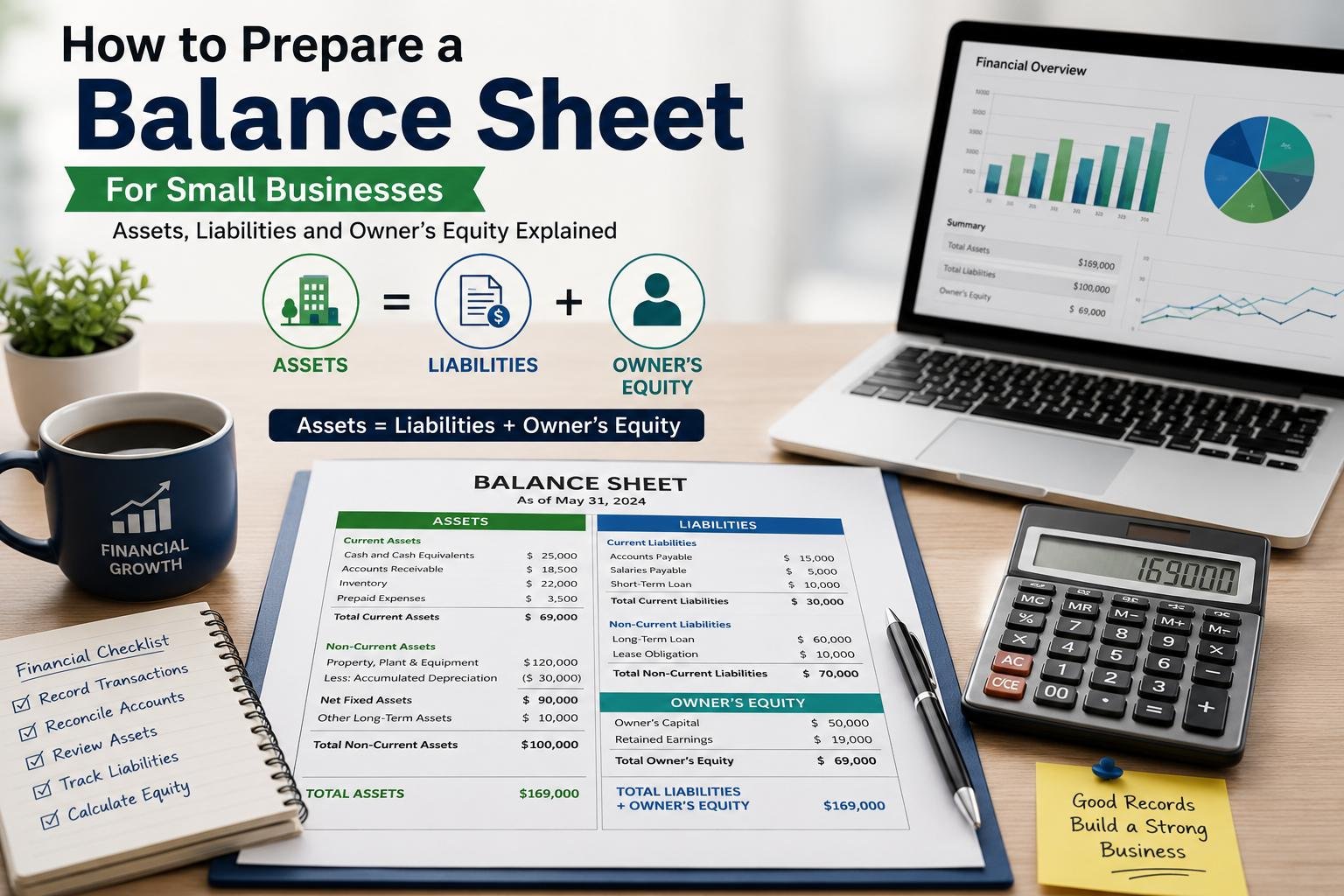
A Balance Sheet is a financial statement which provides a snapshot of a company’s assets, liabilities, and owner’s equity on a particular date. It is based on accounting equation:
Assets = Liabilities + Owner’s Equity
This equation shows that all that a business owns has been funded either by borrowing or the business owner’s investment. All business transactions that affect a business will have at least one impact on one side of this equation and keep it in balance. Due to this relationship, the balance sheet will give valuable information about the financial strength and stability of a company. Investors, lenders, suppliers, managers and business owners use this statement to determine if the business has the ability to pay its debts and has sufficient equity to sustain the business going forward. The well-prepared balance sheet can also aid other financial statements, which have to present key details that help to user understand the liquidity, solvency, and long-term financial sustainability of the business.
The Need for Small Businesses to have a Balance Sheet
Balance sheets are thought to be useful only for businesses that are large or businesses applying for loans. The truth is that having an up-to-date balance sheet is beneficial for all businesses since it would give a transparency to the company’s financial condition. A balance sheet can be used by the owner to see if the company has enough assets to pay off its short term obligations, if they are being over-extended, and the amount of value that the business has gained over time. Balance sheets are common documents that banks need to see before giving a loan to their clients, investors will use to determine whether or not to invest, and tax professionals will need to fill them out when they’re preparing financial reports. Frequently checking the balance sheet also serves as a great tool for business owners to be able to see financial trends, cash flow management, investment planning and spot issues before they grow to an unmanageable size. Knowing and keeping up to date with this key financial statement are important benefits for even the smallest business.
Three Main Components of a Balance Sheet
There are three main components to every balance sheet: assets, liabilities and owner’s equity. The sections are designed to provide a comprehensive financial overview of the business. An asset is any possession that the company has with an economic value. Liabilities are any monetary claims that the business has against others and owner’s equity is the owner’s net claim after subtracting liabilities from assets. It is important to know the category for each of these because if they are not well classified, the information presented in the balance sheet will not be useful for decision making. Managing the business with incorrect asset or liability classification can result in incorrect business management, incorrect financial reporting and compliance problems. Understand the various interactions between these three elements and it becomes easier to prepare a balance sheet.
1. Assets Explained
Assets are resources of the business that are expected to benefit the business in the future. The resources these include are cash, inventory, equipment, buildings, accounts receivable and other valuable resources. Typically, assets are categorized based on how easily they can be liquidated. Appropriate classification enables the users of financial statements to know the amount of liquidity available in the business and the efficiency with which the resources are being utilized. Periodic or regular asset value checks should be done, assets that are not needed should be eliminated, and any depreciation should be considered and recorded to ensure that the financial statements are accurate. Accurate records for all assets also assist in budgeting, insurance coverage, tax reporting and investment planning, and enhancing the reliability of financial information.
Current Assets
Current assets are those assets that can readily be converted to cash, sold or used within one year or within the normal cycle of a business. They are used for day-to-day operations and are crucial for keeping cash flowing. Examples of common current assets are cash and cash equivalents, accounts receivable, inventory, office supplies, short-term investments, and prepaid expenses. The current assets are typically only included in the accounting records in order of liquidity; the most liquid is listed first, e.g., cash, because it is available for use. Tracking current assets can also tell businesses whether or not they have enough assets to pay back their short-term debts and run their business without financial strain. A solid current asset management also helps with cash flow, by decreasing the borrowing of unnecessary assets, and provides better financial flexibility in uncertain times.
Non-Current Assets
Non-current assets, also known as long-term assets, are resources which are likely to benefit the business for more than one year. These assets are not used to sell in the short term; but are used instead for long-term business use and growth. Some of these include land, buildings, equipment, machinery, vehicles, office equipment, furniture, patents, trademarks, software and goodwill. Many intangible and tangible non-current assets have an expected useful life and may be depreciated and/or amortized in accordance with the accounting standards. These assets need to be recorded and businesses should be aware of their long-term investment position, the depreciation costs they can expect and their capital replacement needs.
2. Liabilities Explained
The liabilities are the amounts of money or property that are owed by the business to the other parties and will be settled in the future. The obligations come from borrowing, buying something on credit, receiving something before paying for it, or paying some expenses that have not been paid. Assets are classified as current assets or long-term assets based on when they will be turned into cash. Liabilities are classified in the same manner as assets – based on when they will be settled. Improper classification can affect how business owners assess their financial risk, plan for repaying their debt, and/or determine their debt levels. When liabilities exceed assets, it might be a sign of liquidity issues or a rising financial burden, but when liabilities are in balance with assets, it can be a sign of a healthy business, which can help make decisions about future expansion and investment. By monitoring liabilities regularly, payment deadlines will be met, credit ratings will stay high and relationships with suppliers and lenders will be maintained and built over time.
Current Liabilities
Current liabilities are debts that are to be settled within one year or the current operating cycle of a business. These liabilities have to be paid out with current assets and thus directly influence liquidity. Account payable, accrued expenses, salaries payable, taxes payable, short term loans, interest payable, utilities, current portion of long term debt are examples. Businesses can prevent late payment fines, build positive relationships with suppliers and keep cash flow healthy by having a good control over current liabilities. Businesses should regularly review the current ratio, to determine if they have sufficient current assets to cover their current liabilities, so as to ensure that they can continue to operate normally in the future.
Non-Current Liabilities
Non-current liabilities are those which arise after one year. Generally, these debts are used to finance long-term investments, growth in business or the purchase of major pieces of equipment. Examples are bank loans due in more than one year, mortgages, lease obligations, bonds payable and deferred tax liabilities. While these may not be due immediately, they need to be planned carefully as they will have a significant impact on cash flow and profitability in the future. A combination of long-term financing and owner’s equity can be a good mix to finance sustainable growth and lower financial risk. The long-term liabilities are also tracked to assess the ability of the borrowers and keep a proper debt-equity ratio.
3. Owner’s Equity Explained
Owner’s equity is the amount of money the owner has invested in the business less the business’s liabilities. It is a reflection on the value that has built up within the business over the years and is an important indicator of business financial stability. Some of the items capitalized in owner’s equity generally consist of the contributions by the owner, retained earnings, additional investments, and withdrawals/drawings. There are several types of Equity for a corporation, such as Common Stock, Additional Paid-in Capital, and Retained Earnings. If owner’s equity is positive, the business has more assets than it owes; if the owner’s equity is negative, this can be a sign of problems, or that the business has accumulated losses. Knowing what is owner’s equity can allow an owner to assess the growth of her business, the value of her business, and the overall performance of her business in the long-term.

Overview of how to Prepare a Balance Sheet in Steps
With a systematic approach, preparing a balance sheet can be much easier. As a first step, choose the reporting date since a balance sheet is always a snapshot of financial information as of a certain date. Collect all accounting documentation such as: cash balances, bank statements, invoices, inventory records, loan agreements, accounts receivable, accounts payable, payroll records, asset registers and much more. Next, add all of the assets up by current and non-current. Repeat the exercise and categorize liabilities as current and non-current, making sure all outstanding debts are accounted for. Determine owner’s equity by adding capital contributions, retained earnings, and any withdrawals or losses and their corresponding adjustments. Lastly, make sure that the total assets match the total of the liabilities and owner’s equity. When the two sides do not balance, check transactions to locate any mistakes or missing details before closing out the statement.
Common Errors to Avoid
There are often common mistakes that novices can make when creating a balance sheet. The most frequent error is the classification of current and non-current assets and liabilities, which can affect the liquidity analysis. A second common problem is the failure to include depreciation which causes the assets to be overvalued. Sometimes, companies also fail to document their accrued expenses or outstanding loan balances or accounts receivable, which leads to missing out on sections from their financial statements. Other issues that can affect the accuracy of the balance sheet include mathematical errors, duplicated entries and failure to reconcile bank accounts prior to the balance sheet. Also, inventory not being recorded or the owner’s not withdrawing the inventory can lead to an incorrect amount of owner’s equity. Establishing regular bookkeeping procedures, reconciling accounts and auditing all balances before closing the books greatly enhances the accuracy and reliability of the balance sheet.
How to Analyze a Completed Balance Sheet?
The real value of the balance sheet is in interpreting the information provided by the balance sheet and preparing the income statement. Business owners should consider whether their current assets are greater than their current liabilities and this will be a sign of the company’s ability to pay the current obligations. Analyzing Debt/Equity ratio compares the amount of debt used to the owner’s equity, and thus can be used to judge financial leverage and long-term stability. The use of balance sheets over different periods enables business owners to see trends like growing cash reserves, rising inventory, growing debt, and improving equity. Other financial ratios will offer extra clues as to liquidity and solvency, including the current ratio, debt to equity ratio, and working capital ratio. When businesses continually review these indicators, they can make informed decisions on expansion, loans, budgeting and other improvements to their operations and eliminate financial risks.
Best Practices for an accurate Balance Sheet
In order to keep a clean balance sheet, bookkeeping must be consistent and financial discipline maintained all year long. Make sure to document all business transactions quickly, balance your bank statements monthly, keep inventory records up to date, follow up on accounts receivable and payable, and keep records of supporting documentation for all business transactions. In addition, review of fixed assets should be done periodically to ensure that the correct depreciation is taken and that obsolete assets are removed from the books as needed. Reliable accounting software can make record keeping less cumbersome, calculate accounting figures and minimize manual errors, and regular audits by an accountant give an added layer of security in terms of the accounting statements submitted being consistent with all accounting standards. Regular maintenance is easier to perform at the end of the year and gives management up-to-date information when they have to make major decisions.
Conclusion
The balance sheet is a much more than just a financial report, it is a powerful tool for decision making that can show the financial strength, stability and long term sustainability of a business. The knowledge of classification of current assets and non-current assets, the proper classification of liabilities, and how to properly calculate owner’s equity can help small business owners develop financial statements that will give them helpful insight into their operations. The well prepared balance sheet facilitates effective budgeting, better cash flow management, easier loan applications, better investment decisions and increased confidence amongst stakeholders. Learning how to create a balance sheet will give you a clear view of your business and how it is doing now, whether you’re running a small business or taking classes on accounting, or just trying to learn more about finances. If you keep records regularly, classify items carefully and perform regular financial reviews, your balance sheet will be a good indicator of your company’s financial position and be a valuable tool for future success.
Get more well researched information on How to Prepare a Balance Sheet here.