Most people install louvres for shade or privacy. That is a reasonable starting point. But it is also a fairly limited way to understand what they actually do. The homes that get the most out of louvres are the ones where the owner understood — before installation — that they were dealing with a system that changes airflow, light quality, sightlines, and thermal behaviour all at once. Louvres, used well, are not a finishing touch. They are a decision that restructures how a space performs.
The Light Nobody Accounts For
Direct sunlight and daylight are not the same thing, and most homes are designed without making that distinction clearly. Windows that face the wrong direction flood rooms with glare and radiant heat while doing little to produce the soft, diffused light that actually makes a room comfortable and usable. Louvre slats intercept direct solar rays before they enter and scatter what comes through. The room stays bright. The heat gain drops. The glare that makes a screen unreadable by mid-morning disappears. This is not about blocking the sun — it is about converting it into something the room can actually use.
Stack Effect and Why It Matters
There is a ventilation principle called the ‘stack effect’ – warm air rises and exits through high openings while cooler air is drawn in at low points. Most homes work against this accidentally. Sealed windows, solid walls, and poor opening placement trap rising warm air with nowhere to go. Louvres placed at the right height on the right wall face work with this principle rather than against it. The angled slats direct incoming air at a downward pitch, which pushes it across the occupied zone of a room before it rises. The difference in a room ventilated this way versus one relying on a ceiling fan is significant — one moves heat around, the other removes it.
What External Louvres Do to Neighbouring Sightlines
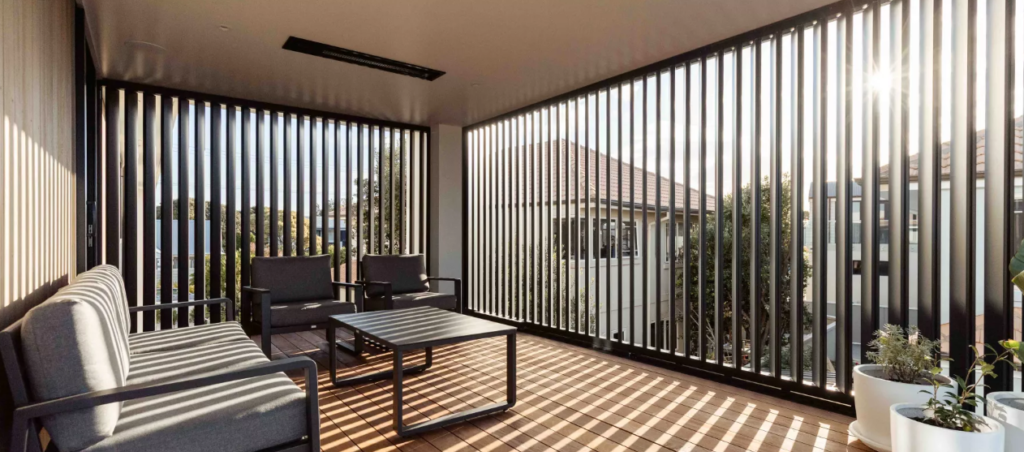
The privacy geometry of external louvres is something most people only discover by accident. An observer standing at ground level outside a building, looking towards a louvre panel, sees the underside of the slats, which is effectively a closed surface from their vantage point. An occupant inside, looking out at a lower angle through the same slats, sees through the gaps with a relatively clear outward view. The angle of the slats, the height of the panel, and the distance of the external observer determine exactly how much privacy is achieved. This is a mechanical relationship, not an approximation — and it means that louvres can be specified precisely for a particular site condition rather than installed and hoped for.
Roof Louvres and the Problem They Solve
A covered outdoor area with a fixed solid roof creates a specific problem in reverse. It solves rain and sun but kills the sense of openness that made the outdoor space worth having. The area feels like a room without walls — enclosed in the wrong direction. Adjustable roof louvres maintain the open-sky experience when conditions allow and close for weather protection when they do not. What changes the character of the space entirely is the ability to move between those states in minutes. That responsiveness is not cosmetic. It determines whether the space gets used at all across changing weather or sits empty for most of the year.
Material Behaviour Over Time
Aluminium louvres do not rot, warp, or absorb moisture. That is worth stating plainly because the alternative — timber — does all three under sustained exposure, regardless of how well it was treated at installation. Salt air accelerates every form of material degradation. UV exposure strips surface finishes gradually and then begins affecting the substrate. Powder-coated aluminium holds its finish and its form in conditions that eliminate most other materials quietly, over the years, without obvious warning signs until the damage is already done.
Conclusion
The placement of louvres in a residence is not determined by a single function, but rather by the combination of tasks they concurrently oversee. Light, ventilation, privacy, weather protection, and long-term durability are rarely reconciled in a single architectural element. Louvres cease to be a product and instead become an integral component of the building’s approach to its surroundings when the specification is appropriate for the site and orientation.