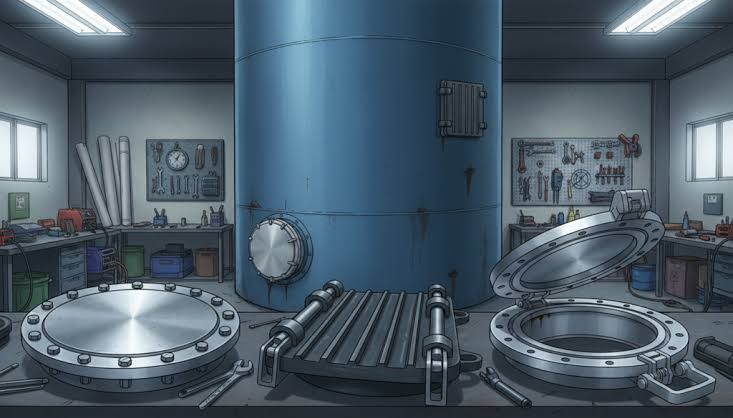
A fermenter that fails to hold its intended pressure can delay carbonation, waste gas, and make a closed transfer unreliable. The correct response is to verify the tank’s rated limits, isolate the symptom, and find the leak or control fault without defeating a relief device. Never increase the regulator setting just to make up for unexplained pressure loss. The investigation should distinguish a true leak from temperature-related pressure change, an open process path, and an instrument error.
Establish a safe and meaningful baseline
Confirm the vessel nameplate, design pressure, operating pressure, and installed relief device before testing. Use the manufacturer’s procedure and trained personnel. Record beer temperature, headspace pressure, tank fill, gas supply status, and the time between readings. Pressure in a closed tank changes when temperature changes; a falling gauge during cooling is not automatically evidence of a leak. Do not pressure-test a vessel with an improvised gas source or outside the permitted range.
Compare the fixed gauge with a known-good instrument at an approved connection. A damaged gauge can create a convincing but false problem. Check whether the reading is in gauge pressure or another unit and that everyone on the shift uses the same units.
Trace every route out of the headspace
List the gas inlet, blowoff arm, spunding valve, pressure relief valve, sample point, carbonation connection, manway, and any transfer connection. Make sure each is in its intended operating state. A partially open blowoff valve or a poorly seated sample valve can lose gas quietly. Check connections in a deliberate sequence rather than tightening every fitting at once; otherwise the team may never learn which component failed.
Use an approved leak-detection method compatible with sanitary equipment. Avoid introducing a non-food-safe solution into product-contact areas. If a leak appears at a clamp, depressurize and isolate the section before servicing it. A clamp that needs repeated tightening may have the wrong gasket, damaged ferrule, or misalignment.
Inspect the control and relief devices
A spunding valve may be set incorrectly, contaminated, or stuck partly open. Verify its setpoint and operation according to the supplier’s instructions. A relief device is a safety component, not an adjustable process valve. If it appears to vent below its intended point, take the vessel out of the relevant service and have a qualified person inspect or replace it. Never plug, cap, or bypass it to complete a batch.
Condensate or cleaning residue in small gas lines can interfere with regulators and pressure sensors. Check line routing and drains, then verify that the gas supply can maintain the required pressure without exceeding safe limits. If pressure loss occurs only when the supply is disconnected, inspect the tank boundary. If it occurs only during transfer, inspect the transfer path and its connections.
Consider temperature and fill effects
During cold crash, gas in the headspace contracts and gas dissolves into beer. A tank can develop vacuum risk if it is sealed without the correct vacuum protection or gas-management procedure. Follow the vessel manufacturer’s guidance and the brewery’s approved operating limits. If pressure changes track cooling closely and the tank passes a controlled hold test at steady temperature, the process may need a better gas-management plan rather than a mechanical repair.
The smaller the headspace, the less gas volume is available to buffer pressure changes. Record fill level and process stage when comparing tests. A pressure behavior that is normal for a full tank may differ from that of a partly filled one.
Repair, retest, and document
After correcting one identified issue, repeat the same controlled hold test at a stable temperature. Record starting and ending pressure, elapsed time, and the conditions of the test. Verify all valves are returned to their correct production positions. The test should be long enough to reveal the original symptom, but its duration and pressure must follow the equipment procedure.
For replacement fermentation equipment, request a clear gas and safety-device schematic that identifies every pressure boundary. For craft brewery tanks, confirm the pressure rating, vacuum protection, device documentation, and access for maintenance. A reliable pressure system depends as much on correct fittings and operating practice as on the tank shell.
Prevent recurrence during routine operation
Add a short valve-position and gasket check to the pre-transfer checklist. Keep spare seals that match the actual fittings and document the relief-device service interval. Teach operators to record temperature along with pressure, and to report a repeatable trend rather than an isolated display number. A pressure problem becomes easier to solve when the next person can see exactly when it began and which connection was changed.
How should a pressure hold test be documented
Use a test form naming the vessel, gauge, approved pressure range, starting and ending temperature, starting and ending pressure, elapsed time, and every connection that was isolated. Follow the vessel manufacturer’s procedure for the test medium and duration. A hold test without a stable temperature or a clear valve boundary can produce a false failure or false pass. Never use the result to justify operating beyond the tank’s rated limit.
If a leak is found, write down its exact location and corrective action. The same connection may leak again because of misalignment, damaged ferrules, or repeated gasket reuse. A maintenance history helps distinguish a one-time assembly error from a design issue.
What if the tank loses pressure only during cold crash
Check the gas-management sequence and the vacuum protection before touching a fitting. Cooling contracts headspace gas and encourages carbon dioxide to dissolve into the beer. The amount of pressure change depends on fill and temperature, so compare like conditions. A tank that holds pressure at stable room temperature may still need a controlled gas supply during crash cooling. Do not close a gas path or disable protection simply to keep a number on the display.
If the equipment is shared by several shifts, record the permitted valve lineup for each stage. A night-shift change to the blowoff or gas supply can otherwise appear as a mysterious leak on the next morning’s log. Clear stage-specific instructions make pressure behavior easier to interpret.