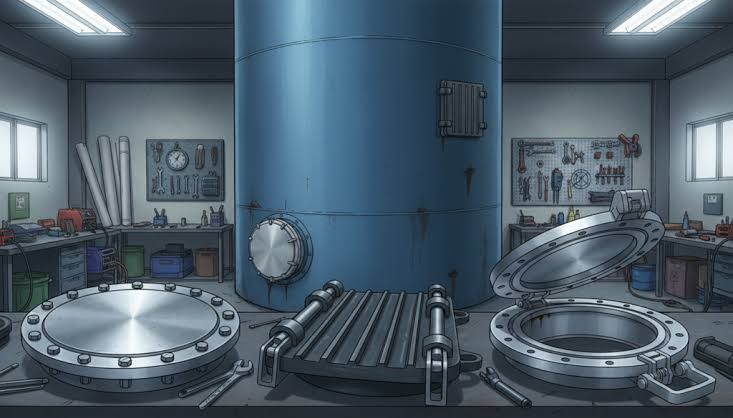
A manway is more than an opening in a fermentation or bright beer tank. Its shape, location, seal, and access affect inspection, cleaning, maintenance, and operator safety over the tank’s entire life. Buyers often compare only diameter and price. A better review asks what workers must reach, what residues may collect, and whether the opening can be serviced without awkward lifting or unsafe entry. No manway design eliminates the need for a formal confined-space assessment when tank entry is contemplated.
Start with the work that must be done
List the tasks planned for that vessel: visual inspection, removal of internal components, gasket replacement, cleaning verification, and occasional repair. A fermentation tank used for heavily hopped beer may need different access from a bright tank that is rarely opened. Determine whether the work can be done from outside using suitable ports and tools. Designing for routine entry is generally a poor substitute for cleanable internals and accessible fittings.
Check the room layout. A side manway may be reachable from the floor but blocked by adjacent tanks or a platform. A top opening may be clear but require safe elevated access. Draw the swing path or clearance needed to remove the cover and gasket.
Compare location and geometry
Top manways can support inspection from above but may place the worker near high-level pipework. Side manways can make certain cleaning and component tasks easier but introduce a different seal and pressure-boundary arrangement. Review the vessel’s operating pressure and the manway rating as one system. Do not assume a generic cover is appropriate for a pressure-rated unitank.
Look at the internal transition around the opening. Crevices, sharp ledges, or weld irregularities can retain soil and make visual confirmation difficult. Ask for close-up fabrication photographs and a drawing showing the manway neck, hinge, and gasket seat. An attractive exterior polish does not prove the internal area drains and cleans well.
Evaluate the gasket and closure
The seal should be compatible with beer, the cleaning chemicals used, temperature, and the pressure duty. Verify the material specification and availability of spare gaskets. A gasket that stretches, twists, or is difficult to seat can create repeated leaks and long changeovers. The cover should close evenly without requiring improvised tools or excessive force.
Ask how the operator confirms correct closure. Are clamps or bolts easy to inspect? Are there pinch points? Can a cover swing unexpectedly? Include the cover’s weight and handling arrangement in the review. A practical manway does not rely on one strong employee to lift a heavy plate into position.
Plan for cleaning and inspection
Inspect the internal surface after the normal cleaning cycle, using the site’s safe procedure. Pay special attention to the gasket groove, hinge-side recesses, and the area immediately below the opening. Residue there may indicate spray shadowing or a poor drain path. If the area cannot be checked without entering the tank, discuss alternative inspection ports, lighting, or cleaning access during procurement.
Follow the manufacturer’s torque or closure sequence when provided. After opening the manway, inspect the gasket for cuts, flattening, swelling, and embedded particles before reuse. Maintain a record of recurring leak locations, which may reveal misalignment rather than a consumable-seal problem.
Make maintenance space part of the purchase
Supplier drawings should show the opening in relation to legs, jackets, ports, nearby walls, and platforms. Confirm that an operator can remove the cover and gasket after the equipment is installed, not just when the tank stands alone in a workshop. If a lift or platform is required, it belongs in the project scope and budget.
When comparing brewery fermentation tanks, request manway dimensions, seal material, pressure rating, hinge details, and internal photographs. For craft brewery equipment, ask how the proposed arrangement supports cleaning and inspection at the planned tank spacing.
Accept the installed manway deliberately
During commissioning, open and close the manway with the people who will operate it. Check clearance, visibility, seal seating, and any interference with surrounding pipework. Document how the closure is inspected before pressurization. If the cover is difficult to operate or the gasket falls out of place, resolve it before production becomes routine. Small access defects become recurring safety and quality problems when a vessel is used every week.
What should buyers ask to see before ordering
Request an elevation and plan view with the manway fully open, not only a closed-tank rendering. Ask for the cover weight, hinge or lifting arrangement, seal cross-section, material specification, and replacement-part number. Confirm the space needed to remove the gasket and clean the groove. If the tank will stand beside another vessel, draw both at their actual spacing. An opening that works in a showroom may be unusable in a tight cellar.
Ask whether the manway and closure are included in the pressure documentation for the whole vessel. A tank shell rating does not replace confirmation of every pressure-boundary component. Clarify what testing and inspection the supplier performs before shipment.
How can operators extend seal life
Clean the gasket and seat without sharp tools that cut the sealing surface. Store spare gaskets in the condition recommended by the supplier, away from heat and contamination. Replace a seal that is swollen, flattened, or nicked instead of using additional clamp force to make it work. Record leaks by location and batch. Persistent leaks after a new gasket should prompt an alignment and closure inspection.
Train staff to depressurize and verify zero energy before opening. A manway is not an ordinary lid on a vessel that can hold pressure. That distinction belongs in both the operating procedure and new-employee training.
When should the design be reconsidered
If routine cleaning repeatedly leaves residue at the seal, if operators cannot reach the cover safely, or if the manway leaks after correct gasket replacement, do not normalize the workaround. Review the spray pattern, opening geometry, support, and closure alignment with the builder. Specify a corrective action and verify it with an actual cleaning and closure cycle. Ease of use should be demonstrated in the installed cellar, not assumed from a drawing.


