Introduction
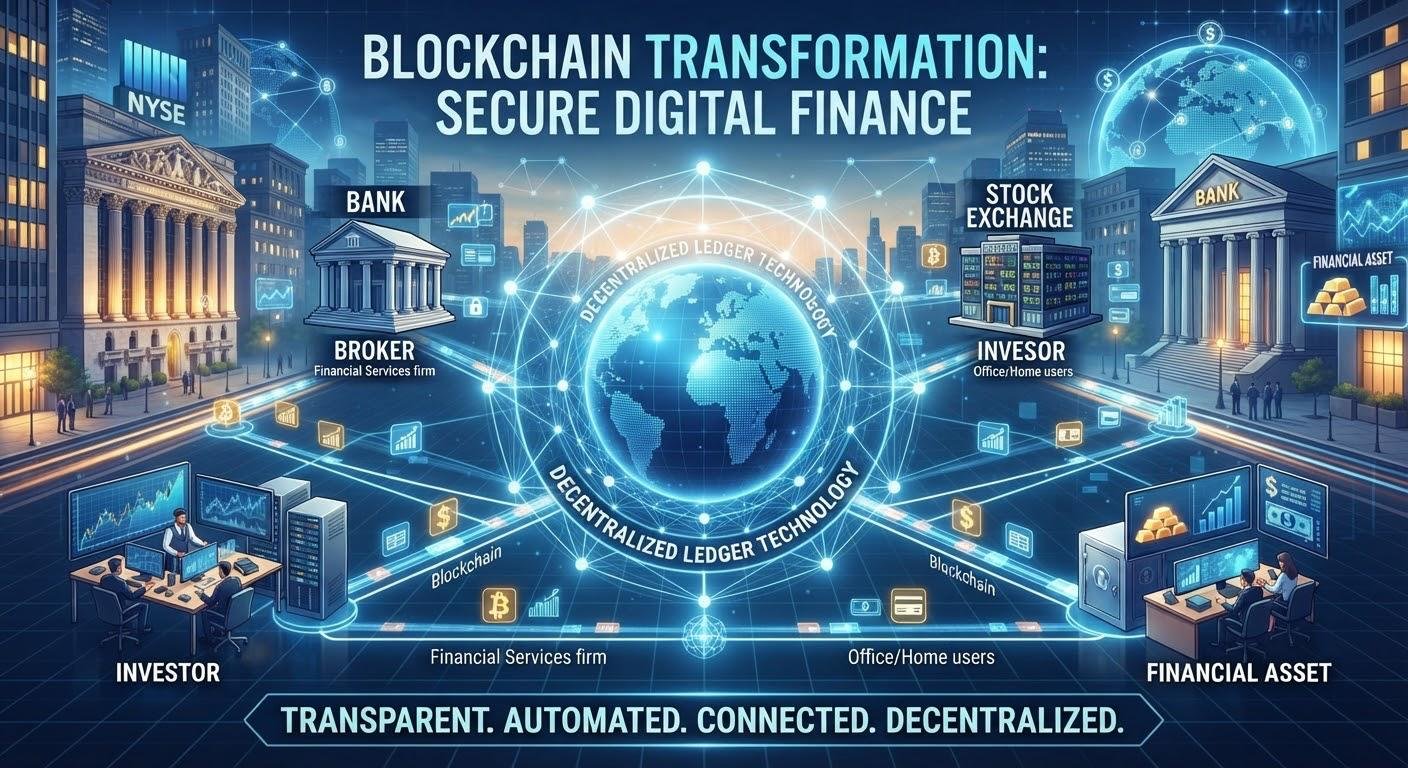
The financial markets rely on the acceptable and dependable capacity of institutions to issue, trade, transfer, record and settle financial assets in an accurate and efficient manner. These activities have been dependent on interrelated systems managed by the banks, brokers, exchanges, clearing houses, custodians and other financial intermediaries for decades. Despite the growing digitization of these systems, many transactions still require multiple databases, manual reconciliation, duplicate records and processes that need various institutions to exchange information for a transaction to be completed. Blockchain technology is another solution that enables participants to maintain a shared ledger of transactions on a network. The concept is highly related to distributed ledgers, which are ledgers that keep transaction records on several computers participating in the network instead of one central computer. This ability will impact ownership, transactions and settlement data in financial markets.
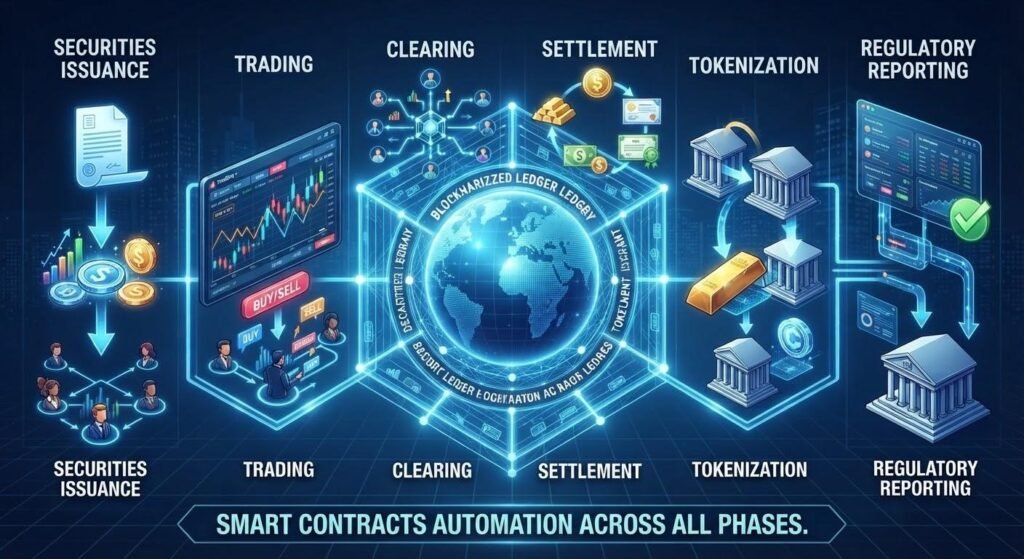
The potential importance of blockchain goes beyond cryptocurrencies. Financial institutions have begun to explore the potential of blockchain and distributed ledger technologies in the field of securities issues, trading, clearing, settlement, collateral management, identity verification, regulatory reporting and recordkeeping. A shared ledger can serve as a unified source of information for authorized participants to access, based on pre-established rules, as opposed to having each participant keeping their own bookkeeping and having to reconcile these accounts again and again. Smart contracts can also trigger certain actions on the basis of specific actions that are set out within the contract itself. These functions can cut down on some of the duplication of effort, enhance transparency, and make transactions quicker. But blockchain is not the panacea to all financial-market issues. Issues such as the regulation of the system, privacy, scalability, cybersecurity, governance, interoperability, and the reliability of information being added to the ledger must be tackled before it can be widely adopted.
Corporal Financial Markets and the Construction of Blockchains
The traditional financial markets are characterized by a multitude of institutions with specific roles. For instance, if an investor buys a security that deal could go through a broker, a trading venue, a clearing organization, a settlement system, a custodian and other service providers. Every participant can have its own database with data about the transaction; in this case, there is a need for reconciling systems. Blockchain’s potential impact on this structure is through the ability to provide a shared and synchronized record to market participants who are authorized to participate in the market. Each institution would not have to independently verify the same data, but would have different permissions and responsibilities, depending on the participant, while using a common ledger. This may help to avoid double entry bookkeeping and help identify ownership and status of an asset. The outcome wouldn’t necessarily mean the end of the intermediaries, but it could mean a shift in their role from keeping multiple records to offering services like compliance, custody, risk management, governance, and transaction validation.
Developing a Common Source for Financial Data
A key characteristic of blockchain is its ability to keep a stable record of transactions between recognized participants. Conventional markets can lead to reconciliation issues when there are differences between databases, especially when numerous transactions are processed between multiple organizations. This can be mitigated with a shared ledger as participants will be operating with synchronized information. Once the validation and record is performed in accordance with the rules of the network, the record becomes available for the participants who are allowed to receive it. This can help provide greater clarity around the status of transactions and minimize the risk of “double counting” information from one institution to another. For financial markets, increased synchronization may contribute to improved operational efficiency and lower some of the administrative expenses. However, a shared ledger requires good governance as each participant must agree on who can access the shared ledger, how the transactions are validated, how errors will be dealt with, and who will be liable when a problem occurs.
Blockchain in Securities Issuance
The blockchain might be able to revolutionize financial markets by altering the way securities are created and issued. When an organization issues a traditional security, there are several intermediaries and administrative steps involved in registering an ownership, distributing assets, keeping records and communicating with investors. The financial institutions would be able to encode the ownership of, for example, bonds, equities or other financial instruments as digital tokens on a blockchain network, thanks to the tokenization. The transfer of a tokenized security may involve the exchange of information on ownership and history of the security between eligible participants via a controlled digital infrastructure. Smart contracts can also automate some of the aspects of the security, including its distribution of bond interest payments when certain conditions are met. This might enable to program the issuance of these and hopefully decrease administrative procedures. But tokenization does not ensure that the asset is legally valid or it has any economic utility.
Making Trading and Market Access more Transformative
Blockchain could also impact the trading securities. Electronic transactions are already used in modern financial markets, but multiple systems may be required to communicate with each other in order to process these transactions. A blockchain-based trading environment could enable the recording of trades on a common network while smart contracts could help establish set rules of trades. This might enable more automated markets and enable some financial assets to be traded outside the building of the traditional markets. Tokenization may also enable the creation of smaller fractionalized units that would allow for increased flexibility in distributing some assets. But greater access to the digital space should be accompanied by investor protection, market supervision, liquidity requirements, and limitations on investor eligibility. Blockchain shouldn’t be considered as a substitute for exchanges or brokers. Rather, it might offer additional infrastructure that will alter the ways in which these institutions relate to investors and to each other.
Clearing and Settlement
Some of the areas in which blockchain could make major efficiency gains are in clearing and settlement. A trade and its final settlement can have several steps in the conventional market. Once a transaction is made, there’s information that must be verified; obligations must be settled and securities and cash must finally be exchanged between the proper parties. Such processes may involve cooperation between brokers, clearing systems, custodians, and settlement systems. Some of the reconciliation between different databases could be reduced, and transaction and ownership information could be brought onto a shared ledger, using a blockchain-based infrastructure. Together with tokenized securities and appropriate variants of digital settlement assets, transactions can be pushed towards faster or even near real-time settlement. Shorter settlement periods would help limit counterparty exposure and capital required to accommodate the settlement process.
Save Reconciliation and Operational Costs
A significant amount of resources are spent by financial institutions to maintain databases, verify transactions, get transaction information across systems and reconcile discrepancies. Some of these costs can be reduced with the use of Blockchain, which could provide a shared record for the participating institutions to refer to. The fewer resources required to compare independently kept records, the less resources that might be required if a broker, custodian, clearing institution and other authorized participants have access to the same validated transaction information. Smart contracts could also automate repetitive tasks by performing actions based on predetermined conditions, further improving the automation of such tasks. For instance, an automatic update of the ownership records following the completion of settlement conditions or an eligible payment could be triggered when a contractual condition is met. Automation may help to minimize manual work and delays in processing. But they would still have employees and systems to deal with exceptions, to investigate questionable activity, to keep them in compliance, to deal with disputes, and to respond to situations that are not programmed.
Establishing Greater Transparency and Recordkeeping
One of the other major benefits of blockchain is that it may help improve the tracking of economic transactions. The chronological nature of blockchain networks allows them to store a history of all transactions and assets that have been validated and accepted by the network participants, so that they are able to access the log without relying solely on their own specific records. This can help improve the audit process and facilitate the determination of transaction occurrences and ownership changes. Financial markets could benefit in this regard through better tracking of records and better checks on unauthorized changes of records, and better ways to investigate any discrepancies. With appropriate access, the technology can also ensure a more consistent record to provide to auditors and regulators. But transparency has to be well planned. Financial institutions deal with sensitive information, and a lack of restriction might result in privacy and confidentiality issues. For regulated financial applications, however, permissioned blockchain network might be more suitable, as it can restrict the access based on the roles of the participants and legal requirements.
Blockchain and the Regulatory Reporting
Another place where blockchain technology can enhance the working of financial markets is in regulatory reporting. Regulators demand banks, brokers, investment firms and other institutions to give it to them in ample supply, including information on transactions, positions, risks and compliance efforts. Gathering this data from various internal systems can be complex, especially if it’s stored in different formats or with inaccuracies. Having access to a shared ledger would allow for access to a common set of transaction information by regulators and authorized institutions, which would help to eliminate the need for multiple data gathering and reconciliation efforts. Another use case for smart contracts is automated compliance checks, where the smart contract can be programmed to follow specific rules for transactions. For instance, a system could determine if a transaction falls into any eligibility requirements prior to allowing the transaction to be processed. This might improve monitoring and minimize delays in reporting.
New Market Structures and Financial Products
Blockchain might eventually provide financial-market infrastructures that cannot be achieved with the conventional infrastructure. A more diversified array of assets might be tokenized, and programmable transactions might enable financial transactions to automatically execute based on certain agreed-upon criteria. The Financial Institutions can invent innovative collateral management, automated lending, digital bond and other products through the blockchain infrastructure. Smaller units of ownership also may have the potential to make more accessible some traditionally hard-to-divide assets to eligible investors. Furthermore, if various blockchain networks are able to communicate with each other, financial markets could become even more interconnected. The developments may present new opportunities for banks, brokers/exchanges, asset managers and technology companies. Meanwhile, there are new market structures which would create new risks. Financial issues, and legitimate transactions, could be sped up by this increased automation, leading to the need of better risk management and market oversight.
Challenges and Limitations
Even though it has the potential to be a significant infrastructure for financial markets, there are still a number of significant challenges for blockchain to overcome. Another is scalability; financial markets can have a huge number of transactions and networks need to be able to process those transactions in a timely and secure manner. Another problem is interoperability since financial institutions are likely to run on various blockchain platforms and traditional databases that will require efficient communication. Financial transactions may also have sensitive information which cannot be just given to all network participants, and privacy is also crucial. Governance is also a challenge as institutions need to reach an agreement regarding how the network works, who can be involved, how network upgrades will be implemented, and how issues will be resolved. Another hurdle to adoption is legal uncertainty as blockchain records and tokenized assets need to fit into existing property, securities, settlement, and financial-services legislation. Last but not least, cyber security is paramount as risks always may lie within the application, smart contract, wallet, interface, and surrounding infrastructure even if the blockchain itself is secure.
The Future of Blockchain in Financial Markets
It’s likely that blockchain will be more of a gradual addition to the financial markets, rather than a complete replacement of the existing systems. The technology will be embraced by financial institutions where there are measurable benefits, especially with regard to multi-party interactions, duplicated records, complex reconciliation and slow settlement processes. This hybrid solution could be particularly relevant as it involves the integration of the blockchain network with the current financial ecosystem, instead of demanding a complete overhaul of these legacy systems. For regulated markets, permissioned networks can also be appealing due to the enhanced access control and visibility of data for the network members. While standards, regulations, interoperability solutions, and digital asset infrastructure evolve, blockchain may have a greater role to play in the securities markets. Its strongest effect might thus lie in the way it will replace traditional financial institutions rather than with their potential to be completely replaced. Its influence and effect may, therefore, lie more in changing the way traditional financial institutions exchange information, transfer assets, automate processes and coordinate transactions than in taking them out.
Conclusion
The use of blockchain technology could transform financial markets by offering an open, shared ledger of transactions, programmable financial assets, quicker settlement times, better traceability, and more automated operational workflows. It can be applied in securities issuance and trading, clearing and settlement, recordkeeping, collateral management and regulatory reporting, etc. Blockchain may solve some entrenched inefficiencies in financial market infrastructure as it eliminates the need for multiple institutions to keep track of and reconcile the same data. New market structures and financial products can be also powered by tokenization and smart contracts. But, beyond capability, it will take more for adoption. Issues of scalability, privacy, cybersecurity, interoperability, governance, recognition and regulation need to be addressed. Blockchain should thus be regarded not as a substitute for the current financial infrastructure, but as a developing financial infrastructure.
Get more well researched information about Blockchain technology in financial markets here.