Introduction
Deciding on an accounting career is one of the most crucial choices students, graduates and professionals can make when thinking about switching careers into accounting or finance. While all accounting jobs involve financial information, it is not the same day-to-day tasks, certifications, career path or earnings all have to follow. Many people entering into an accounting career wonder whether they should pursue a career as a Financial Accountant, Management Accountant or Cost Accountant as the functions are similar in theory, but vastly different in practice.
Knowing about the differences at an early stage can be beneficial to selecting educational experiences, certifications, and hands-on experiences that support future career aspirations. If you want to work for a multinational company, become a strategic business advisor, enter the manufacturing sector or eventually become a chief financial officer, you can choose the best accounting specialization for a better direction to success.
If you are considering a professionally recognized qualification that is recognized internationally, you will find it useful to understand how management accounting qualifications like CIMA can help you to lead and make strategies and decisions for your business.
The booklet offers an overview of the duties, qualifications, skills needed, salary range, career prospects, and career advancement of financial accountants, management accountants, and cost accountants, enabling you to make an informed choice between these accounting professions and your interests and career goals.
The Three Major Accounting Careers
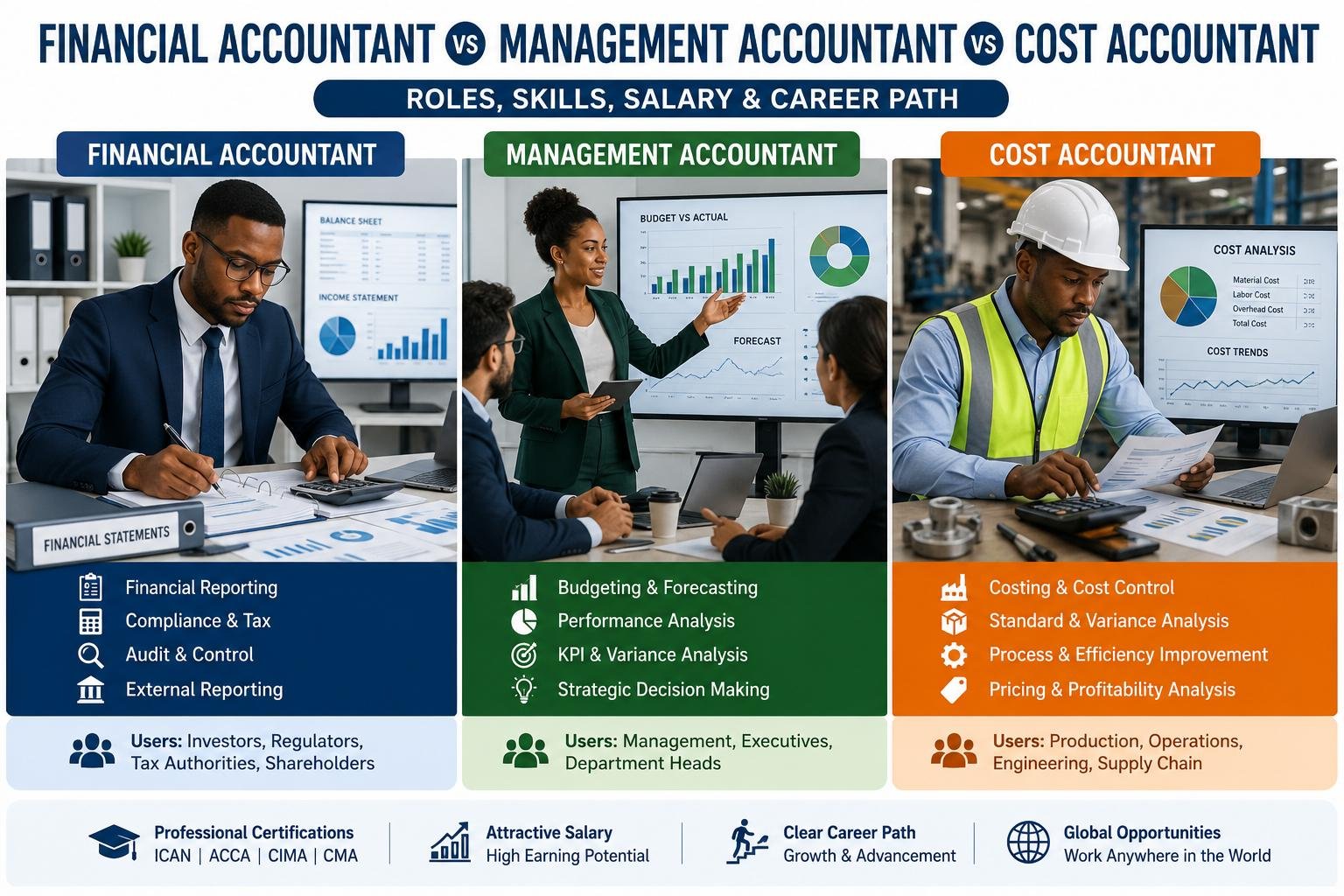
Accounting is considered a job, but in today’s business environment, there are multiple accounting specialists that function in various roles. The main difference between financial accountants, management accountants, and cost accountants is the users they communicate financial performance to, the management accountants communicate financial performance to management for internal business decisions, and cost accountants communicate financial performance to the production to control production costs and improve production efficiency.
These professionals can be in the same company but work on different challenges in the business. A financial accountant is responsible for ensuring that the accounts are in order and for the statutory reports to be drawn up. A management accountant is someone who converts financial information to information that helps managers makes profitable decisions. A cost accountant is someone who examines each and every expense to a business production to help minimize waste, enhance pricing and maximize profitability. Recognizing these differences can guide aspiring professionals to their natural strengths as either compliance, strategic or operational professionals.
What is the purpose of a Financial Accountant?
Financial accountants keep financial records in a systematic manner, summaries and provide financial information in accordance with accounting standards, e.g. IFRS or GAAP. They are more concerned with the accurate depiction of the financial position of the organization in the financial reports presented to outsiders such as investors, lenders, tax authorities, regulators, and shareholders. They are the backbone of transparency and compliance within the business and industry sectors.
The day-to-day tasks can involve preparing financial statements, reconciling accounts, reporting to external auditors, preparing and filing tax returns, supporting external reviews, preparing reports for regulators, and monitoring internal controls and ensuring accounting records meet standards. Financial accountants also close the books at the end of the month, quarter and at year-end under pressure and are extremely accurate and detail oriented.
What Does a Management Accountant Do?
Management accountants can give a financial analysis which helps managers make better business decisions. Management accountants prepare reports only for the internal management team, while financial accountants make reports for the external parties. Their analysis has a positive impact on the organizations increasing their profitability, spending resources efficiently, predicting future performance, analyzing investments and tracking the performance of the organization’s goals.
A management accountant is usually responsible for creating budgets, forecasting future income, studying the difference between actual and proposed performance, formulating key performance indicators (KPIs), conducting profitability analysis, assessing investment opportunities and assisting executives in financial aspects of business decisions. They do more than just record; they add to the business strategy, and are real assets in the planning of the organization.
The Function of Cost Accountant
Cost accountants are specialists who find, measure, analyze and control production costs. They are particularly useful in sectors like manufacturing, construction, logistics, engineering, pharmaceuticals, and others, where production costs can significantly impact profitability. Cost Accountants are not so much concerned with reporting financially as they are with the consumption of resources during the production.
They are involved in product costing, tracking of material consumption, efficiency with labor, evaluation of manufacturing overhead, cost reports generation, cost-saving suggestions, standard costing, variance analysis, inventory valuation and pricing. Cost accountants are vital to organizations to identify waste, find ways to work more efficiently and ensure products are competitively priced whilst still earning a profit.
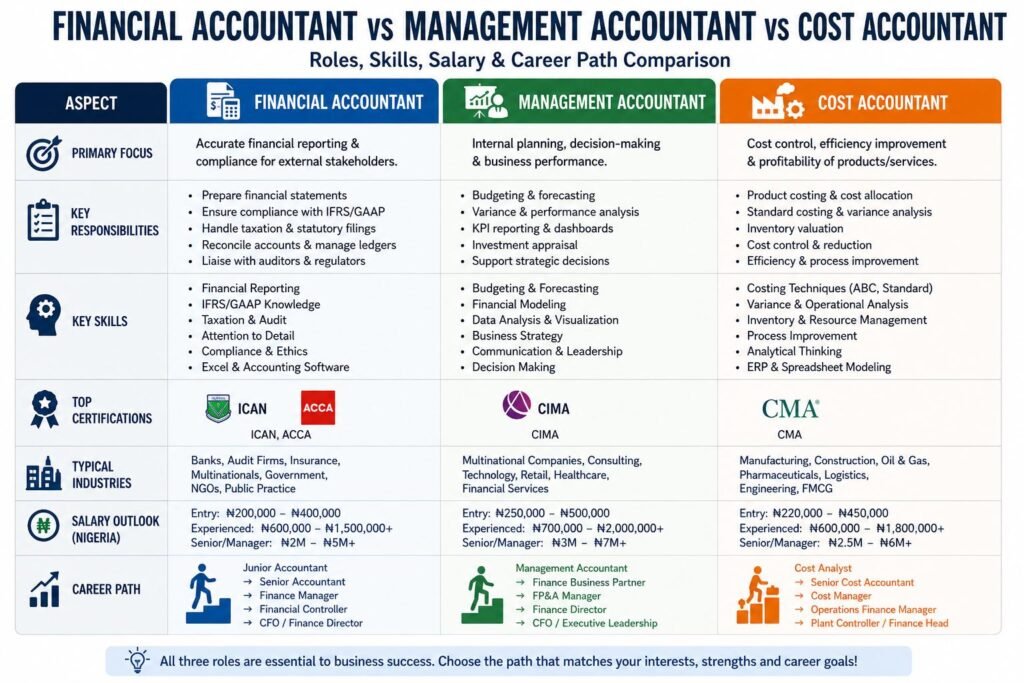
Comparing the Core Responsibilities
While all three accounting experts use monetary information, they have significantly varying goals.
Financial accountants are focused on past financial records and adherence to accounting rules. Their reports report the performance of businesses to outsiders.
Future planning and decision making is the emphasis of management accountants. They convert accounting data into recommendations, which aid in the performance of an organization.
Cost accountants analyze the costs of production in detail. They analyze how products and services use resources, to help management understand exactly how they use them and where they can gain efficiencies.
These differences will affect the certification and technical abilities offered in each specialization as well as the longer-term career prospects.
Skills Required for Financial Accountants
Financial accountants will need to have a blend of technical accounting, analytical and ethical skills to be successful. With compliance requirements occupying a major part of their duties, they need to be aware of the latest changes in accounting principles and tax laws, and ensure accuracy within the strict deadlines set by regulators.
Financial reporting, understanding IFRS and GAAP, auditing principles, taxation, an understanding of account reconciliation and proficiency with spreadsheets, experience with ERP software, attention to detail, regulatory compliance, communication skills, analytical thinking, time management, professional ethics and problem-solving are all important skills. Knowing how to use data analytics and financial reporting software, as well as understanding cloud accounting systems, also helps financial accountants as they become more automated in bookkeeping clerical tasks.
Skills Required for Management Accountants
Management accountants are a business strategy blended with accounting knowledge. They need to be able to translate financial data and explain the results to executives who may not be the best with numbers. Thus, the ability to communicate and to understand business is as significant as an understanding of accounting technique.
These include skills in budgeting, forecasting, financial modeling, variance analysis, business strategy, KPI reporting, risk assessment, data visualization, management reporting, decision analysis, leadership, presentation skills, negotiation, critical thinking, commercial awareness and business performance Deciding on an accounting career is one of the most crucial choices students, graduates and professionals can make when thinking about switching careers into accounting or finance. While all accounting jobs involve financial information, it is not the same day-to-day tasks, certifications, career path or earnings all have to follow. Many people entering into an accounting career wonder whether they should pursue a career as a Financial Accountant, Management Accountant or Cost Accountant as the functions are similar in theory, but vastly different in practice.
Skills Required for Cost Accountants
Cost accountants should have the highest analytical skills as they will be given detailed information about the operation. They need to learn about production systems and processes, inventory management, supply chains, and opportunity costing techniques and recognize where efficiencies could be gained.
These are critical skills like cost allocation, standard costing, activity-based costing, inventory valuation, variance analysis, budgeting, operational analysis, manufacturing accounting, process improvement, statistical analysis, spreadsheet modeling, ERP systems, production planning, analytical thinking and attention to operational details. Cost accounting is an appealing specialty for professionals who love to analyze data patterns and resolve operational issues.
Top Professional Certifications that can boost your Career
At every accounting specialty, a professional certificate offers a great deal of benefits, such as enhanced job prospects, higher income potential, and better promotion prospects. Professional qualifications, such as internationally recognized qualifications, are becoming increasingly important to employers as they help to validate the technical skills and commitment to lifelong learning of candidates and are growing in preference.
ICAN is one of the top financial accounting qualifications for aspiring financial accountants in Nigeria. The Institute of Chartered Accountants of Nigeria (ICAN) provides professionals with the skills required in financial reporting, auditing, taxation, corporate governance and creates job opportunities in the public practice sector, banking and the government sector and multinational firms. Another qualification widely recognized by employers around the world, ACCA offers extensive training across a range of financial management, reporting, taxation, auditing and strategic business management skills and prepares accountants for international careers.
Students choose CIMA to focus their studies on business strategy, performance management, decision making, financial planning and leadership, which are key areas in a management accountant’s role. The qualification is useful for those seeking executive management roles as it equips them to be strategic business partners, rather than being a traditional accountant.
CMA certification can be beneficial for cost accountants who specialize in the areas of financial planning, performance management, strategic analysis, cost management, internal controls, and decision support. Multinational companies and organizations notably entrust the Certified Management Accountant designation to their executives because it merges accounting skills with business operations.
Salary Expectations
The salaries for those with accounts vary with educational attainment, certifications, experience, industry, company size and location. Those who work for multinational companies, financial institutions, consultancy companies or listed companies tend to be paid more than the staff who work for smaller companies.
Typically, financial accountants start at lower levels of the profession, like a junior accountant or assistant accountant, and work to senior accounting roles like financial reporting manager, finance manager, controller and chief financial officer. Professional certifications such as ICAN or ACCA bring a good boost to salary. Since management accountants play a major role in strategic decision making, they tend to be well paid for their role. They tend to follow a career path that involves becoming a management accountant, finance business partner, financial planning and analysis manager, finance director, and executive management. CIMA-certified professionals can often find themselves promoted quickly to senior management.
Cost accountants are greatly appreciated in production-organized, manufacturing, engineering, construction and oil and gas companies. The career path goes from cost analyst to the senior cost accountant, cost manager, operations finance manager, plant controller and operational finance leadership. Because of their niche skills, they can be paid a higher wage in more scenarios that require cost-effective operations to be profitable.
Career Growth Opportunities
Opportunities for advancement are good, but the avenues for career progression vary by accounting specialization and by individual interests and preferences in the industry.
Financial accountants are likely to move on to become compliance officers, financial control officers, tax accountants, financial management leaders, treasury accountants, corporate finance officers, or auditors. They also have experience of statutory reporting, which gives them a head start with regard to their careers in consulting and regulatory roles.
Due to their role in decision making, management accountants often start their career in strategic finance, financial planning and analysis, business consultancy, commercial finance, corporate strategy, executive management and ultimately become a chief financial officer.
A cost accountant can progress into the roles of Operations Management, Manufacturing Finance Management, Supply Chain Finance, Manufacturing Planning, Manufacturing Plant Financial Control, Manufacturing Purchase Analysis and Operational Excellence. They are indispensable in industries that focus on production and strive towards continuous efficiency gains, as their expertise adds significant value.
What’s the best accounting career for you?
The choice of accounting career is based on interests, personality, skills and career plans, not just salary considerations. Financial accounting is the specialization that is most satisfying for those who like precision, compliance, regulations, and reporting in terms of money. Management Accountants are excellent at business strategy, planning, leadership and assisting executives to make informed decisions. Cost accounting generally is a favorite route for professionals who are interested in production systems, efficiency, cost savings and operational analysis.
An additional consideration is that jobs in accounts are still flexible. A variety of professionals starts off with a career in financial accounting and then move into management accounting or cost accounting with extra qualifications and experience. Continuous education, networking and industry experience can often bring opportunities which go beyond job descriptions.
Conclusion
Financial accountants, management accountants, and cost accountants are all crucial in ensuring the financial stability and sustainable growth of an organization. Each have their own set of roles, but they all have good career opportunities, good salaries and well defined career paths. By learning about the specific specialization, accounting students, graduates and professionals can make decisions regarding their education, certifications, and career planning.
Whether you’re striving to keep up with the standards of the international financial reporting environment, shape the decisions of your leaders, or enhance your production and operations with technical and leadership expertise, your opportunity for success will be enhanced by investing in the right professional education and ongoing development of your technical and leadership skills. The world of accounting is constantly changing due to technology, automation and data analytics, and adaptable, highly-skilled accountants are more important than ever.
Get more well researched information about Financial Accountant vs Management Accountant vs Cost Accountant here.