Introduction
Good decision making is essential to any successful organization and it is not enough to rely on the past financial information to make effective decisions. Financial accounting gives an impression of the past to external users, whereas management accounting provides information about the business that is used for planning, controlling and strategic decision making within the business. Management accounting focuses on value-added information and communication instead of compliance or regulatory reporting, as it is intended to help decision makers in the business to allocate resources optimally, minimize their expenses, maximize their profit and meet the overall objectives of their business.
The business world is today extremely competitive and managers need to be reactive to varying customer needs, rising costs, technological advances and economic uncertainty. Traditional financial statements have become the inadequate way to tell a story since they focus mainly on “what happened”. In this way, management accounting fills the gap between finance and non-finance information to provide managers with practical information that will help them to make decisions today and plan for the future. There are some additional details on the concepts of management accounting.
The Definition of Management Accounting
Managerial accounting (also called management accounting) involves gathering, analyzing, interpreting and reporting financial and operational data for decision making within the organization. Management accounting differs from financial accounting in that it is not prepared in a standardized format for the investors, regulators, or creditors, but rather is prepared specifically for the internal users (executives, department heads, project managers or operational leaders). It does not report as per external reporting standards, but tailored to the specific information needs of management. This flexibility makes it possible for organizations to produce reports on a daily, weekly, monthly, or as often as their managers need to pick up information to make a decision in time.
The main purpose of management accounting is to enhance the performance of the organization by planning and controlling it better. It gives managers a useful feedback on costs, revenue, profitability, productivity, efficiency and performance of their operations. The knowledge gained from these can be used to find growth opportunities, reduce waste, optimize resource use, assess investment opportunities and enhance competitiveness. Management accounting is based on the future performance instead of reporting on past transactions so it can be a very powerful management tool which allows the organizations to foresee problems rather than just react to them when they have occurred.
The Purpose of Management Accounting in Modern Organizations
In the world of business, there is a perpetual pressure on organizations to maximize the profits, while keeping the quality, customer satisfaction and operational efficiency on track. Management accounting can assist organizations to balance these competing priorities, by giving them reliable information that can be used to inform evidence-based decision making. Accounting reports allow Managers to make estimates of future sales, to create budgets, to forecast cash flow, to assess the efficiency of production processes, to monitor the performance of the departments and to measure progress towards the strategic targets. This information minimizes uncertainty and provides greater confidence to managers when making decisions.
Another key function of management accounting is to improve performance. Managers want to be aware of the status of their department(s), project(s) or employees to determine if their objectives are being met. Management accounting offers performance measures that highlight strengths and weaknesses, opportunities and areas for corrective action. Managers are given real-time information, instead of waiting until the end of the year financial statements to get information, when performance falls short of expectations, the manager can act promptly. By adopting a proactive stance, organizations can stay agile and competitive amidst the evolving market dynamics, reduce financial risks, and streamline operations.
The Difference between Management Accounting and Financial Accounting
While accounting information is similar in both management accounting and financial accounting, they have different uses and users. Financial accounting reports to external parties such as the income statement, balance sheet and cash flow statement in a standardized format. These reports must be prepared in accordance with accounting principles and be a true and fair view of the organization’s financial performance for the specified reporting period.
Management accounting, however, is directed only towards the internal decision makers. Reports can be tailored to meet management requirements and can feature forecasts, departmental budgets, production costs, performance dashboards, customer profitability analysis and operational efficiency report. Management accounting does not have to be in any specific form as it is not required by outside parties but is used to inform better decisions. This adaptability enables managers to concentrate on pertinent data that is relevant to the company’s strategy and operation.
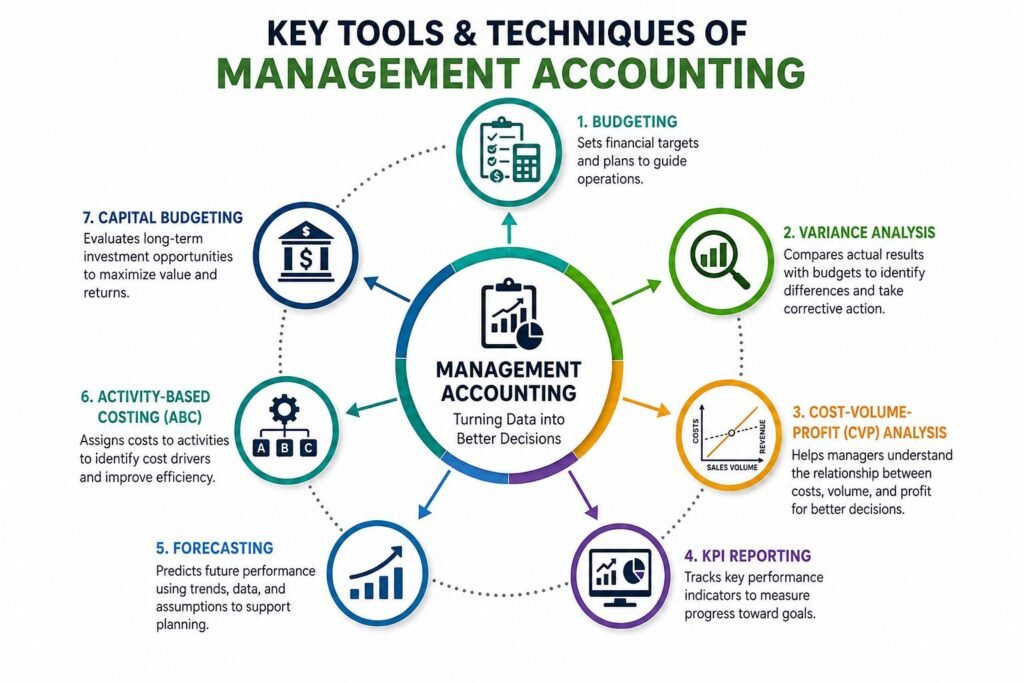
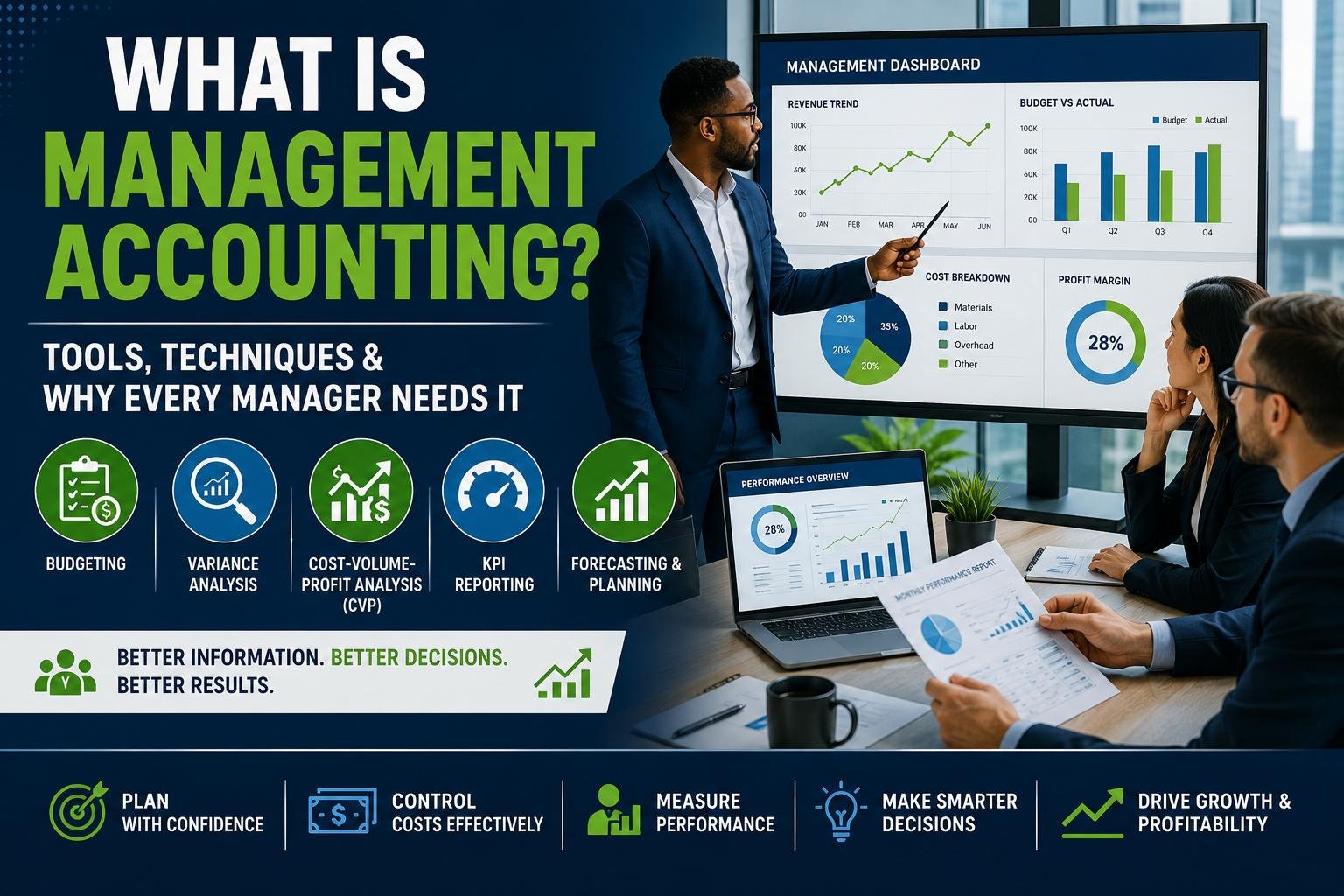
The Tools and Techniques of Management Accounting
Budgeting
Budgeting is one of the most commonly-used management accounting tools, as it converts organizational objectives into financial plans that can be measured. A budget is a statement of expected revenues, expenses, investments and cash flows for a period of time in the future and sets performance targets for departments and business units. Budgets are used to manage resources efficiently, to ensure coordination of activities across various departments, to manage and control expenditures and to measure actual performance against planned goals.
Budgets promote accountability because managers are accountable for meeting financial objectives within a certain budget. During the budget period, the actual quantities of items purchased and services used are continually tracked to compare with the budgeted quantities; if there are unexpected deviations, the managers can take corrective action before the problem gets out of hand. Another benefit of budgeting is that it enhances communication between departments, since everyone’s involved in the organization’s goals and keeps in check with regards to finances.
Variance Analysis
Variance is an analysis that can be performed comparing actual business performance with planned or budgeted business performance that will identify the difference that needs to be managed. They are called variances and can be based on revenue, production costs, labor efficiency, material usage, overhead expenses or profitability. Variances can suggest better performance, or inefficient use of resources and unforeseen issues can emerge.
Variance analysis is used by managers to find out the reasons for the difference between actual and expected results. For instance, due to unexpected increases in raw material costs, a drop in productivity or unexpected equipment downtime, etc., production cost might exceed budget. Knowing the rationale for those differences allows managers to take corrective action, instead of assuming. As the years go by, the variance analysis results in more accurate forecasting, improved cost control and ongoing organizational improvements.
Cost-Volume-Profit (CVP) Analysis
Cost-Volume-Profit (CVP) Analysis is analyzing the cost and sales volume relationship, the selling price and profit relationship. It is useful for managers to get an idea of how varying one factor influences the overall profitability of the business. The break-even point, or level of sales, is one of the most useful results of performing a CVP analysis and is the point at which total revenue equals total costs.
CVP analysis is often used by managers when they introduce a new product, when they consider pricing strategies, when they plan production level or when they consider an opportunity for expanding their production. For instance, management can determine the number of units that will need to be sold for the new product to break even and start producing profits before the product is introduced to the market. This analysis helps to inform decision making, showing the financial risks, returns and how sensitive profits are to fluctuations in sales volume or operating costs.
Key Performance Indicator (KPI) Reporting
Key Performance Indicators (KPIs) are indicators that track progress to organization goals with quantifiable measurements. KPI Reporting is not just limited to financial indicators: It includes operational, customer, employee, and quality indicators. These metrics can be customer satisfaction scores, production efficiency, employee productivity, inventory turnover, profit margins, operating costs, sales growth and on-time delivery performance.
In addition to reporting on KPIs, management accounting also adds them to the management’s regular review of performance, allowing management to track the health of the organization from many different angles, not just the financial side. A properly designed KPI dashboard translates the information of business into a simple form and helps executives to easily recognize new trends, track strategic projects and take prompt decisions. Organizations build a culture of continuous improvement and accountability throughout the organization by consistently monitoring meaningful indicators.
Additional Management Accounting Techniques That Improve Decision-Making
In addition to the above, there are a few other management accounting techniques which aid managerial decision making such as variance analysis, CVP analysis and KPI reporting. Cost allocation methods are used to identify the real cost of a product, service or department by assigning indirect costs to the right product, service or department. Activity Based Costing (ABC) is a tool that can help business organizations reduce the waste of their activities and make better pricing decisions by identifying the activities that contribute to the cost. Standard costing allows easy comparison of actual performance by comparing actual costs against the predetermined costs of materials, labor and overheads.
Forecasting is also a vital management accounting tool as it is used to predict future business performance using past trends, market conditions and assumptions about the future. Capital budgeting is used to help managers assess long-term investment opportunities by comparing the expected future costs and returns to the investments. By integrating financial and non-financial performance measures, balanced scorecards provide a holistic management approach that connects operational activities with strategic goals. These techniques can be used in combination to give managers insights that help them plan effectively, allocate resources appropriately and grow their organizations in a sustainable way.
The Uses of Management Accounting for Internal Planning by Managers
Planning is one of the most crucial roles of a manager and management accounting gives the information to be used in developing realistic business plans. The managers set realistic goals and action plans based on the past performance, market forecasts, operational reports and cost analysis, to support the organizational strategy. Managers do not make decisions based on hunches; they base their decisions on quantitative evidence, which is the evidence that can be quantified. Managers make decisions on quantitative evidence and not intuition, intuition is the evidence that is not quantitative.
Management accounting also facilitates scenario planning, which involves the manager being able to see the various scenarios before coming to a major decision. For example, corporations can assess the monetary consequences of venturing into new markets, enhancing manufacturing capability, launching new products or adjusting pricing strategies. These analyses minimize uncertainty and enhance strategic decision making by managers since they know what risks to expect and what returns to potentially invest into their organizations.
Putting Management Accounting into Practice for Performance Evaluation
A performance evaluation will help an organization assess whether there are goals that are being met efficiently and effectively. Management accounting helps to give reports of performance against set targets, and to highlight strengths, weaknesses and areas for improvement. Performance Measures are carefully selected to measure managers’ productivity, employee performance, operational efficiency, profitability, customer satisfaction, and resource utilization.
Frequent review and evaluation foster accountability by making the managers accountable for the measurable outcomes of their work within the resources they have. Management accounting is useful when performance is not achieving expectations, to identify the causes of the underperformance and formulate plans of action to correct it. On the other hand, if a department is doing well, it can be identified and emulated by other departments. By fostering data-driven decision making at all levels of the organization, continuous performance monitoring drives organizational learning, operational excellence and long term business success.
The Advantages of Management Accounting
There are many benefits to a well-managed accounting system for organizations. Improved planning means increased resource allocation and aids long-term planning goals. A better cost control leads to saving on unnecessary expenditure and better profitability. Access to reliable information that is delivered faster helps managers to be responsive to market changes and new business risks. Better forecasting means that organizations can better plan for their future cash needs, investment prospects, and operational challenges, which aids in their financial stability.
Another benefit of management accounting is that it improves the communication between departments as they have a common set of performance measures and common financial targets. Managers use facts and not assumptions when making decisions, making decision making more objective. Performance measurement is used to create a drive for continuous improvement, and strategic analysis is used to build a sustainable competitive advantage. The combination of these benefits leads to enhanced organizational performance, greater efficiency, improved profitability, and a greater stakeholder trust.
Managing the Business through Management Accounting
Though it has many merits it also has its challenges in management accounting. Data availability, in terms of its accuracy, completeness and timeliness, is a key input to making good management decisions. Bad data can lead to inaccurate forecasts, unrealistic budgets, and strategic decisions that don’t work. The adoption of new management accounting systems could also involve implementing new software, training employees, and new data management procedures, which can all be costly.
One of the difficulties is the choice of indicators of performance. Too many KPIs can be distracting to managers and the wrong ones can create unhelpful behaviors or do not focus on what is important to measure. There is also a need for organizations to see management accounting as a tool to assist them in making decisions, not as a substitute for managerial judgment. Balanced strategic decision making requires the management to be a mix of accounting information, industry knowledge, experience, leadership and market awareness.
Best Practices for Effective Management Accounting.
There are a number of best practices that can help organizations get the most out of management accounting. Management reports should provide users with relevant information, rather than provide too much detail. Budgets and forecasts need to be regularly checked to adjust to market changes and new priorities within the organization. Choosing the right KPIs should directly relate to strategic goals as well and should be designed to stimulate the right kind of behaviors that lead to long-term success.
In fact, technology is a key part of today’s day-and-age in the field of management accounting. Managers have quicker access as well as advanced analytical capabilities in the form of faster access to accurate information, through the use of integrated enterprise systems, cloud-based accounting software, business intelligence platforms and real-time dashboards. By ensuring employees are trained continuously, managers will have an understanding of accounting reports and will be able to interpret the financial data properly. Organizations develop management accounting systems through a collation of reliable information, advanced technology and competent leadership, which enables sustainable growth and informed decision making.
Conclusion
The role of management accounting is now well beyond mere cost reporting to being a complete decision support system for today’s organizations. Management accounting helps managers plan, allocate resources, control costs and evaluate performance by giving them future-oriented information like budgeting, variance analysis, Cost-Volume-Profit analysis, KPI reporting, forecasting and performance evaluation. Management accounting is concerned with providing information to management that will assist them in making decisions that lead to the long-term success of the business, while the financial accounting is more concerned with meeting external reporting requirements.
The need for management accounting will continue to expand as business organizations are facing more challenging and dynamic marketplaces. Managers with a good grasp of and skilled in management accounting techniques can better recognize opportunities, handle risk, enhance performance efficiency and meet strategic goals. Management accounting is a very practical tool for every leader, from the small business to the nonprofit to the multinational company that can help you turn information into action and advantage.
Get more well researched information about What is Management Accounting here.