Introduction
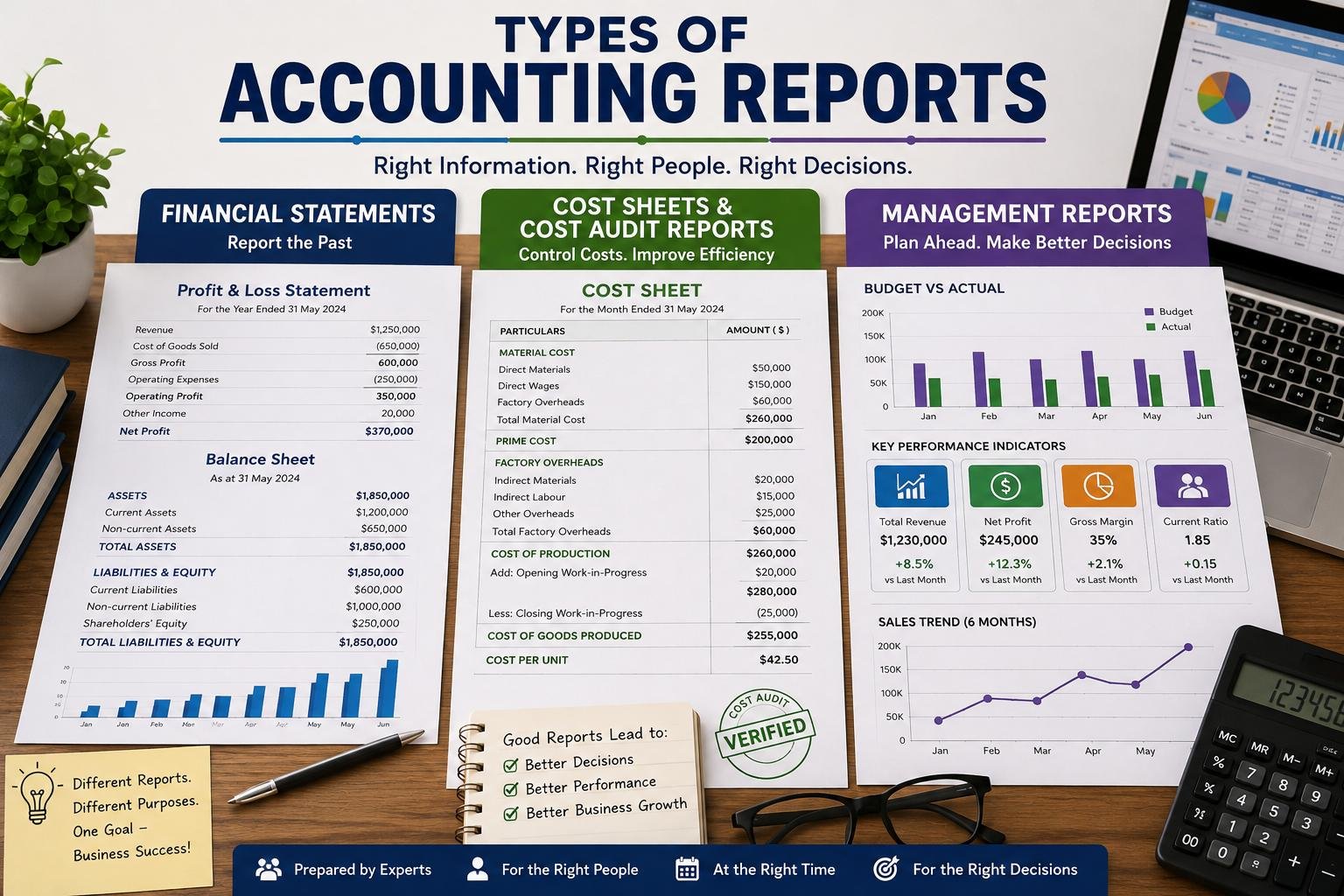
There are various reports that can be generated from Accounting. Accounting information is based on financial information, but the report that is generated is different depending on the accounting type (financial accounting, cost accounting or management accounting). Each report has a specific purpose of addressing different business questions, users and decisions. Financial statements are essential for investors to assess profitability and financial stability, cost sheets are needed by production managers to keep track of manufacturing costs, and management reports are necessary for executives to inform planning and decision-making for the future. Knowing these differences will assist students in accounting, business owners and professionals to interpret properly and understand the purpose of each of the reports in an organization. The selection of the appropriate report doesn’t only involve presenting numbers, it’s about providing the correct information to the correct audience at the correct time. This article will discuss the difference between financial statements, cost sheets, cost audit reports, budgets and Management Information System (MIS) reports, with respect to the preparation of reports, recipients, frequency of report generation, and the decisions made using these reports.
One of the key documents used in cost accounting is the Cost Audit Report which assesses the accuracy of the cost records, and the efficiency of the use of production resources. The reading of this report and how it is different from the financial statements and management reports, give a clear understanding of what the broader accounting system of a contemporary organization is.
What is an Accounting Report?
An accounting report is a report that shows a summary of financial or operational information for particular users. They convert raw accounting data into valuable information that enables organizations to quantify their performance, ensure compliance, manage expenses and make sound decisions. All accounting reports are based on the same accounting data but have varying contents, objectives, reporting requirements and audience. Some reports are legally required and must be prepared in accordance with strict accounting principles, whereas others are created for internal decision making purposes, and do not have to conform to any rules or regulations.
The focus of financial accounting reports is on the past performance of the company and the adherence to accounting rules. The cost accounting reports are related to the production costs, cost control and efficiency. Management accounting reports give information on the future and help managers to plan, budget, forecast and to assess the business performance. These reports give a 360° view of an organization’s financial position, operating efficiency and direction. Recognizing the distinctions among the various kinds of reports will help companies get the information they need to report to investors, regulators, managers and operational staff.
Financial Accounting Reports
Financial accounting generates common reports that give an organization’s financial results and financial position for a given accounting period. These reports are prepared in accordance with the accounting standards like IFRS or GAAP, which facilitates consistency, reliability and comparability between businesses. Their main purpose is to give external users a true picture of the financial situation of the organization. These reports are typically subjected to an external audit and need to follow some specific accounting principles and legal requirements. While financial reports are useful for informing about what has occurred in the past, they are not predictive of future performance, and are vital in assessing the stability, profitability and solvency of a business.
Profit and Loss Statement (Income Statement)
The Profit and Loss Statement is a summary of a business’s income, expenditure, gains and losses over a particular period of time, in addition to the overall profitability or loss. It gauges the profit or loss of the business based on all the operating and non-operating expenses. Business owners, lenders and investors heavily use this report to assess the trends in their business’s financial performance and profitability. It also enables the management to know the revenue growth, the control of expenses and operational efficiency with great ease. The Profit and Loss Statement is one of the most significant financial accounting statements that any entity can create as this statement directly influences the trust of the shareholders and business valuation.
Balance Sheet
The Balance Sheet gives a company a “snapshot” of its financial situation at a particular time. It includes assets, liabilities and shareholders’ equity, in the basic accounting equation Assets = Liabilities + Equity. A Balance Sheet is prepared at a specific accounting date while the Profit and Loss Statement is prepared for a period. It’s utilized by investors to evaluate liquidity, debt, asset management, and long-term financial health. It is looked at by creditors prior to lending and is inspected by regulators to make sure that it is in compliance with reporting needs. The Balance Sheet is an important financial statement that helps assess a company’s financial health and determine if the company has enough resources to cover its liabilities.
By whom is the Financial Statement Prepared?
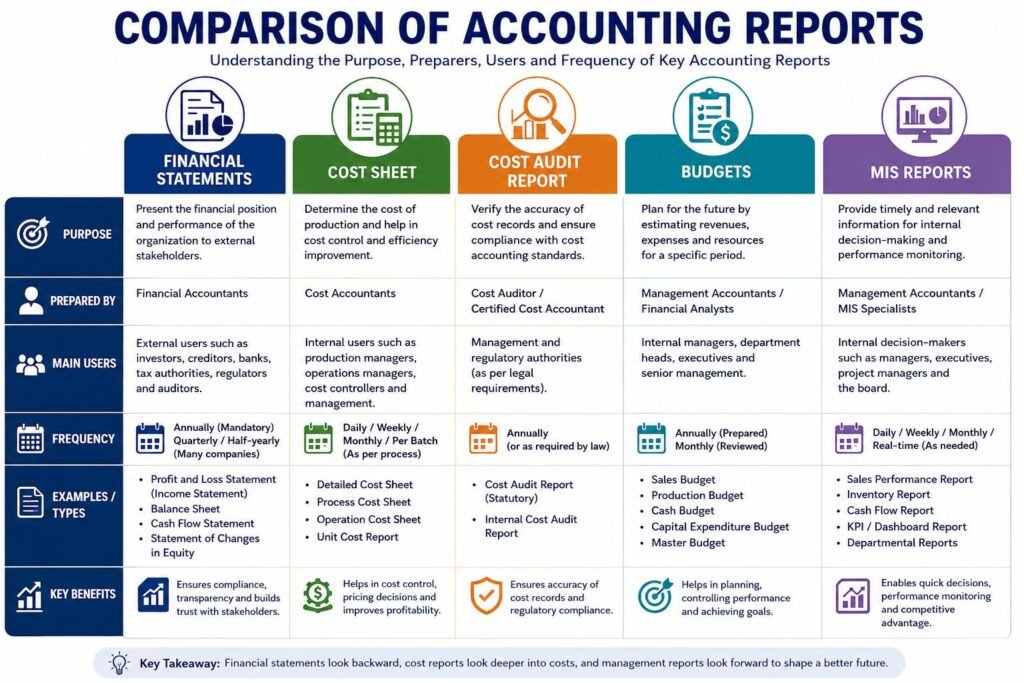
Financial accountants, who are part of an organization’s finance department, are generally responsible for the preparation of financial statements. A large company may have a special accounting group making the statements, or smaller companies would have to use an external accounting firm or certified public accountants to prepare them. Many enterprises publish these reports after they are prepared, but before they are published, they would send them to independent external auditors for external audit.
To Whom Financial Statements are given?
The main role of the financial statements is to the outsiders. These can be shareholders, investors, lenders, financial institutions, tax authorities, government regulators, prospective investors and external auditors. The internal review of financial statements is also undertaken for internal management purposes, although the primary purpose of financial statements is to provide external financial reporting and statutory compliance.
Are Financial Statements Prepared on a Frequent Basis?
Financial statements are prepared annually for most businesses by the business as a matter of statutory requirements. But, public companies often release their financial statements regularly to investors and stock exchange authorities, quarterly and semi-annually. A lot of organizations also prepare monthly internal financial statements to check the performance during the financial year.
Cost Accounting Reports
The major thrust of cost accounting is aimed at the identification, measurement, control and minimization of production costs. The purpose of cost accounting is to serve the internal management and not external parties as financial accounting. Cost accounting reports used by businesses give a clear picture of manufacturing costs, assess manufacturing efficiency, facilitate better pricing decisions and prevent unnecessary expenses. Cost accounting is not mandatory for all companies and businesses, so the reports can be tailored to fit a company’s needs. Cost reports are particularly important for manufacturing industries since the cost of production is a crucial factor in determining the profitability, competitiveness, and operational performance of the industry.
Who prepares the Cost Accounting Reports?
Cost accountants are experts in measuring the cost of production and analyzing the efficiency of operations and prepare cost accounting reports. If a formal cost audit is mandated, the audit will be conducted by an independent Cost Auditor or Certified Cost Accountant who will review the organization’s cost accounting system and supporting records, and produce the Cost Audit Report.
To whom is Cost Accounting Report Issued?
Cost accounting reports are primarily for internal users and generally will be for production managers, operations managers, plant supervisors, cost controllers, finance executives and senior management. Depending on industry and regulation, the Cost Audit Report can be submitted to the relevant regulatory body as well.
How often are Cost Accounting Reports prepared?
The cost sheet can be drawn up on a daily, weekly, monthly or per batch basis as per the manufacturing process of the organization. Typically, a Cost Audit Report is prepared once a year or as required by law, with some organizations carrying out internal cost audits more often to maximize operational efficiency.
Management Accounting Reports
Management accounting produces reports for use only within the company. Management accounting is more about planning for the future rather than reporting on what happened in the past as is the focus of financial accounting. Managers need timely, relevant and flexible information to help them make strategic decisions about budgets, investments, production, staffing and improving performance. Management reports aren’t subject to any external accounting standards, meaning that organizations can tailor their reporting to their business goals. Management accounting is flexible enough for businesses to be able to concentrate on key performance indicators, operational trends, forecasts and financial projections that help them to continuously improve.
Budgets
Budgeting is forecasting revenues, expenses, cash flows, production needs, and capital expenditures for a specific time. Through setting financial goals for yourself, you will have some benchmarks to compare actual results with in the future. Budgets are used to direct the use of resources, planning for operations, departmental spending, and investment decisions. Operating budgets, cash budgets, capital expenditure budgets, sales budgets, production budgets and master budgets are the various types of budgets. Managers compare performance to budgeted performance to determine variances and take corrective steps in a timely manner, before the problem is significant.
Reports that focus on Management Information System (MIS)
MIS Reports present the managers with condensed information about the activities and finances that they need for making decisions on an everyday basis. Some of these reports may contain sales performance, production statistics, inventory levels, trends in customers, departmental performance, profitability analysis, cash flow updates and key performance metrics. Many MIS reports are created automatically from the real time business data in modern enterprise software, allowing managers to keep an eye on the business operations at all times, instead of waiting till the month end for the financial statements. These reports are customized to the management needs of each organization and so there is great variability in the format and content of these reports.
Who prepares Management Reports?
Management accountants, financial analysts, business analysts and management information system specialists create management reports. In numerous businesses, accounting software and enterprise resource planning (ERP) systems will automatically produce reports based on information from various departments and the information will be given to management accountants for review and interpretation prior to being presented to management.
Who will get Management Reports?
Management reports are issued only to those internal users who are key decision makers such as department managers, senior management, chief financial officers, chief executive officers, operations managers, project managers and board members. They are not normally made available to external stakeholders as they often include confidential business information.
How often management reports are made?
Management reports are produced much more frequently than financial statements. They are available for different intervals, depending on the organizational requirements, from daily to weekly, monthly, quarterly or even real-time in the form of business intelligence dashboards. Generally budget reports are made on an annual basis and reviewed monthly; MIS reports are prepared regularly for continuous operational monitoring.
Analyzing and Interpreting Financial Statements, Cost Sheets and Management Reports.
While all accounting reports are based on financial information, they are used for various purposes, to various audiences, at different frequencies and include different content. External stakeholders and regulatory authorities are informed of a company’s financial performance through financial statements, which are presented in a standard format. Cost sheets will focus on production costs and efficiency, helping production managers with cost control and enhancing profitability. The Cost Audit Reports confirm the accuracy of the accounting records and evaluate adherence to the provisions of the cost accounting. Meanwhile, budgets and MIS reports give the management forward-looking information to help them plan, forecast and make decisions. These differences are responsible for the existence of more than one reporting system in an organization rather than reporting in a single accounting report. Each report is designed to provide answers to particular business inquiries, cater to specific users, and add in different ways to the success of the organization.
Why All Three types of Reports are useful for organizations.
Most successful organizations don’t rely on just one accounting report as it has a different function in the financial management system. Financial statements fulfill the statutory reporting requirements and transparency to investors, creditors and regulators. The report of cost accounting can facilitate the efficiency of production, reduce waste in production and set up the pricing strategy with profit for enterprises. Management reports aid in strategizing, budgeting, forecasting and operational decision-making, which promote future growth. These reports can be used in conjunction to form a comprehensive information system, ensuring organizations meet legal obligations, optimize workflows, and achieve long-term goals. Those businesses that can create an effective financial, cost and management reporting system can track their performance more effectively; can spot opportunities; can adapt to challenges; and can make better decisions in an ever-competitive business world.
Conclusion
Accounting reports are much more than just a bunch of numbers. They play a crucial role in the internal communication tools that enable organizations to fulfill regulatory requirements, control costs, optimize operations, and make strategic decisions. The financial statements include Profit and Loss Statement, Balance Sheet, and other records which present the information in a standardized way to external users and provides information about the financial status of a business. Cost accounting reports such as Cost Sheets and Cost audit Reports are designed to provide detail information of the production cost, efficiency and cost control aspects which are useful in operational management. Management accounting reports such as budgets and MIS report provide information in the future, helping to plan, predict and continuously improve performance. Knowing who creates these reports, who they are for, and how they’re generated will help accounting students, finance professionals, and business leaders to fully grasp the purpose and function of each report in the success of an organization. Financial statements, cost reports, and management reports are combined to deliver a complete picture of information that businesses require to be compliant, competitive, efficient and financially viable.
Get more well researched information about the Types of Accounting Reports here.