One of the most valuable assets to have during one’s career is effective workplace communication skills. Communication affects people’s ability to work with other people in any organization, to solve problems, to work through conflicts, and to meet business goals. Effective communication, both with peers and colleagues, management and supervisors, clients and stakeholders, can have a major impact on professional development and organizational achievements.
There are many problems that could arise in the workplace, but that do not rely on the lack of technical skills, but on misunderstandings, unclear expectations, or ineffective communication. Effective communicators tend to be more successful in their relationships and are more trusted and valued in their teams. Effective communication is also an essential element of professionalism at work as it is a way to show reliability, respect and accountability in daily interactions. Communication skills are no longer a choice, but a necessity in the workplace, as workplaces are growing ever more collaborative and diverse.
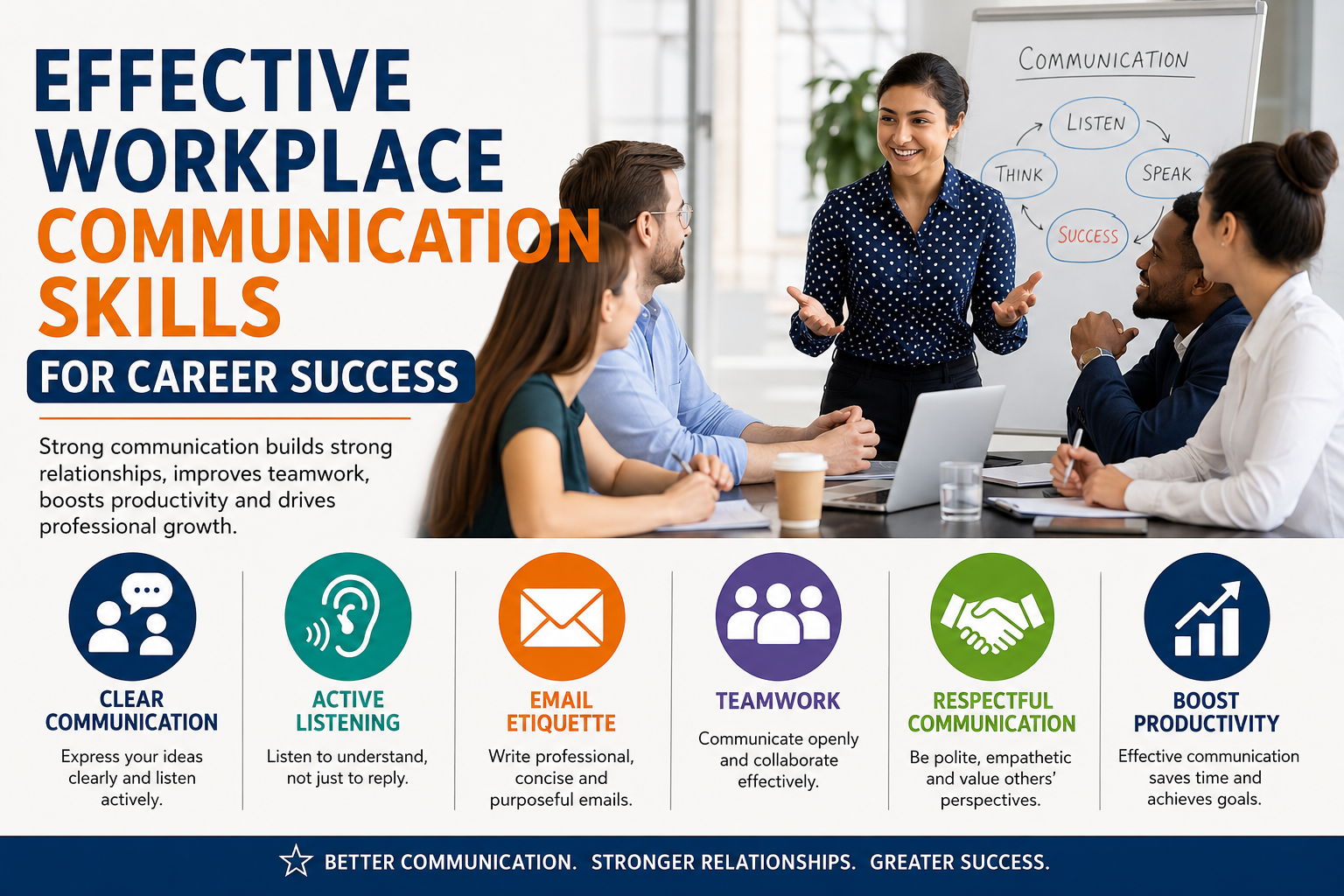
This article discusses the significance of workplace communication, such as email etiquette, teamwork, active listening, respectful work communication, and how communication impacts productivity and work relationships.
The Importance of Workplace Communication
Communication is the basis of any successful organisation. Employees communicate, share ideas, give feedback, and organise tasks using a range of communication methods. Communication is effective when projects proceed smoothly, expectations are clear, and employees are more engaged in their work.
Communication skills are important for an organization to:
- Minimize ambiguities and mistakes
- Enhance teamwork and team building
- Increase employee engagement
- Enhance customer relationships
- Strengthen workplace morale
- Support efficient decision-making
Communication is a factor that can lead to improved productivity and employee satisfaction for organizations that prioritize it. Communication that is clear means that everyone knows what they have to do and how what they do contributes to the wider organisation’s objectives.
Furthermore, communication can help to build trust between staff and management. The sharing of information in an open and honest manner is likely to make people feel valued and respected. This trust fosters a more positive work environment, with people working collaboratively and striving to do their best.
The Relationship Between Communication and Professional Growth
Communication skills are in constant demand. Many other skills are needed to advance in a career. Career development often depends on more than technical abilities. Employers value employees who can express ideas vividly, listen effectively, and work well with others. Communication skills are important for leadership qualities, problem-solving capacity, and professional respect.
Effective communicators are the hallmark of good professionals, and they can generally do the following:
- Present ideas confidently
- Lead meetings successfully
- Manage workplace conflicts
- Build professional networks
- Influence decision-making
- Demonstrate leadership qualities
Having effective communication skills is also a great way to foster professionalism in the workplace. Employees who communicate respectfully and professionally are more likely to build trust, be recognized, and make good and positive impressions during their careers.
Communication is a link between personal performance and organizational achievement and is increasingly shared between workplaces. Employees who become proficient in communication find that they have the potential to advance in their careers, take on leadership positions, and access promotion opportunities.
Understanding Various Ways to Communicate in the Workplace
Communication within the workplace is done via a variety of means, and each has its own set of skills and strategies. These communication channels can be used by professionals in a more suitable way to communicate more effectively.
Verbal Communication
Verbal communication includes face-to-face communication, meetings, presentations, video conferencing, and phone calls. This method of communication is useful for discussions where collaboration or rapid decision-making is necessary because of the ability to provide immediate feedback and clarification.
Good verbal communication involves speaking clearly, being as logical as possible when speaking, and using language appropriate for the audience. Tone of voice, pace, and confidence can also influence the reception of messages.
The purpose of communication for professionals should be to communicate clearly while still providing sufficient detail for understanding. When talking to non-specialists, the avoidance of jargon is another way in which communication can be enhanced.
Written Communication
Written communication entails documentation, emails, reports, memos, proposals, and chat messages. Because written messages are often permanent, it is particularly important that they be accurate and clear.
The following are elements of good written communication:
- Clear organization
- Correct grammar and spelling
- Concise language
- Appropriate tone
- Logical structure
Frequently, miscommunication caused by poor written correspondence can hinder projects, delay work, and damage professional reputation. Taking the time to carefully proofread and revise written messages helps ensure that they accomplish the desired result.
Nonverbal Communication
Body language, facial expressions, eye contact, posture, and gestures are all examples of nonverbal communication. These signals have a tendency to impact the way verbal messages are understood.
Maintaining eye contact can be a sign of confidence and attentiveness, and positive facial expressions can help foster collaboration, for instance. Knowing how to use nonverbal communication will aid your communication in meetings, presentations, and interactions with others.
Mastering Professional Email Etiquette
Despite the fact that email is one of the most popular ways to communicate in the workplace, it can be difficult to master. Since email is frequently the first impression people receive and also records vital discussions, appropriate email etiquette is crucial.
An email should have a straightforward subject heading that clearly indicates what the email will discuss. Recipients should be aware of the purpose of the email even before opening it.
Good email etiquette is characterized by:
- Using professional greetings
- Keeping messages concise
- Organizing information logically
- Maintaining a respectful tone
- Proofreading before sending
- Responding promptly when appropriate
It is not a good idea to use too many capital letters, slang, or emojis. These can appear unprofessional and may result in miscommunication.
Also, being able to recognize when sending an email is appropriate is crucial. If the conversation is complex or sensitive, it might be better to have a conversation over the phone or in person, where clarification can occur immediately.
Using proper email etiquette can improve the credibility of your communication, help communicate effectively at work, and strengthen professional relationships.
The Role of Active Listening in Workplace Career Success
Listening is a critical part of communication, although it might not be as obvious as talking. Active listening means listening to what someone is saying, comprehending the message, and responding thoughtfully to it.
Mistakes in the workplace often happen because people are not listening but rather preparing a response. Active listening enables employees to collect accurate information, understand other people’s points of view, and create better relationships.
These are some of the elements of effective active listening:
- Maintaining attention
- Avoiding interruptions
- Asking clarifying questions
- Providing feedback
- Demonstrating understanding
If employees feel listened to, they will offer suggestions, share concerns, contribute ideas and complaints, and become more involved in productive collaboration. Active listening also helps in resolving conflict by aiding the understanding of the root causes of conflicts.
Leaders who actively listen tend to create better teams because employees feel respected and valued. This creates an environment where communication flows more freely and collaboration improves.
Making Good Use of Communication to Build Strong Teamwork
Strong teams are interdependent and need to communicate with each other to coordinate activities, share information, and accomplish shared goals. Members of the team should be open and consistent with each other so that they are always on the same page.
Strong team communication encourages:
- Information sharing
- Problem-solving
- Innovation
- Accountability
- Trust-building
Frequent team meetings, project updates, and group discussions ensure everyone remains in sync and on the same page. Group members should be comfortable speaking up and voicing opinions and concerns without fear of criticism.
Constructive feedback is also very important during teamwork. Feedback should be directed at improvement rather than blame, creating opportunities for growth and learning.
Companies with open communication generally perform better as teams, achieve higher levels of team performance, and are better able to solve problems.
Respectful Communication in a Professional Environment
One of the basic elements of communication in the workplace is respect. All staff must communicate with courtesy and consideration in all roles and situations.
Respectful communication means respecting the diversity of viewpoints and being considerate towards others. This helps improve relationships in the workplace and fosters a positive organizational culture.
Key practices include:
- Using polite language
- Avoiding personal attacks
- Maintaining self-control in conflict situations
- Showing empathy
- Acknowledging the contributions of others
People are brought together in workplaces from diverse backgrounds, experiences, and cultures. Differences are addressed in a respectful manner, and inclusion is fostered through respectful communication.
Conflicts can be avoided through professionalism and respect, even during challenging situations. Respectful communication is a way for employees to win the trust and cooperation of both colleagues and managers.
How Communication Improves Productivity
Communication has a direct impact on workplace productivity. Clear communication can save employees time that would otherwise be spent clarifying information or correcting errors.
The following are ways clear communication can assist employees:
- Understand expectations
- Prioritize tasks effectively
- Meet deadlines
- Avoid duplication of effort
- Solve problems faster
However, a lack of communication can result in confusion, delays, and costly errors. Teams may waste significant time addressing misunderstandings that could have been avoided through better communication.
Productivity is often increased through communication training. Organizations that invest in communication training frequently experience measurable productivity improvements. Employees are more efficient because they have a better understanding of objectives, roles, and procedures.
Effective communication can also be instrumental in improving decision-making. If the right information is disseminated throughout the company, management can make well-informed decisions that are in the best interests of employees and business goals.
Managing Workplace Conflict Through Communication
In the workplace, conflict can occur at any time, but it is often the way people communicate that determines whether conflict becomes destructive or constructive. Communication aids people in resolving conflicts constructively and reaching mutually satisfactory resolutions.
Conflict resolution requires:
- Active listening
- Emotional control
- Empathy
- Open dialogue
- Problem-solving skills
It is important to handle problems quickly and avoid allowing them to escalate into bigger issues. Staff should concentrate on behaviours and solutions rather than blame.
Good communication during conflict can enhance relationships and build understanding and trust. Handling disagreements in the right way can lead to innovation, better processes, and stronger collaboration.
With open communication, organizations are better able to resolve conflicts because employees feel comfortable speaking up before issues get out of hand.
Building Communication Skills for Long-Term Career Success
Communication skills can be enhanced and developed through consistent practice and self-awareness. Those who are dedicated to developing their communication skills often experience many career benefits.
Strategies for improvement include:
- Asking others for their thoughts and opinions
- Practicing active listening
- Participating in presentations
- Improving writing skills
- Observing effective communicators
- Participating in communication training programs
Reading broadly and engaging in professional discussions with others will also improve communication skills. The more people do this, the more confident and effective they become at communicating their ideas clearly and listening to others.
The development of communication skills should be considered a continuous process rather than a one-time event. Continuous improvement helps employees meet the expectations and communication demands of an ever-changing work environment.
Conclusion
Career success and organizational effectiveness rely on good communication skills. Effective communication contributes to strong teamwork, better workplace relationships, higher productivity, and improved career development. From email correspondence to active listening, respectful interactions to collaborative teamwork, powerful communication skills help employees become more effective in their work and create a stronger professional image.
When employees communicate respectfully, honestly, and openly, it creates opportunities for organizational progress. Similarly, individuals who work to improve their communication skills have greater potential for advancement, leadership, and future success. Practicing effective communication consistently can have a significant impact on individual performance and professionalism, providing value to both the individual and the organization.
Frequently Asked Questions (FAQs)
Why are communication skills important in the workplace?
Communication skills enable employees to share information effectively, work together with colleagues, avoid misunderstandings, meet expectations, and contribute to the goals of the organization. Good communication can also help advance one’s career and build professional credibility.
What do you mean by active listening in the work environment?
Active listening is the full engagement of the listener’s attention to the speaker, understanding the message, asking questions, and giving thoughtful responses. It aids understanding and enhances workplace relationships.
What impact does email etiquette have on professionalism?
Email etiquette is a sign of respect, clarity, and attention to detail. Well-written emails enhance communication efficiency and create positive impressions on colleagues and clients.
What are the advantages of communicating respectfully in the workplace?
Respectful communication promotes inclusion, reduces conflicts, builds relationships, and creates a conducive work environment where employees feel valued and motivated. Valuing staff and fostering a positive working environment and a sense of belonging enhances communication and reduces conflict.