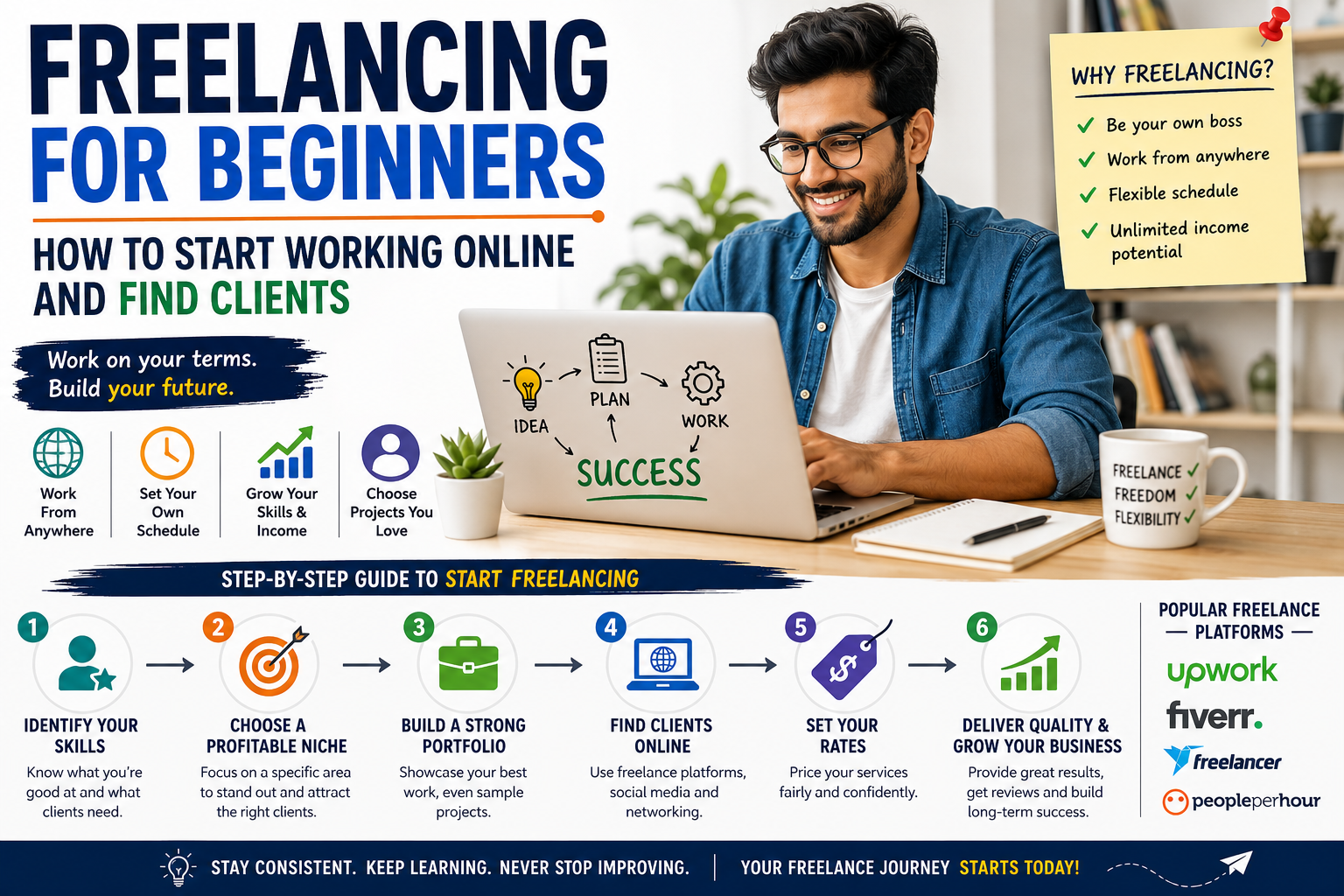
Freelancing is one of the most flexible and easy-to-access sources of income online these days, which enables people to be both independent and flexible. Freelancing is different from the conventional workplace because people are able to sell their skills and capabilities to clients on a project-by-project basis. Freelancing can be a great way to get the right job done. Whether you are looking for tips for freelancing for beginners or you’re a writer, graphic designer, web developer, virtual assistant, digital marketer, or video editor, there are opportunities to be pursued from anywhere.
Freelancing is becoming more viable than ever now that more and more people want to work remotely and online. Freelancers are commonly hired by businesses all over the world to handle tasks, cut costs, and obtain special expertise. Because of this, there are a lot of people looking to find out how to start a freelancing career and create a stable income from the comfort of their own homes. Freelancing offers possibilities in all kinds of industries and skill levels, whether it is to make extra money, to achieve location independence or even for a transition to self-employment.
The freelancing career can be daunting to newcomers. Issues like finding clients, determining what skills you have that can be marketed, setting rates, building up a portfolio, and selecting a niche are often causes of uncertainty. But with the correct course of action, anybody can learn the process and become a successful freelancer. This guide will detail the very first steps you need to take in order to get started on your freelancing career and how to find your first client. With a systematic method, novices can progressively create their own credibility and make a steady freelance career.
Understanding Freelancing and Its Advantages
Freelancing is a form of employment in which a person works for several companies but is not hired by one particular company. Freelancers tend to work for several clients, and they have a flexible schedule and work on their own. This flexibility is among the main attractions of freelancing for everybody, no matter their field of endeavor.
The great thing about freelancing is that you have freedom. Freelancers may select projects they desire to work on, establish the hours they can work, and pick the clients who might be interested in their services and objectives. In this way, people can achieve the balance between their work and life that is most appropriate for them.
The other advantage is that there is income potential. Freelancers are not tied to a single salary and so can work their way up as they become more experienced, get more recognition, and gain more expertise. There are a lot of very successful freelancers who grow, increase their pricing, or form an agency to grow their businesses. Moreover, freelancing can involve working with clients from various countries, giving freelancers a chance to explore a wide range of industries and projects.
Why Freelancing Is a Great Career Option Today
Digital economy has revolutionized business. More and more, businesses use freelancers to perform certain tasks, making freelancing a viable and sustainable career option. Many companies out there have to employ freelancers for short-term and long-term projects, and this can be from startups and small businesses to multinational companies.
Online marketplaces have also made it easy to find clients for freelance work. Start-ups can use freelance platforms like Upwork, Fiverr, Freelancer, and PeoplePerHour to display their talents and bid on jobs. The demand for freelance services is likely to stay high in different sectors with the advancement of technology.
Identifying Your Strengths and Skills
Before starting freelancing, it is crucial that you know what skills you can provide. People often underestimate their own skills as they only consider formal qualifications. The truth is that there are so many freelance positions that are available, even for those with strong writing, graphic design, bookkeeping, social media management, customer support, programming, translation, and data entry skills.
Begin with professional experience, education, hobbies, and technical skills. Think about things that others often need you to do for them or things you do well. These strengths can be turned into a service that is in demand by freelancers.
Evaluating skills also assists you in identifying what further training might be helpful. Taking online courses, certifications, and tutorials can help build your expertise and confidence before meeting with potential clients.
Selecting a Profitable Freelance Niche
One of the most crucial things to do when you’re starting or running a successful freelance business is to choose a niche. A niche is a certain area of specialization that enables you to focus your services and target a certain audience. Specialists have a tendency to bring in paying customers due to their focus on their specialty, rather than providing general services to everyone.
For instance, instead of marketing yourself as a general writer, you specialize as a healthcare content writer, technology blogger, or even an SEO copywriter. Likewise, graphic designers can concentrate on logo design, branding files, or social media images.
Rather than having a broad range of products and services, it is best to specialize, making your products and services stand out from the crowd and helping to clarify the value you offer to your clients. Once your reputation rises within a niche, oftentimes, repeat business and referrals will follow.
Developing a Professional Portfolio
A portfolio is a document that documents your skills and abilities. One of the most valuable tools that you can have in your freelance business is a portfolio. A portfolio is one of the tools that can help you find potential clients to hire you, as it helps them understand what you do and how you do it.
Those who don’t have any client projects can develop sample work to show their skills. Writers can write blog articles, designers can create mock branding projects, and web developers can create sample websites. The purpose is to demonstrate quality and professionalism.
When Creating Your Portfolio Include the Following:
- Examples and samples of your best work produced (Highlights of your works)
- A short description of each project
- Services you offer
- Contact information
- Testimonials if available
Having a well-structured portfolio can help establish credibility and improve chances of landing projects.
Creating Your Online Presence
Having a robust online reputation is crucial for attracting and assessing clients. Having your work profile on freelance sites, LinkedIn, and your own website can be a great boost to your online presence.
The Details You Include in Your Profile Should Be Easily Understood to Convey the Following:
- Your expertise
- Services offered
- Experience level
- Portfolio samples
- Professional photo
- Contact details
The uniformity of all platforms helps to build a professional image and reinforce your own brand. When people are deciding on hiring freelancers, they often research them before deciding; thus, updating their online presence is vital.
Locating Clients on Freelance Platforms
The freelance marketplaces are often the easiest and simplest beginning for novices. Such platforms provide a link between businesses actively seeking services from freelancers.
Popular Platforms Include:
Upwork
Upwork enables freelancers to submit bids for different projects in various industries. Having a good profile and sending personalized proposals could help to boost the chances of success.
Fiverr
Freelancers can use Fiverr to set up a service package referred to as gigs. Clients look for services offered and buy directly from freelancers.
Freelancer
Freelancer has competitive bidding opportunities in different aspects of projects and skill categories.
PeoplePerHour
This platform is geared more toward freelance services and project-based work, making it appropriate for professional workers in many fields.
Being successful on these platforms depends upon patience, persistence, and professionalism. While it may take time to build reviews and ratings, positive feedback will greatly enhance future opportunities.
Networking as a Tool in Finding Freelance Opportunities
While freelance sites are great, sometimes the best way to find higher-quality clients and relationships is to get out there and network. Networking is a way to develop professional relationships with other people that can lead to referrals and recommendations.
Effective Networking Strategies Include:
- Participating and networking in industry communities
- Engaging on LinkedIn
- Joining professional groups
- Attending virtual events
- Connecting with business owners
Having good working relationships can provide opportunities that are not widely advertised.
Understanding Pricing Strategies for Freelancing
One of the most difficult things for a beginner freelancer is determining rates. If you charge too low, you are undervaluing your skills, and if you charge too high without experience, you’re losing out on potential clients.
There Are a Number of Pricing Schemes:
Hourly Pricing
The number of hours worked will be billed to the client. This model works for projects that are in progress and consulting services.
Project-Based Pricing
A fixed fee is agreed upon in advance of work completion. This is a good way to know the cost to clients and what freelancers are expected to deliver.
Retainer Pricing
Clients have to pay a regular monthly fee for continuous services. You can find financial security and lasting partnerships with retainers.
Knowing the typical costs and prices in the industry and from competitors can help determine the correct pricing. Freelancers tend to increase prices as they gain experience and expertise in their field.
Mastering Client Communication
Proper communication is a critical area of success for freelancers. Clients value freelancers who communicate effectively, are responsive, and have a professional demeanor when it comes to setting expectations.
Important Communication Skills Are:
- Promptly answering questions
- Clarifying project requirements
- Setting realistic deadlines
- Providing regular updates
- Addressing concerns professionally
Communication helps to avoid misunderstandings and foster trust. Happy customers will be more inclined to recommend your products and services or return for future purchases.
Efficiently Managing Freelance Projects
To maintain productivity and deliver quality work, organization is an important factor. Time management is a valuable skill for freelancers who have to deal with juggling multiple projects simultaneously.
Useful Project Management Techniques Include:
- Creating detailed schedules
- Using task management tools
- Setting milestones
- Tracking deadlines
- Prioritizing important tasks
Good project management can contribute to the timely completion of projects while maintaining high standards of work.
Establishing Long-Term Client Relationships
While it is crucial to find a client, it is more valuable to keep clients. Repeat customers eliminate the need to constantly market and generate income that is more predictable.
To Establish Positive and Lasting Relationships:
- Work productively and consistently to a good standard
- Meet deadlines
- Communicate professionally
- Offer solutions proactively
- Exceed expectations when possible
Long-term clients can be a reliable and consistent source of repeat business and referrals.
Frequent Freelancing Mistakes to Avoid
There are certain common errors made by novice freelancers that can slow them down, and these are unnecessary. It is important to realize what these potential problems are so that you have a better chance of success.
Common Mistakes Include:
- Charging extremely low fees or possibly even working free of charge
- Having no selection process for projects
- Missing deadlines
- Ignoring contracts
- Not being able to communicate clearly and effectively
- Neglecting portfolio updates
It may be beneficial to learn from these mistakes to build a more solid, stronger, sustainable, and effective freelance business.
Conclusion
Freelancing is a great way to create a flexible and rewarding career path while being self-employed. You can build a solid groundwork for long-term success if you know your skills, find a profitable niche, make a powerful portfolio, develop an online presence, and understand how to effectively communicate with clients.
Freelancing can be a demanding and challenging endeavor, but the potential for success and rewards is great. With dedication and a commitment to furthering their skills, newbies can slowly build a reputation, earn clients, and create a successful freelance career. It is important to take it slowly, make small efforts, provide added value to your clients, and evolve your skills as you gain experience.
Frequently Asked Questions (FAQs)
Can beginners start freelancing without experience?
Yes, it is possible to begin freelancing without experience. New freelancers can create sample projects, build up their portfolios, and begin with smaller assignments to gain experience and prove themselves.
Which of the following is the most suitable beginner freelance skill?
Beginners can enter into any of the following categories: writing, virtual assistance, social media management, graphic design, and data entry.
How long does it take to get your first freelance clients?
The timeline varies. Some freelancers are able to find clients within days, while others can take several weeks or months. It depends on the niche and how much marketing they do.
Can freelancing become a full-time job?
Yes. As people gain more experience and establish a client base, they are able to successfully make the shift from part-time freelance work to full-time independent professionals.