Digital marketing has revolutionized the method of communication between businesses and customers. Regardless of whether you are a small local business, an online business, or a growing start-up, knowledge of the correct online marketing techniques will help you connect with more individuals and improve sales without breaking the budget. Unlike conventional advertising, digital marketing enables companies to target certain audiences, measure the outcomes of their advertising and marketing strategies, and enhance them according to actual data. Thus, it is one of the best methods for developing brand awareness and developing a business in the present environment.
For those just starting out, learning and understanding the fundamentals of digital marketing is a great first step. Digital marketing basics are the foundation of a successful marketing campaign that will draw in visitors, turn them into customers and help them become loyal to your brand. These fundamentals are the base of any successful online business, regardless of scale, for producing long-term growth.
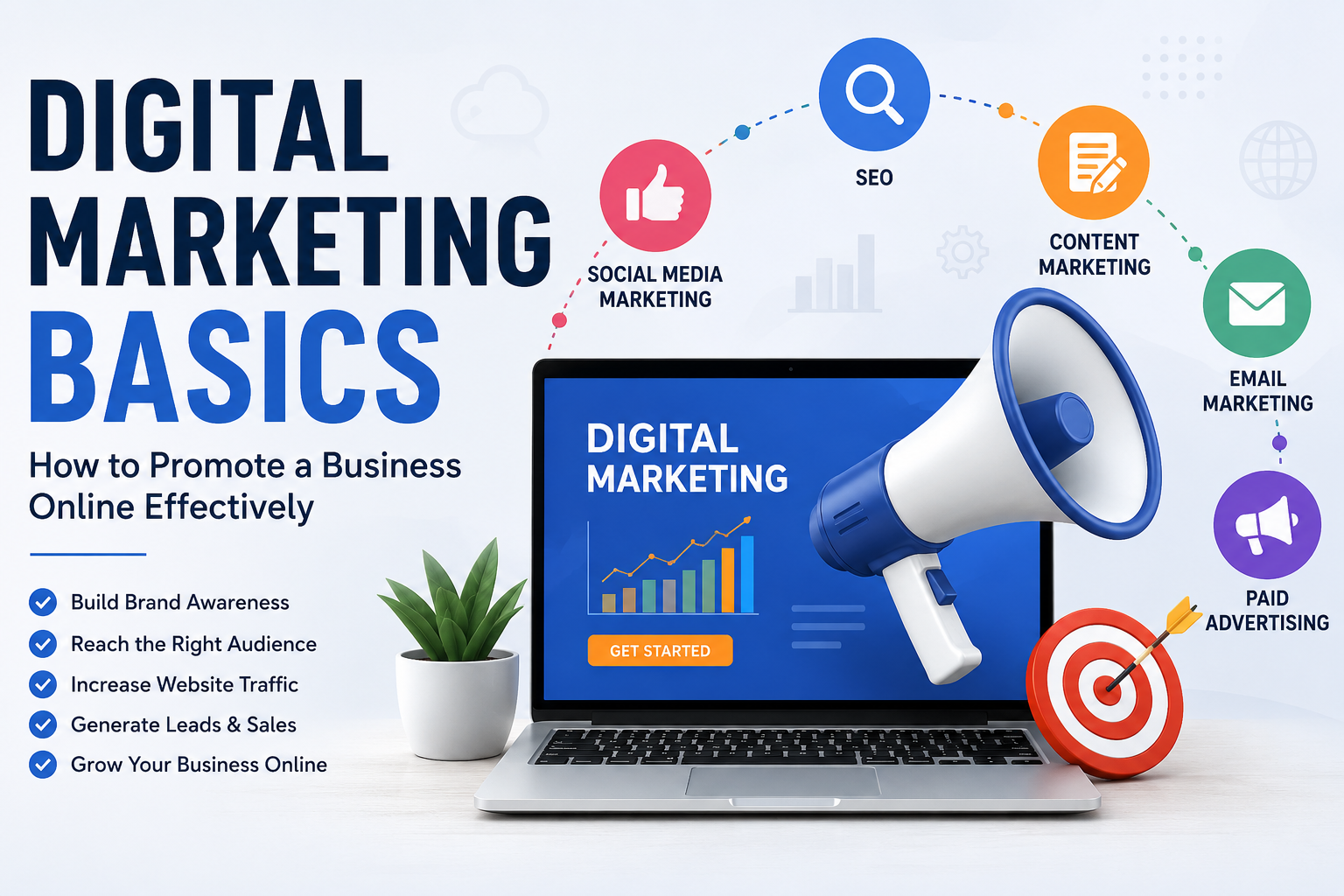
There are no shortcuts for digital marketing. It includes a number of channels, all of which complement one another to assist businesses achieve their objectives. Social media marketing can help you get your message across, content marketing can be used to educate your potential customers, SEO can bring people to your website via search engines, email marketing can be used to further develop the relationship with your customers, and paid advertising can give you instant visibility. Some channels can complement other channels in a way that presents a seamless marketing system that consistently seeks to attract new customers while maintaining existing ones.
What is Digital Marketing?
Digital marketing is a form of marketing that utilizes digital channels, like social media, mobile applications, search engines, email, and websites to promote products or services. Businesses don’t just depend on TV, newspapers, or billboards to reach out to prospective customers, but on the internet to reach them wherever they are online.
The greatest benefit of digital marketing is being able to target a specific audience. Businesses can show advertisements to people based on their interests, location, age, browsing histories, or past purchases. This kind of accuracy helps businesses make their marketing budgets more efficient and also save money and time by targeting individuals who are more likely to be customers. Digital marketing also offers in-depth campaign performance reports, which let you know exactly what generates traffic, leads, and sales.
Why Digital Marketing Is Crucial for All Businesses to Embrace
Most consumers now do a search prior to buying. They read reviews on products, watch video tutorials, and visit company websites before purchasing, and even perform comparisons. If your business does not have a website or social media accounts, then there is a chance that your products or services will go undiscovered by many of your potential customers.
Digital marketing can build credibility for businesses and keep them in the customer’s sight throughout the customer journey. Having a good online reputation creates trust since customers can find useful information, read through reviews, and interact with your business via various channels. Small firms particularly benefit since, with digital marketing, they have the chance to rival bigger firms by means of creativity and not huge advertising and marketing budgets.
The Main Components of Digital Marketing
There are a number of important marketing channels that need to be combined to achieve a successful digital marketing strategy. Every channel has its own role and provides back-up to the other channels.
1. Social Media Marketing
Social media marketing is the promotion of products, creation of communities, and engagement with customers by utilizing social media platforms like Facebook, Instagram, LinkedIn, TikTok, Pinterest, and X. Each platform draws a different type of viewer and audience, and it is crucial to know where your target audience is spending their time so that you can create content for them.
Social media marketing isn’t about selling products all the time; it’s about giving value. Tips on learning, behind-the-scenes content, customer success stories, fun videos, and informative answers to frequently asked questions are all designed to engage. When a business replies regularly to comments and messages, it also builds its customers’ relationship with the business since people like to see brands where they can put their comments and messages openly. All these engagements build trust, awareness, and loyalty over the years.
2. Content Marketing
Content marketing is all about developing content that is useful to your audience and provides them with solutions to problems or answers to questions. Rather than selling products, businesses post valuable content, which helps them establish a reliable reputation in the field.
Content can be in the form of blog posts, videos, podcasts, infographics, downloadable guides, webinars, case studies, and, oftentimes, frequently asked questions. Good content draws search engine traffic and holds readers’ interest on your site. It also offers you content you can use for social media and email marketing campaigns, making it one of the most versatile digital marketing tools you can have.
Creating content that is original and meets the needs of customers should be the focus of businesses instead of copying and pasting information from other sites online. Consistency is also a factor, as the consistent delivery of useful information retains readers and ensures that any information added to the site in the future is seen by search engines.
3. Search Engine Optimization (SEO)
Optimizing your web pages for search engines, which is also known as search engine optimization or SEO, is a process whereby you make your web pages rank better in search engines. By improving your SEO, your website has a greater chance of getting found when people are searching for products or services that are relevant to your business but don’t pay to advertise.
Keyword research, writing informative content about the keywords, optimizing site speed, making it mobile-friendly, page organization, and obtaining quality backlinks from trusted sites are important parts of the SEO process. Websites that offer valuable and trustworthy information and great user experiences will be rewarded by search engines.
The process of SEO takes time, as search engines will take time to recognize the improvements. But, unlike paid advertising, good search engine optimization could keep producing traffic for the site for a long time, as much as months and even years after its publication, making it one of the most cost-effective marketing strategies available for long-term endeavors.
4. Email Marketing
Email marketing is still one of the most successful digital marketing channels, as it enables businesses to directly reach out to individuals who have already shown interest in their products or services. Rather than relying on social media algorithms, businesses have their own email lists and can contact their subscribers at any time.
The first step in effective email marketing is to ethically acquire email addresses by having people sign up on your website, offering resources that can be downloaded, through newsletters, or from purchasing customers. Purchasing email lists is not a business’s best bet, as unsolicited emails can have negative effects and lead to a loss of trust.
Examples of useful email campaigns are educational newsletters, product announcements, special offers, seasonal promotions, customer success stories, event invitations, or targeted product suggestions. Businesses can send more personalized messages due to segmentation, which will help them attract more engagement and decrease the number of customers who cancel their subscriptions.
5. Paid Advertising
Businesses can immediately get their advertisements seen by users through paid advertising across search engines, social media platforms, websites, and video platforms. Businesses can see traffic to their sites from paid ads as soon as the ads run, whereas SEO takes time to generate rankings. Businesses can target advertisements using demographics, interests, behaviours, keywords, and geographic location. This targeting feature allows advertisements to be shown to users most likely to be interested in becoming customers.
Successful paid advertising needs to be continuously monitored. Businesses should trial various headlines, images, videos, landing pages, and even audience settings on a regular basis to see which ones work best for them to generate a higher return on investment. By carefully managing budgets, unnecessary spending can be avoided, and campaign performance maximized.
How Each of These Marketing Channels Functions Together
The best digital marketing is when all the marketing channels complement each other and work together to best effect, not all working individually. For instance, a company can compose a blog post that is optimized for search engine optimization (SEO), enabling consumers to see it via search engine results. In that article, it is suggested that readers sign up for an email newsletter. Later, subscribers will get informational emails about new products or services, which will provide them with education. The same content is shared on social media to reach a larger audience and through paid ads to introduce it to users who have never heard of the brand.
This “all-in-one” solution provides a number of points of customer contact before they decide to buy your product or service. Your brand could be found by some of your customers via social media platforms, a Google search, or email marketing. It doesn’t matter where they start from; each of the marketing channels leads them to the same business goal.
Creating a Simple Digital Marketing Strategy That You Can Use for Your Business
Newbies should steer clear of using all the marketing platforms at once. Rather, begin with clear business objectives and work out who the target audience is. Become familiar with your target customer and their problems and internet surfing habits. Then, build a professional website that clearly states what your products or services are. Create valuable content that meets the needs of customers and answers their questions while at the same time containing relevant keywords naturally. Create profiles on the social media sites that are important to your audience instead of trying to keep up with all of them.
Start building your list of email subscribers as early as possible, since email marketing has always been important and will likely continue to be in the future. Lastly, try out small paid advertising campaigns once you have established a solid organic presence and understand your target market’s preferences.
Measuring Digital Marketing Success
A benefit of digital marketing is the capability to accurately measure its efficiency. Key metrics to track include web traffic, search rankings, email open rates, click-through rates, conversion rates, customer acquisition costs, and return on advertising investment.
These metrics can be used to track and measure the success of your strategies and determine which ones need improvement. Instead of speculation and assumptions, companies can make informed decisions based on actual customer behavior. Marketing campaigns can be continually tested and optimized, thus improving gradually over time.
Common Digital Marketing Errors That Beginners Should Avoid
While some newbies think they will achieve results overnight, it’s vital to be patient and consistent with digital marketing for long-term success. One or two blog posts or social media posts don’t always mean that you will become an overnight success. Those companies that show a drive to offer content consistently do better, typically, than those that are looking for a quick payoff.
Another frequent error is neglecting customer needs by concentrating solely on selling the product. People engage and interact more with businesses that educate, entertain, or provide a solution to a problem rather than businesses that start selling their products. Businesses also shouldn’t overlook mobile optimization, as a lot of people use their smartphones to get information and make purchases.
Lastly, a lack of performance analysis causes businesses to miss out on a great deal of learning opportunities. Frequently checking marketing data can help companies make better decisions about their upcoming marketing campaigns and prevent them from making the same errors.
Conclusion
Digital marketing is a cost-effective solution that can be easily measured, providing businesses of any size with a budget-friendly and measurable method to connect with their audience, establish trust, and generate profits. Knowing about social media marketing, content production, search engine optimization, email marketing, and paid advertising can help novices create their own marketing system for the long-term growth of their businesses.
The secret is understanding digital marketing basics and that these marketing channels can be used in conjunction, not separately. Valuable content attracts visitors, promotes SEO visibility, boosts social media reach, allows email nurturing for relationships, and paid advertising promotes growth when needed. Companies that continually learn, adjust, and cater to their audience will create more resilient businesses and succeed in the online world.