Introduction
In present times’ ever dynamic financial world businesses, investors, governments, and financial institutions are always on the lookout for methods to predict what is to come and base their decisions on that information. Economic conditions we see are not usually stable for long. We see business profits go up and down, investments which may grow or lose value, inflation which in turn changes what money can buy, and markets which react to global events on a daily basis. Due to these constant changes professionals require solid tools to study trends and plan for the future. This is where differential equations in finance and economics comes in.
In the field of economics and finance we see very wide use of differential equations. Although these equations are a part of math, what they allow us to do practically goes way beyond what is taught in the classroom. They are a tool which economists, accountants, and financial analysts use to study how financial conditions play out over time and how one economic variable plays into another.
Differential equations in finance and economics are a very useful tool for which is to look at change and motion. Rather of looking at financial terms at one point in time, what they do is present professionals with the trends, the growth, the decay, and the economic action over large scales of time. In these mathematical models organizations are able to do better prediction, reduce the element of chance, and improve strategic planning.
This article reports on the application of differential equations in finance and economics issues. We see how they play a role in business growth, investment analysis, economic forecasting, and risk management which also includes the use of these models by accountants and economists to support financial decisions and to put forth forecasts of future economic climate.
Understanding Differential Equations in Economics and Finance
Differential equations which are mathematical tools for looking at change over time. In economics and finance change is a constant. Business revenues fluctuate, investment values go up and down, inflation plays with prices, and employment levels see variation with the economic climate. Differential equations allow professionals to study these changes in an organized fashion.
Unlike basic calculations which give out set results, differential equations look at relationships between variables and how they change over time. This is what makes them very useful in the study of financial systems which are dynamic in nature rather than static.
Economists and financial experts put forward these equations as tools to simplify which are in fact very complex issues and to also bring to light trends which may at first go unnoticed. By looking at how one element plays out in relation to another over time they are able to inform better business and government decision making and also to prepare for what is to come.
In modern times we see an increased use of differential equations in finance because the world economy is very much a connected and ever changeable entity.
Mathematics’ role in Financial Decision Making
Mathematical modeling as a field which takes real world issues and presents them in a mathematical term. In the fields of economics and finance we use these models to put forward theories of financial behavior, to look at what may play out in the future, and to do risk assessment.
Financial systems include a great many variables which play off each other like consumer spend, inflation, interest rates, unemployment, production levels, and investment activity. As these variables are in constant interaction with each other mathematical models are used to put very complex economic relationships into more simple terms.
Differential equations are a valuable tool which allows for the study of change over time. In these models we see that professionals are able to:
- Forecast business growth
- Predict investment trends
- Analyze market behavior
- Study inflation and unemployment
- Evaluate financial risks
- Improve long-term planning
Mathematical modeling provides organizations with a basis for decision which is founded in data and analysis as opposed to speculation.
Differential Equations in Business Growth Modeling
Business growth is a primary area in which differential equations are used. Companies see fluctuations in sales, profits, customer demand, and market share over time. To do better we must understand these changes which are essential to long term success.
Differential equations are used by businesses to research growth trends and predict future performance. In which they look at past and present trends companies are able to make better decisions regarding expansion, staffing, production, and investment.
Forecasting Business Performance
Businesses which put out projections of future revenue and market growth do so frequently. Differential equations are a tool which analysts use to determine if we will see consistent growth, growth that is slowing, or a decline in growth.
This type of forecast supports what is important in business which includes:
- Budget planning
- Resource allocation
- Product development
- Market expansion
- Financial management
Accurate prediction of trends allows companies to better prepare for what is to come.
Understanding Market Saturation
In most fields growth at some point slows down as markets reach saturation. Business use differential equations to determine when we may see customer demand level off or drop. For instance a new product may see great initial success but as time goes on sales growth may drop which in turn may be a result of increased competition from other players in the field or that the base of potential customers has been exhausted. Understanding those patterns which in turn allow companies to revise their approaches and stay competitive in dynamic markets.
Applications in Investment Analysis
Invest in which present a fluctuating picture of economic conditions, interest rates, political events, and investor behavior. We see that differential equations are a tool which financial analysts use to study how investments play out over time and also how markets react to various conditions.
Predicting Investment Trends
Investors use math models to predict performance of investments which is into the future. Also these models are used by individuals and organizations to make informed decisions regarding savings, retirement plans, and long term financial goals.
Through analysis of investment trends, financial professionals are to:
- Compare investment opportunities
- Assess future profitability
- Plan for financial growth
- Reduce uncertainty
Differential equations are of great use as investments do not usually grow at a constant rate. Markets fluctuate constantly and math models are used to explain that fluctuation.
Understanding Market Volatility
Financial markets are very volatile. We see large fluctuations in stock prices, currency values, and asset prices as a result of change in economic conditions or investor sentiment.
Differential equations are used by analysts to study market volatility and to identify patterns in financial behavior. This information is of value for:
- Portfolio management
- Risk assessment
- Financial forecasting
- Investment planning
Banks, investment firms and financial institutions use a great deal of these math tools in making strategic investment decisions.
Economic Growth and National Development
Economists apply differential equations in study of how national economies develop over time. What goes into economic growth is many factors which include investment, production, employment, technology, and population growth. Economies are in a constant state of change, which is why we use mathematical models to study how various factors play out and impact long term development.
Economic Forecasting
Governments and policymakers turn to economic models for predictions of the economic climate in the future. These predictions in turn inform leaders which tax and spend, what employment programs to put in place, and what national development strategies to pursue.
Economic prediction is of great value as it does:
- Prepare national budgets
- Develop economic policies
- Plan infrastructure projects
- Promote sustainable growth
Differential equations are a tool for analyzing long term economic trends and seeing how changes in one sector play out for the whole economy.
Technology and Productivity
Technology is a large component in economic growth. Economists put together mathematical models which we use to study how tech improvements play out in terms of productivity, employment, and industrial expansion. These relationships we see as a base for which policy makers to build strategies of encouragement for innovation and growth.
Inflation and Unemployment Analysis
Inflation and unemployment are of the most import health indicators of economy. We see how these variables change over time and how they interact with each other through the use of differential equations which economists do.
Inflation Modeling
Inflation is the increase of prices over time. Economists use math models to study what causes inflation which includes consumer demand, production costs, and money supply. Comprehending inflation trends allows governments and central banks to put in place policies which in turn promote economic stability and protect purchasing power.
Unemployment Trends
Unemployment rates fluctuate as the economy grows or shrinks. Also it is the role of differential equations to study labor market action and to determine what factors play a large role in employment.
This analysis supports development of policies which:
- Job creation
- Economic stability
- Workforce development
- Poverty reduction
Through the use of math in forecasting governments are able to better respond to economic issues.
Population Growth and Consumer Demand
Population growth plays a large role in economic activity. As we see more people in a given area, we also see a different demand for products and services. Businesses and governments use math models to study these trends which in turn help them prepare for what is to come in terms of demand.
Differential equations help analyze:
- Population growth
- Consumer behavior
- Housing demand
- Healthcare needs
- Resource consumption
Businesses use that data to grow into new markets, introduce which is new to their portfolio, or increase production. Governments use population projection in the development of public services and infrastructure.
Risk Management in Finance
Risk management is a fundamental element of today’s finance and accounting. In the financial world we see that which related to investments, loans, insurance, and market fluctuations present a great deal of uncertainty. Differential equations are used by organizations to better determine and handle these risks.
Financial Risk Assessment
Banks and investment companies use math based models to look at which of our financial losses are likely to happen and also to see what risks we may face before they turn into big issues.
These models support:
- Loan evaluation
- Credit analysis
- Investment planning
- Insurance forecasting
Through analysis of risk trends financial institutions are able to make safer and more informed decisions.
Managing Economic Uncertainty
Economic stability does not always present itself as it may break out of the blue because of recessions, inflation, political instability, or global crises. Also we see that differential equations are a tool which companies use to research that which is uncertain and to put in place strategies to deal with the ever changing economic climate. This increases long term financial planning and also improves organizational stability.
Accountants and Economists use models which are mathematical.
Accountants and economists depend on mathematical models for better financial analysis, forecasting, and strategic planning. It is the differential equations which in particular do well at studying changes which take place over time.
How Accountants Use Mathematical Models
Accounting professionals use models which are mathematical in nature in areas such as:
- Budget forecasting
- Revenue analysis
- Cost management
- Cash flow planning
- Financial reporting
- Investment evaluation
These models help companies to assess their financial performance and improve on profitability and efficiency.
How Economists Use Mathematical Models
Economists turn to differential equations to analyze large scale economic systems and to predict trends. They look at:
- Economic growth
- Inflation rates
- Employment levels
- Consumer behavior
- Market performance
These models which present possible outcomes of economic decisions are used by policymakers.
Supporting Strategic Decisions
Mathematical models inform better choices for organizations:
- Predict future trends
- Reduce uncertainty
- Improve financial planning
- Allocate resources efficiently
- Respond to economic changes
As of now businesses and governments are better at dealing with.
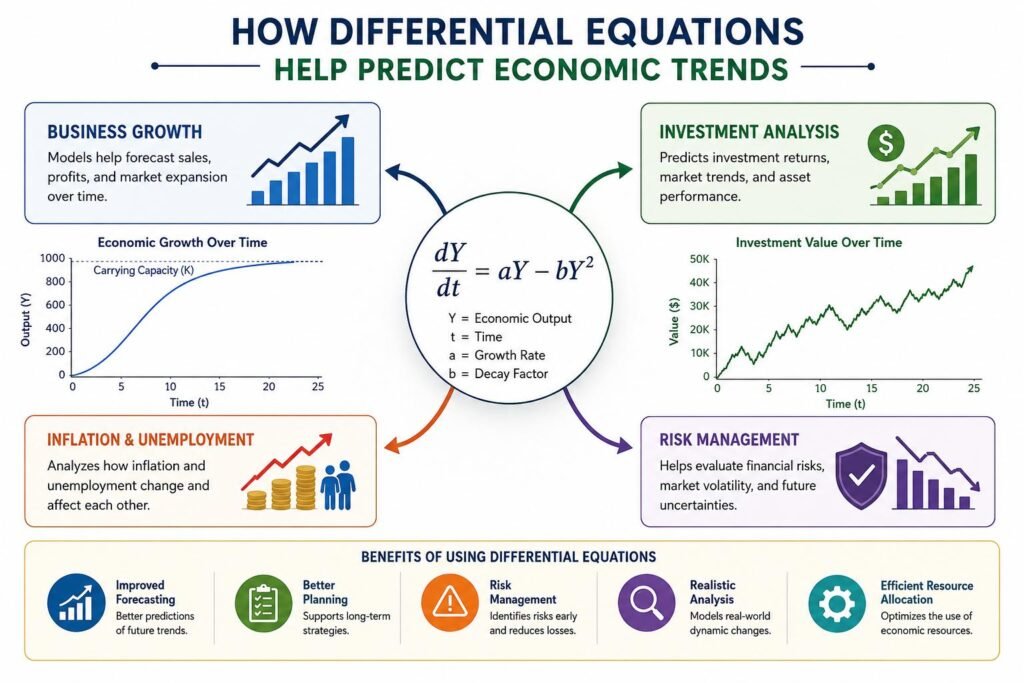
Benefits of Using Differential Equations in Finance and Economics
Differential equations play key roles in economic and financial analysis.
- Improved Forecasting: They enable organizations to see into the future better by looking at how variables play out over time.
- Better Planning: Businesses and governments can put in place long term plans which are based on economic projections.
- Enhanced Risk Management: Mathematical models which also in turn present early warning signs of risk and at the same time improve the quality of financial decisions.
- Realistic Analysis: Due to the constant change in economic and financial markets, differential equations are a better model for financial behavior.
- Efficient Resource Allocation: Organizations can better use economic resources when the future is more predictable.
Limitations of Differential Equation Models
Though differential equations are very useful they also have limitations.
- Dependence on Assumptions: Many economic models base their theories on which in some cases may not accurately present the real world.
- Complexity of Economic Systems: Financial markets and in fact economies are affected by many unpredictable elements which in turn makes full accuracy hard.
- Human Behavior: Consumer sentiment, political actions, and social issues play a role in economic results which may not be accounted for by mathematical models.
- Data Challenges: Reliable forecasting is a function of good data. Poor quality information will in turn reduce what a model can do.
Despite of those issues differential equations still are at the top in economics and finance.
The Future of Math in Economics
Technology is redefining how we use mathematical models in finance and economics. Presently economists and financial analysts are using differential equations along with artificial intelligence, machine learning, and data analytics to improve forecast accuracy.
These days we see that large scale information processing is made easy for companies which allow better response to economic changes. As we see the growth of global financial systems’ complexity, mathematical modeling will play a large role in economic planning, investment analysis, and business strategy.
Conclusion
Differential equations are at the core of financial and economic issues which they do for instance in that they model how key variables shift over time. We see their use in business for projection of growth, in investment for analysis of market trends, and in economics for research into inflation, unemployment, and economic growth.
Through the use of mathematical models organizations are able to better understand financial systems, improve forecasting, manage risk, and make informed strategic decisions. Also differential equations support in long term planning which in turn allows businesses and governments to prepare for future economic conditions.
Although we can’t expect mathematical models to predict all real world events exactly, we do see them as tools which improve our financial and economic decision making. As technology grows we are seeing an increase in the use of differential equations in finance and economics which will play a large role in the development of business strategies and economic policies in the future.
Get more well researched information about Differential Equations in Finance and Economics here.