If
you were to investigate all the different types of microcontrollers available,
you would probably be amazed at the number of different ones available. The
different types of microcontroller can be broken down as:
you were to investigate all the different types of microcontrollers available,
you would probably be amazed at the number of different ones available. The
different types of microcontroller can be broken down as:
·
Embedded 8-bit microcontrollers(self contained)
Embedded 8-bit microcontrollers(self contained)
·
External memory microcontrollers (16- or 32- bit data paths)
External memory microcontrollers (16- or 32- bit data paths)
·
Digital signal processors
Digital signal processors
Embedded microcontrollers
The
term ‘embedded’ is usually substituted for ‘self contained’. There is a wide
range of self-contained devices available in an embedded microcontroller. In
this type of microcontroller, the memory, I/O, etc are available on the chip,
so all that is need is the provision of power and clocking.
term ‘embedded’ is usually substituted for ‘self contained’. There is a wide
range of self-contained devices available in an embedded microcontroller. In
this type of microcontroller, the memory, I/O, etc are available on the chip,
so all that is need is the provision of power and clocking.
These
devices are used to control ‘smart’ machine, such as microwave ovens, clothes
washers, metal lathes, etc. This means that there is a great deal of variation
of operation modes, even in devices that are performing the same tasks. The
primary role of these microcontrollers is to provide an inexpensive
programmable logic control and interfacing to external devices.
This
means that they are typically not required to provide highly complex functions,
but they are capable of providing surprising sophisticated control of different
applications
means that they are typically not required to provide highly complex functions,
but they are capable of providing surprising sophisticated control of different
applications
In
an embedded microcontroller, the following are usually available, they are:
an embedded microcontroller, the following are usually available, they are:
·
Processor reset
Processor reset
·
Device clocking
Device clocking
·
Central processor
Central processor
·
Control store
Control store
·
Variable RAM
Variable RAM
·
I/O pins
I/O pins
·
Instruction cycle timers
Instruction cycle timers
The
diagram shown in fig 1.1 below show how an embedded microcontroller could be
laid out and interfaced to the outside world
diagram shown in fig 1.1 below show how an embedded microcontroller could be
laid out and interfaced to the outside world

For
more sophisticated embedded microcontrollers, the basic requirements of a
computer system may be added. These added features are:
more sophisticated embedded microcontrollers, the basic requirements of a
computer system may be added. These added features are:
·
Built-in monitor/debugger program
Built-in monitor/debugger program
·
Built-in control store programming from a direct host convection
Built-in control store programming from a direct host convection
·
Analogue I/O
Analogue I/O
·
Serial I/O (synchronous and asynchronous data transfer)
Serial I/O (synchronous and asynchronous data transfer)
·
Parallel 1/0 (including directly interfacing to a master processor)
Parallel 1/0 (including directly interfacing to a master processor)
·
External memory interfaces (‘microprocessor mode’)
External memory interfaces (‘microprocessor mode’)
All
these features increase the flexibility of the device considerably and not only
make developing applications easier, but possible in some cases. Note that most
of these options (added features) enhance the 1/0 pins functions.
these features increase the flexibility of the device considerably and not only
make developing applications easier, but possible in some cases. Note that most
of these options (added features) enhance the 1/0 pins functions.
The
primary limiting factor of the embedded microcontroller is the access time of
the memory used. Maximum speeds for these devices are typically in the low tens
of megahertz.
primary limiting factor of the embedded microcontroller is the access time of
the memory used. Maximum speeds for these devices are typically in the low tens
of megahertz.
Family of Embedded Microcontroller
Family
8051
TMS-1000
MC6801
AVR
Basic Stamp |
Manufacturer
Intel
Texas
Motorola
Atmel
Parallax |
External Memory Microcontrollers
Some
microcontrollers (most notably for devices with 16- or 32- bit data paths) rely
completely on external memory. This external memory contains the control store
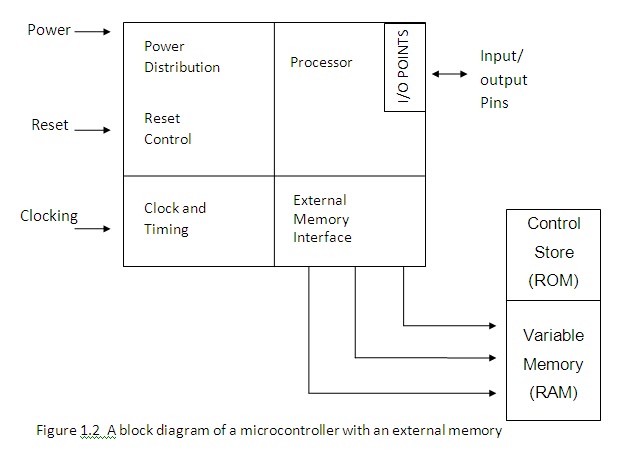
as well as any Random Access Memory (RAM) required for the application. So to
make provision for this, fig 1.1 can be updated to include external memory as
shown in fig 1.2 below
A
classical example of this type of microcontroller is the Intel 80188. This was
originally an 8088 (used in IBM and IBM compatible PCs), but an additional
circuiting to provide many of the ‘standard’ functions needed to run different
applications (i.e interrupt) added to the chip. The purpose of th 80188 was to
provide an integrated package containing all the circuiting for the development
engineer to simply create an 8088 application.
External
memory microcontrollers are designed for more diversified applications than the
embedded microcontrollers. These applications generally required large amounts
of RAM and a few 1/0 pin functions (other than serial or bus interfaces). In an
application well suited for an external memory microcontroller, the critical
resource is RAM, as opposed to general-purpose 1/0 pins, as in the case with
embedded microcontrollers.
A
typical application for an external memory microcontroller is as a hard disk
buffer that buffers and distributes large amount of data (usually measured in
megabytes). The external memory allows the device to run at higher speeds that
what an embedded microcontroller’s memory would run at.
typical application for an external memory microcontroller is as a hard disk
buffer that buffers and distributes large amount of data (usually measured in
megabytes). The external memory allows the device to run at higher speeds that
what an embedded microcontroller’s memory would run at.
Digital signal processors
Digital
processors (DSP) are a relatively new category of processors. The purpose of a
DSP is to take sample analogue system and calculate an appropriate response.
DSPs and their Arithmetic Logic Units (ALUs) run at very high speed to allow
this control in real time. DSPs are often used in applications like active
noise-cancelling microphone in aircraft (a second or ambient noise microphone
signal, allowing cancelling out of the ambient noise, leaving just the pilot’s
voice) or eliminating ‘ghosting’ in broadcast television signals.
DSPs
come in a variety of designs that use features found in the embedded
microcontrollers. While typically not designed for standalone applications,
they can be used for controlling external digital hardware as well as
processing the input signals and formulating appropriate output signals
come in a variety of designs that use features found in the embedded
microcontrollers. While typically not designed for standalone applications,
they can be used for controlling external digital hardware as well as
processing the input signals and formulating appropriate output signals