Introduction
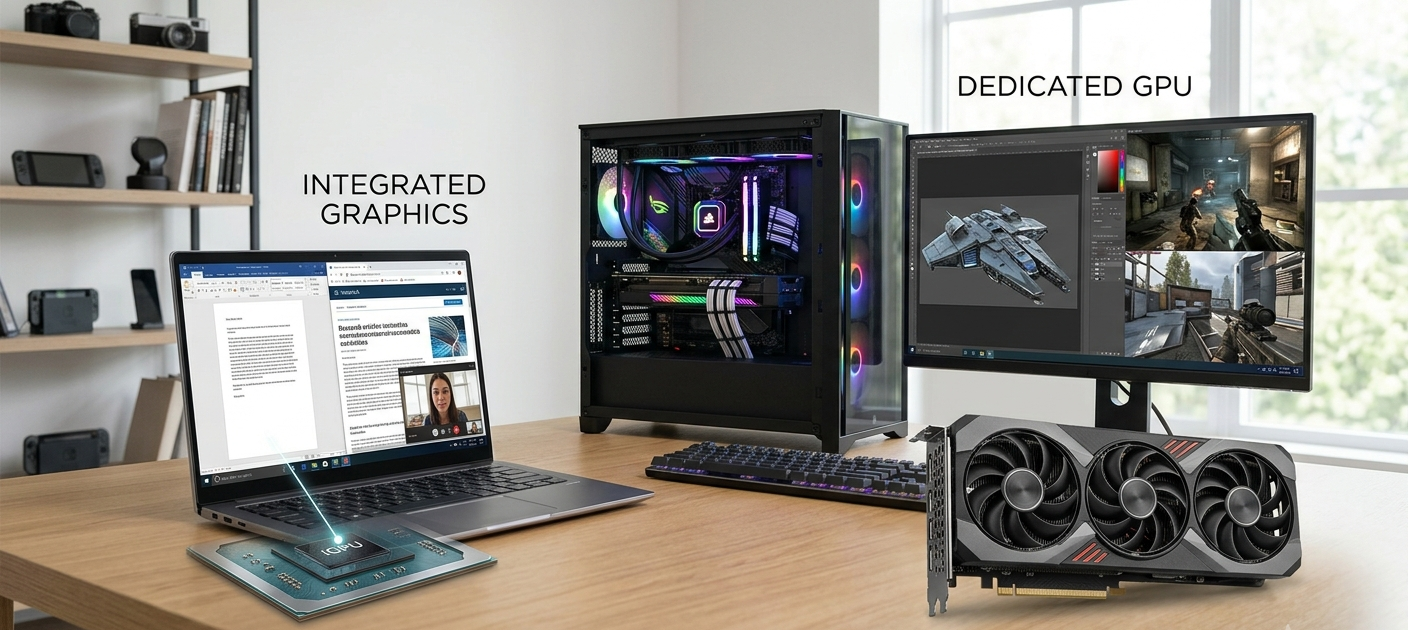
One of the most confusing aspects of purchasing a computer, laptop or desktop is whether to go with a dedicated graphics card or a graphics card that is integrated into the motherboard. Some of the users think that all the powerful computers are required to have a separate GPU or if the computer has a powerful processor, then it should be capable of doing all the tasks without additional graphics hardware. The reality is more even. For some people, using a computer may be for daily tasks, gaming, creating something, work or even learning new skills. Over the years, graphics technology has advanced considerably and today’s integrated graphics can handle the tasks of a dedicated graphics card. But power-hungry applications requiring additional CPU power benefit greatly from dedicated GPUs.
The graphics system of a computer creates and displays images, video, animation and visual effects on the screen. It can handle simple tasks such as displaying a website or complex tasks like creating and rendering 3D environments for games or editing high-resolution videos. So far, there are two types of graphics available: integrated graphics and dedicated GPUs (graphics processing units). Integrated graphics are built into the computer processor, dedicated graphics are separate parts that specialize in intensive graphics calculations. Since both options are viable, knowing how they function can help students, professionals, gamers and others save money on features that they may not need.
What is Integrated Graphics?
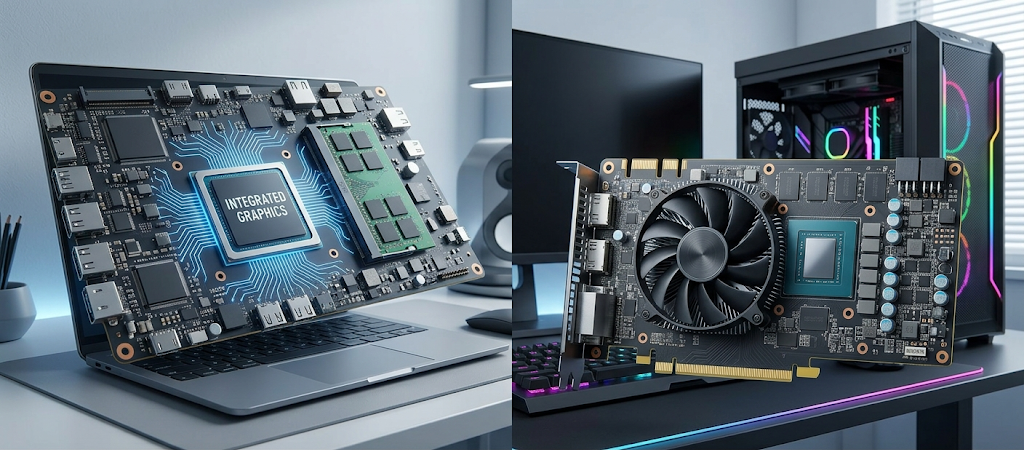
Integrated graphics are graphics processors that are built into the same chip as the computer’s central processing unit (CPU). Integrated graphics means instead of having a graphics card in the computer, the integrated graphics share resources with the processor and use a portion of the system’s memory (ram) to do the graphics work. Fewer components are needed in this design which will make the computer smaller, cheaper and more energy efficient. Today’s processors from companies like AMD and Intel come with the high-end integrated graphics, which makes everyday computing tasks easy. Integrated graphics are sufficient for most casual users for tasks like browsing the web, streaming videos, joining online classes, creating documents, and other productivity tasks.
The best thing about integrated graphics is their efficiency. Having the graphics processor embedded in the CPU generally means that the laptop will also have a long battery life and will generate less heat when in use, than those with powerful dedicated GPUs. They are particularly handy for students, office workers and anyone requiring portable computers for studying or working away from home. Modern graphics are also much better than older versions of integrated graphics. A few of these solutions in use at present are able to manage multiple displays, high resolution video playback, light photo editing and even some games at lesser settings. If they aren’t going to use the computer for graphics-intensive work, it’s not a lot of money that’s really needed.
Integrated graphics work by using the computer’s resources rather than their own. A dedicated graphics card uses a different type of video memory, known as VRAM, to store and utilize large volumes of graphics information, which is useful for the card to process rapidly. Integrated graphics, however, tend to be based on a portion of the computer’s primary RAM. This common solution will save manufacturing expenses, but it also restricts performance when it comes to the most challenging jobs. Opening documents, streaming videos, for instance, demand only a little graphical power; integrated graphics can easily handle such tasks. But for games, professional animation software and advanced visual effects, more processing power is needed, and that’s where complexity comes in.
While integrated graphics chips used to be thought of as less powerful than dedicated chips, that’s no longer true. For the average consumer and even some light gaming, modern AMD’s Ryzen series graphics and Intel’s more recent Core series graphics can impress. Integrated graphics now support more demanding applications due to improvements in architecture, memory and software support. Integrated graphics are a great combination of performance, price and battery life for many users who are purchasing a computer for school, business, communication or entertainment.
What Is a Dedicated GPU?
Dedicated GPU: A graphics processing unit (GPU) that is used exclusively for graphics. Dedicated GPUs have much larger and more complicated graphical tasks because they have their own processor cores and dedicated VRAM as opposed to integrated graphics. Dedicated graphics cards can offer much more power as they will have no competition for CPU resources. They are widely used in gaming PCs, high-resolution engineering workstations, and top-tier laptops for creators and engineers. For applications with extensive graphical data, like 3D rendering, artificial intelligence, scientific simulations, and professional video production, dedicated GPUs are particularly useful.
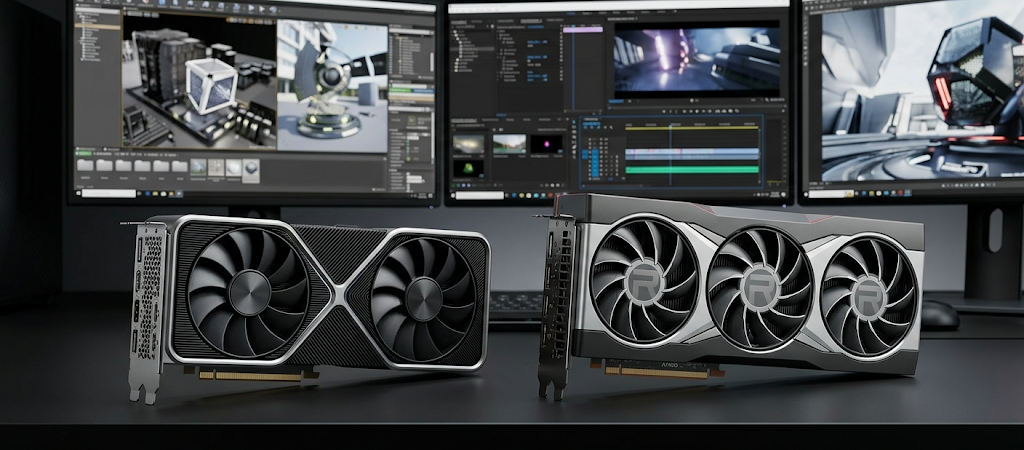
NVIDIA and AMD are the top two companies in the manufacture of consumer dedicated GPUs. Both companies have multiple graphics cards, for various users. The advanced ray tracing capabilities, AI-enhanced imagery, and robust software support make NVIDIA’s GeForce graphics cards highly sought after by gamers, content creators, and professionals alike. AMD also offers competitive graphics solutions in the form of its dedicated graphics products, Radeon, which can deliver good performance at various price points.
Key differences between integrated graphics and dedicated graphics
The performance is the biggest difference between integrated graphics and dedicated GPUs. Gates’ integrated graphics are optimized for efficiency and everyday computing, while dedicated GPUs are optimized for maximum graphical power. If the computer user primarily uses a computer for writing assignments, attending virtual classes, browsing websites, or watching movies, then there will be little difference between the two options. A dedicated GPU will make a huge difference, however, for anyone who is editing 4K videos or creating 3D models, playing the latest games, or using professional design software.
The other difference is memory. Dedicated graphics cards have their own VRAM that can store textures, models, etc. separately from the computer’s memory. This enables them to perform complex applications quickly and accurately. Integrated graphics are sharing system RAM with the system, so they can have trouble if the processor and the graphics system require large amounts of memory at the same time. This distinction is what makes it so that dedicated GPUs work better in cases where they need to process a lot of visual data at a fast speed.
There are other areas where the two technologies differ in terms of power consumption. Integrated graphics typically consume less power as they are built to be efficient and are part of the processor. This is perfect for use in thin laptops and portable computers where battery life is an important consideration. Dedicated GPUs use more electricity and generate more heat due to the amount of processing equipment they have. Gaming laptops and professional workstations or desktops that have dedicated graphics may require a more powerful cooling system and larger battery for the additional energy demands.
NVIDIA or AMD: Which is Best for you?.
As a key consideration in selecting a dedicated graphics card, many users will compare NVIDIA and AMD, as they are the two major players in the consumer graphics card market. The two manufacturers make good graphics products, but some of their strengths differ somewhat. The NVIDIA GeForce Graphics cards are known for their cutting-edge technology, including support for real-time ray tracing, upscaling with AI, and performance in professional applications. DLSS (Deep Learning Super Sampling) technology, among others, helps to enhance gaming performance by utilizing artificial intelligence to achieve smoother images while minimizing the strain on the graphics processor. Due to its software ecosystem and computing capabilities, NVIDIA GPUs are widely adopted by professionals engaged in video production, 3D Design, and machine learning.
AMD’s Radeon graphics cards are also very competitive and have great performance at their price point. AMD’s main aim is to provide high performance raw graphics capabilities with a variety of choices for all budgets. The Radeon GPUs are favored by gamers and content creators looking for performance without high-end price tags. AMD’s technologies, such as FidelityFX Super Resolution (FSR), help improve performance in supported games and applications. The choice between NVIDIA and AMD usually depends on factors such as budget, software requirements, performance expectations, and personal preference. If a dedicated graphics card is required, either Evoque’s dedicated GPU models will suffice for most common users.
Integrated Graphics: A Targeted Question.
For many people, the integrated graphics options are the optimal option since most activities they undertake on their computer require a non-complicated graphics processor. Modern integrated graphics can have students, office workers, researchers and casual computer users carry out all their tasks comfortably. Tasks like writing assignments, creating presentations, searching for education websites, participating in online meetings, viewing streaming content, and using productivity software are relatively low-graphical tasks. A computer with built-in graphics can also be cost effective, allowing for additional funds to be spent in other areas, such as storage, memory, processor power, or battery life.
One of the groups where integrated graphics provide much benefit to students is the one I mentioned earlier.One of the groups that are greatly benefited from integrated graphics is the student group, as I said earlier. Students who use their laptop for schoolwork, online learning, programming, research and entertainment rarely require a high-end dedicated GPU. Lighter Laptops with built-in graphics can be carried more easily, have longer battery life and are sufficient for academics. Students who are learning subjects that are not directly related to drawing and using graphics, such as business, humanities, basic sciences, or general computer studies, will in most cases be able to use integrated graphics. A dedicated graphics card may be unnecessary for any course that does not include advanced design, engineering simulations, animation or production of professional media.
Even those who do not play games, but use the computer primarily for communication, surfing the web, document creation and entertainment can enjoy integrated graphics. Most modern processors are able to support high-resolution video playback, multiple browser windows, photo archiving and simple image manipulation. These users do not have to purchase additional graphic equipment that they will likely never use, but instead can pick a halfway house computer that suits their needs. This will offer greater value because of the way that the computer performs, which relies on a number of elements such as the processor, storage speed, memory capacity, and overall design.
Do you really need a dedicated GPU?
Integrated graphics is sufficient for many, but dedicated graphics is needed for some. One of the more apparent examples is gamers. High-definition graphics processing is used in many contemporary video games to produce intricate environments, realistic lighting, complex animation and animation frames per second. With a dedicated GPU, games can be played at higher resolutions and settings and will perform smoother. Players who only play simple or older games may be fine with integrated graphics but those who want to play the latest AAA games, competitive games or virtual reality will likely be better off with a dedicated graphics card.
Another group that can benefit from the use of dedicated graphics is video editors and content creators. Larger projects, visual effects and editing high resolution videos demands significant processing power. Use of a dedicated GPU can accelerate rendering and enhance the responsiveness of creative apps. For simple video editing needs, an integrated graphics card should suffice, but those pursuing professional video projects with 4K video, motion graphics, color grading or complex effects will appreciate the extra performance offered by a dedicated graphics card.
Other professionals like graphic designers, architects, engineers, and 3D artists also use dedicated GPUs. Computer-aided design (CAD), 3D modeling, animation and visual simulations are essential tools for programs. These applications require complex models to be displayed without any glitch and calculations to be done in an efficient manner—where a dedicated GPU helps. Professionals who rely on visual accuracy and performance may find that having a more robust graphics solution can save them time and boost their productivity.
Do casual gamers need to invest in a dedicated graphics card?
Casual gamers are in the middle ground as their requirements are dependent on the type of games they play. Having a high-end graphic card is not necessary for every player. Many games already exist that run well on a modern integrated graphics card, and many of them have simple graphics, such as educational or indie or older games or less demanding multiplayer games. Those who play games from time to time and don’t mind holding their setting to a lower level can experience a satisfying gameplay by using integrated graphics.
For those looking for a more visual experience, better frame rates, and access to newer releases, however, a dedicated GPU might be a better option for gamers. Today’s games are becoming more and more realistic, featuring better lighting, environments, and worlds, which are much bigger and demand powerful hardware. These experiences will not suffer in terms of graphics quality, but will benefit from the increased performance of a dedicated graphics card. It is important to acknowledge that the question isn’t “Does he play games,” it’s “What kind of gaming does he want his computer to provide?
The Best Choice for Different Types of Users
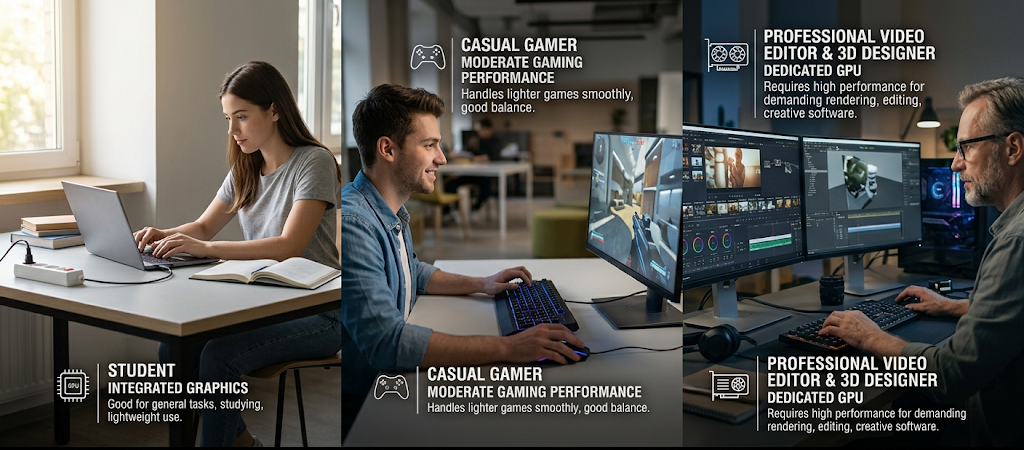
Understanding the needs of the user is the key to choosing between integrated graphics and a dedicated GPU, rather than just picking the biggest and best graphics card you can. If students require a laptop they can rely on for studying, research, writing, coding and entertainment, then integrated graphics boards are typically a better option. They are cost effective and energy efficient without compromising on performance, and are extremely portable and convenient to use. If a student has no need to use demanding applications such as creations or games, he or she can save money by not purchasing extra graphics hardware.
For professionals and creators, it is all about workload. A person who sometimes alters family movies or makes simple designs may not be at ease with inbuilt graphics. Photographers, filmmakers, animators, architects and engineers, however, often need dedicated graphics cards because the software they use can actually make use of the extra capability they bring. The added expense may be worth it in the time saved in editing, rendering and processing.
Gamers will have to choose based on the gaming objectives. Someone with an interest in casual gaming doesn’t require an exclusive GPU, but those with an interest in more serious gaming do. The graphics card should match the resolution of the monitor and the level of performance desired for the game. Although it is not always essential to purchase the top-of-the-range graphics card, it is crucial that the equipment will be capable of performing the activities that you have in mind so that you will not end up disappointed in the long run.
The Future of Integrated and Dedicated Graphics
Differences between integrated graphics and dedicated GPUs keep evolving with the advancement of technology. The expensive graphics system is being integrated into the processor because the processor manufacturers are working on improved processor design, faster memory system and more efficient graphics technology. There are some new integrated solutions which perform as well as old dedicated graphics cards, but in smaller bodies and with lower costs. This improvement reduces the need for people to purchase their own computer graphics components, while allowing them to use a capable computer.
Meanwhile, the dedicated GPUs are also moving forward at a rapid pace. New generations of graphics cards offer better performance, energy efficiency and special options for gamers, AI, professional creativity and scientific research. With the growing complexity of applications, special GPUs will continue to be relevant for those who need maximum processing power. Integrated graphics and dedicated GPUs are not replacing one another, but are evolving to meet the needs of different sets of users.
Conclusion
Not all computer users need a dedicated graphics card. With modern integrated graphics, a lot of folks can get through the day just fine, all while saving money, getting more battery life and mobility. If you’re a student or office worker, or simply someone who consumes a lot of information online, produces documents, watches videos, or does simple work, integrated graphics are usually enough.
For those seeking higher performance, however, dedicated GPUs are still necessary. Dedicated memory, advanced features, and increased power of graphics cards are what set them apart from other graphics cards, offering advantages to gamers, video editors, 3D designers, engineers, and creative professionals. It is not just about picking the most powerful hardware available, but it’s about what it will be used for.
When purchasing a new computer, users must think about what they will use the computer for, what they will want to achieve with the computer, and how much they will be willing to spend on it. If the dedicated GPU adds value to the job of doing something important then the extra cost is worthwhile, but if it’s just for basic computing then it’s not worth the extra cash. By knowing the difference between integrated graphics and dedicated GPUs, buyers can make informed decisions and select the right computer that meets their needs without compromising on performance, cost, or efficiency.



Great information shared.. really enjoyed reading this post thank you author for sharing this post .. appreciated