
The world we live in is all about data. In the era of Big Data, every business, organisation and industry creates a vast quantity of information through customer interactions, financial transactions, digital platforms, scientific research and through their operations. But data can’t generate value by itself, and it’s the job of the right people – and skills – to convert that data into meaningful insights that can help make better decisions. The surge in demand has led to job opportunities in areas like data analysis and data science. A Data career might be a good fit for analytical thinkers who enjoy solving problems, finding patterns, and using technology to answer questions, as it offers a rewarding path with good growth opportunities. The path to the journey is not an overnight process. Rather, aspiring professionals can develop their careers step-by-step by gaining foundational knowledge of key tools, hands-on experience, and progressing from entry-level analytical jobs to more advanced roles that include predictive modeling, AI, and strategic decision making.
Many individuals who enter the data field start as data analyst. Data analysts collect, clean, categorize and analyze data to gain insight into what has occurred. They analyze trends and share results through spreadsheets, databases and visualization tools. With experience, practitioners can advance to data science careers, applying programming, statistics, and machine learning to forecast future outcomes and address more complex challenges. Knowing this career path is beneficial for beginners to establish a learning trajectory rather than attempting to learn all data skills at once. There are many components to a successful career in data, including technical knowledge, business knowledge, communication skills, and continuous improvement.
Differences Between a Data Analyst and a Data Scientist

The Role of a Data Analyst
One of the easiest jobs to get into the data industry is that of a data analyst. Their main role is to analyze current data and offer insights that can inform organizations’ decision-making processes. They are generally dealing with structured data sets, finding significant patterns, generating reports, and building dashboards that enable teams to track and monitor performance. For instance, a company can employ a data analyst to examine how customers are buying their goods or services, evaluate the effectiveness of sales, determine if there is any unnecessary costs they can cut down on, or analyze the effectiveness of their marketing campaigns. Data analysts are crucial, as they help to convert complex data sets into information that can be understood and utilized by decision-makers.
A data analyst’s job involves both analytical and technical capabilities. Analysts need to be curious, have problem solving skills, and use tools like Excel, SQL, and Power BI. Before analysing data, they have to ask the right questions, as the quality of insights is highly dependent on the understanding of the business problem. A good analyst isn’t just a chart maker or number cruncher, they are also a researcher who delves into the reasons behind patterns and uncovers what should be done in a business situation. From healthcare to finance, technology to education, and retail to government, data analysts are useful in a variety of fields due to the power of linking data to real-world decisions.
The Role of a Data Scientist
A data scientist is a more sophisticated user who is able to use programming, statistics, mathematics, and machine learning to address complex tasks. Data scientists are far more likely to consider predicting future events and creating automated solutions, whereas analysts tend to focus on comprehending past information. They can build recommendation systems, predict customer demands, identify fraudulent transactions, or even build AI models that can enhance business processes. Data scientists employ large datasets and sophisticated analysis techniques to gain more insight into information that wouldn’t have been apparent by other means.
The role of a data scientist typically requires experience in an analyst or other technical position, as it involves a broader set of skills. To be a data scientist, one needs to know how to gather and clean data, choose the right algorithms, train machine learning models, analyze results and communicate them effectively. While technical knowledge is necessary, business knowledge is crucial as effective data science projects address real problems. An individual who has a technical and business acumen can better be equipped to provide solutions that have the potential to have a significant impact.
Step 1: Build a Strong Foundation with Excel and Data Fundamentals
Learning Excel for Data Analysis
Excel is still one of the most important for new entrants to the data field. While most advanced professional users work with programming languages and other special platforms, many of the companies rely on Excel to manage information, conduct calculations and produce reports. Learning Excel is a good introduction to working with data because it covers essential data cleanup, formulas, functions and analysis techniques.
Future data professionals should be familiar with basic Excel tools such as pivot tables, lookup functions, conditional formatting, charts, filters and data validation. They should also be able to sort through “messy data”, deduplicate it and deal with missing data and summarise enormous amounts of data in an efficient manner. The skills are commonly applied in the workplace, as a lot of businesses maintain operational data in spreadsheets. By learning how to use Excel, novice users will be able to grasp the organization of data, which will give them a solid foundation for exploring other, higher-level technologies.

Developing Analytical Thinking
Data professionals are not made from technical tools. Analytical thinking is among the most vital skills needed in this career path. Analytical thinkers are able to break down complex problems into smaller questions, analyse information, look for patterns or connections and make rational conclusions. For instance, when sales drop, an analyst will delve deeper to determine why it has dropped, for instance, are customers changing their purchasing habits, is the price, is there some competition in the market or are there any issues with the operations.
This mindset needs to be developed with practice. There are several ways to enhance your skills as a beginner: by examining information in everyday situations, doing personal projects, taking part in online challenges, and reading through real business scenarios. Students will learn to solve problems as a data professional, asking questions and making decisions based on evidence.
Step 2: Master SQL for Working with Databases
SQL, also known as Structured Query Language, is one of the essential skills for anyone aiming to enter the field of Data Analysis or Data Science. Professionals retrieve, organize, and analyse information in a database with SQL, which is used to store a vast amount of information within an organization. An individual with knowledge of SQL can access the company databases directly, without just pre-prepared files.
Students who are new to SQL should master the basic SQL concepts like selecting data, filtering records, sorting data, joining data from multiple tables, generating aggregate data etc. As they advance, they can delve into advanced subjects such as subqueries, window functions, database optimization, and intricate data transformations. The skills enable analysts to respond to key business questions: What products are the most profitable? What do customers want to do? How do customers react to events? How is the business performing?
SQL is particularly important because it is utilized in various business sectors. From financial firms to health care providers and technology or marketing companies, organizations require professionals to be able to access and analyze information stored in the system. Knowing SQL well provides an excellent basis for the progression to higher level data careers.
Step 3: Learn Python for Advanced Data Analysis
Thanks to its flexibility and strong data and science libraries, Python has emerged as one of the most popular programming languages for data analysis and data science. Although Excel and SQL are very suitable tools for many analytical jobs, Python is better for professionals to automate jobs, work with bigger data sets and do sophisticated analysis.
The first step for beginners is to understand the basic programming concepts, loops, functions, data types and variables in Python. They should also start working on the following data libraries: Pandas for data manipulation, NumPy for numerical computing, and Matplotlib or other visualization libraries for plotting charts after gaining a solid understanding. These libraries enable professionals to efficiently clean datasets, analyze information, and uncover patterns.
As professionals shift towards data science, Python is becoming more and more significant. It is commonly used in machine learning, AI, automation, and statistical modeling. By mastering Python, aspiring data professionals can transcend from simple reporting to crafting sophisticated solutions.
Step 4: Develop Visualization Skills in Power BI
Data visualization is an essential skill, as “data” means nothing if people cannot make sense of it. Business Intelligence (BI) is a widely-used platform that enables business professionals to convert data into interactive business dashboards and reports. By studying Learning Power BI, analysts can effectively communicate their findings to managers, executives, and other stakeholders.
Experts need to know how to use Power BI to link to various data sources, clean up data, build visual reports and design dashboards that show key trends. They should also have an understanding of more advanced concepts like filter, selecting an appropriate chart, and presenting information clearly. But a good dashboard does more than just show numbers; it tells a story and leads users to the important conclusions.
Power BI skills have become important as companies require individuals who can connect the technical with the business. A person who is able to interpret data and communicate it effectively is well-positioned in the job market.

Step 5: Learn Business Analytics and Data Storytelling
Technical skills are only one part of becoming successful in data careers. The professionals need to be familiar with the business objectives and know how to convey their findings. Business analytics is the practice of leveraging data to enhance strategies, resolve issues and generate value for organizations.
A proficient data professional recognizes the business fundamentals like revenue growth, customer satisfaction, operational efficiency, and market trends. They do not analyze data just because information is there; they analyze data to answer important questions and/or support better decisions.
Data Storytelling is Data Analysis + Communication. It includes an analysis of the implications of the data, why it is important, and what should be done. The successful data storyteller establishes a linkage between numbers and actual results. This skill is more critical as many decision makers are not technically trained. They must be given insights which are presented simply, convincingly and meaningfully.
Step 6: Adopt Machine Learning and Data Science Principles
Following the experience in analysis, programming, databases and visualization, professionals can start learning about machine learning. Machine learning makes computers able to detect patterns and make predictions from past data. It is one of the most essential technologies of traditional data analysis from data science.
For the beginners they should have basic knowledge in supervised learning, unsupervised learning, regression, classification, clustering and model evaluation. They should also take a course in statistics and math, as machine learning models heavily depend on these. Some of the most pivotal libraries used in Python for machine learning are Scikit-learn, TensorFlow, and PyTorch.
When it comes to learning machine learning, practical projects are a must. Learners will gain an understanding of the workings of machine learning in real-world scenarios, like building projects, where they are predicting customer behavior, analysing market trends or creating recommendation systems. Having a portfolio that reflects ability can enhance job prospects.
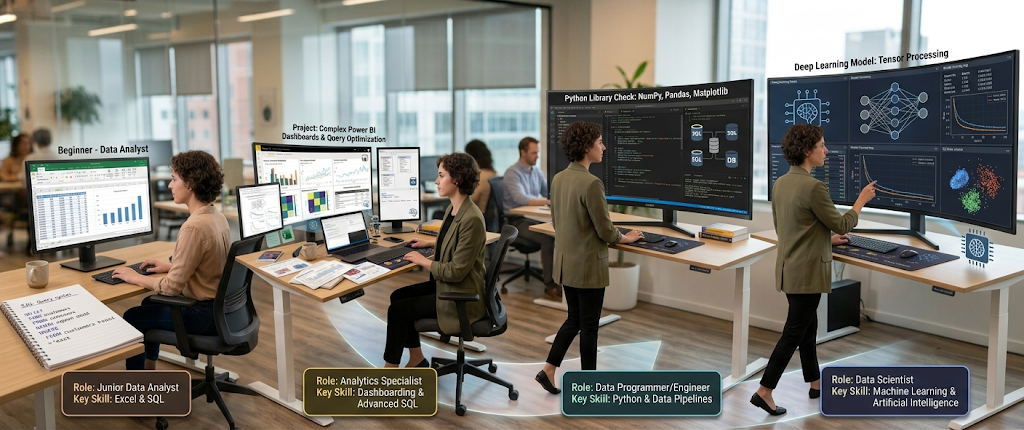
Developing a Career Roadmap (Beginner to Data Scientist)
Entry Level Stage: Data Analyst – Getting Started
The first phase in a data career involves development of practical skills and experience. Basic analytics, statistics, Power BI, SQL, and Excel are important skills to master for beginners. Developing confidence through the creation of personal projects and completing online courses, and using real datasets to practice this.
This stage is not about learning all the things, but about getting comfortable in solving real analytical problems. Many professionals start working in their profession on a junior level, as a reporting specialist or as a business intelligence assistant.
Advanced Stage: Advanced Analyst
Once having developed skills in the workplace, analysts can further their skills by studying Python, automation, advanced visualization and further statistical techniques. They should start working on more complex projects and gaining more business knowledge.
Advanced analysts may be accountable for larger data sets, generate automated reports, and offer strategic suggestions. This stage is for professionals who are looking to take the next step toward becoming data scientists.
Advanced Stage: Data Scientist
The last step is the integration of technical knowledge and the use of sophisticated analytical techniques. Programming, statistics, machine learning and business knowledge are all tools that data scientists employ to develop a solution that can predict.
Such professionals should further build their skills by conducting research, experiments, and real projects. Data Science is a constantly evolving field, and hence, learning is key.
Building a Successful Future in Data
Data Analysis and Data Science provide promising career avenues for those with a passion for technology, problem-solving, and finding meaning. The path from being a beginner to a data scientist doesn’t happen overnight, but it is possible to do it through a well-designed learning roadmap. The core competency is to start with Excel and analytical thinking, followed by SQL, Python, Power BI, business analytics and finally machine learning, which provides a solid foundation for success.
The best data pros are technically proficient and also curious, they are able to communicate, and they understand business. They are not just number manipulators—they are information users who make improved decisions to solve problems. If you’re interested in getting into the data field, it’s important to start learning regularly, practice with real projects, and slowly work your way up to becoming a data scientist. By working hard and making consistent efforts, a fulfilling data career is attainable.