Introduction
Correlation analysis in accounting and finance is very much in the business of data interpretation. We see that companies collect financial info related to sales, profits, investment, expenses, market trends, and operating costs. But that is only part of the picture. What businesses also must do is to understand how these financial variables play out in relation to each other which in turn informs better decision making. This is the role of correlation theory.
Correlation analysis is a tool which accountants and financial professionals use to determine the degree and direction of relationship between two variables. For instance a company may wish to see if there is a relationship between what they spend on advertising and sales growth, if production costs play a role in profitability, or what effect stock market performance has on investment returns. Via statistics accountants are able to present this info which in turn supports in the planning, forecasting, budgeting, auditing, and strategic decision making processes.
In finance and accounting which is a very large field of study we see that correlation analysis is a very important tool. This method enables professionals to note when financial variables are related, when they do the opposite, or when in fact they are not related at all.
Correlation theory is a base which we must have as accounting students as it is the fundamental element of financial analytics, business forecasting, and evidence based management decisions. Also we use correlation analysis to determine risk, evaluate performance, and to better improve financial planning strategies.
What Is Correlation Theory?
Correlational analysis is a statistical method which we use to determine the relationship between two variables. It is for the purpose of ascertaining that which changes in one variable are related to changes in another variable.
In the fields of accounting and finance we see:
- Revenue
- Profit margins
- Operating expenses
- Share prices
- Investment returns
- Interest rates
- Production costs
- Market demand
Correlation is not causation which means that when variables move together in a predictable pattern it does not prove cause and effect.
For example:
- If advertising expenses goes up and sales go up as well there may be a positive correlation.
- If profit goes down operational costs go up we may see a negative correlation.
- If with new uniform colors sales do not see a change, there may be no correlation.
Correlation analysis which in turn helps businesses transforms raw financial data into valuable information for decision making.
Understanding the Correlation Coefficient
The measure of how well and in what way a relationship exists between variables is the correlation coefficient which we see represented by the symbol r.
The correlation coefficient may range from -1 to +1.
Positive Correlation
A positive relationship is when two variables move in the same direction.
Examples include:
- Increased sales which in turn produce higher profits.
- Increased resources leading to greater returns.
- Rising customer demand which in turn is increasing production levels.
Interpretation
R= 1 indicates a perfect positive relationship.
R=0.8 indicates a very strong positive relationship.
R=0.3 is a weak positive relationship.
Negative Correlation
A negative association is when variables go in different directions.
Examples include:
- Rising costs reducing profit
- Higher inflation decreasing purchasing power
- Increased debt reducing liquidity
Interpretation
R =-1 indicates a perfect negative relationship.
R=0.7 is a very strong negative relationship.
R=0.2 which is a weak negative relationship.
Zero Correlation
No relationship exists between variables which report zero correlation.
For example:
- Office paint colors and annual revenue.
- Employee foot size and company profits.
Interpretation
R=0 indicates no relationship.

Types of Correlation in Accounting and Finance
Simple Correlation
Simple correlation is a measure of the relationship between two variables.
Examples:
- Revenue and advertising costs
- Profit and operational expenses
- Stock prices and interest rates
In accounting research this is the most used type of.
Multiple Correlation
Multiple correlation determines the relationship between several independent variables and a dependent variable.
For example:
A company may study how:
- Marketing expenses
- Employee productivity
- Raw material costs
Together influence total profit.
This approach gives a wider picture of financial performance.
Partial Correlation
Partial correlation is a measure of the association between two variables as we control for the effect of other variables. For example accountants study the relationship between profit and advertising which also includes consideration of inflation or seasonal demand. This produces better financial results.
Importance of Correlation Theory in Accounting
In today’s world correlation is a key element of accounting practices. We use it to analyze business data, to see patterns, and in support of strategic planning.
Financial Forecasting
Businesses apply correlation in forecasting future performance.
For example:
- History past performance in terms of sales and seasonal trends can be used to project future revenue.
- In the past we may look to past production costs as a guide for what to expect in the future.
This increases budgeting accuracy and financial planning.
Risk Assessment
Correlation study investors and accountants use to determine financial risk. In investment management we see that diversification strategies use correlation.
For example:
- Two high positive correlation investments may increase your portfolio risk.
- Investment in assets which are uncorrelated or negative may reduce risk.
This helps companies create diverse investment portfolios.
Cost Management
Businesses look at their operational costs in relation to profitability. If profit trends down production costs go up which is what management will pay attention to. Correlation analysis thus supports effective resource allocation.
Performance Evaluation
Organizations use relationships between variables to assess financial performance.
Examples of this include analysis of relationships between:
- Employee productivity and company revenue
- Customer satisfaction and profit growth
- Inventory levels and sales performance
This helps businesses improve operational efficiency.
Correlation Analysis in Accounting
Understanding Correlation Analysis
Correlation study is the term used for the analysis which determines the relationship between variables. Accounting professionals use correlation analysis for identifying financial trends and to support evidence based decisions.
The process generally involves:
- Gathering financial data.
- Organization of variables.
- Determining the correlation coefficient.
- Presenting results.
- Drawing out financial results.
Correlative analysis enables companies to base their choices on fact rather than assumption.
Methods Used in Correlation Analysis
Pearson Correlation Coefficient
The Pearson’s product moment correlation is the most used method for linear association between variables. The formula measures the variation of one variable in relation to another.
It is useful when:
- Variables are numerical
- Data follows a linear pattern
- Relationships are measurable quantitatively
Examples in accounting include:
- Revenue and marketing expenses
- Inventory costs and profit margins
- Interest rates and borrowing costs
Spearman Rank Correlation
Spearman’s rank correlation measures relationship using ranked data.
It is useful when:
- Data is non-linear
- Rankings are involved
- Variables are of an ordinal nature rather.
For example:
An auditor may rate branches by their profit and customer satisfaction which in turn may determine a relationship between two variables.
Kendall Rank Correlation
Kendall’s is a rank based method which does well for small data sets. It is used in audit and financial research.
Applications of Correlation Analysis in Accounting
Relationship between Costs and Profit
One large application of correlation analysis is looking at which costs affect profitability.
Businesses monitor relationships between:
- Production costs
- Administrative expenses
- Labor costs
- Profit margins
As profits decline and costs rise management may find that it is the time to review and reduce costs.
Revenue and Advertising Analysis
Companies report on how advertising spend impacts revenue. A large positive relationship between what is spent on marketing and sales growth which in turn may justify bigger promotional budgets. Weak association may indicate poor advertising strategies.
Investment and Market Performance
Investors perform correlation analysis on investment assets.
For example:
- In the same sector we see high positive correlation.
- Bonds and equities may trade off less.
This information is for diversification and portfolio management.
Cash Flow and Liquidity Management
Businesses also look at relationships between cash inflows, liabilities, and operational expenses. Strong tie out between liabilities and liquidity is a sign of financial instability. This is for the tracking of cash flow.
Audit and Fraud Detection
Audits perform correlation analysis to identify atypical financial trends.
For example:
- Sudden discrepancies in sales and inventory records.
- Aberrant relationships between expenses and production output.
Such issues may point out accounting errors or signs of fraud.
Advantages of Correlation Theory in Accounting
Improved Decision-Making
Correlation study results provide better financial decisions. Managers may use data to inform their strategies instead of assumption.
Better Financial Planning
Forecast which results come true is better when companies know the relationships between financial variables. This improves on accuracy of budgets and long term planning.
Enhanced Risk Management
Organizations can catch financial risks at an early stage by looking at relationships between market variables and internal performance metrics.
Increased Operational Efficiency
Correlational analysis which is used by businesses to improve their operations by identifying what causes costs and what affects performance.
Limitations of Correlation Theory
Although we see value in correlation theory it also has issues.
Correlation Does Not Mean Causation
Two variables may go together at the same time yet one does not cause the other.
For example:
Ice cream sales may go up and so does electricity use in hot weather but one does not cause the other. Accountants must therefore avoid incorrect assumptions.
External Factors May Influence Results
Economic factors like inflation, government policies and market trends which in turn play upon relationships between variables. This may distort correlation findings.
Non-Linear Relationships
Some financial relationships may not be linear. Traditional approaches to correlation may not report these complexities.
Data Quality Issues
Poor quality financial reports which are incomplete can lead to wrong results. Reliable accounting information is essential to accurate correlation analysis.
Correlation Theory and Modern Technology
Today’s accounting systems are using technology and analytics software to do correlation analysis.
Tools such as:
- Microsoft Excel
- SPSS
- Power BI
- Tableau
- ERP accounting systems
Allow accountants to efficiently analyze large financial data. Artificial intelligence and machine learning also improve on predictive analytics which is a result of them recognizing patterns in large sets of financial data. As digital transformation of the accounting field progresses correlation theory is still very much at the core of data driven financial management.
Practical Example of Correlation in Accounting
A retail company is looking at the relationship between what it spends on advertising and monthly sales revenue.
Sample Observation
- January advertising expense increases
- February sales revenue rises
- March advertising spending drops
- April sales decline
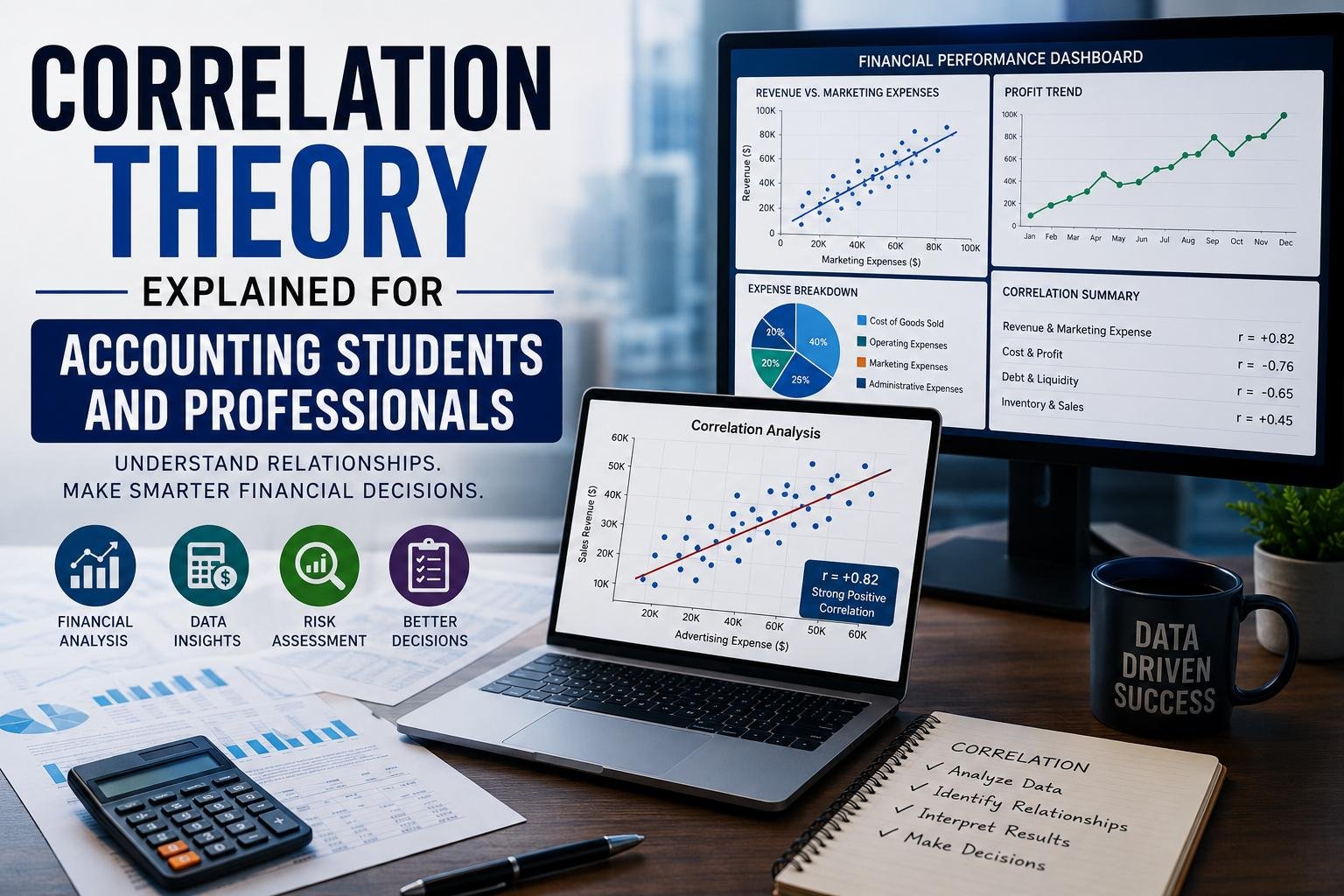
After calculation of the correlation coefficient we have r=+0.82.
This is a high degree of association between advertising and sales performance. Management may determine that marketing investment plays a large role in revenue growth which is cause for increased promotional activities.
Accounting Students and Correlation Theory
Accounting students’ benefit from study of statistical tools which include correlation theory as the field of accounting grows in its use of data analysis.
Knowledge of correlation helps students:
- Interpret financial reports
- Conduct research studies
- Analyze business performance
- Understand financial forecasting
- Improve auditing skills
- Support strategic decision-making
Employers also look for accountants which have a mix of financial and analytical skills. As companies grow in their use of data, we see that correlation analysis is a key skill for accountants.
Conclusion
Correlation is a key element in statistical analysis which accountants and financial professionals use to determine relationships between financial variables. Via correlation analysis businesses are able to study the connections between revenue, costs, profits, investments, market trends, and operational performance.
Through the use of correlation and direction of relationships organizations improve in accuracy of their forecasts, we see also that they do a better job at risk management, we see they do a better job at also at cutting costs and in which they base their strategy on fact not feel. Also we see that correlation analysis supports in large scale audit, investment decision making and performance review.
Despite that which may be put forth against it, correlation theory is still a useful resource in accounting which we use to make financial data relevant and meaningful. As technology and financial analytics are in a state of growth, what we get out of interpreting correlations will only increase in importance for students, accountants, auditors and business leaders. Understanding of correlation theory is also what we put in to account professionals’ tool kits which in turn enable them to do well in today’s financial world that is very much centered on data.
Get more well researched information about correlation analysis here.