Introduction
In present business climate organizations depend greatly on accurate financial forecasting to be competitive and profitable. Companies are always in search of reliable methods to predict future revenue, manage expenses, and assess business growth. For this purpose which is very effective companies use the application of linear regression in forecasting revenue.
Linear regression has wide application in accounting and finance which is a result of its ability to study the relationship between financial variables and support in decision making based on past data. Instead of a guesswork approach or assumption which is what we see in many cases, companies are able to use statistical data to put together budgets, allocate resources and at the same time see improvements in operational efficiency.
Application of linear regression in forecasting revenue has grown which is great for companies looking to analyze trends and improve their strategic planning. We see that by studying the relationships between variables like sales, marketing spend, production costs, and profits accountants are able to put forth forecasts which in turn support better decision making.
This paper reports on the application of linear regression in accounting which is used for revenue and expense forecasting as well as business growth. Also we see what the benefits, issues, and practical applications of regression analysis are in today’s financial management.
Understanding Linear Regression
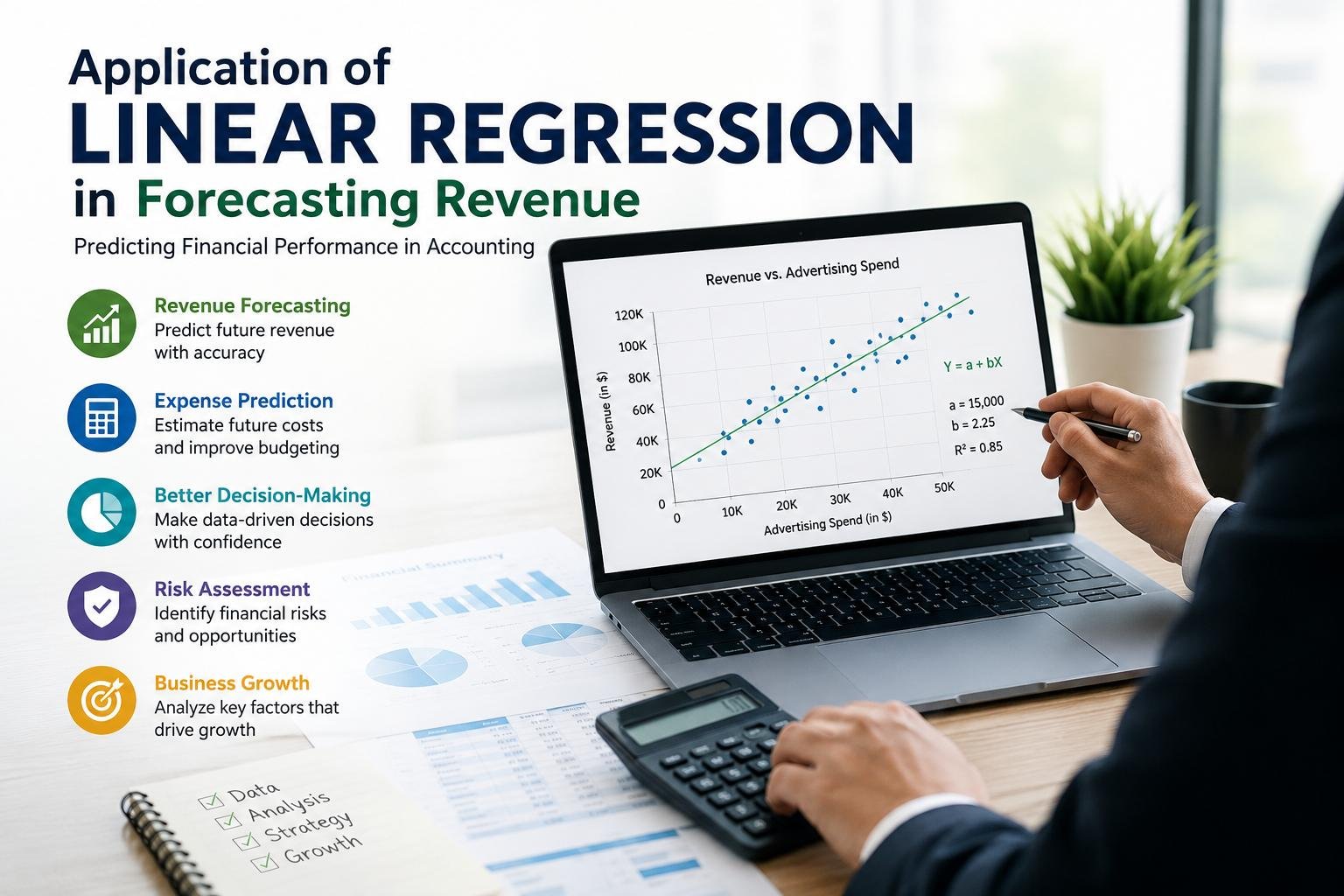
Linear regression is a statistical tool which we use to see relationships between variables. In accounting that includes how one financial element plays with another. Also it is very much used to predict future results based on past financial info.
The basic for linear regression is:
Y = a + bX
Where:
- Y represents the dependent variable
- X represents the independent variable
- a represents the intercept
b is a regression coefficient which also represents the slope.
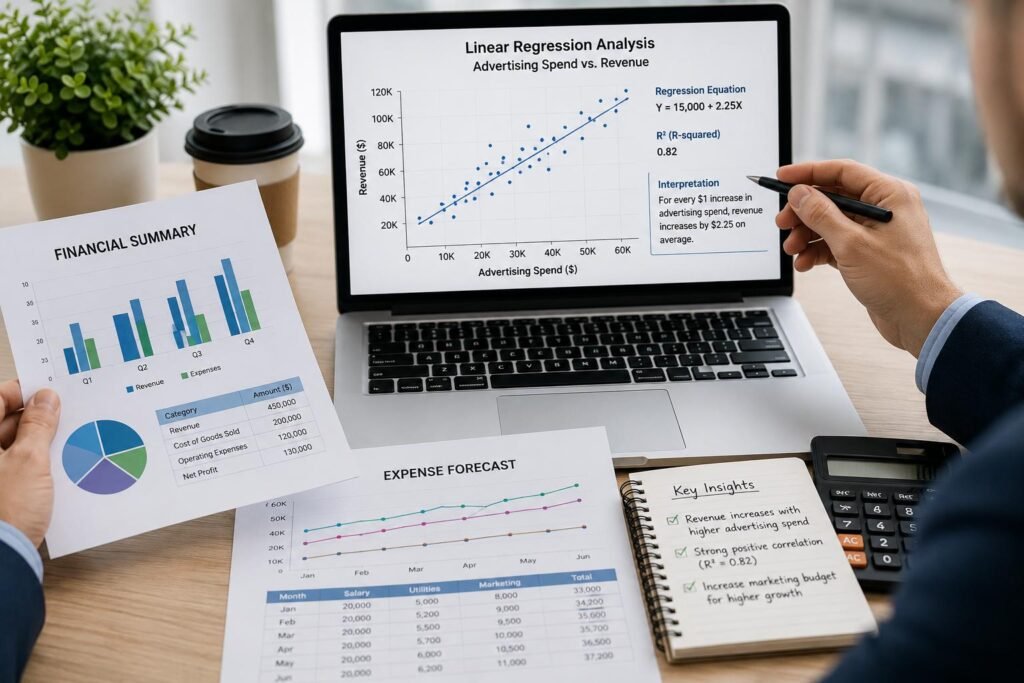
The regression coefficient reports the change in the dependent variable for a change in the independent variable. For instance a business may wish to see what the relationship is between their advertising expenses and sales revenue. Regression analysis in this case will tell us if there is in fact a direct relationship that as we put more into advertising we see an increase in sales.
Importance of Linear Regression in Accounting
Accounting professionals apply regression analysis which in turn improves financial forecasting and supports business planning. Exact forecasts which we get from regression analysis in turn help organizations reduce risk and make strategic decisions with confidence.
Improved Financial Forecasting
Regression analysis is a tool which allows companies to predict future revenues, profits, and expenses based on past financial data. This in turn improves the accuracy of budgeting and planning processes.
Better Decision-Making
Managers use regression results to determine which of the following actions to take expanding operations, increasing production, investing in marketing, or reducing costs.
Cost Management
Businesses can see which of their operations are putting out the most expense. This helps companies to identify what spending is in fact unnecessary and in turn improve efficiency.
Risk Assessment
Regression analysis is a tool which allows companies to identify financial risks and see off trend indicators that may cause large issues before they actually do.
Performance Evaluation
Organizations may use actual financial results as a check against what was projected to determine the success of business strategies.
Application of Linear Regression to Revenue Forecasting
Revenue prediction is a very valuable application of regression analysis in accountancy. Companies require precise revenue forecasts for budgeting, investment decision making, and to keep cash flow in good health. Application of linear regression for forecast purposes allows businesses to look at past financial data and also present market conditions to predict future sales.
For instance a retail company may look at the relationship between what they put into advertising and the monthly revenue. By looking at past financial reports we see that it tends to be the case that as advertising expenses goes up so does sales performance.
Using that data the company is able to develop a forecast which projects out revenue based on which we put in the advertising budgets. This also allows management to set which products to push marketing wise and what sales targets to aim for.
Revenue projection using regression analysis brings in many benefits. It which in turn improves cash flow prediction for businesses, improves inventory management, sets achievable financial targets, and we see it also as a tool to forecast market changes. Organizations which are able to accurately project revenue are better positioned to react to economic change and maintain financial health.
Forecasting Expenses with Linear Regression
Also in addition to forecasting revenue we see that regression analysis is used to determine future expenses. Companies incure a variety of operational costs which include salary, transport, utility, and production expenses. Knowing how these costs will perform is important for maintaining profitability.
Linear regression is a tool which accountants use to determine the relationship between expenses and operational activities. For example a manufacturing company may look at how power costs vary as production output goes up. If the relationship is seen to be the same across time regression analysis may be used to project future utility expenses based on planned production levels.
Expense projection allows companies to put together better budgets and see off unexpected financial issues. Also companies are able to identify expense trends and put in place measures to reduce unneeded spending.
Another benefit of expense forecasting is in better pricing strategies. As organizations put a handle on what their operational costs will be we are able to set product prices that at once include our profit margin and which also stand up to market competition. Regression analysis also supports in long term financial planning which is done through the use of forecasts for what is to come in terms of operational requirements and resource allocation.
Predicting Business Growth through Regression Analysis
Business growth is a result of many elements which include customer demand, employee productivity, market expansion, and investment activities. Linear regression is a tool which companies use to determine how each of these elements plays a role in total performance.
Companies in many cases use regression analysis to study the relationship between variables like employee training spend and profit growth, customer acquisition and sales performance, or marketing investment and market share expansion.
For instance a company may find out through regression analysis that which they can greatly improve productivity and profit by increasing what they put into employee training. From that which is reported to them the management team may decide to put more into workforce development programs.
Regression analysis is a tool for strategic planning by which businesses are able to project future growth trends. We see that this information is used to set realistic goals, allocate investment resources properly, and confidence in expansion projects. Businesses who know what is fueling growth are more likely to see long term success in competitive markets.
Varieties of Linear Regression in Accounting
Simple Linear Regression
Simple in linear regression we have one independent variable and one dependent variable. That model is put to use in study of direct relationships between financial factors. For instance a business may look at how advertising spend impacts monthly sales revenue.
Multiple Linear Regression
Multiple linear regression models that of many input variables which in turn predict a single output variable. Also this method puts forth more accurate results as it takes into account many different influencing factors at the same time.
For example we see that revenue is predicted by advertising costs, employee count, production levels, and customer demand. In present time multiple regression models are very much used in accounting as business performance is usually a result of many variables which in turn are independent.
Steps Involved in Regression Analysis
At the outset of regression analysis it is that which the financial goal is to be set. Companies must identify what they will be forecasting which may be revenue growth, operational expenses, or profit margins.
At the next step we see to it that we get out of accounting records, sales reports, and operational systems the relevant past information. For accurate and full data we aim at the quality base which in turn will support dependability of our forecasts.
After we collect data accountants determine which variables are dependent and which are independent for the analysis. We then put that data into statistical software which produces the regression equation and also allows us to see the relationships between variables.
Once we complete the analysis accountants will interpret the data to determine if there are any significant relationships. Also we will use the regression model for the purpose of forecasting future financial results. At last companies review what the forecast said against what really happened in order to determine the forecast model’s accuracy and improve it as needed.
Technology and Regression Analysis in Accounting
Technological growth has brought about the improvement and access of regression analysis for accountants. Today’s accounting software includes the tools which may process large scale financial information very quickly. Software like Microsoft Excel, Power BI, SAP, and IBM SPSS is used by companies for automated financial forecasting and improved reporting accuracy.
Technology also at its best reduces human error, we see also that is speeds up data processing, which in turn improves the accuracy of forecasting and that which also enables to do financial analysis in real time.
Artificial intelligence and machine learning tools also are improving the scope of regression analysis which in turn is helping to bring to light unknown financial trends and to improve predictive accuracy. As time goes by we see greater adoption of digital accounting systems by organizations, we see more of the use of data analytics and regression modeling in financial management.
Linear Applications of Regression in Accountancy
Application of linear regression in forecasting revenue is a popular tool in many industries for financial forecast and strategic planning. Retailers use regression analysis for identifying seasonal sales trends which in turn helps in better inventory management. In manufacturing we see that companies use this technique to project production costs and operational expenses according to levels of output.
Banks use regression models for credit risk assessment, default prediction, and interest income estimation. In the hospitality sector we see regression analysis used for demand prediction and occupancy rate projection.
Healthcare providers use regression methods to review treatment costs and operational expenditures. Also in the academic world we see regression analysis used to predict enrollment trends and budget needs. These examples show the value of regression analysis in financial decision making which is seen across many industries.
Financial Forecasting benefits of Linear Regression
Linear regression also has the advantage of accuracy. We see that which is put forth by statistical analysis in general is more reliable than what is based solely on intuition. Regression analysis is also a easy to grasp and implement concept which modern software has made possible. This makes the topic approachable to many in the fields of accountancy and business management.
Another advantage is in cost. Companies may reduce waste by identifying trends in their finance and in turn make informed budgeting choices. Regression analysis also provides strategic value by which we see relationships between financial variables that may not be present in standard accounting reports.
Improved also that we see in many cases is that of better planning. Companies which put this into practice are able to create more realistic budgets, set out doable financial goals, and in turn prepare for the next set of business issues which come up.
Limitations of Linear Regression
Although it has some great benefits linear regression also has issues. In that which we put our faith is past data. What we see in the past may not at all be an indicator of what is to come in the market.
Linear regression also has a base in a linear or straight line relationship which does not always play out in the real world of business. External issues like inflation, economic recessions, political instability, or sudden market disruptions which in turn affect forecasting accuracy.
Also, we see that which is of poor quality or is incomplete financial data produces unreliable regression results. Businesses also must see to it that their accounting info is accurate and up to date. Although we see these limitations, regression analysis still is the best method of choice in accounting and financial management.
Best Practices for Effective Regression Analysis
Businesses should present accurate and current financial data in their regression analysis. Quality data improves forecasting results and also decreases the chance of wrong predictions. Organizations also know when to choose which variables to include. Also including irrelevant variables may in fact damage the performance of the regression model. Regression models must be put out for review at regular intervals to adapt to change in business climate and market trends. Companies do well to not use out of date forecasting models for long term decisions.
In another important practice we see the use of statistical analysis in conjunction with professional judgment. While regression analysis gives us valuable information at large, human expertise is the element which still is very much in play in the effective interpretation of results. Training accountants to also do work in data analysis and statistics will also improve the quality of results from regression based forecasting.
Future of Regression Analysis in Accounting
In the years to come accounting will be very much a field of data which businesses are growing to use more of. We are to put more into analysis, automation, and artificial intelligence in order to better run our finances.
Regression analysis is still a primary tool which organizations use for forecasting financial performance and managing resources. We see in advanced analytical systems a ability to process large data sets, identify complex financial trends and report very accurate predictions in real time.
As technology progresses accountants will do well to develop stronger analytical and statistical skills in order to compete in the profession. Which companies that adopt data analytics and forecasting tech will see great success in the present which is very much a changing business climate.
Conclusion
Application of linear regression in forecasting revenue is a fundamental element of today’s accounting which is used by companies to project revenue, forecast expenses, and look at growth. Through the analysis of relationships between financial variables businesses are able to identify trends, improve budgeting accuracy and make informed strategic choices.
Regression analysis is a tool which allows companies to look beyond guesswork and into what the data says which in turn supports evidence based financial planning. We see this play out in sales forecasting, cost management, and growth analysis which all benefit from the valuable insights linear regression provides for achieving long term success.
Although we see that which regression analysis has is a it’s true that it puts some limits on what it can do, what we do find is that the benefits which it provides in financial forecasting is what in fact overcomes these issues. As accounting as a field also grows with tech development, linear regression will still be a key tool for improving financial performance and in supporting effective business management.
Get more well researched information about application of linear regression in forecasting revenue here.