Introduction
It can be fun too to keep the mind active. Brain games provide a variety of fun activities to stimulate the brain to note, remember, identify patterns, solve problems and make informed decisions. Each puzzle offers a different type of brain teaser, from number puzzles and word games to visual challenges and card arranging puzzles. Some games demand that the player is patient and makes careful calculations; others demand that the player must react quickly, but not lose their focus. These are all enjoyable activities that give mental stimulation, but should not be considered to be a substitute for a full diet of brain food. Cognitive skill enhancement and protection from cognitive decline is not guaranteed by puzzle playing. Brain games provide a low-tech and entertaining method for practicing specific thinking abilities, for doing problem solving, and for using free time as a meaningful challenge. Sanshui: Poker Puzzle 三水 is a game that particularly appeals to players who like to use logic, memory, and strategy.
How Brain Games can Challenge the Mind.
Brain games are non-competitive, mental games. They might struggle to recall a sequence, find a relationship between objects, solve a number problem or take several steps in advance. Concentration helps players focus on the information that is relevant, and working memory helps them to hold and manipulate the information temporarily. Logical thinking allows players to determine if a solution meets the rules and strategic thinking prompts them to think through the implications of their choices before taking action. There is often overlap in skills and can require multiple skills to complete a puzzle. The level of difficulty of the activity, how well the player knows the rules and the length of time available also play an important role in this experience. The attraction is that there is a problem to solve, feedback is provided and then it is found out whether an alternate approach yields a better result.
Number Puzzles and Logical Reasoning
Number puzzles are favorites among those who like some kind of structured problems having rules and measurable solutions. Players must analyze the information, look for patterns, and cross out numbers that don’t fit in the Sudoku, arithmetic problems, number sequences, and mathematical riddles. A Sudoku, for instance, requires the player to enter numbers into a grid so that each row, column, and 3×3 blocks contains no duplicate numbers. It takes concentration to solve a challenging grid, since a wrong number in one place can impact choices made in another. Players can use working memory to maintain information about possible placements, and logical reasoning can facilitate the elimination of incorrect responses. Some puzzles also require planning as a choice in one section may affect the other sections. This can be enjoyable for both novices and seasoned puzzlers. It is not always the goal to solve everything quickly, but an enjoyable way to look at clues, test possibilities, and slowly, incrementally work one’s way to a consistent solution.
Challenging the pattern and focusing on it.
Pattern recognition puzzles require the player to find sequences, repetitions, differences and/or relationships in a set of symbols, shapes, colors, or numbers. A challenge could feature a series of visuals, one of which is blank, and have the player fill in what is missing in the picture. Other activities include finding differences between almost identical images, or which object is not part of the group. It is these games that require especially high levels of visual attention as some details can make all the difference in the right answer. In addition to comparing information, players will need to identify repetition and be able to tell the difference between patterns and chance. Players might need to remember earlier elements and evaluate new elements, which can be a more demanding challenge and thus require working memory. Pattern games are a great relaxing game for those who like visual puzzles, but don’t like reading a long set of instructions. What is often hard for them to see is what seems trivial at first, and feels rewarding when the relationship becomes evident.
Word Games and Verbal Memory
Word games also offer an alternative to the mind-stretching fun of word, memory, and problem-solving. Crosswords can be used to help children understand word meanings and to identify appropriate words; word searches can be used to train children to look for words they recognize or can spot by visual recognition of letter patterns. Anagrams are games that ask players to arrange letters into words, word association games ask players to link words that have the same meaning or related by other common associations. Vocabulary, spelling knowledge, attention and working memory are used in the activity, depending on the type. If the crossword puzzle game is more challenging, it can generate several answers for the same clue before revealing the correct one, based on the words that match with the clue. Timed word games put pressure on the players because they have limited time to remember and consider choices. But fast isn’t the only thing that makes fun. Some players like games that are played informally, where they get to discover new words, and enjoy the challenge of, after careful consideration, working out the meaning of a clue.
Card Arrangement Puzzles and Strategic Decisions
Card arrangement puzzles are a variation on the problem, since the player has to think about how each choice contributes to the overall arrangement. They must arrange a number of cards to fit into a specific pattern but make sure that different sections complement each other without solving one clue. This establishes a natural link among logical reasoning, working memory, attention and planning. A card that is perfect for one part may be better suited for another; thus the players need to consider options before making their final choice. They also must recall the rules, consider the outcomes of their decisions, and not take a risk because an option seems to be a good prospect. When a puzzle presents a line of choices that leads to a solution, these puzzles can be particularly satisfying. Sanshui is a logical game, and it is a good example for those who enjoy playing with cards as a mental exercise instead of a game of chance.
Sanshui: A Card Puzzle that Rewards Thoughtful Play
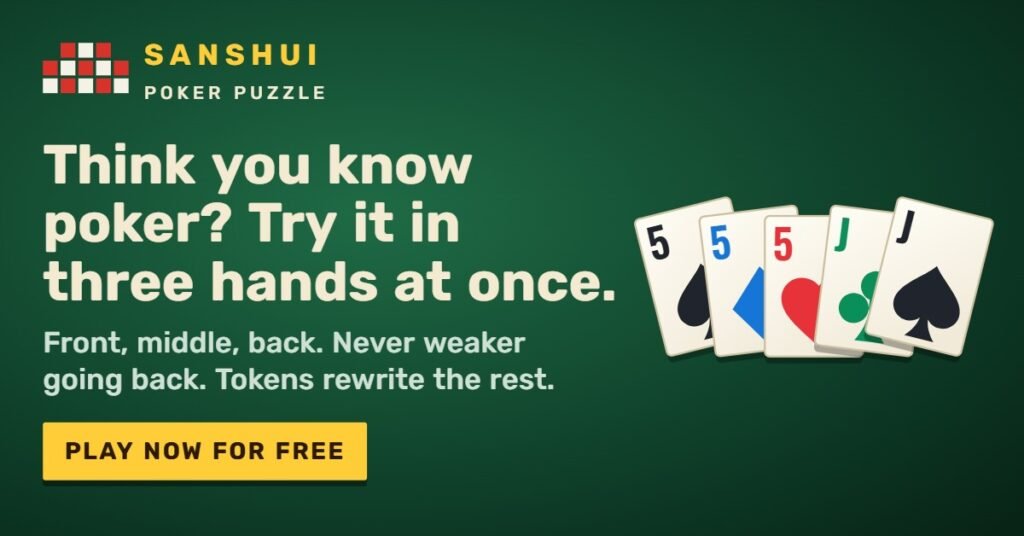
Sanshui: Poker Puzzle three water is a puzzle game of card arrangement based on logic and careful placement, and decision making. The players deal out 13 cards to make three hands, three cards at the front, five cards in the middle and five cards at the back. The challenge is to make decisions that adhere to the game’s arrangement rules; therefore, each placement needs to be evaluated by taking into account other placements. A card can both help one hand and make another more complicated, helping to create thinking outside the box for players. It’s not a game or competition based on gambling for cash. The challenge is based on a pure logic puzzle; information is provided, and the challenge is to use as much information as is possible to make the best decisions. The appeal lies in the conflict between what they want to do, and what they’re allowed to do, for those who like some structured challenge that has several interacting parts to it.
Concentration under Pressure: The Timed Challenge
The addition of a clock adds a new dimension to brain games. Players do not have to take the quickest route and takes time to think, rethink and come up with multiple solutions. Timed modes do just that; it makes everything feel more real-time. The player needs to be fast and accurate, look for the good patterns, and not let go of good thinking for speed. The timed mode, which is introduced by Sanshui, brings this kind of challenge to the game by having to win par for three stars. The goal sets a clear goal and also helps to develop interactive players through repeated attempts. It may be especially attractive to those who like to compare themselves to a set of standards. But a quick fix is not a good evidence of smarts. Skill at playing a game and practice can have a significant effect on performance. The fun is in mastering the clock along with the creative thought process that makes a puzzle fun.
Memory, Planning and the value of a Difficult Decision
There are a lot of tricky puzzles that will require the player to recall information and assess multiple possibilities. Working memory becomes particularly significant when someone is required to keep in mind the options that are available, the rule to follow, and the various solutions to compare, but not forget the big picture of what they are trying to achieve. Planning is an additional layer because actions can have repercussions other than the immediate move. For instance, with a card arrangement puzzle, a person could place a card in their hand that may limit the number of options they have for the other cards. The player needs to take the immediate benefit and the arrangement that might ensue into account. The process will allow for intentional experimentation as they make a decision, review the outcome, discuss any errors or issues, and adjust accordingly. The benefit of these activities is not that they will permanently change cognition, but that they will engage the student. A puzzle could be a good thing just because it keeps the interest of the audience and makes a problem, and when you solve it, you feel you deserve it.
Discover your Interests and Find the Right Brain Game for you.
The best brain games to play are the ones that are most enjoyable to the person. Sudoku and arithmetic puzzles are for those who are drawn to definite numerical patterns, while shape sequences and difference spotting are more appealing to those who are visual. For word lovers, there are options to explore crosswords, anagrams and vocabulary puzzles, while for people who love to check out a number of options, card arrangement puzzles might be of interest. The desired tempo should also be taken into account. There are activities that require a quiet break and timed activities that are more suited to those who like to strive towards a quantifiable goal. Problem difficulty is also a factor: If a puzzle is too easy, it won’t be very interesting; if it is too hard, it will be frustrating. Players will try them out and find out what they like. While there is no “best brain game” for everyone, fun is a reasonable motive for continuing to play after all, without every game having a measurable effect on your everyday cognitive abilities.
Explore Sanshui and Join the 5000 Club
If you’re interested in a more strategic card puzzle, Sanshui will give you first-hand experience in the challenge through the free demo. It makes for a compact but challenging problem (13 cards), and timed play can provide stress for those wishing to challenge their decision making further. Players can also chase the longest (unbroken) run, known as Presence which is shown on the leaderboard. The idea is to continually try again, taking time to understand each scenario and how much focus and planning can be transferred during a shot. Another way for those interested in the full game’s release is to join the 5000 club today. Players who join the club before the 5,000th player will be able to play the full game for free for life on release day (23 December 2026). No cost to join and is voluntary just one Google tap away. For everyone else, the full game will only be available for purchase, there will be no extra purchases, special cards or paid boosts.
Conclusion
Brain games are fun to play and are based on challenging activities that require concentration, memory, logic and planning. Number puzzles stimulate logical thinking, pattern games involve attention to detail and word games stimulate language and memory. Card arrangement puzzles combine a number of these requirements the player has to judge each decision in the context of the overall plan. While no game can guarantee to make you smarter or stave off brain decay, it can’t do a lot to diminish the satisfaction of working through a challenging problem. The greatest enjoyment is derived from selecting activities that are interesting, not expecting too much and enjoying the process as well as the outcome. Sanshui provides a unique challenge for those who love a good card puzzle, and more complex choices as they progress. Come play the poker puzzle game for free and find out where your next arrangement will lead.