Introduction
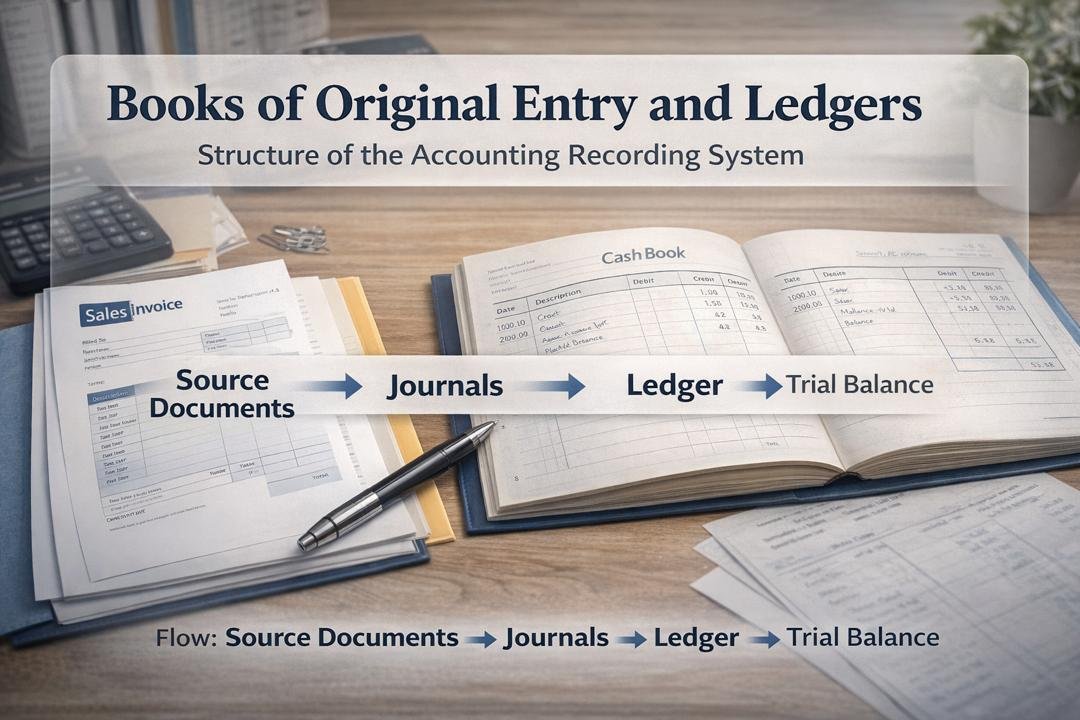
Accounting is the process of organizing, categorizing, summarizing and making sense of the financial transactions. Books of Original Entry and Ledgers form the structural foundation of the accounting recording system under double-entry bookkeeping. The core of this process is a properly structured entity called the accounting recording system. They are a combination of the foundation of the double-entry accounting system employed by companies across the globe.
The flow of transactions between the source documents into journals and final into ledger accounts is crucial in understanding the flow of transactions as a student, business owner, or accounting professional. This paper defines the main books of original entry and ledgers namely: sales journal, purchase journal, cash book, returns books and general journal and how they combine with the ledger system to provide the accurate financial reporting.
Introduction to Books of Original Entry
The initial formal records are those books of original entry and ledgers where business transactions are captured after they have taken place. All transactions have to be entered in a journal before they can be reported as being on the ledger by evidences in form of source documents.
What Are Source Documents?
A written evidence of a transaction that has occurred is known as source documents. They include:
- Sales invoices
- Purchase invoices
- Receipts
- Payment vouchers
- Debit notes
- Credit notes
- Bank statements
- Cheque counterfoils
Such documents present such key information as date, amount, parties, and description of the transaction. They are sources of evidence and they form the foundation of journal entries.
Introduction to the Double-Entry Framework
Accounting recording system is based on the principle of the dual entry books keeping. According to this principle, any transaction involves at least two accounts one debit and one credit, and that the total debits should always be equal to the total credits.
For example:
- In the case of cash sale of goods, cash gains (debit) and sales gain (credit).
- In the case of goods being acquired on credit the purchases (debit) and account payable (credit) is increased.
The journals are registered in a chronological order and the ledger is used to categorize the transactions into definite accounts.
Principal Books of Entry
The major books of entry are specific journals that were meant to document specific kind of transactions. They simplify the accounting process by putting similar transactions together and ensuring the process becomes organized and efficient.
Sales Journal (Sales Day Book)
All credited sales of goods are recorded in the sales journal. It fails to document cash sales and sales of fixed assets.
Features:
- Records only credit sales
- Based on sales invoices
- Organized by date
- Displays the name of the customer, invoice number and the installment.
Structure of a Sales Journal:
| Date | Customer Name | Invoice No. | Amount |
Example: When a firm sells products amounting to N50, 000 on credit to Mr. Ade, it is identified in the sales journal.
At the end of a period:
- The cumulative of the sales journal is recorded in Sales Account (credit side) in the ledger.
- The amounts are credited to the personal accounts of customers (debit side).
- Purchases Journal (Purchases Day Book).
Purchases journal is a journal that records all purchasing of goods, which will be resold. It does not include cash purchases and purchase of assets.
Features:
- Purchases are only credited in the records.
- Based on purchase invoices
- Arranged chronologically
Structure:
| Date | Supplier Name | Invoice No. | Amount |
Posting:
- In the ledger, total purchases will be debited in Purchases Account.
- Crediting of individual supplier accounts is done.
Cash Book
All the transactions of cash and bank are recorded in the cash book. It is used as a journal and also a ledger of cash and bank accounts.
Cash books are of various kinds:
- Single-column cash book
- Double-column cash book
- Three-column cash book
Form of a Three-Column Cash Book:
| Date | Descriptions | Discount | Cash | Bank |
Receipts are recorded at the debit side and payment recorded at the credit side.
Example:
- Cash received from a customer
- Cash paid for rent
- Cheque sent and deposited in the bank.
Cash book does not require the individual cash and bank ledger accounts to be opened since it is already a ledger account.
Returns Books
Books that are returned are classified into:
- Sales Returns Book (Returns Inward Book).
- Purchases Returns Book (Outward Returns Book)
Sales Returns Book
Registers items sent back by customers.
- Based on credit notes
- The decrease in the number of debts.
Posting:
- The entire is debited to Sales Returns Account.
- Crediting of accounts is done to individual customers.
Purchases Returns Book
Documents goods sent back to suppliers.
- Based on debit notes
- Cuts down liability to suppliers.
Posting:
- The Total is debited into Purchases Returns Account.
- Debiting of individual supplier accounts.
General Journal (Journal Proper)
Although numerous journals may be classed as General Journal (Journal Proper), they are not designated as such, the general journal registers the transactions that cannot be registered in a particular special journal.
Examples include:
- Opening entries
- Correction of errors
- Transfer entries
- Depreciation
- Accruals and prepayments
- Selling or buying of fixed assets under credit.
The General Journal is formatted as shown below:
| Date | Particulars | Debit (₦) | Credit (₦) |
Each entry includes:
- The accounts involved
- Amount debited and credited
- An explanation of the transaction in the form of a narration.
The general journal is used to ensure completeness of the accounting system as this captures all non-routine transactions.
The Ledger System
Whereas journals are the chronological documents of transaction, ledger is the account-based document of transactions.
A ledger is a set of separate accounts which represent all the transactions concerning each set.
Types of Ledger Accounts:
- Personal Accounts
- Customers
- Suppliers
- Real Accounts
- Assets (Cash, Equipment, Land)
- Nominal Accounts
- Income
- Expenses
Structure of a Ledger Account (T-Account)
Account Name
Debit Side Credit Side
Every journal entry is entered into the ledger as per the rules of double-entry.
For example:
If goods are sold on credit:
- The account of the customer is debited.
- Sales account is credited
Flow of Transactions: Source Documents to Ledger.
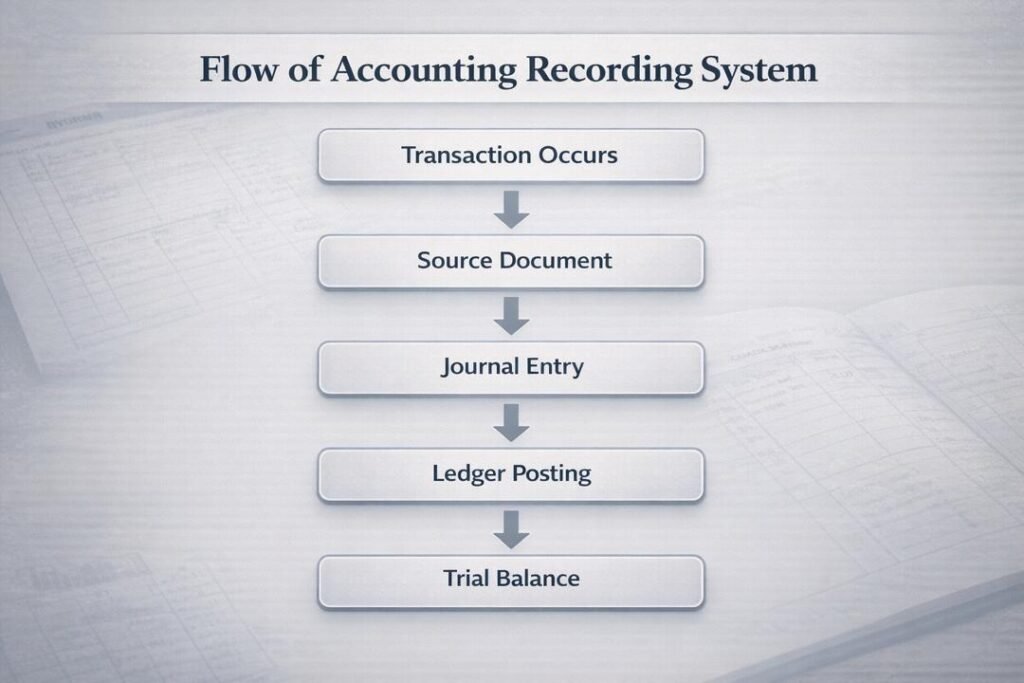
The accounting recording procedure is organized based on the following flow:
Step 1: Transaction Occurs: A business event takes place.
Step 2: Generation of Source Document: The invoice, receipt or voucher is made.
Step 3: Recording into the relevant Journal:
In one of the principal books of entry the transaction is noted:
- Sales journal
- Purchases journal
- Cash book
- Returns books
- General journal
Step 4: Posting to Ledger: The journal entries are converted into the ledger accounts.
Step 5: balancing ledger accounts: Balancing of accounts is done to establish totals at the end of a period.
Step 6: Preparation of Trial Balance: A balance sheet is drawn to ensure that the total debits are equal to total credits.
This is a systematic flow which guarantees accountability and accuracy.
Importance of the Structural Organization
The organized application of journals and ledgers has a number of advantages:
- Division of Work: Various books enable work of more than one clerk at a time.
- Accuracy: The similar transactions are pooled to minimize errors.
- Efficiency: Dedicated books make the process of recording easier.
- Internal Control: Segregation of responsibility boosts accountability.
- Audit Trail: All transactions may be tracked disparaging financial statements to source documentation.
Relationship between Journals and Ledgers
The correlation between ledger and journals can be summed up in the following:
| Journal | Function | Ledger Role |
| Records entries in a chronological manner. | First stage recording | Categorizes transactions as per account. |
| Based on source documents | Presents evidence of transaction. | Provides account summaries |
| Temporary recording | Permanent classification |
Transactions would not be chronologically documented without journals. Financial summaries cannot exist without ledgers.
Integration within the Double-Entry System
The double-entry system assures:
- Each debit is balanced by an equal credit.
- Balance of financial statements is maintained.
- Errors can be detected
The journals start the process of the two entries. The ledger finishes it by reclassifying and matching the accounts.
For example:
Transaction: Bought goods using credit of N100, 000.
Journal Entry:
- Debit Purchases N100,000
- Credit Supplier N100,000
Ledger Posting:
- Purchases Account (Debit side)
- Supplier Account (Credit side)
Such a structural organization makes sure that the accounting equation:
Assets = Liabilities + Equity always remains in balance.
Modern Adaptation in Computerized Systems
Even though paper books of entry are conventional, the contemporary accounting packages are similar and are installed digitally as well.
- Sales journals are substituted by Sales modules.
- Purchases journals are substituted with purchase modules.
- Cash books are substituted with cash modules.
- Adjustments are done in general journal modules.
Structural logic is also unchanged. It is a flow of transactions between input screens (source documents) to digital journals then to electronic ledgers.
Common Errors and Their Correction
They can be made at the different stages:
- Omission
- Double entry
- Wrong account
- Transposition
Such errors are normally corrected by making changes to entries in the general journal.
Having a well-organized system of books of original entry and ledgers will assist in the detection and correction of the errors effectively.
Conclusion
The accounting recording system is well organized with the books of original entries and ledger. Sales journal, purchases journal, cash book, returns books and general journal are specific accounts of transactions captured in systematic manner. These journals are supported by source documentations and they chronologically record business activities.
Based on the journals, transactions are recorded to the ledger, and they are associated to specific accounts within the framework of the double entry bookkeeping. Accuracy, accountability and financial transparency are ensured in this process.
The flowing nature of transactions between source documents, journals, and finally the ledger accounts allow one to better value the more organized nature that is the basis of financial reporting. Regardless of whether it is stored in paper-based form or in digital form, the system is the backbone to the proper accounting practice.
Get more well researched information about the books of original entry and ledgers here.