Introduction
Double-entry bookkeeping is the building block of modern-day bookkeeping. This is a concept that you need to understand before you learn to make journals, ledgers, financial statements, or accounting software, regardless if you are a student, entrepreneur, freelancer, or aspiring accountant. Each transaction involves a minimum of two accounts and double entry bookkeeping makes sure that the impacts of the transaction are accurately recorded. This system is in use for centuries due to its ability of maintaining accurate financial records, error detection and complete financial position of a business. If not, businesses would be unable to draw up accurate financial statements, assess their performance, or meet accounting standards. Ever wonder why accountants have to use the terms “debits” and “credits” Want to know in plain English exactly what they mean. At the end of this article, you will understand the concept of ‘double entry bookkeeping’, why all transactions have to be double entered, how it works and why it is the bedrock of accounting in today’s digital world.
What is Double Entry Bookkeeping?
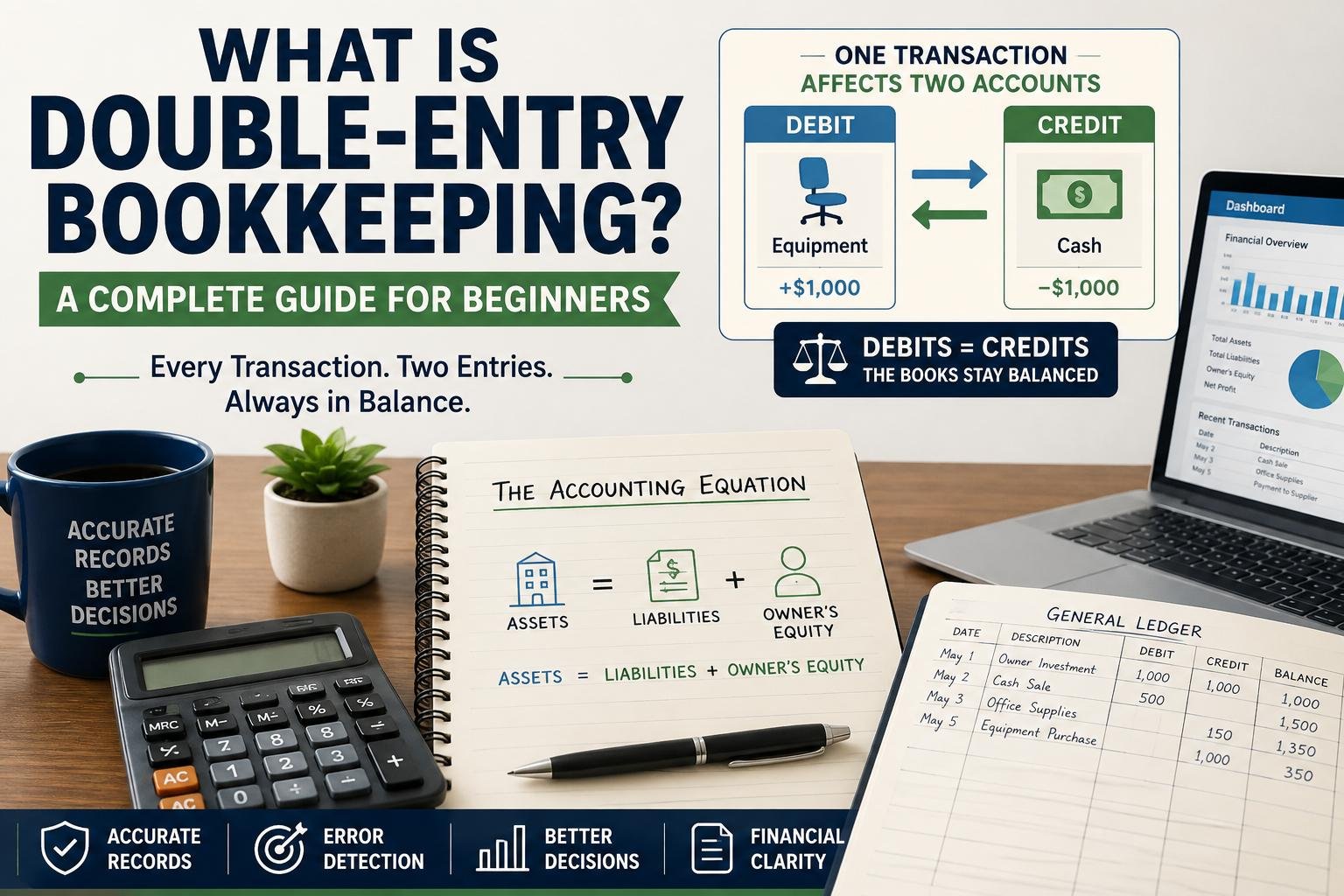
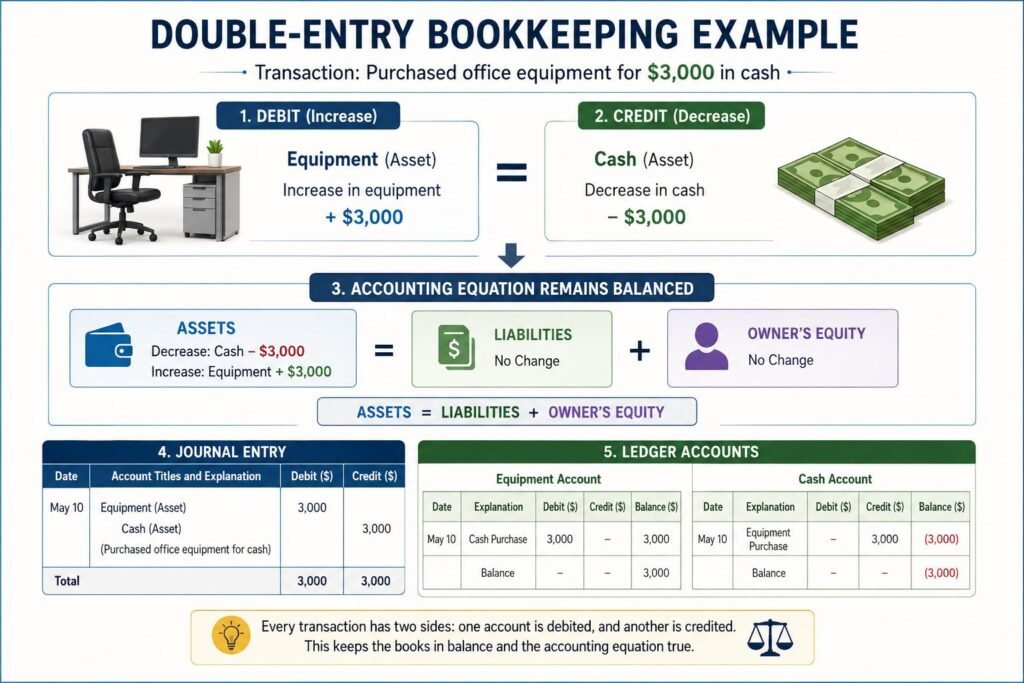
Double entry bookkeeping is a system of accounting where each financial transaction impacts on two or more accounts. One of the accounts is credited and the other is debited the same amount. This will keep the accounting equation in balance at all times. The amount of cash in a business account decreases by the same amount as the equipment is added to that account, for example, when the cash is used to purchase equipment. Each transaction will have equal and opposite effects so the total value of assets and liabilities and owner’s equity will remain in balance. This doesn’t necessarily mean that you have to double book every single transaction, but it’s not quite that simple either. The objective should not be not to duplicate; it should be to record all the financial events from both sides to ensure that the accounting records are fully and correctly documented. If you’re interested in learning more about what is double entry, you will need to understand this balancing principle first because this is a good introduction into why accountants say every debit must have an equal credit.
Bookkeeping System of Double Entry
Financial transactions were recorded for thousands of years, and double-entry bookkeeping as it is known today is a product of the development of international trade in medieval Europe. As business grew in complexity, it became important for merchants to have a more reliable method of keeping records of purchases and sales, debts and profits. The breakthrough was in 1494 when bookkeeping was documented in a book by the Italian mathematician Luca Pacioli, which described how merchants in Venice were using the methods of bookkeeping already in use. For this publication, Pacioli is known as the “Father of Accounting.” He was not the originator of double entry bookkeeping but he clearly recorded the rules and they spread throughout Europe and later the world. With the growth of business in the Industrial Revolution and later, with the advent of globalization, businesses of all magnitudes embraced it because of the ability to generate accurate financial data. Even though cloud accounting software, automation and other innovations has come since that time, the core principles haven’t changed all that much, making this accounting method and approach still as valuable today.
Purpose of Double-Entry Bookkeeping
For many businesses, double-entry bookkeeping has not yet caught on; before the era, cash in and cash out was the primary focus of many businesses’ records. This was easy for very small business operations, but challenging for large businesses to detect errors, fraud and to understand the actual financial status of a business. Merchants required a method to keep a record of assets, liabilities, revenues, expenses and owner’s equity. What double-entry bookkeeping did was that it made it so that each transaction would affect more than one account of the same value. The balancing mechanism helped to maintain accurate records, create financial reports and gain insight into the impact of every business decision on profitability and financial stability. With the development of trade, lenders and investors also required reliable financial information before lending or investing. The double entry system of bookkeeping was adopted in preference to the single entry system as it gave clear accounts, which could be checked from outside. The practice is still very much in use today, thanks to its accuracy and responsiveness in terms of accountability that is necessary for good business administration.
Core Principles of Double-Entry Bookkeeping
Several fundamental principles are the keys to the success of double-entry bookkeeping, which must go hand-in-hand to ensure that financial records are kept accurate. This principle is that there are at least two accounts involved in every transaction. But no financial event can be recorded separately as there is always a source and a destination of value. Another fundamental is that every transaction affects both the assets and the liabilities of a company and the accounting equation will always hold true, meaning that total debits will equal total credits. The structure of all bookkeeping entries is based on the accounting equation: Assets = Liabilities + Owner’s Equity. Further, all transactions should be documented with proof like receipts, bank statements, contracts, etc., to ensure that the records are accurate and verifiable. Another accounting principle is consistency, which refers to the need for consistency in accounting practices over time. These principles, combined, can form a reliable system for businesses to report accurate financial information, and minimize the risk of errors or wrongful activity.
Understand what Debit and Credit are.
The most difficult thing for beginners is to comprehend debits and credits. These terms have nothing to do with the inflow or outflow of cash in the business. Rather, they explain the effects of transactions on various accounts. Debit is used for asset and expense accounts to increase the account while it is used for liability, equity, and revenue accounts to decrease the account. A credit has the exact reverse effect: it is an increase of liabilities, owner’s equity and revenues and a decrease of assets and expenses. Some new players can get confused since the different types of accounts are affected differently by debits and credits. The best way to deal with this problem is to remember the accounting equation, and not the rules, without understanding what they are. After knowing the characteristics of each account category, recording transactions becomes easy. While the software does this automatically, it is important to know how the calculations work, since software isn’t going to substitute for accounting knowledge when it comes to reviewing reports or pinpointing errors.
Accounting Equation as a fundamental Principle
The double entry bookkeeping system has the accounting equation as its basis. It is the accounting equation which reads Assets = Liabilities + Owner’s equity. Assets are what the business owns, such as cash, inventory, equipment and buildings. Liabilities are sums of money that the business owes to others, for example, loans or unpaid supplier bills. Owner’s equity is the net worth of a business after subtracting the debts from the business’s assets. This equation must be kept true for all transactions that are entered into the accounting books using double-entry system. For instance, if a business buys inventory on credit, that inventory is added to the business, and so, too is the corresponding increase in accounts payable. Increasing capital in the business by the owner adds both cash and owner’s equity. The accounting equation thus serves as an inherent check on the correctness of the accounting as any discrepancy typically means a transaction has been mis- or under recorded.
Understand the Principles of Double Entry Bookkeeping.
The procedure starts whenever a financial transaction is performed. First of all, it is identified and backed up with a receipt or invoice. Then the accountant identifies the accounts that are impacted and if they should get debited or credited. It is then entered into the journal, and then moved to the book of accounts (the ledger), where all of the transactions for each account are recorded. After all transactions are posted a trial balance is prepared to verify that the total debits are equal to the total credits. The trial balance will be the same if the business can prepare financial statements with increased confidence. If it does not balance the accountant will go through the books to see if any mistakes were recorded before preparing the financial statements. It is a systematic process that will help keep track of accurate records and give the business owners, investors, lenders and regulators a lot of useful information about their business.
Practical Examples of Bookkeeping System of Double Entry
Illustrations can be helpful to understanding a concept more than a definition. Assume that a businessman puts in $20,000 to finance a business. The asset, Cash, is increased by a debit of $20,000 and the owner’s equity is increased by a credit of $20,000. Later the business buys office furniture for $3,000 in cash. The $3,000 of office furniture is added to the assets and cash is subtracted from the assets by $3,000. When the company sells a $1,500 worth of products for cash, cash is increased by a debit entry and the sales revenue is increased by a credit entry. Likewise, paying rent will be a decrease in cash and a rent expense. In each example there will be two accounts involved, debits will equal credits, and the accounting equation will be balanced. The above illustrations make it clear that double entry bookkeeping is no more a theoretical system but a truly practical method of keeping the books which not only keeps a true record of business transactions but also enables the business owner to gain a clear understanding of transactions.
Importance of Double Entry Book Keeping
Double entry bookkeeping is crucial in the financial management of companies and their decision making process. The fact that each transaction is balanced makes it easier to identify errors than with simpler bookkeeping systems. This reliability increases investors, lenders, tax authorities and business owners’ trust in financial statements for key decisions. Good bookkeeping can also enable businesses to track their profitability, manage their cash flow, control their expenses, and plan their growth. Properly maintained double entry accounting records during auditing will afford evidence to support the financial information reported, thereby minimizing compliance risks. This system is the basis for the accounting standards in use today, including international accounting standards, as it always produces reliable financial statements. Double entry bookkeeping is a valuable system for financial records that any size business can implement early in their growth, to create a discipline and improve the value of financial records as operations grow.
Two Main Methods of Bookkeeping: Double-Entry and Single-Entry.
The distinction between single entry and double entry bookkeeping can help you to understand why businesses eventually make the switch to double entry bookkeeping. Single entry bookkeeping only records one-half of the many transactions it involves and takes a narrow view of cash movements. This method is suitable for a person or very small business that has a straightforward financial transaction, but will not give you much information and making mistakes will be hard. The double entry accounting system, on the other hand, accounts for both sides of any transaction, providing a comprehensive record of the finances. It enables to prepare balance sheet, income statement and cash flow statement and gives enhanced internal controls. For most businesses that are looking for loans, investors or meet with financial reporting requirements, double entry bookkeeping is the most ideal way to keep books accurate and transparent than single entry bookkeeping.
Most Common Mistakes
For some people, the first time they encounter the terms debit and credit, they think that debit equals plus and credit equals minus, which is incorrect. Others do not record a transaction on both sides, thus unbalancing the accounting equation. Another frequent error is the selection of the wrong accounts in the bookkeeping process in which transactions are recorded such as recording an expense as an asset or recording an owner’s equity as a liability. In the event of a dispute, beginners will also struggle to substantiate transactions later on as they may have overlooked important supporting documents. Not knowing the principles behind the accounting process, and merely relying on accounting software another common mistake since software only logs what they tell it to log. Understanding the underlying principles of double entry bookkeeping can help to avoid such errors and boost confidence in dealing with financials.
The use of Double Entry Bookkeeping in the Modern world
In spite of the rapid rate of technological, AI and cloud accounting software development, double entry bookkeeping is as relevant as ever before. While all of these accounting systems use the same double-entry principles that were established centuries ago, they’re all automated and can perform journal entries, balance accounts and create financial reports in seconds. No matter how high-tech the software becomes, businesses will still require well-balanced records, trustworthy audit trails and accurate financial statements. Business owners, auditors, financial analysts, and accountants still use this system due to its consistency, accountability and transparency. The knowledge of these can also give users a leg up in detecting software problems, critically examining financial statements and discussing the matter with accountants. While bookkeeping has been made easier through technology, it hasn’t taken the place of the framework that allows for accurate accounting.
Conclusion
Double entry bookkeeping is more than just a bookkeeping technique; it’s the backbone of accounting today. This way, each financial transaction is recorded in at least two accounts, and all debits and credits will balance out. This will keep the financial records accurate, balanced and reliable. Although its history dates back centuries, its principles continue to be at the core of accounting software applications, financial reporting standards and business decision-making processes today. Double entry bookkeeping is a useful and important concept for beginners as it enables them to fully comprehend the journals, ledgers, trial balances and financial statements with ease. The reason for every transaction having two entries is explained and thereafter the rest of accounting becomes easy to learn. The first step you can take in your business is to learn double-entry bookkeeping, whether you’re aiming to start a business or gain a good understanding of accounting and finances for your career.
Get more well researched information on What is double entry bookkeeping here.