Introduction
There are all sorts of decisions to be made when starting and expanding a business, but one of the most crucial is selecting the accounting system. Most of the business owners start out with a simplified way of tracking income and expenses, thinking it will be their only way of keeping track. This could be good for a business at the beginning, but businesses eventually need to have more detailed financial information to enhance profitability, control costs, gain investor interest and facilitate business growth. If the accountancy system you pick is incorrect, then business owners can make important decisions when they are in short of information, which can cause poor budgeting, cash flow issues, pricing problems, and growth lag.
The silver lining is that a business doesn’t have to use all of the accounting systems on the first day of business. The needs of the business in different stages of development are different, both in terms of scope and level of financial information. Compliance and reporting is built on the basis of financial accounting. Cost accounting assists the business to know the true cost of the goods and services. Management accounting takes this one step further by providing internal reports, forecasts and performance analysis to aid in strategic decision making. Knowing which system to use when helps business owners to invest in the appropriate systems when they need them, and when they don’t. This guide features an explanation of the differences between financial accounting, cost accounting and management accounting, and how small businesses can incrementally move from one to the other as they scale.
Three Main Accounting Systems
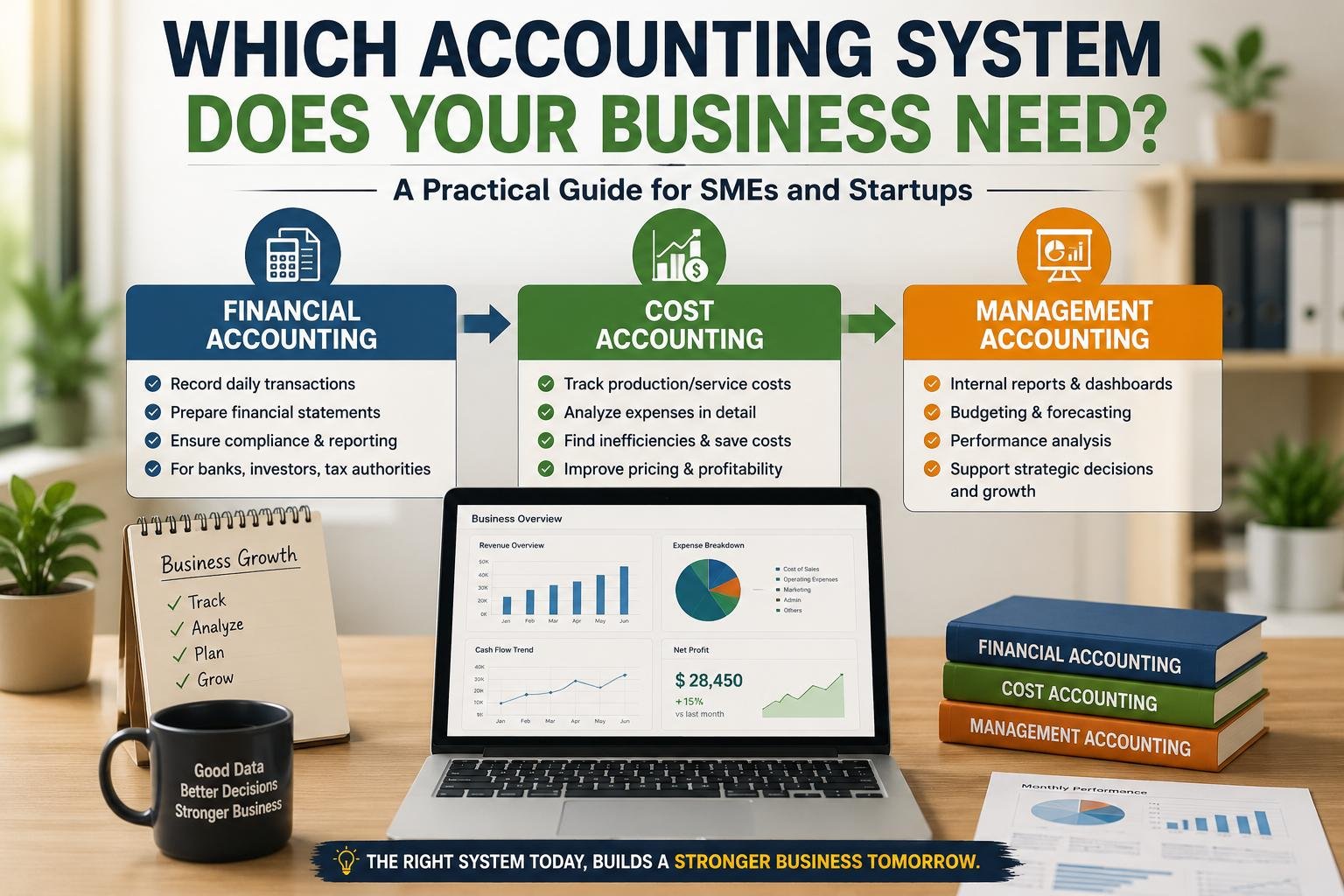
Before an entrepreneur can determine which accounting system will be right, he or she should have a basic knowledge of the role played by each of the accounting systems. Financial accounting, cost accounting, and management accounting are similar with different scope of solving business problems. Financial accounting emphasizes is the recording of business transactions and the preparation of a set of standard financial statements for external users. Cost accounting involves the measurement and management of production/service costs. Information from both of these systems is used by management accounting to guide managers in making decisions about business. They complement each other to form a full financial management system, but are not necessarily equally critical in the same phase of business development. Understanding these disparities enables the business owner to not develop too simple a system or a system that is too sophisticated for the level of operations they currently have.
Financial Accounting
Financial accounting is the first step in all businesses, no matter how big or small they are, and no matter the business’ industry. It processes financial transactions of the business on a daily basis and records them before they are consolidated into financial statements such as an income statement, balance sheet and cash flow statement. These reports are useful to an owner to determine if the business is profitable, as well as to comply with legal, tax and regulatory demands. Financial accounting reports are heavily used by banks, investors, tax authorities and lenders; they are prepared according to accounting standards which guarantee consistency and reliability in accounting reports. Even if you are self-employed and just running a product selling website, it is important to have proper financial records as this will make filing taxes easier, keep track of your cash flow, and give you a record of the performance of your business for loans or grants.
When Financial Accounting Is Enough
In the initial phase of business activity many startups and micro-businesses can get by with financial accounting data. For a small consulting firm with just one person, a freelance designer, a digital marketer or a local retail shop, the financial activities are typically simple, and they’re engaged in for the most part to track income and expenses. They are mainly interested in keeping records, paying taxes properly and checking bank accounts as well as checking the profit and loss. This stage, it may not be worth the additional expense to invest lots of resources in a sophisticated management reporting or elaborate costing system. The business owner can then get on with developing their customers, refining their products and keeping their finances flowing rather than dealing with financial accounting for compliance and simple financial monitoring.
When Financial Accounting is proving to be Inadequate
As the business expands, new problems arise which are not adequately addressed by financial accounting. Once business grows, questions start to arise that cannot be answered from the traditional statements. They may ask themselves why they are not making as much profit on their sales as before, which products are most profitable, are their labor costs too high, who are their most profitable customers and much more. While financial accounting reports tell how well the overall business is doing, they are not likely to give enough detail to answer these questions. In the absence of multiple product lines, employees, and inventory, businesses can get by with only financial accounting, and make decisions based on assumptions. Once this occurs, it is more of a need than an option to add more accounting methods.
Introduce Cost Accounting to Control Expenses.
With businesses going beyond simple financial reporting, it is important to have a grasp of the actual cost of business operations. This is where cost accounting comes in handy. Cost accounting is different from financial accounting, which concerns itself with reporting historical financial performance, as it concerned with the cost of goods or services produced. It can include factors like raw materials, labor, and overheads in the factory, utilities, equipment depreciation, and administrative expenses. These costs are separated and analyzed to give the business owner a greater depth of understanding about profitability at product, service, department or project level. Rather than just finding out if the business made a profit in total, they can find out exactly where profits are made and where unnecessary expenses are reducing the profit in the business.
Signs your Business Needs Cost Accounting
There are a number of warning signals that any business should consider implementing cost accounting. A common sign is when the profit margin dips and dips while the sales figures remain the same. A second is when managers do not know how to price competitively because they are unable to estimate the production costs. Cost accounting can be very beneficial for manufacturers, restaurants, construction firms, bakeries, tailoring services, logistics companies and any other services that have substantial labor expenses, as they are very dependent on their operational costs. Companies facing increases in inventory costs, material waste, production inefficiencies or supplier increases are also in need of detailed cost information to find opportunities for improvement. If no cost accounting then owners might be selling products too cheaply, they might be spending more than necessary on producing the product, or they may be producing products that make little contribution to the overall profitability.
Cost Accounting is Beneficial for SMEs
Cost accounting has certain practical benefits which directly affects the working of a business. It enables business owners to see where they are wasting money, how they are doing it, how well their suppliers are working, how to use their stock more efficiently and how to price their products properly. The managers can compare actual production costs to what they would expect and find any sources of production that are not working out as planned to prevent financial issues. Cost accounting can also aid budgeting by offering realistic forecasts of production costs for the future and help in negotiations with suppliers on the basis of a detailed cost analysis. Business owners can make informed decisions instead of depending on their intuition to make their business more efficient, by having some financial proof. These insights can generate instant savings by cutting down on costs and at the same time, it can help ensure business profitability in competitive markets.
Management Accounting: Getting ready for growth.
Management accounting is the next phase of the financial development of a business. Financial accounting is required by external reporting purposes; cost accounting, on the other hand, will increase the efficiency of operations; but management accounting will help managers make decisions for the future of the business. It integrates finance, operations, market, budgets, forecasts, performance indicators and strategic analysis in reports which are only available for internal use. Because they are developed specifically for planning, decision making, performance evaluation and the growth of the business, they don’t follow accounting standards. Management accounting is about making financial data from the past useful, and helping to decide on future business strategies rather than just past decisions.
When Management Accounting is Necessary for Your Business
Management accounting is typically implemented in a business when they no longer have the capacity to manage the business using a simple set of financial statements. This may be due to the fact that companies that start up in various locations, launch new product lines, employ departmental managers, seek investors, apply for large amounts of funding or expand internationally need more complex information than financial accounting offers. The following are the functions of management accounting that help in the budgeting and forecasting, performance measurement, risk assessment, capital investment decision, and strategic planning. It helps business leaders to understand the various scenarios before taking important decisions and reduces uncertainty and improves the allocation of resources. Management accounting is a vital tool for sustainable growth and is essential to growing business because it promotes planning before reacting to problems.
Understanding the Role of an Investor and the Management Accounting
Historical financial statements are not the only basis on which investors and lenders make decisions to invest and lend. They are looking for proof of leadership insight into the business, effective monitoring and sound growth strategies. Management accounting provides you with numerous reports that investors look for such as cash flow forecasts, financial projections, key performance indicators, profitability analysis, departmental performance reports and strategic budgets. The reports show that management is planning for future growth, not just a report of sales and transactions. Companies that have a robust management accounting system seem well-managed and financially disciplined, and better able to manage the investment capital. Therefore, management accounting plays a crucial role in enhancing the credibility of a company in the fund-raising, mergers, acquisition and strategic partnerships.
How to Compare the Three Accounting Systems
There are three types of accounting financial accounting, cost accounting, and management accounting, all of which have financial information, but have different purposes and users. The major purpose of financial accounting is to provide accounting information for external users in the form of a set of standardized financial statements, which are required by law and regulations. Cost accounting helps operational managers because it aids in analyzing the costs and improving efficiency in the production process. Management accounting is used by senior management to aid in planning, forecasting, budgeting, investment analysis and decision making. These systems work in conjunction, not in place of, one another. In financial accounting, the financial data is produced in a reliable way, in cost accounting the accounting results are analyzed and in management accounting the financial and accounting results are converted into actionable business intelligence. When these systems are integrated, they can be most valuable to businesses.
Choosing the Appropriate Accounting System for the Various Types of Businesses
The business complexity is not the only factor to consider when choosing an accounting system, it should also be based on a company’s age. Because operations are relatively simple, financial accounting can be used and a consultant can be a success for several years with only one customer. But a startup manufacturing company with an explosive growth rate can need cost accounting within the first year, as production costs can make significant impact on profitability. The more departments get added to the expanding organization, the more important management accounting can be in coordinating departments, managing budgets, evaluating investments, and facilitating growth in the business. Business owners need to periodically review if the accounting information they have is actually addressing the questions that they have to answer everyday. When vital decisions are made based on a hunch or uncertain financial information, it’s probably time to upgrade the accounting system.
Practical Roadmap for SMEs and Startups
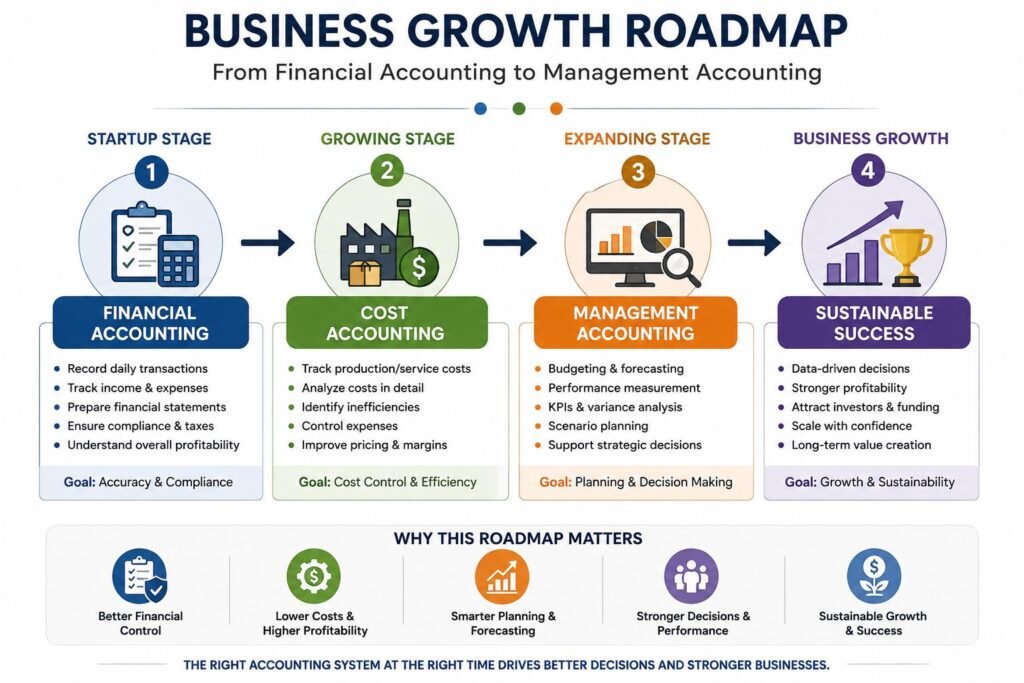
Developing an accounting system should be a continuous process, and not a huge one-time investment. At the startup phase, companies should also have correct financial accounting systems in place that are supported by a good accounting software and they should keep a proper accounting record of all the transactions. As the operations grow more complex, cost accounting should be implemented to keep track of production costs, to make better pricing decisions and to find out operational inefficiencies. Last but not least, companies that are in the process of rapid expansion, external investment or scaling up should adopt management accounting procedures that help with budgeting, forecasting, strategic planning and performance measurement. This sequential process allows the company to avoid the unnecessary expenses and provides it with a way to keep financial information growing along with the business. It doesn’t force the implementation of too much complex system for small businesses, but instead provides space for accounting functions to grow according to the increasing needs of the business.
Common Errors-What not to do
Small business owners often either postpone upgrading their accounting systems, or they use more sophisticated accounting systems than they really need. But, if you wait too long, you will find that you are making poor pricing decisions, incurring unnecessary costs, having budgets that are not correct, and may not have good financial planning. The other way around, however, is that if the business has not yet generated enough operational data, complex management accounting systems can be introduced but will not provide any real value for the business. The other common error is to consider accounting as a compliance tool to tax authorities and not as a strategic management tool. Companies that consider accounting as business intelligence are better equipped to make decisions as they are not only aware of the financial events, but they also know why these events occurred and how they could be done better in the future. By regularly checking accounting requirements, financial systems can be kept in sync with business goals all through the business’s development.
Conclusion
All businesses need financial information to be accurate, but the kinds of information needed vary depending on the size of the business. Financial accounting forms the base – it records transactions and generates reliable financial statements that are required for compliance and reporting. As business operations grow and costs get more complicated, cost accounting gives business owners more details to manage costs, determine pricing, and boost profits. As businesses start to grow aggressively, appeal to investors and start running different departments, Management accounting becomes essential to support Planning, Forecasting, Budgeting and Strategic decision making. Entrepreneurs need not ask themselves which accounting system is best and most universal, but which one is best for them in their present developmental stages. Strategically applying the right accounting technique at the right time can empower SMEs and startups to enhance their financial management, make better decisions, and establish a more solid foundation for future success.
Get more well researched information on which accounting system does your business need here.