Introduction
Real Estate Investment Trusts (REITs) have made real estate investment a little more possible as they enable people to invest in income producing properties without the need to buy buildings. But blockchain technology is now offering new opportunities to keep financial assets and interests recorded, transferred and handled. With tokenized real estate, real estate rights can be tokenized onto a blockchain, which enables investors to have fractional ownership and access more efficient real estate transaction systems. While tokenization and REITs aren’t identical, their principles could work together in some investment strategies. To understand this relationship, it is necessary to understand the working of blockchain, the changes brought by tokenization, and the potential of these technologies to enhance real estate investment without the introduction of legal, financial, or security risks.
Real Estate and Blockchain Technology: How Does it Work?
Blockchain is a system of digital record-keeping that records transactions in blocks of data that are chained together and stored on a network of computers. Based on the design, the network can make it difficult to modify the records without authorization or consent to its rules. In the real estate market, blockchain can be used to store data on digital assets, transfers and some real estate market activities regarding ownership. Certain parties can rely on a common database for the information, rather than having to access various party-specific databases. This can enhance communication between investors, administrators and other investors who provide services. However, the blockchain does not clearly demonstrate that the record of ownership is the property right. There may be cases where the official land registry, corporate records, contractual agreements, and laws still establish the legal owner or the rights to the income from an asset.
Real Estate Tokenization
Real estate tokenization is the process of creating digital tokens that represent various elements of real estate ownership, such as financial claims or legally-defined rights. If, for instance, the commercial property’s worth is $2 million, it could be linked to 200,000 tokens, each of which could have a specific economic interest worth $10 when they are first issued. This illustration is not intended to imply that all tokens are direct shares of ownership of a part of the building. Tokens may be, for example, shares of a property holding company, interest in a fund, a debt claim or a contractual right to a certain income, depending on the legal form. Some investments may allow for tokenization to lower the investment threshold and simplify ownership transfers digitally. The actual value of the token, its investor protections and rights, however, will vary based on the offering documents and relevant securities and property laws.
The Possibility for Blockchain and REITs to Work Hand-in-Hand
REITs are generally used to pool capital from investors in order to acquire, manage, and/or finance income generating real estate. Generally, investors do not own individual buildings; instead they own shares of the trust or company. These structures could be made more efficient with the use of blockchain to record eligible share transfers, to keep digital shareholder records or to assist with some administrative processes. For instance, a REIT could offer up compliant digital securities that would reflect the shares in its investment vehicle, as long as the structure meets the corporate, securities and custody requirements. This would maintain the separation of ownership of REIT shares and direct ownership of property and, at the same time, modernize the way in which investments are administered. Tokenization would not be a change in tax treatment or distribution or governance requirements for a REIT. Those attributes would remain subject to its legal status and the place in which it does its business.
The Advantages of Tokenization for REIT Investors
The Ability to Own or Access Fractions
The advantage of tokenization is that it can be broken down into smaller digital pieces of investments that are eligible for tokenization. Real estate investments can be expensive, especially for those who invest directly in real estate or join private real estate funds. Depending on minimum investment requirements and/or offering limitations, tokenization of securities may provide an avenue for investors, who are qualified or eligible, to purchase smaller, shares in select property investment offerings. This might provide more opportunities for investors who previously have not been able to participate. But fractional ownership does not mean that there is no risk in investing, that it is necessarily affordable or that it is open to everyone. Issuers should also take into account that is eligible for the investment, the transaction costs, the minimum investment size and relevant legislation. With smaller units of investment comes more flexibility; however, it is not necessarily a better investment or a way to insure the investor against fluctuations in the property market.
Enhancement of Transparency and Transaction Records
Blockchain can also enhance the transparency and uniformity in investment records. Authorized participants, on one platform or another, might be able to validate the transfer of tokens, check transaction trails, and verify relevant details concerning digital securities. A shared record would eliminate discrepancies between databases; make reconciliation easier for administrators dealing with a large number of investors. This can help REITs with more efficient shareholder record-keeping and have better audit trails for eligible transactions. However, the transparency will be determined by the type of information that is actually captured and who can access it. A blockchain can demonstrate a token’s transfer from wallet to wallet but it cannot establish the validity of the underlying property valuation, or the correct reporting of rental income or the issuer’s disclosure of all material risks. Good reporting, independent audits and good governance are always necessary.
Smart Contracts and Administrative Efficiency
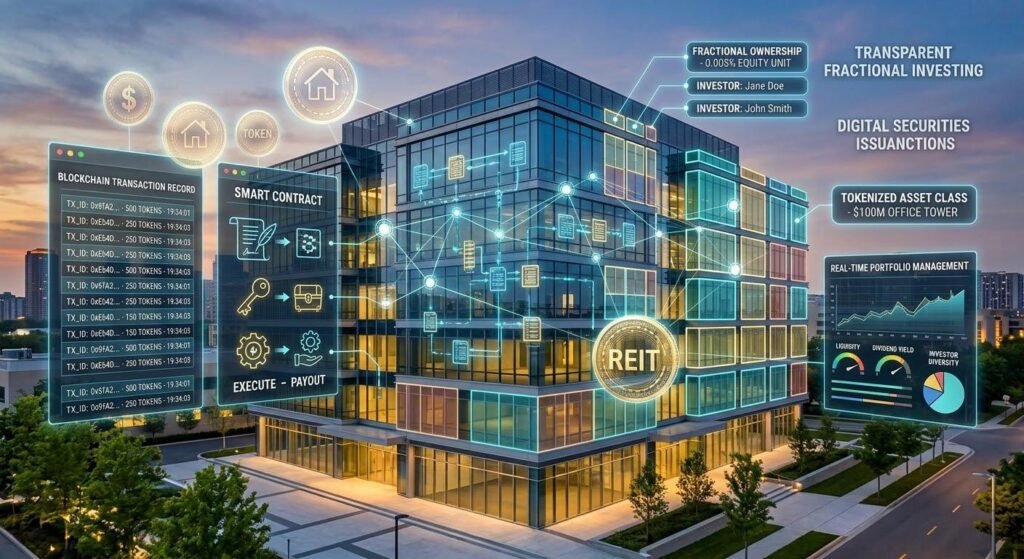
When certain conditions are met, smart contracts are programs that are stored and executed on the blockchain networks that they are compatible with. They might be used to ensure that transfers are restricted, establish the number of tokens to be sent, execute some distribution commands automatically, or verify if the deal falls short of specified conditions. As another example, if verified information has been provided that the funds are to be distributed to eligible token holders, a properly designed system would distribute funds based on a token’s ownership percentage according to the recorded ownership percentages. This automation could eliminate repetitive administrative tasks, and potential for some manual mistakes. Smart contracts, however, cannot create any conclusions about whether or not a building has generated enough rental income or if a legal obligation has been met without reliable information being provided to the system. It is important to test, overlook and review software programs, inaccurate inputs and poorly designed rules, as these can lead to losses as well.
Potential for Tokenization to Enhance Liquidity and Settlement
The traditional real estate transactions can be lengthy, involving a lot of paperwork, intermediaries, identity verification, and settlement. Blockchain technology-enabled systems can streamline some of the digital securities transfers, and can facilitate faster transactions if the necessary infrastructure and regulatory frameworks are in place. Tokenized interests also could be offered for sale on regulated digital asset exchanges, which could open new avenues for investors to meet other buyers and sellers. Better settlement and transfer process may help minimize operational friction and ease the process of updating the ownership records for REITs. But faster technical processing does not guarantee a transaction will complete technically or financially in a timely manner. There may still be other intermediaries, such as bank, custodians, regulators, etc. Similarly, willingness to buy, demand of the market, trading permission and platform reliability plays a role in liquidity. Selling a token that can be transferred digitally might be tough and costly.
Business regulatory compliance and legal ownership
The legal rights and classification of tokenized real estate will be contingent on the type of rights the tokens are representing, as well as the jurisdiction in which they are used. Tokens that are determined to be securities can be registered, disclosed, limited to certain investors, traded and subject to intermediary requirements. Anti-money laundering laws, identity verification, taxation and applicable property laws must also be taken into account by the law makers of the issuers. There can be further complications when an offering is made across borders since a token may be available on-line but the underlying investment is restricted in multiple countries. Moreover, a blockchain entry does not always supersede an official land title or officially registered ownership register of shareholders. Investors’ rights and the obligations of the issuer, as well as mechanisms for resolving disputes and the consequences if a platform fails, must be clearly defined in agreements. The “ownership” of digital assets may be deceptive, as there is much uncertainty with regards to what investors are really claiming when there are no legally binding arrangements in place.
Cyber Risk and Operational Risk
Smart contracts, fraudulent token offerings, compromised digital wallets, and lost private keys are potential security concerns to consider for blockchain systems. Once an investor has lost control of a wallet, it is difficult to recover assets, especially if there is no means to effectively recover a wallet. Other platforms rely on outside data sources to provide data on property values, rental income, or other events. Even if the blockchain functions as intended, it can be undermined with incorrect or manipulated data. For those REITs who are looking at tokenization, the operator should evaluate the cybersecurity controls, independent auditing of the code, custodianship, access, incident response plans, and business continuity protocols. Investors should check the issuer, the nature of holding the tokens and go through the legal documentation before investing. Whilst digital records will help increase traceability, this does not mean that fraud or asset protection is eliminated.
The Market Uptake of Tokenized REITs and its Prospects
The future of blockchain and REITs will depend on whether or not tokenization can offer practical benefits over traditional investment methods. As digital securities infrastructure, custody and regulatory guidance and investor protection evolve so will adoption. It is possible that some REITs will first investigate blockchain for their internal recordkeeping and settlement processes before considering selling tokenized shares to investors and other REITs could consider tokenizing a specific property or private fund for the investors. These methods have varying legal and financial ramifications and cannot be replaced with each other. It will take interoperable platforms, reliable information regarding valuation, redemption and transfer rules to be clarified, and market participation to increase the uptake. Investors will also require easy-to-understand disclosures on fees, restrictions on liquidity, aspects of governance and the connection between digital tokens and underlying assets. Trust and proper investment fundamentals are needed to develop a sustainable investment market alongside technology.
Conclusion
The creation, registration, transfer and management of real estate investment interests may be impacted by blockchain and tokenization. Possibilities for REITs include increased investment unit availability, increased transaction record access, automated administration, and settlement quicker than traditional systems allow. But, tokenization does not imply direct property ownership, the certainty of liquidity, elimination of intermediaries, or investment returns. Fundamentals of regulatory compliance, enforceable ownership rights, cyber security, reliable information and investor protection continue to be the essentials for the industry. The most feasible long-term may be based on embedding the blockchain into current REITs instead of replacing them with a complete reimagining. The future of the tokenization of real estate assets in the mainstream of investment will ultimately hinge on whether it provides meaningful efficiencies and maintains the necessary legal clarity, transparency and accountability for investors.
Get more well researched information about Blockchain and REITs here.