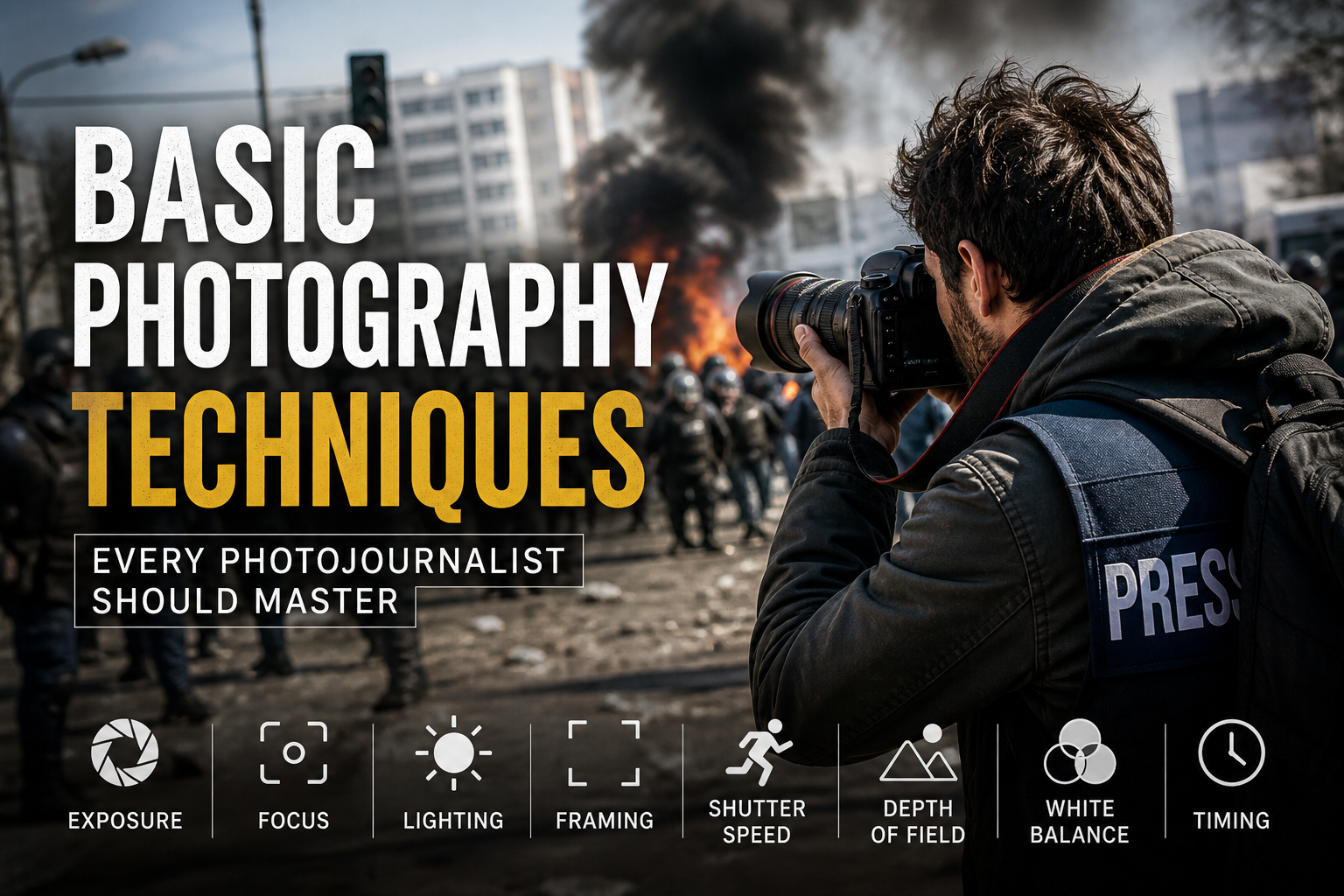
Photojournalism is founded on one principle; telling the truth in pictures. Urgent, emotional, conflict, and human resilience can be conveyed more quickly through a single photograph than any number of words. However, telling great stories in photojournalism does not exist just in being at the right place, but also in knowing how to capture that moment in the best way. The lack of solid technical skills will make even the most significant scene poorly captured, undermining the effect of the scene and its credibility.
Control of exposure, learning to focus, lighting knowledge, and powerful framing skills make or break an image to convey the truth of an event. Basic Photography Techniques (Learning) helps a beginner to create professional, sharp and emotionally powerful visual narratives in a rapidly evolving journalistic setting.
Photojournalism, unlike studio photography, can occur in unpredictable situations. Breaking news, protests, sports events, or humanitarian crises have no second chances. A photojournalist should be fast with choosing to respond and retaining the technical control of the camera. This paper will discuss the key photography skills that any photojournalist needs to master to enhance technical skill and increase story-telling capacity.
Knowing Exposure: The Key to Great Pictures
One of the most crucial photography skills is exposure, as it decides whether the image is light or dark. In photojournalism, the correct exposure makes sure that the story in the frame is clear and correct. An under exposed image may conceal some very important details, and an over exposed image may erase some important details. Learning the exposure requires an understanding of how three key camera settings interoperate: aperture, shutter speed, and ISO.
Aperture
Aperture regulates the amount of light that gets to the lens and influences depth of field. The larger aperture, like f/2.8, lets more light through, and it will blur the background, making the subject stand out. A smaller aperture such as f/11 preserves more of the picture in focus, as is helpful with subjects that need to be documented, or scenes of crowds of people. Photojournalists frequently alternate between these settings, based on the setting of the story being covered.
Shutter Speed and ISO
The use of the shutter speed determines the duration of the exposure of the camera sensor to light. The high shutter speeds freeze the action and are, therefore, crucial when taking photos of sports, protests, or conflicts. The movement can be captured in slower shutter speeds, e.g., the movement of crowds or the activity of the environment. Sensitivity of sensors to light is regulated by ISO. Higher ISO assists in low-light situations but can bring noise. One of the most important Basic Photography Techniques in the attainment of dependable image quality is mastering the balancing of aperture, shutter speed, and ISO.
Mastering Focus for Sharp and Clear Storytelling
It is focus which guides the attention of a viewer and determines the subject of an image. In photojournalism, focus is critical, as it can result in a good picture and a missed shot. Because a lot of journalistic situations occur in a short period of time, it is necessary to understand the autofocus system and the manual focus technique.
Autofocus Modes
There are a few autofocus modes of the modern cameras. Single autofocus is best when dealing with still objects such as interviews or portraits. Constant autofocus is more useful in moving objects like a sports person, a politician in the crowd, or emergency personnel in the field. The ability to know when to alternate between these modes is useful in keeping sharp in dynamic situations.
Focus Points
The points of focus are also relevant. The center-point focus is sometimes quicker and more dependable in emergencies, whereas various focal points can be applied to aid with flexibility in composing. Eye-detection autofocus has also come in handy in portrait style journalism, as it keeps the human subjects in focus and interesting. Focus tracking on fast-moving objects can go a long way in enhancing a photojournalist to capture decisive moments without losing his/her sharpness.
The Purpose of Lighting in Visual Journalism
Light defines emotion, mood, and clarity in imagery. Learning about lighting can assist photojournalists to preserve the quality of images despite the conditions in the environment. In contrast to studio work, which is typically controlled, journalists usually have to deal with natural or uncontrollable sources of light, and flexibility is an important skill.
Natural Light
There is the change in natural light during the day. Morning and evening light are softer and warmer and add depth and mood. Lunch time is very bright, and the shadows are deep, and the contrast is high. Understanding the placement of subjects with respect to the light source can help enhance the quality of the images. Front lighting results in making the subjects clear and well-lit, side lighting results in adding texture and dimension, and back light can result in dramatic silhouettes.
Indoor Lighting
Lighting indoors poses other challenges. Color accuracy can be influenced by fluorescent lights, LED lights, and mixed lighting conditions. White balancing is important in keeping colors realistic, and this is essential in journalism where authenticity of images is paramount. One of the most feasible Basic Photography Techniques to use in real-world reporting is learning how to utilize the available light well.
Framing and Composition: Visual Narratives Construction
Framing is the art of putting things together in a manner that reinforces the story. Good composition leads the eyes of the viewer and gives them emotional or informational emphasis. Framing in journalism is particularly critical, since the image must be able to convey a message swiftly and concisely.
Rule of Thirds
One of the best compositional principles is the rule of thirds. Images can be made more balanced and interesting by having subjects that are off-centered on grid lines.
Leading Lines and Background Control
The leading lines have the ability to lead the eye to the central item, and the natural framing such as windows or doorways can provide a background and depth to the subject.
Photojournalists have to consider background control as well. The background can distract the viewer or become confusing. It is possible to simplify the frame by changing angles, moving closer, or changing the focal length. Composition is not merely about beauty but clarity. Anything in the frame ought to assist the story being told.
Shutter Speed Control for Capturing Action
Photojournalism can be very mobile. Regardless of whether one is capturing sports, protests, accidents, or celebrations, it is necessary to have knowledge of the shutter speed in order to freeze or focus on the action. Quick-paced scenes can vanish in a blink of a second, and technical preparedness holds the key.
High and Slow Shutter Speeds
A high shutter rate such as 1/1000 second can freeze rapid motion, making clear the details such as facial expression or flying debris. This can be applied in sporting activities and breaking news. The slower speeds of shutters, such as 1/30 second, may produce motion blur, displaying movement and dynamism in traffic, crowds, or rain.
Balancing Exposure
The problem is a trade-off between exposure and shutter speed. Higher shutter rates cut off light and necessitate opening up or increasing the ISO. Working in varying motion-heavy conditions assists photojournalists in forming intuitive decisions in shutter speed. This enhances the response time and image quality in actual tasks.
Depth of Field and Subject Isolation
The depth of field influences the extent to which the image looks clear in the foreground and background. This affects the first point of gaze of the audience in storytelling. Shallowness of depth of field separates the subject matter out of the surrounding and focuses on the feeling and details. A greater depth of field retains context of the environment, and aids in telling larger stories.
Shallow Depth of Field
In the case of a portrait or an emotional scene, the large aperture will cause isolation and concentration to the subject. It works well when doing interviews, humanitarian portraits, or emotional responses.
Greater Depth of Field
In the case of environmental journalism or documentary, smaller apertures can be used to maintain the context well so that the viewer can perceive the whole picture.
The depth of field is also important to understand how the lens choice influences it. It is inherent that longer lenses will create more background blur and that wider lenses will retain more detail in the environment. The correct selection of depth of field serves to reinforce the intended story.
White Balance and Color Accuracy in Journalism
In journalism, color accuracy is important, as it influences authenticity. The misuse of white balance may distort the truth of a scene, and this may undermine confidence in visual reporting. White balance is used to regulate the appearance of the colors in various lighting situations.
White Balance Settings
There are daylight, shade, tungsten, and fluorescent lighting that have varying color temperatures. Cameras also have the option of preset white balance modes, although custom white balance can be more effective. The auto white balance is good in most cases, whereas the tough mixed-light conditions can be difficult to adjust manually.
Shooting in RAW
When shooting in RAW, a photographer is more flexible in correcting the white balance in the editing process without the loss of image quality. Nevertheless, in-camera capturing saves time, and this is significant in journalism that is time-driven. True color enhances the credibility of the image and provides truthful depiction.
Learning about Perspective and Camera Angles
The interpretation of stories is affected by perspective. The angle of camera influences feeling, power, and proximity. Eye level shots are realistic and relatable, whereas low angles may make the subjects appear powerful or imposing. The high angles may make it vulnerable or give it a wider context.
Changing Position
Switching role can radically enhance narration. Getting closer brings about intimacy and emotion. Taking a detachment can indicate environmental context and subject-subject relationships. During busy or disorganized moments, perspective shifting can assist in making cleaner and stronger frames.
Ethical Limits
Photojournalists should be conscious of ethical limits in pursuit of good angles. The idea is to speak the truth more clearly, not to play with the perception.
Timing: Capturing the Decisive Moment
Time is also one of the most characteristic skills in photojournalism. The moment of action, emotion, and composition are at the same point, that is the decisive moment. Technical knowledge aids in timing by making sure that camera settings are already done before the event occurs.
Anticipation
Anticipation is critical. Skilled photojournalists monitor body language, movement, and environmental indicators in order to anticipate action.
Burst Mode and Timing
Burst mode may be used to record sequences, and it is more likely to get the best frame. Timing, however, is not about making more photographs; it is about knowing when to squeeze the shutter.
Powerful timing turns the mundane into impactful visual stories. It brings out a sense of emotional appeal and documentary worthiness that can appeal to viewers.
Post-Processing Basics for Journalistic Integrity
Modern photography involves editing, yet journalism must have some ethical limits. Modifications must enhance clarity as opposed to altering factuality. Other simple fixes such as exposure fixes, cropping, white balance fixes, and sharpening are acceptable when applied in moderation.
Ethical Editing
Credibility may be harmed by over-editing. It is unethical to either remove or add elements in journalistic photography. It is aimed at presenting the truth, rather than distorting it.
Editing Tools
To learn how to use editing programs such as Adobe Lightroom or Adobe Photoshop may assist photographers to process images effectively without jeopardizing the standards of journalism.
Concise editing process enhances consistency, speed, and professionalism, particularly when there are newsroom deadlines.
Conclusion
Learning photography does not mean learning how to use the camera buttons or to memorize settings. In the case of photojournalists, the technical ability directly affects the quality of storytelling, accuracy, and credibility among the people. Exposure, concentration, lighting, framing, timing, and color accuracy are all interconnected to produce valuable images that educate listeners and document facts.
When it comes to building powerful technical basics, it requires time, experience, and practice. Any task, big or small, is the chance to get better. With these Simple Photography Techniques, photosjournalists develop the necessary confidence and skill to take important pictures. The camera is not just a tool in journalism but is also a witness. How to use it properly will make sure that valuable stories are viewed, interpreted, and recalled.
Frequently Asked Questions (FAQ)
Which are the most significant Basic Photography Techniques?
The most significant methods are to know exposure, focus, lighting, framing, and timing. Such abilities are the basis of good photojournalism and enhance the quality of the images to a greater extent.
Why is exposure important in photojournalism?
Brightness and detail in an image is controlled by exposure. Appropriate exposure guarantees the appearance of significant visual data and its accuracy of representation.
How can photojournalists improve focus accuracy?
In real life situation, accuracy of focus can be enhanced by using the right autofocus mode, the right focus points, and practising on moving subjects.
Is editing allowed in photojournalism?
Yes, but with basic corrections like the cropping tool, exposure tool, and white balance tool. Ethical journalism does not allow distortion of factual content.
What is the best lighting for photojournalism?
The light of early morning or late afternoon can give the best effects, but experienced photojournalists can learn to work using all types of light.